The rumble of engines grew louder, a relentless thunder that shook the frozen ground. German tanks, their gray armor dusted with snow, surged forward like a steel tide. The 2nd Panzer Group was on the move, and nothing seemed to stand in their way.
In the small town of Venv, the defenders watched with growing dread as the horizon filled with enemy vehicles. “They’re coming straight for us,” a young lieutenant whispered, his breath forming clouds in the frigid air. The order was clear: hold the line at all costs.
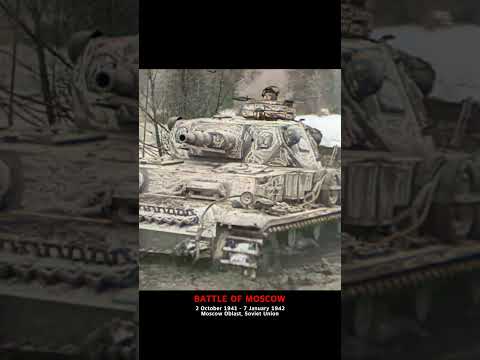
But the Germans were relentless. Within hours, Venv fell, and the panzers pushed deeper into the Soviet heartland. Their next target: Kashira. “If Kashira falls, Moscow is ours,” a German commander declared, his voice crackling over the radio. The road to the capital would be wide open.
Kashira was more than just a town—it was the last natural barrier before Moscow. Its capture would allow the 2nd Panzer Group to flank the city from the south, cutting off supply lines and sowing chaos. The Soviets knew this, and they scrambled to reinforce the defenses.
As the sun set, painting the sky in hues of blood and fire, the first German tanks appeared on the outskirts of Kashira. The defenders, exhausted and outnumbered, prepared for the onslaught. “We hold here, or we die here,” a grizzled sergeant muttered, gripping his rifle. The battle for Kashira was about to begin.
The first shell screamed overhead and slammed into a row of wooden houses, sending splinters and snow exploding into the twilight. The Soviet defenders ducked low in their trenches, clutching their weapons as the ground shuddered beneath them. Then came the tanks—dozens of them, their long barrels swinging toward the town like accusing fingers.
“Anti-tank crews, hold your fire until you see the whites of their optics!” the sergeant bellowed, his voice barely cutting through the din. A young gunner swallowed hard, his hands trembling on the breech of his 45mm gun. He had never fired at a real tank before.
The lead Panzer rolled to a halt just three hundred meters out, its turret rotating with a mechanical whine. For a heartbeat, the world seemed to hold its breath. Then the gunner squeezed the trigger.
The shell struck the tank’s glacis plate and ricocheted harmlessly into the sky. “Aim for the tracks! The tracks!” the sergeant roared. The next shot tore through a tread, and the Panzer lurched sideways, smoke billowing from its wounded flank. A ragged cheer went up from the trench—short-lived, as the tanks behind it simply swerved around the crippled vehicle and kept coming.
By midnight, the fighting had dissolved into a brutal, close-quarters melee. German infantry, dismounted from their half-tracks, crept through the burning streets, lobbing grenades into cellar windows. Soviet soldiers fought from house to house, from rooftop to rooftop, their faces blackened with soot and frost.
In a crumbling church at the town’s center, a radio operator hunched over his set, frantically tapping out coordinates. “Requesting immediate air support at grid seven-four,” he hissed. The reply crackled back: nothing available. Every plane was committed to the defense of Moscow itself.
The sergeant, bleeding from a gash above his eye, gathered the remnants of his squad in the church’s shadow. “We can’t hold the whole town,” he admitted, his voice hoarse. “But we can make them pay for every street, every house, every pile of rubble.” The men nodded grimly, checking their ammunition and fixing bayonets.
Outside, the roar of engines surged again—a fresh wave of Panzers, their headlights cutting through the smoke like ghostly eyes. The battle for Kashira was far from over, and the road to Moscow still hung in the balance.
The fresh Panzers advanced in a wedge formation, their engines howling as they smashed through the skeletal remains of the town’s outer defenses. The sergeant grabbed a bottle of flammable liquid, his last Molotov, and thrust it into the hands of a wide-eyed private. “Wait for my signal,” he growled, pointing toward a narrow alley where the lead tank would have to slow down.
The private crouched behind a collapsed wall, his heart hammering against his ribs. The tank’s treads crunched over debris, closer now, closer still. When it was nearly on top of him, the sergeant screamed, “Now!” The private hurled the bottle. It shattered against the engine deck, and flames erupted, sending the crew scrambling out of the hatches.
But the reprieve was brief. Another Panzer rumbled past the burning wreck, its machine gun raking the alley with bullets. The private fell back, clutching a wound in his shoulder, as the sergeant dragged him behind cover. “Medic!” someone shouted, but there was no medic left—only soldiers fighting for every inch of ground.
At the town’s edge, a group of Soviet engineers worked frantically under fire, laying the last of their anti-tank mines across the main road. “Two minutes!” the lieutenant yelled, glancing at the approaching headlights. The engineers sprinted for cover just as the first tank hit a mine, its hull erupting in a shower of steel and fire.
The explosion momentarily stunned the German advance, buying the defenders a precious few minutes. In that lull, the radio operator in the church finally received a message: a single squadron of Sturmoviks was being diverted, but they wouldn’t arrive until dawn. “Hold until first light,” the voice crackled. “Help is coming.”
The sergeant, now down to a handful of men, relayed the news. “You hear that? We just have to last till morning.” He looked at the exhausted faces around him—some barely out of their teens—and felt a pang of something like hope. But the German commander, watching from a distance, had other plans. He ordered his tanks to encircle the town, cutting off any chance of retreat.
As the night wore on, the defenders fought with a desperation born of despair. Every street became a killing ground, every house a fortress. The sergeant, wounded twice more, continued to rally his men, his voice a beacon in the chaos. “They shall not pass!” he roared, and the cry was taken up by the survivors, echoing through the burning ruins.
But the Germans were relentless, and the noose was tightening. With dawn still hours away, the sergeant gathered his remaining soldiers in the church, their faces gaunt and determined. “If we die, we die with honor,” he said quietly. “But we don’t die yet. We fight.” Outside, the engines roared again, and the final assault began.
The Panzers came at the church from three sides at once, their shells tearing through the ancient stone as if it were paper. The sergeant pressed his back against the altar, clutching a rifle with a cracked stock, and counted the men still standing. Seven. Seven souls against an entire armored spearhead.
Then, above the thunder of the guns, a new sound—a low, throbbing drone that swelled until it rattled the shattered windows. “Sturmoviks!” the radio operator screamed, tears freezing on his cheeks. The first aircraft dove out of the gray dawn, its cannons spitting fire, and a Panzer erupted in a geyser of flame.
The German commander, watching his lead tanks burn, ordered the retreat before the second wave could be caught in the open. “Pull back! Pull back to Venv!” he barked into the radio, his voice tight with fury. The steel tide that had seemed unstoppable now recoiled, leaving behind smoking hulks and frozen bodies in the snow.
The sergeant staggered out of the church into the pale morning light, his ears ringing, his hands shaking. Around him, the survivors emerged from cellars and rubble, their faces smeared with soot and blood, staring at the sky as if seeing it for the first time. Kashira still stood.
He found the young private propped against a wall, his shoulder bandaged with a strip of torn shirt. “We held,” the boy whispered, disbelieving. The sergeant nodded slowly, then sank down beside him, too exhausted to speak. The road to Moscow remained closed.
But the war was far from over, and both men knew it. The Germans would regroup, refit, and return—perhaps within days. The frozen ground between Venv and Kashira was littered with the wreckage of their first attempt, but it would soon be watered with blood again.
As the sun climbed higher, the sergeant pulled a crumpled photograph from his breast pocket—a woman and two children, their smiles faded by frost and time. He looked at it for a long moment, then tucked it away and rose to his feet. “Rest while you can,” he told his men. “Tomorrow, we bury our dead. And then we do it all again.”
The defense of Kashira had bought Moscow precious time, but the cost had been terrible. The town was a graveyard now, its streets choked with rubble and silence. Yet somewhere in that silence, a flag still flew over the shattered church—torn, scorched, but unbroken.
What do you think—was the stand at Kashira a turning point, or merely a temporary reprieve before the storm returned?
Report this article
Select a reason for reporting:






