Rachel Chin had examined thousands of 19th-century photographs, but the daguerreotype she found at a Richmond estate sale in August made her breath catch. It showed a prosperous white family posed before their brick mansion—but it was the young Black woman standing behind them, barely visible, who held Rachel’s gaze. Around her neck, just above her calico collar, was a beaded necklace with a pattern that seemed deliberate, not decorative.
Rachel, a conservator at the Smithsonian’s National Museum of African American History and Culture, knew that such details could hide entire worlds. She purchased the image for the museum’s archives and drove back to Washington, her mind racing. Something about the woman’s erect posture and direct stare suggested a story far larger than the photograph’s margins.
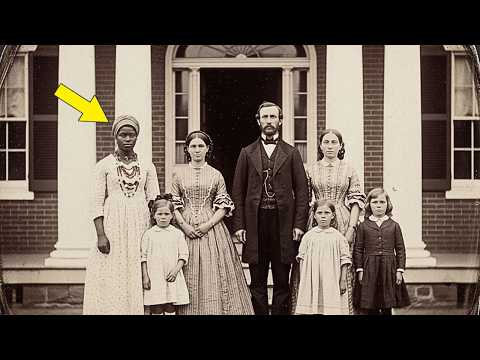
Under high-resolution scanning, the necklace revealed its secret: three white beads, two red, one black, two red, three white—a precise, repeating sequence. Rachel recognized it as possibly Yoruba, a cultural code enslaved people used to preserve identity. She called Dr. Amara Okefor at Howard University, who confirmed within hours that the pattern signaled lineage and spiritual protection. “She was making a statement,” Dr. Okefor said. “In 1860 Richmond, for an enslaved woman to wear that openly took courage.”
Rachel began tracing the white family first. The house’s distinctive brickwork led her to Daniel Whitfield, a tobacco merchant. The 1860 census matched the family: Daniel, his wife Margaret, and three children. But the slave schedule listed only a “20-year-old mulatto female”—no name. Frustrated, Rachel dug into Freedman’s Bureau records from 1865 and found her: Abeni Whitfield, age 25, formerly enslaved by Daniel Whitfield, occupation seamstress, one daughter named Grace.
Rachel posted her findings on genealogy forums, hoping for a descendant. Within a week, an email arrived from Diane Washington in Atlanta: “I think you found my great-great-great-grandmother.” Diane’s family had preserved oral histories about Abeni and a special necklace—a pattern from Africa, taught by Abeni’s mother before they were separated. “Grandma said Abenie believed that as long as she wore that necklace, she carried her mother’s protection with her,” Diane wrote.
Rachel read the email three times, tears blurring her vision. The necklace wasn’t just jewelry—it was a lifeline between a mother and daughter torn apart by slavery. She called Diane immediately, and they spoke for over an hour. Diane shared how Abeni, born around 1840, had been sold away from her Yoruba mother at 15, keeping only the beads and the stories. After freedom, Abeni made more necklaces, teaching the pattern to Grace, who taught it to her children. “We always knew it meant something important,” Diane said, “but the specific meaning got lost.”
With Diane’s permission, Rachel arranged a meeting with Dr. Okefor at the museum. Diane brought family photographs and a small collection of beaded jewelry passed down through generations. Dr. Okefor examined each piece, identifying the Yoruba elements that had survived and evolved over five generations. “The core pattern is still here, still intact,” she said. “Your family preserved this connection for over 150 years.”
Then Dr. Okefor explained the pattern’s original meaning: three white beads for purity and spiritual connection, two red for life force, one black for ancestors and the earth. “This particular combination was used by certain Yoruba families to indicate royal or noble lineage.” Diane’s eyes widened. “Royal lineage? You mean Abeni’s mother came from a royal family?” “Very possibly,” Dr. Okefor confirmed.
Rachel watched Diane process the revelation—grief for what was lost, pride in what survived. “Abeni wore this necklace in that photograph,” Rachel said gently. “She was saying, ‘I know who I am. I know where I come from. I am not just what you have made me.’”
Word spread through genealogical networks. Within weeks, three more families reached out, each claiming connection to Abeni. A family tree emerged: Abeni had lived until 1898, married twice, raised her daughter Grace and several orphaned children. Her descendants now numbered in the hundreds. Rachel organized a gathering at the museum, inviting all known descendants to see the photograph and learn about their ancestor.
On a Saturday in October, over 60 people filled the community room. Marcus Washington, Abeni’s 86-year-old great-great-grandson, stood before them. “All my life I heard stories about Mama Abenie,” he began. “They said she was a woman who never forgot where she came from, who taught us to be proud of our African roots even when the world told us to be ashamed.” He held up a photograph from the 1890s showing an elderly Abeni wearing a beaded necklace with a familiar pattern. “She wore it her whole life. From slavery through freedom, through Reconstruction and Jim Crow, that necklace was her testimony, her resistance.”
Diane displayed several pieces of the family’s beadwork, explaining how the pattern had been preserved. “This is our inheritance,” she said. “Not money or property. Abeni didn’t have those things to leave us, but she left us this pattern, this knowledge, this unbroken connection to who we are and where we come from.”
Dr. Okefor took the research further, consulting scholars in Nigeria. Dr. Folake Adibayo at the University of Ibadan recognized the pattern as one used by a Yoruba subgroup from the Oyo region—families connected to the Alafin, the ruler of the Oyo Empire. “This pattern indicated their status and spiritual protection,” Dr. Adibayo explained in a video call. She concluded that Abeni’s mother was likely captured during the Oyo Empire’s conflicts in the 1820s or 1830s, a young woman carrying knowledge of her people, her status, her identity.
Rachel shared this with Abeni’s descendants at a follow-up gathering. The room fell silent. An elderly woman named Clara spoke quietly: “All those years we kept making that pattern, wearing those beads, teaching our children, we were keeping her alive. We were keeping her mother alive. We were keeping Africa alive even when we didn’t fully understand what we were preserving.”
The museum began planning a cultural exchange program connecting Abeni’s descendants with Yoruba communities in Oyo. Rachel curated an exhibition titled Abeni’s Necklace: One Pattern, Five Generations, Two Continents. The centerpiece was the 1860 photograph, magnified to show the beadwork clearly, surrounded by the full story and examples of beadwork from each generation.
On opening night in February, over 70 descendants attended, many wearing beaded jewelry featuring the traditional pattern. They stood together before the photograph, looking at their ancestor, at the necklace that had preserved her mother’s legacy. The exhibition’s impact extended far beyond the museum walls—schools brought students, genealogists used Abeni’s story as a case study, and artists incorporated the patterns into their work.
But the most significant impact was on the family itself. Branches that hadn’t known about each other connected. Cousins met for the first time. Diane took on the role of family historian, creating an online archive and teaching beadwork workshops. “This isn’t just about preserving the past,” she explained. “It’s about keeping these traditions alive and relevant. When we make these patterns today, we’re saying our heritage matters, our ancestors matter.”
The family established a scholarship fund in Abeni’s name and several members traveled to Nigeria, visiting the Oyo region and participating in ceremonies honoring their ancestors. Two years after Rachel’s discovery, the museum hosted the creation of a collaborative beadwork piece incorporating the traditional pattern, contributed to by over 100 descendants. The finished work hung in the museum’s central atrium alongside Abeni’s photograph.
At the installation ceremony, Rachel addressed the crowd. “When I first saw this photograph, I almost didn’t notice Abeni at all. She was in the background, considered peripheral. But by looking closely, we discovered a story far more significant than anything about the family who commissioned the photograph.” She gestured to the beadwork. “This pattern traveled from the Oyo region of Nigeria to Virginia, survived the Middle Passage and slavery, passed through five generations, and now hangs here as testimony to the unbreakable human spirit.”
Marcus added, “Abeni couldn’t have known that a photograph taken in 1860 would still exist today. She couldn’t have known that her necklace would lead to this rediscovery. But I believe she hoped. I believe that’s why she wore that necklace openly, despite the risks. She wanted to be seen, to be remembered, to have her truth preserved. And now, finally, she is.”
The ceremony concluded with a traditional Yoruba blessing. As the practitioner blessed the beadwork, many family members wept—tears of grief for what had been lost, but also tears of joy for what had been recovered.
In the months that followed, the installation became one of the museum’s most visited exhibits. Abeni’s family continued to visit, bringing new generations to see their ancestors’ legacy made visible. The photograph remained on display nearby, a reminder of how much history hides in plain sight, waiting for someone to look closely enough to see it.
Abeni stood in that background, eternally 20 years old, wearing her mother’s gift and her people’s heritage around her neck. Her quiet act of defiance, preserved across time. She had kept the pattern alive in 1860, when doing so was dangerous. Her descendants kept it alive through Reconstruction, Jim Crow, and into the 21st century. And now, thanks to one overlooked photograph and one researcher who took the time to look closely, Abeni’s story would be remembered and honored for generations to come.
The pattern endured. The memory endured. And Abeni’s testimony, silent but powerful, spoke across a century and a half: I am here. I remember. I survived. And now, finally, I am seen.
Months after the exhibition opened, Rachel received a letter from a woman in Lagos named Adaeze Oyelaran. She had read about Abeni’s necklace in a Nigerian newspaper and believed her own family carried a matching story: a female ancestor captured during the Oyo wars, whose name had been passed down as a warning and a prayer. “We were told she wore beads of white, red, and black,” Adaeze wrote. “We were told she was never forgotten.”
Rachel forwarded the letter to Dr. Adibayo, who arranged a video call between the two families. On the screen, Diane and Adaeze compared photographs of their beadwork side by side. The patterns were not identical—generations of distance had reshaped them—but the sequence of colors, the rhythm of the stringing, matched too closely to be coincidence.
Dr. Adibayo cautioned that proof would require more research. But she also smiled. “In Yoruba tradition, we say the bead remembers the hand that strung it. Perhaps the pattern remembers too.” The two families agreed to fund a joint oral-history project, recording elders on both continents before their memories faded.
That winter, the museum added a small new panel to the exhibition: a map with two glowing threads, one stretching from Oyo to Richmond, the other looping back across the Atlantic toward Lagos. Visitors paused there longest, tracing the lines with their fingers.
Rachel sometimes returned after closing, standing alone before the 1860 photograph. Abeni’s gaze still met hers across a century and a half, steady and unafraid. The necklace was barely a smudge of color now, yet it had carried a mother’s love across an ocean, through bondage, into freedom, and finally into a museum where thousands came to look closely.
History, Rachel had learned, does not always shout. Sometimes it waits in the background of a photograph, wearing beads, hoping someone will finally notice.
What overlooked detail in your own family’s photographs might be waiting for someone to look closely enough to see it?
Report this article
Select a reason for reporting:






