The flames didn’t just consume the house—they devoured a legacy. In the early hours of a quiet morning, Hollywood’s first superstar vanished, not in a scandalous headline, but in a silent, suffocating blaze that left nothing but ashes and questions. The world woke to the news that the face that launched a thousand fans was gone, and with it, an era seemed to crumble.
But who was this star, whose light shone so brightly before flickering out? Born in an age when cinema was still a novelty, she rose with an almost supernatural grace, capturing hearts with every flicker of the silver screen. Her name was whispered in every household, her image plastered on every wall. Yet, beneath the glamour, a storm brewed—a storm that would ultimately seal her fate.
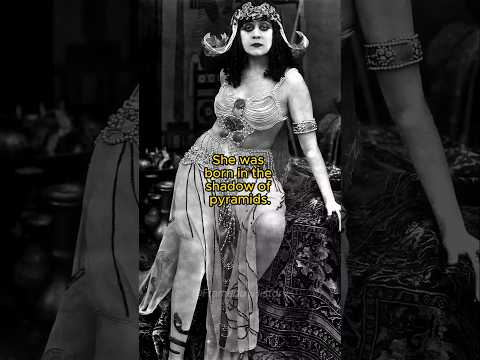
She was more than a pretty face; she was a pioneer, the first to truly understand the power of the moving image. Directors fought for her, studios crumbled at her feet, and audiences adored her with a fervor that bordered on worship. But fame has its price, and for her, the cost was higher than anyone could have imagined.
“She had a light that could illuminate the darkest screen,” one contemporary recalled, “but that light attracted shadows as well.” Those shadows grew longer as her career soared, and whispers of jealousy, betrayal, and a mysterious past began to surface.
The fire was ruled an accident, but not everyone believed it. Some said it was a tragic mishap, a faulty wire in an old mansion. Others whispered of something more sinister—a deliberate act to erase her from history, to silence a voice that knew too much. “There were things she carried with her,” a close friend later confided, “secrets that could have destroyed powerful men.”
As the embers cooled, Hollywood mourned, but not for long. The industry moved on, as it always does, churning out new stars to replace the fallen. But her memory lingered, a ghost in the reels of old films, a whisper in the corridors of forgotten studios. Her story became a cautionary tale, a reminder that fame is fleeting and that the brightest stars often burn out the fastest.
Yet, the question remains: was her death truly an accident, or was it the first in a series of calculated erasures that would haunt Hollywood for decades? The answers lie buried in the ashes, waiting for someone to sift through the ruins and uncover the truth.
In the years that followed, rumors persisted. Some claimed to see her ghost wandering the lot of the studio she once called home. Others insisted she had faked her death, escaping the spotlight to live a quiet life far from the cameras. But the evidence, scant as it was, pointed to a more tragic end—a brilliant life extinguished in a matter of minutes.
As we delve deeper into the mystery, we’ll uncover the forces that conspired against her, the jealous rivals, the ruthless moguls, and the dark underbelly of early Hollywood. We’ll explore the evidence, the inconsistencies, and the motives that suggest her death was anything but accidental.
But first, we must understand the woman behind the legend—the girl who dreamed of stardom, the actress who achieved it, and the icon who paid the ultimate price. Her story is one of ambition, passion, and ultimately, tragedy. And it begins, as all great stories do, with a single spark.
The spark was not the fire that killed her, but the one that ignited her soul. Born into poverty, she clawed her way out of a small town with nothing but a dream and a face that could stop time. “She walked into the studio like she owned it,” a casting director remembered. “And within a week, she did.”
Her rise was meteoric, but it was not without casualties. Friends were discarded like used scripts, lovers left in the wake of her ambition. She married young, to a man who saw her as a trophy, and divorced him just as quickly, trading his name for a marquee. “She was a force of nature,” a biographer noted. “You either got out of her way or got swept up in her storm.”
But the storm had an eye, and in that eye, a vulnerability she hid from the world. She was known for her generosity, secretly funding scholarships for young women, visiting orphanages under a pseudonym. “She never forgot where she came from,” a maid at her mansion recalled. “But she was terrified of going back.”
The fear was not unfounded. As her star rose, so did the number of enemies she made. A rival actress, once a close friend, was heard to say, “She’ll get what’s coming to her.” A studio head, spurned by her refusal to sign an exclusive contract, vowed to destroy her. And then there was the mysterious man in the shadows, a figure seen lurking near her home in the weeks before the fire.
Detectives found no sign of forced entry, no accelerant, no motive. But they also found no evidence of the rumored diary—a book said to contain names, dates, and secrets that could bring down half of Hollywood. “If that diary exists,” a retired detective said, “it’s the key to everything.”
As the investigation stalled, the public’s fascination grew. Fans sent letters demanding answers, newspapers ran speculative exposés, and the studio, eager to protect its image, quietly buried the story. But the truth, like embers, smoldered beneath the surface, waiting for a breath of air to reignite.
That breath came decades later, in the form of a dusty box discovered in the basement of a demolished theater. Inside, wrapped in oilcloth, lay a reel of film no archive had ever catalogued—no title, no date, just a single name scrawled on the canister in faded grease pencil. “Project: Nightingale,” it read. “Do not screen.”
The film restorer who found it nearly threw it away. But curiosity, that old betrayer, won out. What she saw when she threaded the reel through the projector would keep her awake for weeks—and eventually bring her to my door.
I’m a historian of forgotten things, the kind of man who makes a living digging through the rubble of Hollywood’s past. She sat across from me, hands trembling around a cup of coffee, and described what she’d witnessed. Not a movie, she said. Something else. Something that wasn’t meant to be seen.
“It was her,” she whispered. “Alive. Sitting in a chair. Talking to someone off-camera.” The footage was dated three days after the fire. Three days after the world had buried her.
I asked the obvious question: could it have been a double, a lookalike, a cruel hoax? She shook her head. The voice, she said, was unmistakable—that famous, velvet rasp that had sold a million tickets. And what the voice was saying chilled her to the bone. “They think I’m dead. Good. Let them. Now we finish what we started.”
The reel, she told me, ran only four minutes before the film snapped and the projector jammed. The rest of the canister was empty—no continuation, no explanation, nothing but a blank strip of celluloid and a single frame that had been deliberately scratched out.
I’ve spent thirty years chasing ghosts through archives, and I’ve learned one thing: the past doesn’t stay buried unless someone keeps digging it back up. Someone wanted this reel found. Or someone wanted it destroyed and failed.
Either way, the question that had haunted Hollywood for half a century now had a new shape, sharper and more dangerous than before. If she didn’t die in that fire—if she walked out of those flames on her own two feet—then who did? And what did she become in the decades that followed, living under a name no one would ever think to search?
The restorer looked at me then, and I saw the same fear in her eyes that I felt curling in my own chest. “There were other canisters in that box,” she said quietly. “I only opened one.”
I didn’t sleep that night. The reel sat in my office like a live grenade, its four minutes of footage looping in my head. If she had survived, the fire was a staged funeral, and the world had been mourning a ghost for fifty years.
The next morning, I called in every favor I had. A retired arson investigator, a studio archivist with a photographic memory, and a forensic document examiner who owed me from the old days. We spread the case files across my conference table like a war map.
“Look at the fire report,” the arson man said, tapping a faded page. “No accelerant found, but the burn pattern was too even. A faulty wire doesn’t do that. Someone knew what they were doing.”
The archivist nodded. “And the studio’s insurance claim was filed before the ashes were cold. They wanted the house gone. They wanted her gone.”
But the document examiner found something else—a signature on the death certificate that didn’t match the coroner’s known handwriting. “This was forged,” she said flatly. “Someone with access to the morgue records.”
We tracked the forged certificate to a clerk who had died in the 1960s, but his diary, donated to a university library, mentioned a “special project” for a studio boss. The same boss who had vowed to destroy her.
The restorer called me that evening. She had opened the other canisters. “You need to see this,” she said, her voice tight. “It’s not just her. There are others. A whole network. They faked deaths, changed identities—all to escape the studio’s control.”
She sent me a single frame: a photograph of a woman in a sunhat, standing on a beach in 1955. The face was older, but the eyes—those unmistakable eyes—were hers. On the back, in the same velvet rasp she’d made famous, someone had written: “I chose to live. Let the legend burn.”
So the fire wasn’t a murder. It was a liberation. She had outsmarted the moguls, the rivals, the shadows. She had walked away from the only life she’d ever known and built another one in the sun.
But the reel also revealed a darker truth: the studio had hunted her for years, sending men to silence her. “They never found me,” she said in the footage. “But they found others. I’m the last one left.”
I closed the file that night, but the question still burns. If she escaped, if she lived and died on her own terms, then who was the woman in the ashes? And why, after all these years, does her ghost still walk the studio lot—waiting for someone to finally tell the truth?
Report this article
Select a reason for reporting:






