The Ranger on watch lowered his rifle, keyed his radio, and said four words that would echo through the ranks for years: “What in hell’s that?” Six dust-caked Land Rovers, weapons mounted, drivers half asleep at the wheel, had just rolled through the perimeter of Camp Rhino at first light. They looked like relics from another war—no doors, no roof, just long-wheelbase frames bristling with heavy guns and a small motorcycle strapped to the back. The men inside wore mismatched uniforms and carried rifles the Americans didn’t recognize. It was November 2001, and the Australian SASR had arrived unannounced.
The Rangers had been told an Australian element was inbound. Nobody had told them the Australians would refuel, eat a hot meal, and then vanish into the desert the same afternoon. Nobody had told them what those Land Rovers could actually do. And nobody had told them that the men they were looking at were about to do things at Camp Rhino that the American special operations community had never seen up close.
Camp Rhino sat about 100 miles southwest of Kandahar, dropped into the middle of the Registan desert. It had started life as a hunting camp for an Emirati sheikh—a paved runway laid into a dry lake bed, a few outbuildings, almost nothing else. On October 19, 2001, 200 Rangers from 3rd Battalion, 75th Ranger Regiment had parachuted into that dry lake bed under the cover of darkness and seized the airstrip. It was the opening ground assault of the war in Afghanistan. By November, Rhino had become a forward operating base for the coalition’s push into the south. And by the end of that month, the Australians had arrived.
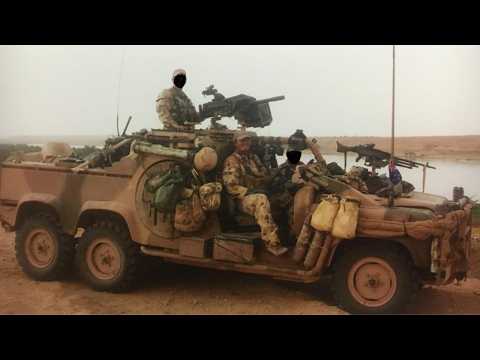
The vehicles were the first thing the Americans noticed. Plenty of hardware had rolled into Rhino—Humvees, light armor, heavy trucks, USSOF platforms. The Australian vehicles weren’t any of those. They looked like museum pieces. Long wheel base Land Rovers, six wheels each, no doors, no roof. Dust caked from bumper to tailgate. Heavy weapons mounted in the middle. Gunner’s seat up front. A small motorcycle strapped to the back. It was the first time the Rangers at Rhino had seen a long range patrol vehicle. It would not be the last.
The LRPV was built on the six-wheel drive variant of the Australian Army’s Land Rover Perentie. Turbocharged Isuzu diesel. Around 365 liters of fuel capacity. Real world range north of 1,500 kilometers on a single fill. The central weapons ring took either a .50 caliber Browning or a Mark 19 grenade launcher. A MAG 58 sat in front of the left-hand seat. A Suzuki 250cc trail bike rode on the rear tailgate for dismounted scouting. Crew of three. Enough fuel, water, ammunition, and rations to keep a patrol running for weeks without any contact with friendly forces. It was, in the simplest terms, a vehicle built to disappear.
That was the part the Americans struggled to get their heads around. US special operations doctrine in 2001 was built on speed strikes. Get in, hit the target, get out. The longest American special operations missions in the post-Vietnam era were measured in days. The Australians at Rhino were measuring theirs in weeks. The journalist Ian McPhedran, in his history of the SASR’s early operations in Afghanistan, would later write that the Australian-designed LRPVs proved ideal in the harsh Afghan environment because they could stay on patrol for weeks on end without needing to return to base. That wasn’t a sales pitch. That was the actual capability.
Within days of arrival, the first LRPV patrols were pushing out of Rhino and heading north. Small convoys, four to six vehicles. Night driving for the first leg, every leg. Long silences on the radio. They kept going, hundreds of kilometers past the last friendly position, past every village the Americans had on their maps, past every spotter network the Taliban had built to watch for coalition movement. The LRPVs went into terrain that no coalition asset had touched.
When the Rangers at Rhino asked the Australian command element where the patrols were going, the answer didn’t change. “Out.” When they asked when the patrols would be back, the answer didn’t change. “When they’re done.” The Australians weren’t being rude. They didn’t know. The patrols had the latitude to operate. The orders were broad. The men in the field made the calls. It was a different way of fighting a war.
The Rangers were direct action specialists, among the finest light infantry on the planet. Trained at Fort Benning, drilled in airfield seizure, urban combat, raid operations, and quick reaction force missions. They were very good at what they did, and the 75th Ranger Regiment had spearheaded the ground war in Afghanistan by jumping onto Rhino. They would lead American direct action operations for the next 20 years. The Australians at Rhino were doing something else entirely. Not kicking doors, watching, measuring, mapping. They were the eyes that would tell other forces where the doors actually were.
What the eyes were seeing in November and December of 2001 was reshaping the coalition picture of the south one patrol at a time. Australian patrols came back with things the satellites had missed. Taliban supply routes the drones hadn’t picked up. Weapons cache locations that human intelligence had only guessed at. They photographed compounds. They counted men. They timed convoys. They listened. Then they refueled, restocked, and went back out. The cycle was relentless. By the end of December 2001, the Australian element at Rhino had become the coalition’s most productive reconnaissance asset in the south. Nobody outside the base could quite work out how they were doing it.
The patrol craft itself was old knowledge dressed up in modern equipment. The Special Air Service Regiment had been formed in 1957, modeled on the British SAS, based since its founding at Campbell Barracks in Swanbourne, Western Australia. It had inherited a philosophy from the elite reconnaissance work of the Second Australian Imperial Force in the Second World War, the Z Special Unit, the independent companies in New Guinea and Borneo, the commandos who had operated behind Japanese lines across the South Pacific. The regiment carried that lineage. The motto was “Who dares wins”, shared with the British SAS. The method was patient, lethal, quiet observation. The LRPV was just the modern tool that let the method scale.
That patient, quiet method was the part American observers found hardest to copy. US special operations training in 2001 produced operators who could do almost anything. They could parachute, fast-rope, kick a door, clear a building, extract within minutes. They could fight in cold, heat, jungle, desert. They could do it all very well. What they couldn’t do, at least not yet, was vanish into a country for three weeks at a time and come back with a complete intelligence picture of an enemy network. The Australians could. The reason came down to three things: selection, training, culture.
The SASR selection course in Western Australia was among the most punishing in the world. Pass rates in the single digits in some cycles. The men who passed had spent weeks under sustained physical and mental load that broke almost everyone else. Sleep deprivation, food deprivation, cold. They had been pushed through the bush carrying weight that approached the limits of what the human body could take. They had been interrogated, isolated, tested at every level of personal failure. The ones who came out the other end weren’t just fit, they were patient. They could endure. They could wait. They could think clearly when every part of them wanted to stop. That capacity to endure was the actual weapon. The vehicles were transport.
By January 2002, the Australian patrols out of Rhino were ranging deep into Helmand province and the borderlands of the Registan desert. Working in temperatures that dropped to 20 below zero at night. Sleeping beside their vehicles in shallow scrapes covered with desert camouflage. Eating cold rations. Drinking water that had been sitting in jerrycans for days. Communicating in burst transmissions. Sometimes nothing more than a coded position report once every 48 hours. They went weeks at a time without seeing another coalition asset and they kept finding things.
The Australian humor at Rhino was something else the Americans hadn’t expected. The SASR called their officers by first name. They mocked their own commanders openly. They had built a small mess room out of plywood and packing crates and had somehow procured a supply of beer that no American officer could account for. They were the most informal special operations force any Ranger or Marine had ever met, and they were ferocious about loyalty. An Australian patrol would walk through fire for any of its members. When the bullets started flying, rank and politics disappeared, and the man on your left and right was the only man who mattered. The Australians had figured out something it took the Americans longer to learn. Men who could joke under pressure could think under pressure. The humor wasn’t a coping mechanism. It was a tactical asset.
That tactical asset was about to be tested by the worst day in the regiment’s modern history. On the 16th of February, 2002, an SASR patrol was operating in the Helmand Valley. The patrol was mounted in LRPVs, moving across terrain that hadn’t been mapped by coalition forces. The exact mission remains classified. What is known is documented. One of the vehicles struck a land mine. The blast destroyed the LRPV. Two members of the crew were wounded. A third, Sergeant Andrew Russell, was killed. He was 33 years old. He had a wife and a newborn daughter at home. He died during medical evacuation. He was the first Australian soldier killed in combat since the Vietnam War and the first member of the SASR to die in action since the regiment’s operations in Vietnam more than 30 years earlier.
The news traveled through Camp Rhino within hours. The Australians grieved privately. They held a memorial in their compound. Photographs on a small table. Letters written home. Then they put their kit back on and went out the gate. There was no extended pause in operations, no retraction of patrols. There was a quiet, fierce determination to honor the man by doing the job he had given his life to do.
Within a short time, every remaining LRPV in the squadron was fitted with what the regiment called a survival enhancement kit. Armor plating beneath the vehicle, shock absorbent seats, hardened components designed to give the crew a chance the next time a mine went off. The kit didn’t bring Russell back. It would save lives later in the war.
The Rangers at Rhino watched the Australian response and understood something that day they did not forget. There is a certain kind of professionalism that doesn’t need to be performed. It doesn’t need a speech. It doesn’t need flags or formations. It just continues. That was the moment the American operators at Rhino stopped thinking of the Australians as allies and started thinking of them as peers.
The 1 SAS Squadron rotation ended in April 2002. 3 Squadron followed, then 2 Squadron. Each rotation continued the long range patrol work, the deep reconnaissance, the steady quiet professionalism established in those first months at Rhino. By December 2002, the initial Australian Special Forces Task Group was withdrawn. Then in September 2005, the regiment came back. What followed over the next nine years was one of the longest sustained special operations deployments in the history of the Australian Defence Force. By the end of operations, 41 Australian soldiers had died in Afghanistan and more than 250 had been wounded.
Camp Rhino itself is gone. The runway the Rangers seized in October 2001 is mostly desert again. But the work that came out of it—the patrols, the intelligence, the lessons, the casualty taken and the casualties avoided—is permanent. It’s in the after-action reports. It’s in the doctrine. It’s in the memories of the American operators who watched the Australians come and go.
If you ever speak to a Ranger who served at Rhino in late 2001 or early 2002, ask him about the Australians. Most will go quiet for a moment. Then most will smile. Then most will say some version of the same thing. They will tell you that the men who rolled through the gate that morning with their old vehicles and their casual manners and their absurd plywood mess hall were the most professional special operations soldiers they ever served alongside.
Being the most powerful force on the battlefield is not the same as being the most lethal. Money buys equipment. Budgets buy training. The kind of patient, quiet, endless professionalism the Australians brought to Rhino comes from somewhere else. It comes from culture. It comes from history. It comes from a regiment that learned its trade in the jungles of Borneo and the highlands of Vietnam and never forgot what it learned.
The Australians didn’t come to Camp Rhino to impress anyone. They came to do a job. They did the job. When the job was done, they went home, and the regiment kept doing what it had always done. The next time someone tells you the most powerful military force always wins, point them at a dry lake bed in southern Afghanistan in November 2001, and a small Australian patrol that rolled through the wire one cold morning and disappeared into the desert for 11 days. Ask them to explain what those 11 days were worth. The Americans who were there will tell you. The Australians, in their usual way, won’t.
So here’s the question for you: when history remembers the war on terror, will it remember the forces that made the most noise—or the quiet ones who disappeared into the desert and came back with the war in their hands?
Report this article
Select a reason for reporting:






