May 1945. The war in Europe was over, but its wreckage still breathed. In a muddy refugee camp outside Munich, Corporal Daniel Morrison, a 26-year-old medic from Oregon, knelt before a skeletal boy. The child weighed just 32 pounds—half what he should have. His ribs pressed against paper-thin skin, his eyes enormous in a shrunken face. Morrison offered a chocolate bar, a standard gift for hungry children. The boy took it with trembling hands. Then he spoke three words in broken English that made Morrison’s breath catch—words that would haunt him for the rest of his life.
Those three words were: “Is this real?” Not a question about chocolate, but about reality itself. A 5-year-old boy who had seen too much, lost too much, and trusted nothing—not even kindness.
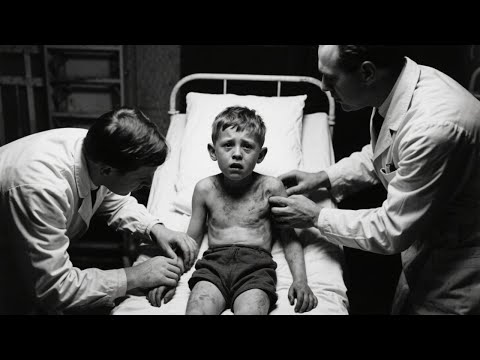
Daniel Morrison had served with the 45th Infantry Division since North Africa. He had treated combat casualties, watched young men die from survivable wounds, and maintained professional detachment through three years of war. But this was different. This was chronic malnutrition, the slow erasure of childhood. And this boy—Kurt Hoffman—was asking if the world could contain generosity.
Morrison had arrived at the camp on May 12th. It was a sea of canvas tents, ankle-deep mud, and the hollow faces of millions of displaced persons. His job was triage: weigh, measure, categorize. Critical, moderate, stable. The categories felt obscene. Almost everyone was starving. But resources were limited, and choices had to be made.
On May 15th, Kurt stood in line with his grandmother. His clothes hung loose on a skeletal frame, his legs thin as kindling. When Morrison weighed him, the number confirmed his fear: 32 pounds. A healthy 5-year-old should weigh 45 to 50. Kurt had lost nearly a third of his body mass. His height was normal—suggesting the starvation was recent, not lifelong. Something had happened in the past six months.
“When did he last eat properly?” Morrison asked the grandmother. Her face crumpled. “November, maybe December. Our city was bombed. We fled east, then back west. Food became… there was nothing.” They survived on roots, on begged bread, on hope that had long since died.
Morrison examined the boy. Bleeding gums—scurvy. Bowed legs—rickets. Skin infections, thinning hair, a body consuming itself to survive. “He needs hospitalization,” Morrison said. “Immediate nutritional intervention. If we don’t treat this aggressively, his organs will fail.” The grandmother’s voice was barely a whisper: “He doesn’t complain. He hasn’t spoken much for weeks. Just exists, like he’s too tired to be a child anymore.”
Morrison reached into his bag and pulled out a Hershey’s bar—one of several he kept for moments when sugar and sweetness might matter more than medicine. “For you,” he said. “Good food will make you stronger.” Kurt stared at the chocolate with an expression Morrison couldn’t read. Not excitement. Not even hunger. Something more complicated—disbelief, perhaps, or fear that accepting the gift would make it vanish.
Slowly, Kurt took the bar. He held it reverently, as if it were glass. Then he looked up, met Morrison’s eyes, and spoke the three words that would echo through decades: “Is this real?”
Morrison froze. The question was simple, but it carried the weight of a world shattered. A boy wasn’t asking if the chocolate was actual chocolate. He was asking if kindness was real. If American soldiers actually gave food to starving children. If generosity could exist after months of deprivation. If hope was real.
Tears stung Morrison’s eyes. He had treated terrible wounds without breaking down, watched men die without losing composure. But this child’s question—delivered in three small words—shattered his emotional armor. “Yes,” Morrison said, his voice rough. “It’s real. You can eat it. It’s yours.”
Kurt looked at his grandmother, seeking permission. She nodded, tears running down her weathered face. The boy unwrapped the chocolate slowly, broke off a small piece, and put it in his mouth. The expression that crossed his face was transcendent—pure sensory experience, unmediated by thought or expectation. Sugar and cocoa and fat, tastes his body had been deprived of for months. He ate the piece slowly, making it last, then carefully rewrapped the rest and held it against his chest, saving it, protecting it. Not trusting that more might come.
Morrison had to look away, had to breathe deeply, had to gather himself before he could continue. When he looked back, Kurt was still clutching the chocolate, still staring with those enormous eyes that had seen too much. “He’ll be okay?” the grandmother asked. “Yes,” Morrison said, though the certainty was more hope than medical judgment. “We’ll hospitalize him. Start refeeding protocols gradually. But he’s young. His body can recover if we’re careful.”
He marked Kurt’s file as critical priority, then watched them walk away—the old woman supporting the skeletal boy, both moving slowly through mud that sucked at their inadequate shoes. After they left, Morrison sat for several minutes before calling the next refugee forward. He was supposed to process dozens of people per hour. But he needed time to understand why three words from a starving child had affected him more deeply than three years of combat medicine.
“Is this real?” The question implied a world where reality itself had become suspect, where basic assumptions about cause and effect and human decency had been so thoroughly violated that a child could no longer trust his own perceptions. Where receiving food felt impossibly unlikely. Where American kindness contradicted everything he had learned to expect.
Morrison thought about his own childhood in Oregon—enough food, parents who provided, the basic security that allowed children to be children. He thought about what it would take to break that security so completely that a 5-year-old no longer believed in simple generosity. And he understood with sudden clarity that treating Kurt’s malnutrition was only the beginning. The physical damage could be healed with food and time and proper medical care. But the psychological damage—the fundamental fracturing of a child’s trust in reality—would take much longer to address, if it could be addressed at all.
That evening, Kurt was transferred to the field hospital. Morrison accompanied him—officially to document the transfer, unofficially because he couldn’t stop thinking about the boy’s question and needed to see what happened next.
The field hospital occupied a converted school building—classrooms transformed into wards, the gymnasium serving as surgery and intensive care. It smelled of disinfectant, unwashed bodies, and the particular odor of severe illness that no amount of cleaning could eliminate. Nurses and doctors moved through the hallways with exhausted efficiency, treating hundreds of cases daily: typhus, tuberculosis, malnutrition, injuries from the war’s final chaos.
Captain Sarah Chun, the hospital’s chief pediatric nurse, met them at intake. She was 34, Chinese American, trained at Johns Hopkins before volunteering for the Army Nurse Corps. She had spent eighteen months treating children affected by war—orphans, wounded, malnourished, traumatized. She had developed the professional detachment necessary to function in such circumstances: the ability to see patients as medical cases requiring specific interventions rather than as individual tragedies requiring emotional response.
But when she saw Kurt, her professional mask slipped slightly. “How much does he weigh?” she asked Morrison.
“Thirty-two pounds. Five years old. Severe malnutrition, probable vitamin deficiencies, showing early signs of organ stress.”
Chun nodded, making notes on a clipboard. “We’ll start with glucose IV to stabilize his blood sugar, then very gradual refeeding—small amounts every two hours, monitoring for refeeding syndrome. Vitamin supplements. Close observation for complications.” She looked at Kurt, who sat on a gurney, clutching his partially eaten chocolate bar. “Has he been responsive? Communicative?”
“Not much,” Morrison said. Then, after a pause: “He asked me if the chocolate was real.”
Chun’s pen stopped moving. She looked up at Morrison, reading the implications in his expression. “He asked if it was real,” she repeated quietly. “In English. Three words. ‘Is this real?’ Like he couldn’t trust that someone would actually give him food.”
Chun was silent for a moment. Then she knelt beside Kurt’s gurney, bringing herself to eye level with the boy. She spoke in German, her accent competent if not fluent. “Hello, Kurt. I’m Nurse Chun. We’re going to take care of you here. Give you food, make you stronger. You’re safe now.”
Kurt stared at her with those enormous eyes, processing the words, trying to determine if they were trustworthy. Finally, he whispered: “Is this real?”
“Yes,” Chun said firmly. “This is real. You’re in a hospital. We’re going to help you get better. I promise you this is real.”
Kurt considered this, then looked down at his chocolate bar. He broke off another small piece and ate it slowly, savoring each taste, still not quite believing.
The refeeding process required extreme care. When a body has been starving for extended periods, reintroducing food too quickly can cause refeeding syndrome—a potentially fatal complication where sudden nutrition shifts trigger electrolyte imbalances that can cause cardiac failure, respiratory distress, and organ damage. Chun started Kurt on a glucose IV to provide immediate energy while his digestive system was carefully reawakened. Every two hours, nurses brought small portions of easily digestible food: broth, mashed potatoes, soft bread—perhaps three or four spoonfuls per feeding, amounts that seemed cruelly inadequate but which represented all his damaged system could safely process.
Kurt accepted the food with the same careful reverence he had shown the chocolate bar. He ate slowly, methodically, as if each spoonful might be his last, as if abundance was a temporary illusion that would disappear if he took it for granted. He didn’t speak much, responding to direct questions with single words or nods. Mostly he just watched—observing nurses, doctors, other patients—cataloging this new environment with the weariness of someone who had learned that safety was temporary and promises were unreliable.
Morrison visited daily during his off hours, checking on Kurt’s progress, bringing small gifts when he could: a toy soldier carved from wood by a German POW, a picture book salvaged from the school’s ruined library, another chocolate bar carefully rationed into daily portions. On the third day, Kurt finally asked a question beyond his haunting initial inquiry.
“Where is Ma?” he whispered to Morrison during an evening visit. “My grandmother. She was with me.”
“She’s in the refugee camp,” Morrison explained. “She visits twice a day—morning and evening. The nurses bring her to see you. She can’t stay here because the hospital is only for patients who need intensive care, but she’s close. She’s safe.”
Kurt absorbed this information silently. Then: “Will she get food, too? Is she real, too?”
The question revealed his continued uncertainty about reality—his need for confirmation that the kindness extended to him wasn’t isolated, that his grandmother was also receiving care. Morrison felt that familiar twist in his chest. “Yes,” he said firmly. “She’s getting food, regular meals. She’s in a tent with a stove and blankets. She’s being taken care of.”
Kurt nodded, some tension leaving his thin shoulders. The confirmation seemed to matter more than his own treatment—knowing that his grandmother was also safe, also fed, also real.
As Kurt’s physical condition stabilized, his psychological state became more apparent. He exhibited symptoms of severe trauma: hypervigilance, difficulty sleeping, emotional flatness, persistent anxiety about food disappearing. The nurses noted that he hoarded food when he could, hiding pieces of bread under his pillow, checking obsessively to ensure his meals would arrive as promised.
Captain Chun requested a consultation with the hospital’s psychiatric specialist, Dr. Robert Klene, a 38-year-old psychiatrist from New York who had been documenting the psychological effects of war on civilian populations. Klene interviewed Kurt through a translator, asking careful questions about his experiences during the past year.
The story that emerged was a catalog of displacement and deprivation. Kurt’s father had been drafted in 1942, sent to the Eastern Front, never returned—presumed lost but never officially confirmed. His mother died in November 1944 during a bombing raid on Stuttgart, where they lived. Kurt survived because he was visiting his grandmother in a nearby town. They fled east ahead of the Soviet advance, then west again as the Soviet forces continued pressing forward, caught in the massive displacement of civilians trying to escape the war’s final convulsions.
For six months, they had survived as refugees—begging food where they could find it, sleeping in barns or abandoned buildings, walking endless kilometers through winter cold with inadequate clothing and no clear destination. Kurt had watched other children die from cold or hunger or disease, had seen adults become desperate enough to steal from each other, to abandon weaker family members, to commit acts of survival that contradicted every civilized norm.
He learned, Dr. Klene explained to Morrison and Chun during a case review, “that the world is fundamentally unsafe. That food is scarce and must be protected. That adults cannot be trusted to provide or protect. That reality itself is unreliable—that promises of safety or sustenance often prove false.”
“So when Morrison gave him chocolate,” Chun began, “he couldn’t integrate it into his worldview—”
“—hence the question,” Klene finished. “‘Is this real?’ He was literally asking if what he was experiencing matched objective reality, or if he was hallucinating, dreaming, or being deceived.”
“Can he recover?” Morrison asked. “Psychologically, I mean. I know his body can heal if we feed him properly. But the mental damage—”
Klene was silent for a moment. “Children are remarkably resilient,” he said finally. “Their brains are still developing, still forming patterns of understanding. If we can provide consistent safety, reliable care, evidence that the world can be trustworthy—if we can show him that reality includes kindness as well as cruelty—then yes, he can recover. But it will take time. Months, possibly years. And he’ll never completely forget what he experienced. The trauma will leave marks.”
Kurt remained hospitalized for three weeks. His weight climbed from 32 to 41 pounds. His blood work improved. But the deeper transformation came slowly: by the second week he spoke in short sentences, asked about his grandmother, and began building towers from wooden blocks—then knocking them down and rebuilding, as if testing whether good things could return.
The hoarding faded. He stopped hiding bread beneath his pillow. And one afternoon, launching a paper airplane across the ward, he smiled—a small, startled thing, but real.
On May 30th, Dr. Klene asked him one last question: “Is this real? The hospital, the food, the people?” Kurt considered it carefully. “Yes. But it is strange real. Before real was always afraid. This real has food every day, a bed that doesn’t move, people who say they will help and then they help.”
Decades later, a letter arrived in Oregon. Kurt Hoffman, now a civil engineer, wrote: “You gave me chocolate, but more than that, you gave me hope.” Morrison read it three times, weeping at his kitchen table.
So tell us—when the world feels cruel, what small act of kindness has ever made reality feel real to you?
Report this article
Select a reason for reporting:






