Petty Officer First Class Sarah Jenkins had already survived the Navy’s toughest medical training. She could suture a wound in the dark, diagnose a tension pneumothorax by touch alone, and keep a casualty alive under fire. But none of that mattered when she reported to Camp Pendleton for her Fleet Marine Force qualification. The Marines didn’t care about her medical expertise. They cared about one thing: could she keep up?
“You’re a corpsman,” the gunnery sergeant said, his voice flat. “That means you’re ours now. And we don’t carry dead weight.”
Sarah had heard the stories. The FMF pin wasn’t just a badge—it was a blood oath. To earn it, she’d have to pass the Marine Corps physical fitness test, qualify on the rifle range, navigate through hellish terrain with a map and compass, and prove she knew Marine Corps doctrine as well as any infantryman. And that was before the written exam.
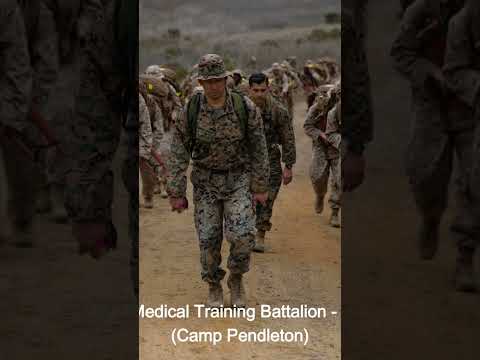
The first test was the PFT. Three miles in under 28 minutes, max pull-ups, and crunches. Sarah had trained for months, but the California heat was brutal. By mile two, her lungs burned and her legs felt like lead. “Push!” a Marine corporal screamed beside her. “You don’t stop until you cross that line!” She finished in 27:45—barely. But barely was enough.
Next came the rifle range. Sarah had fired a weapon before, but the M16A4 was different. The recoil, the weight, the pressure of hitting a target 500 yards away while Marines watched. She qualified as a sharpshooter, one step below expert. “Not bad for a doc,” the range coach admitted.
Land navigation nearly broke her. Dropped in the middle of the woods with only a compass and a topo map, she had to find six checkpoints in four hours. The terrain was unforgiving—steep hills, thick brush, and a maze of trails that all looked the same. By checkpoint four, she was lost. Her confidence wavered. “You’re not lost,” she whispered to herself. “You’re just not where you thought you’d be.” She reoriented, took a bearing, and pushed on. She found the last checkpoint with ten minutes to spare.
The written test was a different beast. Marine Corps doctrine, customs, courtesies, rank structure, and tactical procedures. Sarah studied every night for weeks, memorizing details she never thought she’d need. “Why does a corpsman need to know the range of an M249?” she asked a fellow sailor. “Because you might be the one calling for fire,” he replied.
On the final day, Sarah stood in formation with her Marine unit. The commanding officer walked down the line, pinning the FMF badge on each graduate. When he reached her, he paused. “You’ve earned this, Doc. Welcome to the fleet.”
But the real test was yet to come. Sarah’s unit was slated to deploy in three months. And in the back of her mind, she knew the FMF pin was just the beginning. The desert was waiting.
Three months later, Sarah found herself strapped into the back of a KC-130, the roar of the engines drowning out any attempt at conversation. Around her, Marines slept, wrote letters, or stared blankly at the bulkheads. She checked her medical bag for the hundredth time—morphine, tourniquets, chest seals, airway adjuncts. Everything was where it should be.
“Hey, Doc,” a young lance corporal shouted over the noise. “You ready for this?”
Sarah grinned. “I’m ready to do my job. You ready to do yours?” The Marine laughed and gave her a thumbs up.
They landed at a forward operating base in Helmand Province just after dawn. The heat hit her like a wall—dry, baking, relentless. Dust coated everything. Within an hour, Sarah had set up her aid station in a cramped tent, organized her supplies, and met the platoon she’d be attached to. The platoon commander, a wiry captain named Reyes, shook her hand firmly.
“Doc, we’ve got a long patrol tomorrow. Twelve klicks into the green zone. I need you sharp.”
Sarah nodded. “I’ll be sharp, sir.”
The patrol started before sunrise. Sarah walked near the middle of the column, her rifle slung across her chest, medical bag heavy on her back. The Marines moved like ghosts through the dusty village compounds, clearing rooms, scanning rooftops, communicating in hand signals. Sarah watched everything, her senses heightened.
Then the radio crackled. “Contact! Contact right! Small arms fire!”
The world erupted. Bullets snapped overhead. Marines dropped to the ground, returning fire. Sarah pressed herself against a mud wall, her heart pounding. “Doc! We’ve got a casualty!”
She didn’t hesitate. She ran toward the voice, crouching low, her training taking over. A Marine lay behind a low wall, blood soaking through his trouser leg. She dropped to her knees beside him.
“Hey, buddy, I’m here. You’re gonna be fine.” Her hands moved automatically—tourniquet high and tight, pressure applied, wound checked. The Marine screamed in pain. “I know it hurts. Stay with me.”
The firing slowed. The Marines pushed the enemy back. Sarah stayed with her patient, monitoring his vitals, talking to him, keeping him calm. When the medevac bird finally arrived, she helped load him onto the stretcher. “You’re gonna make it,” she told him. “I promise.”
Captain Reyes approached her afterward, his face smeared with dirt and sweat. “Good work, Doc. That Marine owes you his leg—maybe his life.”
Sarah nodded, but she didn’t feel like a hero. She felt exhausted, wired, and strangely calm. “Just doing my job, sir.”
But as the patrol moved out again, Sarah knew the truth. The FMF pin had prepared her for the physical tests, the land navigation, the written exam. But nothing could truly prepare her for the moment when a Marine’s life was in her hands. That was something she’d have to earn one day at a time.
That night, Sarah sat outside her tent, cleaning her medical gear by the light of a headlamp. The base hummed with the low murmur of generators and the distant crackle of radio traffic. She kept replaying the patrol in her head—the snap of bullets, the blood, the way her hands had moved without her even thinking.
“Can’t sleep either?” A voice came from the darkness. It was Sergeant Delgado, the platoon’s squad leader, a stocky man with a shaved head and a permanent squint.
Sarah shook her head. “Just running through it. Making sure I didn’t miss anything.”
Delgado sat down on an ammo crate beside her. “You didn’t. That tourniquet saved Ramirez’s leg. The docs at Bastion said so.” He paused. “But I’ve been doing this a long time, Doc. The first one stays with you. The trick is not letting it get inside your head.”
Sarah looked at him. “And how do you do that?”
Delgado shrugged. “You don’t. You just carry it. And you keep showing up.”
The next two weeks passed in a blur of patrols, dust, and heat. Sarah treated everything from heat exhaustion to a fractured wrist to a Marine who’d stepped on a nail. She learned the rhythm of the platoon—the way they joked before a mission, the silence after. She learned which Marines needed a firm hand and which needed a quiet word.
Then came the call that changed everything. Captain Reyes gathered the platoon in the briefing tent, his face grim. “We’ve got intel on a weapons cache in the village of Sangin. Two compounds, heavily guarded. We’re going in tonight, before first light. Doc, you’re with second squad.”
Sarah felt her stomach tighten. Night operations were different. The darkness, the confusion, the risk of friendly fire. But she nodded. “Understood, sir.”
After the briefing, Delgado pulled her aside. “Stay close to me tonight, Doc. And if it goes bad, you do what you do best. Don’t worry about anything else.”
Sarah checked her bag again. Three units of blood, extra tourniquets, a chest tube kit. “I’ll be ready.”
But as the sun dipped below the horizon and the platoon began to gear up, Sarah felt something she hadn’t felt since the first patrol—a cold knot of fear in her chest. Not for herself. For the Marines around her. For the ones she might not be able to save.
The night was moonless, the kind of dark that swallowed shapes and turned every shadow into a threat. Sarah moved with second squad through the irrigation ditches, boots sinking into cold mud, her breath shallow and steady. No one spoke. The only sounds were the soft clink of gear and the distant bark of a dog.
Then the first compound loomed ahead—a low mud-brick wall, a wooden gate, a single window glowing faintly. Delgado raised his fist. The squad froze. He signaled two Marines forward, then glanced back at Sarah. “Stay here till we clear it,” he whispered.
They breached the gate. Sarah heard a muffled shout, a scuffle, then silence. “Compound one secure,” Delgado’s voice crackled in her earpiece. “Moving to compound two.”
That was when the world exploded. A burst of machine-gun fire tore from the second compound, pinning the squad in the open courtyard. Sarah heard a scream—not a battle cry, but the raw, animal sound of a Marine hit. “Doc! Doc, we need you!”
She ran. Bullets kicked up dirt around her boots, but she didn’t stop. She found Delgado crouched behind a stone trough, blood streaming from a gash on his forehead, one hand pressed to his side. A Marine lay beside him, gasping, his chest heaving with a sucking chest wound.
Sarah dropped to her knees. “Delgado, I need you to keep pressure there. Don’t move.” Her hands flew—chest seal applied, needle decompression, oxygen mask. The Marine’s breathing eased. “You’re doing great, buddy. Just hold on.”
Above her, the firefight raged. Marines returned fire, grenades thumped, and the enemy’s weapon fell silent. Then came the radio call: “Cache secured. Two enemy KIA. One Marine wounded. Doc’s got him.”
By the time the medevac bird touched down, Sarah had stabilized both patients. Delgado refused to be evacuated. “I’m not leaving my squad,” he growled. Sarah looked at him, then at the gash in his side. “Fine. But you’re riding in the back of the truck, and you’re letting me stitch you up when we get back.”
Delgado almost smiled. “Deal, Doc.”
Back at the FOB, Sarah worked under the harsh glare of surgical lights, closing the wounded Marine’s chest wound and stitching Delgado’s side. Her hands were steady, her mind quiet. The fear was gone—replaced by something she couldn’t name. Not pride. Not relief. Just a deep, settled certainty.
Captain Reyes found her at dawn, sitting on the same ammo crate, watching the sun rise over the desert. “You saved two Marines tonight, Doc. I’ve already put you in for a commendation.”
Sarah shook her head. “I just did my job, sir.”
Reyes sat down beside her. “That’s what heroes always say.”
She looked at the FMF pin on her chest, then at the desert stretching out before her. The pin had been a test. The patrols had been a test. But the real test would never end—the test of showing up, of carrying the weight, of being the one who runs toward the gunfire when everyone else runs away.
She was a corpsman. She was a Marine. And she was exactly where she was supposed to be.
What would you do if you were the one running toward the gunfire?
Report this article
Select a reason for reporting:






