Dr. Maya Richardson had spent fifteen years studying the hidden language of photographs—the subtle gestures, the coded symbols that African Americans once used to preserve their identity under the watchful eyes of a hostile society. But nothing prepared her for the quiet defiance captured in a single, fading image from 1901.
She had been examining the portrait for twenty minutes, her pulse quickening with each passing second. A black woman, perhaps in her late thirties, sat with a young girl of about seven standing beside her. Their Sunday best, the plain studio backdrop—it all seemed ordinary. But then Maya saw the woman’s left hand resting on her daughter’s shoulder, and her breath caught in her throat.
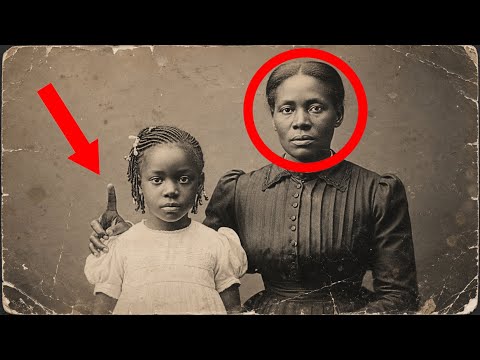
The thumb and middle finger touched at the tips. The index finger extended slightly upward. The remaining fingers curved inward. It was too deliberate, too specific to be accidental. Maya had seen this before—in her research on West African spiritual and healing practices. She pulled out her reference materials on Yoruba, Igbo, and Akan symbolic gestures, cross-referencing text after text until she found it.
The hand position matched a traditional healing symbol used by practitioners across multiple West African cultures. It represented protection, spiritual power, and the transmission of ancestral knowledge. This wasn’t just a family portrait. It was a declaration hidden in plain sight.
She turned the photograph over. In faded pencil, someone had written: Mama Esther and daughter Grace, Atlanta, Georgia, June 1901. The Lord is our strength. Below that, in different handwriting, much fainter: She knew.
Maya’s pulse raced. She knew. The photographer or someone else had recognized the significance of the gesture. This was a statement of identity and purpose, a silent act of resistance captured on film.
The photograph had arrived at the Atlanta History Center as part of a large donation from the estate of Ruth Morrison, who had died at ninety-three. Maya made a note to examine the rest of the donation carefully. She suspected this photograph held a story that needed to be uncovered—a story about resistance, healing, and the preservation of African knowledge in a society that sought to erase it.
The next day, Maya worked through the Morrison estate donation, searching for any information about the woman and child. In the fifth box, she found a leather-bound journal with Grace Morrison embossed on the cover. The first entry was dated 1945.
I am writing this account now at age 51 because the stories must be preserved. My mother, Esther Williams, died 10 years ago, taking with her knowledge that sustained our community for decades. I was too young to understand the full scope of her work when I was a child. But now I recognize what she was, what she risked to keep our people alive and healthy when white doctors would not treat us or treated us with contempt and cruelty.
Maya continued reading, her excitement growing. The photograph taken in 1901 was her mother’s idea. She insisted they have it made, though it cost money they could barely spare. She wanted proof that our knowledge existed, that we existed.
Grace’s journal explained that Esther had been what the community called a root woman or granny healer—a traditional practitioner who used herbs, spiritual practices, and ancestral knowledge to treat illnesses, assist with childbirth, and provide care that the segregated medical system denied to black residents of Atlanta.
Maya found a second journal, this one much older and more fragile, with Esther Williams written inside the front cover. The entries began in 1895, written in careful, practiced handwriting.
January 1895, delivered Mrs. Patterson’s baby tonight. The labor was long and difficult, but I used the herbs grandmother taught me. Blue cohosh to strengthen contractions. Red raspberry leaf tea for the mother’s strength. Mother and baby are well. Mrs. Patterson tried to pay me with the two pennies she had saved, but I refused. Our people have so little. The white doctors charge $5 for a delivery and will not even enter our neighborhoods. I do this work because it must be done.
Maya realized she was looking at a detailed record of traditional African-American healing practices from over a century ago, preserved by a woman who understood the importance of documentation, even as she practiced in secret. Esther had kept meticulous records of every patient she treated between 1895 and 1930—three boxes of journals, each entry documenting symptoms, treatments, and outcomes with the precision of a trained physician, though Esther had never attended medical school.
March 1896, a young Thomas Green came to me with deep cough, fever, difficulty breathing. His mother said the white doctor at the charity hospital examined him for five minutes, said it was negro consumption, and sent them away with no treatment. I recognized pneumonia, prepared a steam tent with eucalyptus and pine, gave him tea made from mullein leaf and wild cherry bark, applied a mustard plaster to his chest. Stayed with the family for three days and nights, monitoring his breathing. The fever broke on the fourth day. Thomas survived.
Entry after entry revealed the same pattern. Black patients denied care or mistreated by white medical establishments, turning to Esther as their only option. She treated everything from childhood illnesses to difficult births, from injuries to chronic conditions, using a combination of herbal medicine, spiritual healing, and practical nursing care.
But Maya also found evidence of the risks Esther faced. A journal entry from 1899:
The new health commissioner, Dr. Bradford, has declared that all unlicensed medical practitioners in Atlanta will be prosecuted. He means us—the root women, the granny midwives, the healers who serve our people. He calls us ignorant and dangerous. Says we spread disease and superstition. He does not mention that his licensed doctors refuse to treat negroes or that they experiment on us without consent or that they let our children die rather than dirty their hands touching black skin.
Maya found a newspaper clipping from the Atlanta Constitution, November 1899: CITY CRACKS DOWN ON UNLICENSED NEGRO HEALERS. The article described Esther and other traditional practitioners as threats to public health, calling their practices primitive and potentially deadly. But tucked into the same journal page was a counternarrative—a letter from a white physician, Dr. Samuel Foster, dated December 1899.
Dear Mrs. Williams, I am writing to warn you that Dr. Bradford intends to make an example of you by prosecuting you for practicing medicine without a license. I have observed your work from a distance, and though I cannot say so publicly, I recognize that you provide competent and compassionate care to a population that our medical establishment shamefully neglects. Please be cautious. The law is not on your side.
Maya turned the page, her hands trembling slightly. The next entry explained where Esther’s knowledge came from—a lineage that stretched back across the ocean to a woman named Akosua, brought from the Gold Coast on a slave ship, who had been a healer in her village. The symbol in Esther’s fingers was a declaration: This knowledge survives. We survive. And we will not be erased.
Maya set the journal down and stared at the photograph again. Four generations of knowledge, carried across an ocean and through slavery, distilled into a single gesture. Akosua to Abana to Esther to Grace. The names felt like a prayer.
She returned to the boxes with renewed urgency, searching for any trace of the network Esther had described. It didn’t take long. In the seventh box, beneath a bundle of faded receipts, she found a small cloth pouch containing a folded square of paper covered in Esther’s handwriting—a list of names, each followed by a symbol and a date.
Sister Clara — crossroads mark — Tuesdays. Sister Josephine — river mark — Fridays. Sister Ruth — mountain mark — first Sunday. Beside each name, Esther had drawn a tiny hand with fingers arranged in a different configuration.
Maya photographed the page and sent it to her colleague Dr. Emeka Okafor, a linguist at Emory who specialized in Akan and Igbo symbolism. His reply came within the hour: “These aren’t just names. It’s a map. Each hand sign corresponds to a different lineage of healing knowledge. You’ve found a directory of an entire underground medical network.”
She spent the next three days cross-referencing the names against census records, church registries, and death certificates. What emerged was astonishing. At least fourteen women across Atlanta and the surrounding counties had practiced as healers between 1890 and 1930, all connected through a web of shared knowledge, coded signals, and mutual protection.
But the records also revealed something darker. In 1913, a woman named Josephine Carter—listed in Esther’s network as a specialist in childbirth—had died under suspicious circumstances. The death certificate listed “natural causes,” but a margin note in Esther’s journal told a different story.
They came for Josephine in the night. Three men, not in uniform but with the smell of authority about them. They said she had caused a mother’s death with her filthy negro remedies. The mother had died of childbed fever—a fever she contracted in the white hospital where they sent her after Josephine delivered her safely. But the men needed someone to blame, and Josephine was convenient. They beat her. She died two days later. The law did nothing. Dr. Bradford said it was a warning to others like her.
Maya felt a cold weight settle in her chest. This wasn’t just persecution through legislation. It was violence—organized, deliberate, and sanctioned by silence.
She found a later entry, dated 1921, in which Esther described a quiet act of defiance. A young woman named Hattie, pregnant and terrified after Josephine’s death, had come to Esther begging for help. Esther had agreed—but on her own terms.
I delivered Hattie’s son in the back room of Sister Ruth’s church, with lookouts posted at both doors. We used no lights, only candles. When the baby came, I placed him in his mother’s arms and spoke the old blessing over him. I told Hattie that this child would carry the knowledge forward, that the ancestors were watching, that no law could erase what lived in our blood. She named him Moses, because he was born in hiding, and because he would lead our people out of bondage.
Maya paused. Moses. She searched the Morrison donation again, pulling out a photograph she had initially overlooked—a young black man in a World War II uniform, standing proudly beside a middle-aged Grace. On the back, in Grace’s handwriting: My nephew Moses, 1944. Named for deliverance.
She traced the connection. Moses had survived. The knowledge had survived. But the story wasn’t finished—there were still boxes she hadn’t opened, still pages she hadn’t read. And somewhere in the remaining papers, she suspected, lay the answer to a question that had been nagging at her since she first saw the photograph.
Who was Ruth Morrison, and why had she kept these secrets for so long?
Maya found her answer in the final box: a letter from Ruth, dated 1998, addressed to no one. I am Grace’s daughter, and I have kept these journals hidden for sixty years. My mother told me the symbol in Grandmother Esther’s hand was a promise—that our knowledge would outlive every attempt to silence it. I am old now. It is time to let the light in.
Maya read the letter twice, then looked back at the photograph. Esther’s hand, still raised in that ancient sign, seemed to reach across a century.
On opening night of the exhibition, Ruth’s granddaughter placed her own hand on the display case, fingers mirroring Esther’s. “We’re still here,” she whispered.
Maya closed her research journal and turned off the lamp. The gesture had survived slavery, Jim Crow, and erasure—and now it was finally being seen.
What hidden symbol in your own family’s photographs might be waiting to be understood?
Report this article
Select a reason for reporting:






