The morning of September 4, 1967, began like any other in the Que Son Valley—hot, humid, and deceptively quiet. But for the men of Delta Company, 1st Battalion, 5th Marines, that silence was about to shatter into a nightmare. As they moved through the tangled vegetation, a single thought gnawed at the back of their minds: the jungle was too quiet. No birds. No farmers. No movement. Even the insects seemed to hold their breath.
Then the world exploded. Automatic fire ripped through the trees, RPGs screamed overhead, and mortars slammed into the earth. In seconds, Delta Company was pinned down by an enemy force five times their size, trapped in a kill zone engineered with deadly precision. “We’re surrounded. Request immediate assistance,” a radio operator screamed into his handset. But help was miles away, and the enemy was closing in.
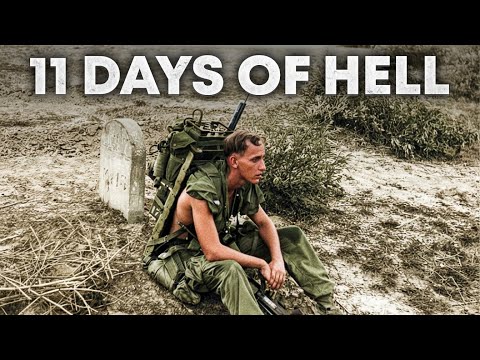
Back at battalion headquarters, the call came through: Delta Company was in danger of being overrun. Without hesitation, Alpha Company was ordered to move. They pushed forward through open rice paddies, unaware that the same enemy force was shifting its fire toward them. “Keep advancing. We have to reach them,” a squad leader shouted, but each step forward came at a terrible price.
Marines fell, hit before they could reach cover. Machine gun teams fired from the open, trying to suppress bunkers they could barely see. Radio operators begged for support, and finally, air power arrived. Jets screamed overhead, dropping ordnance so close that the shock waves slammed into the Marines’ chests. But the enemy didn’t break. It was as if the jungle itself was fighting back.
As the battle raged, a new force entered the fight: 3rd Battalion, 5th Marines. These hardened Marines signaled that the fight wasn’t ending—it was building. The NVA had transformed the valley into a fortress of interconnected bunkers, tunnels, and camouflaged fighting positions. Every fallen tree, every mound of dirt, every shadow had the potential to erupt into violence.
Marines fought tooth and nail to clear each position. Grenades went in first, then rifle fire, then fire teams charged forward with bayonets and shotguns. But the enemy was relentless. Night attacks brought new horrors: whistles echoing through the valley, mortar rounds arcing overhead, and shadows moving between the trees. “It felt like the jungle was alive and trying to kill us,” one Marine later recalled.
By the 11th day, the tide began to turn. Air power took control, and ground troops coordinated tighter assaults, leapfrogging between ridges and destroying bunker after bunker. The enemy’s fire became less coordinated, their reinforcements slower. “We didn’t win the valley in one moment. We broke them little by little until they couldn’t hold the line anymore,” a platoon commander said.
But victory came at a staggering cost. When the smoke settled, the Marines had suffered 114 killed and more than 300 wounded. The valley was secured, but the men who fought there would never be the same. And as they left the Que Son Valley, they carried with them the weight of a battle that would echo through Marine Corps history forever.
But the story of Operation Swift does not end with the final roll call. In the weeks that followed, the men of Delta and Alpha Companies returned to the same valley—not to fight, but to finish what the battle had started. They walked the ground they had bled for, now silent and scarred, and saw it with new eyes. The bunkers that had nearly swallowed them whole were now collapsed graves of earth and splintered timber. The rice paddies, once torn by craters, were already greening again under the monsoon rains.
It was there, standing among the ruins of an NVA command post, that a young lieutenant found something that stopped him cold. A logbook, water-stained and half-buried in the mud, filled with neat Vietnamese script and hand-drawn maps. It was a detailed plan for the destruction of Delta Company—complete with timetables, ambush coordinates, and the expected hour of annihilation. The enemy had not simply reacted to the Marine patrol. They had studied it, waited for it, and laid a trap with the patience of hunters.
That discovery sent a chill through the ranks. The NVA had known the Marines were coming. They had known the route, the timing, even the size of the force. Someone, somewhere, had given them the patrol schedule. Whether it was a leak, a captured document, or simple pattern recognition, no one could say for certain—but the implication was unmistakable. The valley had been a stage, and the Marines had walked onto it exactly as scripted.
For the survivors, the questions lingered long after the shooting stopped. Why had the enemy been so well prepared? Why had the ambush been so perfectly sited? And why, despite everything, had the Marines still managed to break through? The answers, if they existed at all, lay buried in the same jungle that had tried to kill them.
But there was no time to dwell. The war was already moving on. Fresh intelligence reports from the Que Son Valley suggested that the NVA, though bloodied, had not abandoned the region entirely. Small units were still slipping through the tree lines at night, carrying supplies and wounded toward the mountains. The Marines had won the battle, but the corridor remained a wound that refused to close.
Commanders ordered new patrols, deeper and more aggressive than before. This time, the Marines moved with a hardened edge—no longer the same men who had walked into the valley on September 4th. They had learned the enemy’s tricks, memorized the terrain, and developed a cold, methodical rhythm to their movements. They no longer trusted silence. They trusted each other.
It was during one of these follow-up sweeps that a squad from 3rd Battalion stumbled upon a scene that would haunt them for years. A small clearing, hidden deep in the jungle, filled with freshly dug graves. Dozens of them, marked only with wooden stakes and the faint smell of earth. These were not Marines. These were NVA soldiers, buried by their own comrades in the chaos of retreat. The enemy had suffered far more than the official estimates suggested—and someone had taken the time to honor them.
The squad leader, a staff sergeant from Texas, stood over the graves in silence for a long moment. Then he ordered his men to move on. There was no time for reflection, no time to process what it meant. The war did not pause for the dead, on either side.
As September bled into October, the Que Son Valley began to change hands in quieter ways. Villagers who had hidden during the fighting slowly emerged, rebuilding their homes and watching the Marines with wary eyes. Some offered information about enemy movements. Others said nothing at all. The valley was no longer a battlefield, but it was not yet at peace.
And somewhere in the mountains to the west, the survivors of the NVA 2nd Division were already regrouping, licking their wounds, and studying the lessons of Operation Swift. They had lost the valley—for now. But they had learned something too. The Marines could be ambushed. They could be bled. They could be forced to fight for every inch of ground. The next time, the enemy would be even more prepared.
For the men of the 1st Marine Division, the victory in the Que Son Valley was bittersweet. They had held the line, rescued their trapped brothers, and shattered an enemy offensive. But the cost was written in the faces of the survivors and the empty boots of the fallen. Operation Swift was over. But the war was far from finished.
The discovery of the logbook did more than unsettle the men—it triggered a quiet investigation that few outside the battalion ever knew about. Intelligence officers pored over the captured documents, cross-referencing timetables and coordinates with their own patrol records. What they found confirmed their worst suspicions: the NVA had been watching the valley for weeks, mapping every trail and listening to every radio transmission they could intercept. The ambush on September 4th had not been improvised. It had been rehearsed.
That knowledge changed the way the Marines operated. Patrol routes were scrambled. Radio silence became doctrine. Units began varying their departure times, their formations, even the sounds they made moving through the brush. “We stopped being predictable,” one platoon sergeant recalled. “And the jungle got a whole lot quieter after that.”
But the enemy adapted too. The small NVA units slipping through the tree lines at night grew bolder, more daring, probing Marine perimeters for weakness. Firefights erupted in the dark—brief, vicious exchanges that ended as suddenly as they began. Marines learned to sleep with their rifles across their chests and one eye open.
Then, in the third week of September, a patrol from Charlie Company made a discovery that would reshape the entire operation. Deep in a ravine west of the valley floor, they found an abandoned NVA field hospital. Operating tables. Surgical instruments. Stacks of bloodied bandages. And a ledger listing the names of over two hundred enemy wounded evacuated in the final days of the battle.
The ledger told a story the body counts never could. The NVA had not simply melted away—they had conducted a disciplined, organized withdrawal, carrying their wounded on litters through hidden mountain trails. The enemy had been hurt, badly, but they had not been broken. They had simply pulled back to fight another day.
For the Marines, that realization was sobering. They had won the valley, but the war beyond its ridgelines remained unchanged. The NVA 2nd Division was still out there, licking its wounds, rebuilding its ranks, and waiting for the next opportunity.
By early October, the men of the 1st Marine Division had settled into a new rhythm. The valley was quieter now, but the tension never fully faded. Villagers returned to their rice paddies, casting nervous glances at the tree lines. Marines rebuilt bunkers and reinforced perimeter wire. Helicopters ferried supplies and mail, and for the first time in weeks, men read letters from home.
But the war had left its mark. Some Marines carried physical wounds—shrapnel scars, missing fingers, the dull ache of old fractures. Others carried wounds no one could see. Men who had fought side by side for eleven days now sat apart at chow, staring at nothing, replaying moments they could not forget.
One evening, a young corporal from Delta Company walked to the edge of the perimeter and stood looking out at the valley. A staff sergeant found him there, silent, watching the sun sink behind the mountains. “You alright?” the sergeant asked. The corporal didn’t answer for a long moment. Then he said, “I keep waiting for the shooting to start again.”
The sergeant nodded. He knew the feeling. They all did.
And as the sun set over the Que Son Valley, casting long shadows across the scarred earth, the Marines of Operation Swift understood a truth that would follow them for the rest of their lives. The battle was over. But the valley—and the war—would never truly let them go.
Weeks later, a chaplain’s assistant packed Capodanno’s few belongings—a worn Bible, a letter to his mother, a silver crucifix. He had been recommended for the Medal of Honor, but the men who watched him die didn’t need a medal to know what they’d seen. They carried his story out of the valley like a flame cupped against the wind.
The Que Son Valley fell quiet that autumn, but the war’s shadow stretched long. Tet loomed just months away, and the lessons of Swift—the ambushes, the tunnels, the enemy’s patience—would echo in every firefight to come. Some of the men who survived September 1967 would not survive January 1968.
Yet they had held. Eleven days, five-to-one odds, and still the line never broke. That was the truth the Marines carried home: not that they had won the war, but that they had refused to lose each other.
What do you think we owe the men who fought in places like Que Son Valley—and what stories should we never let fade?
Report this article
Select a reason for reporting:






