Dr. Marcus Reed had examined thousands of 19th-century photographs, but none had ever made him stop cold like this one. The image showed a Black family of four, formally posed in a Richmond studio in 1889. The father’s suit was threadbare, the mother’s dress carefully mended, and the younger daughter, no more than eight, sat on a low stool wearing a delicate silver locket that seemed impossibly out of place. Marcus reached for his magnifying glass, and his breath caught. The locket was engraved with initials—R.M.—and it was slightly open, as if deliberately positioned to reveal that it contained something inside.
He called his colleague, Dr. Jennifer Washington, a specialist in post-Civil War African American genealogy. She arrived within the hour, and together they stared at the photograph, the implications settling between them. “Families didn’t commission studio portraits lightly in 1889,” Jennifer said. “Every element was chosen. They wanted someone to notice this locket.”
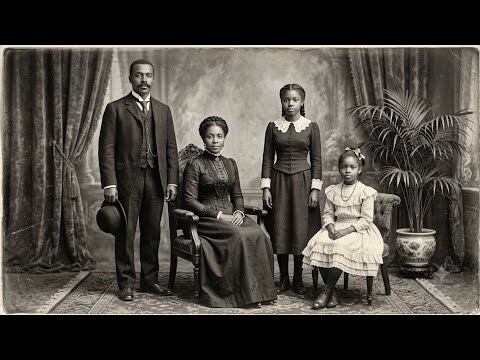
Their search led them to church records that revealed the younger girl, Sarah Williams, wasn’t the biological daughter of Samuel and Grace Williams. A note from 1889 read: “Grace Williams reports Sarah’s nightmares continue. Child speaks of the house with green shutters and asks for Mama Ruth.” Marcus felt his skin prickle. Sarah was asking for someone named Ruth—but Ruth was the older sister’s name. Or was she someone else entirely?
They traced Sarah’s life through census records, death certificates, and a 1951 obituary that said she had spent years searching for information about her early childhood. “Mrs. Peterson spent many years searching for information about her early childhood and birth family, hoping to solve the mystery of her origins,” the obituary read. Sarah had died still searching, but her children had continued the quest.
Marcus found a name in the 2024 Superagers Registry: Ruth Peterson Cole, age 118, living in Silver Spring, Maryland. Sarah’s daughter. Within days, they sat across from Ruth in her care facility, her great-granddaughter Keisha beside her. Marcus laid the photograph on the table. “That’s her,” Ruth whispered. “That’s my mother.”
Keisha reached into her bag and withdrew a tarnished silver locket. Marcus opened it with gloved hands. Inside was a tiny photograph of a young Black woman and a birth certificate, handwritten in elegant script: Sarah Ruth Morrison, born March 15th, 1881. Mother, Ruth Ellen Morrison. Father, unknown. Freeborn. The room fell silent.
“After 138 years, finally we know her name,” Ruth said, tears streaming down her cheeks. But the mystery was only deepening. Who was Ruth Morrison? And why had she sent her daughter away with nothing but a locket and a secret?
Marcus and Jennifer promised to find out. They had no idea that the answer would lead them to a burned house, a stolen fortune, and a cover-up that had lasted more than a century.
With the birth certificate as their anchor, Marcus and Jennifer began to pull at the threads of Ruth Ellen Morrison’s life. Keisha brought them boxes of Sarah’s research—decades of dead ends, but also a road map of what had already been tried. They started fresh with the name and date from the locket, and within a week, Jennifer found a property deed dated 1879 in Henrico County. Land purchased by Ruth Ellen Morrison, free woman of color, forty acres, payment in full.
“She owned land,” Jennifer said, her voice tight with excitement. “A Black woman, just fourteen years after emancipation, buying property outright.” Marcus stared at the deed. Ruth Morrison wasn’t just a name on a birth certificate—she was a woman of substance, a property owner in a time and place that made such things nearly impossible.
The 1880 census listed Ruth, aged twenty-eight, as a seamstress and property owner, living with her mother Ella and infant daughter Sarah. Newspaper advertisements from 1881 and 1882 announced “R. Morrison, fine dressmaking and alterations,” taking commissions from Richmond’s wealthiest families. Ruth had built something real. But then the records stopped. No advertisements after 1882. No property taxes paid after 1883.
Marcus searched newspaper archives for weeks, scrolling through hundreds of pages of microfilm until his eyes burned. Then he found it—a small article in the Richmond Dispatch dated September 14th, 1883. “Tragedy in Henrico County. The home of Ruth Morrison, a free woman of color, was destroyed by fire Tuesday night. Miss Morrison is reported missing. Her mother, Ella Morrison, perished in the blaze. The cause remains under investigation, though neighbors report seeing men on horseback leaving the property before flames were discovered.”
Marcus read the words aloud, his voice tight with anger. “They burned her house. Killed her mother. Tried to kill Ruth and Sarah.” A second article from October reported that the investigation had been closed, no evidence of criminal activity found. Ruth Morrison was presumed deceased. The property was seized for unpaid taxes and auctioned. The buyer: Thomas Whitfield, a local planter who’d owned slaves before the war, for two hundred dollars—a fraction of its value.
“They covered it up,” Jennifer said bitterly. “Whitfield burned Ruth’s house, killed her mother, then bought the land for almost nothing. And the investigation was closed without charges.” They sat in heavy silence, understanding the pattern. Ruth Morrison had been too successful, too independent. Someone had decided she was too prosperous, too confident—and destroyed everything she’d built.
But Ruth had saved Sarah. Somehow she’d gotten her daughter away, put her on a train with a locket containing her real name—the only proof of who she was. The question was, what happened to Ruth herself? Jennifer expanded the search beyond Virginia, checking church records in neighboring states. Finally, in the First Baptist Church records in Washington, D.C., she found a note from October 1883: “Provided sanctuary and medical care to Ruth M., freed woman from Virginia, suffered injuries to hands and arms. Woman reports violent attack on her property. Church provided temporary housing and employment assistance.”
“She survived,” Jennifer said. “Ruth Morrison made it to Washington.” They traced her through city directories—a laundress on K Street, then a marriage record in 1890 to Thomas Freeman, a railroad porter. Ruth had rebuilt her life quietly, keeping a low profile, hiding from whoever had destroyed her Virginia home. But she’d never returned for Sarah, never reclaimed her daughter who lived just two hours away in Richmond.
The answer came in a pastoral note dated December 1883: “Ruth M. inquired about reclaiming her daughter. Advised against returning to Virginia due to safety concerns. Woman reports men who attacked her may be searching for child as well. Decision made to allow child to remain in safe situation until threat passes.” Marcus read it aloud, his voice thick with emotion. “She couldn’t go back. If she went to Richmond, she’d lead the men who burned her house right to Sarah. So she gave up everything—her child, her identity, her property—to keep her daughter safe.”
But the story didn’t end there. In 1902, they found a letter in the church archives, written in Ruth Freeman’s hand: “I have learned my daughter Sarah married James Peterson and moved to Washington. She lives five miles from where I work. I have seen her from a distance. She’s beautiful and appears happy. I want desperately to tell her who I am, but would it help her to know her mother is alive but lived all these years without contacting her?” The pastor’s reply was written at the bottom: “The truth, spoken with love, is rarely wrong.”
Marcus called Keisha immediately. “Did your great-grandmother ever mention Ruth Morrison trying to contact her mother?” There was a pause. “Actually, yes. Great-grandmother told me that in 1902, a woman approached her mother on the street in Washington. The woman called her Sarah Ruth Morrison. She told Sarah she was her mother, that she’d saved her from a fire, that she’d stayed away to protect her.”
“What did Sarah do?” Marcus asked, barely breathing. “She invited the woman to her home. They spent an afternoon together. Ruth told her everything—about the property, the fire, the men who tried to kill them, about putting Sarah on a train with the locket. She explained why she’d stayed away. Because she loved Sarah too much to risk leading dangerous men to her.”
“Did they meet again?” “A few times over several months. But then Ruth Freeman died of pneumonia in February 1903. Sarah mourned deeply. She kept the locket and wore it every day. She spent the next fifty years trying to document her mother’s story, trying to prove Ruth Morrison had existed and been destroyed by racist violence.”
Marcus felt the weight of those fifty years pressing on him. Sarah had spent her life gathering evidence, writing letters, chasing dead ends—all to prove her mother existed. “She never found justice,” Keisha said quietly. “But maybe you can finish what she started.”
They spent the next week compiling everything: property records, newspaper articles, church testimony, and Sarah’s own meticulous documentation. The evidence painted an undeniable picture. Thomas Whitfield had orchestrated the arson to steal Ruth Morrison’s land, and the legal system had let him. “We need to present this publicly,” Jennifer said. “Not just as research—as formal documentation of racist violence and land theft.”
Marcus contacted an investigative journalist at the Washington Post. Within two weeks, the story ran on the front page: “How Virginia Families Were Robbed: The Systematic Land Theft That History Forgot.” The response was overwhelming. Descendants of other families who lost property came forward. Historians investigated similar patterns across Virginia. And Ruth Cole, at 118, finally saw her mother’s story told.
But one piece remained. A civil rights attorney named David Richardson contacted Keisha, specializing in historical restitution. “Your great-great-grandmother’s case is exceptionally well documented,” he explained. “We can sue for acknowledgement and compensation.” Keisha didn’t hesitate. “My great-grandmother spent her entire life trying to get justice. I’m not stopping now.”
The lawsuit, Keisha Williams et al. v. The Whitfield Family Trust et al., was filed three months later. The turning point came when Richardson projected the 1889 photograph in court, zooming in on young Sarah’s locket. “This is Sarah Ruth Morrison,” he told the judge. “She was three years old when Thomas Whitfield burned her home and murdered her grandmother. Her mother placed this locket around her neck and sent her to safety. Inside was proof of who she was. Sarah wore it every day for seventy years, preserving evidence of the crime.”
The courtroom was silent. Two weeks later, the Whitfield Family Trust agreed to settle—formal acknowledgement of fraud and violence, plus $2.3 million in compensation. But for Keisha, the money wasn’t the point. “It’s the acknowledgement,” she said at a press conference. “For 142 years, my family’s story was erased. Now the truth is on record.”
The settlement included a historical marker where Ruth Morrison’s home had stood. On a bright June morning, dozens of descendants gathered as the marker was unveiled. Ruth Cole, now 119, touched the engraved letters of her great-grandmother’s name. “She existed,” Ruth whispered, tears streaming down her face. “She mattered. She’s remembered.”
Six months later, Ruth Peterson Cole died peacefully at age 120. She’d lived long enough to see justice served. Keisha called Marcus with a final request: “She wanted you to have the locket. She said you gave Ruth Morrison her voice back.”
Marcus installed the locket in a permanent museum display, beside the 1889 photograph. The display text told the story of four generations—Ruth Morrison, Sarah Williams Peterson, Ruth Peterson Cole, and Keisha Williams—and how a single locket became a voice speaking truth across time. A young girl stood before the case, studying the locket intently. “Why did she keep wearing it?” she asked her mother. “Because remembering was important,” her mother said, “even when it hurt.”
Marcus stepped outside into the setting sun. Ruth Morrison had been erased, her property stolen, her life destroyed. But she had not been silenced. Because of one locket, one photograph, and four generations who refused to let her story die, her voice still spoke—and the world was finally listening.
What would you have done if you found a similar mystery hidden in your own family’s attic—would you have the courage to chase the truth, no matter how painful?
Report this article
Select a reason for reporting:






