Sarah Martinez had spent fifteen years appraising estates, but the wooden box in Eleanor Whitman’s attic felt different. The old woman had inherited the Chicago house from her great-aunt, and forgotten memory boxes filled every corner. As Sarah lifted each item carefully, her fingers brushed against a leather photo album wedged under moth-eaten quilts.
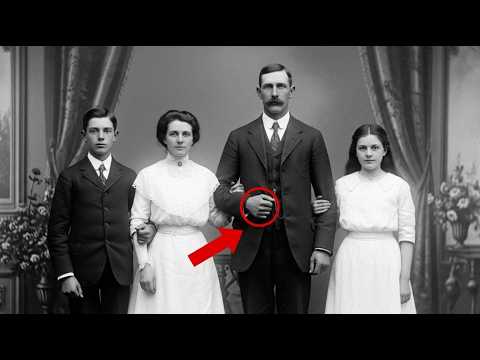
September afternoon light seeped through dusty windows as Sarah opened the album. Page after page revealed typical early 1900s portraits—stiff poses, formal attire, stern expressions. Then she stopped at a studio portrait dated 1910. An elegant family of four stood before a decorative backdrop. A stern father in a three-piece suit, a woman in an intricate white gown, and two children—a boy of twelve and a girl of eight.
“Beautiful family,” Mrs. Whitman said, peering over Sarah’s shoulder. “I’ve wondered about them for years. No one in our family knows who they are.”
Sarah studied the photo closely, her trained eyes catching details others might miss. The father’s posture was formal, his left hand resting on his son’s shoulder. But his right hand gripped something tightly, partially hidden by the folds of his jacket.
“Mrs. Whitman, do you have a magnifying glass?” Sarah asked slowly.
The old woman shuffled away and returned with a small lens. Sarah placed it over the photo, focusing on the father’s concealed hand. What she saw made her breath catch. It wasn’t a pocket watch or a handkerchief. It looked like a small leather wallet or document case, and at its edge, barely visible, was what appeared to be the corner of an official seal or stamp.
“I think we need to examine this more carefully,” Sarah whispered, her heart racing with the thrill of discovery. Something about the way the father held that object suggested it was far more important than it seemed.
Dr. James Harrison, a photographic historian at Northwestern University, adjusted his high-powered microscope for the third time. Sarah had brought the photo to his lab the next morning, unable to shake the feeling that the father’s hidden object held significance.
“The photograph itself is authentic,” Dr. Harrison confirmed after examining the paper and chemical composition. “It’s a gelatin silver print consistent with studio work from 1910. The aging patterns, the sepia tones—everything matches the period perfectly.”
Sarah leaned forward. “But look at what the father is holding.”
Dr. Harrison placed the photo under his strongest lens and began adjusting the focus slowly. His confident expression gradually shifted to curiosity, then surprise. “This is really extraordinary.” The object in the father’s hand became clearly visible now—a small leather document case, with an official government seal protruding from its edge. But most intriguing were the letters barely discernible: “Department” and what looked like “of Justice.”
“A Department of Justice document in 1910?” Sarah asked, puzzled.
“That’s the strange part,” Dr. Harrison said, adjusting the focus again. “The Department of Justice was only established in 1870, but it was very small then. This seal looks more formal, more established. And see here?” He pointed to additional markings. “There appear to be case numbers and dates.”
Dr. Harrison leaned back, removing his glasses to clean them thoughtfully. “Sarah, this man appears to be holding documents from a federal law enforcement agency. In 1910, that would have been extremely unusual for a family portrait. Most people would have had no contact with federal authorities.”
A chill ran down Sarah’s spine. The charming family photo had transformed into something far more mysterious. What kind of case would have required federal involvement in 1910? Something serious?
“Something worth hiding in a family portrait,” Dr. Harrison answered grimly.
Three days later, Sarah found herself in the basement archives of the Chicago Historical Society, surrounded by ledgers, city directories, and newspaper collections. Dr. Harrison had connected her with Maria Santos, the society’s senior researcher specializing in early twentieth-century Chicago families.
“Studio portraits like this were expensive,” Maria explained, pulling out a thick directory. “Only wealthy families could afford formal sittings. The clothing and backdrop suggest this was taken at one of the finest downtown studios.”
Maria’s fingers traced the faded pages. “Ah, here. Blackstone Studio, operated by William Blackstone from 1908 to 1915. Located on State Street. They were known for their work with Chicago’s wealthy families.”
Sarah studied the photo again. The father’s attire spoke of prosperity—a tailored suit, a gold watch chain, polished shoes. “Is there any way to identify the family?”
“We can try cross-referencing city records. The children’s ages, the clothing style, even studio client records if they survived.” Maria pulled another ledger. “Blackstone kept meticulous records. Let’s see what 1910 shows us.”
Hours passed as they combed through the records. Finally, Maria stopped at a page dated October 15, 1910. “Sitting, family of four. Mr. Thomas Brennan, wife Catherine, son Michael, daughter Rose. Residence, 1247 Prairie Avenue.”
Sarah’s pulse quickened. Prairie Avenue was where Chicago’s elite had lived—the Armours, the Fields, the Pullmans.
Maria was already reaching for another volume. “Let’s see what we can discover about Thomas Brennan.” As she opened the city directory, both women noticed something troubling. The page containing Brennan’s information showed signs of tampering—delicate erasures and overwritten entries suggesting someone had tried to alter the records.
“Someone went to great lengths to hide the true story of this family,” Maria said quietly.
The next morning brought unseasonably cold October weather as Sarah stood outside 1247 Prairie Avenue. The grand mansion had been demolished decades ago, replaced by a small park. But Mrs. Chen, the elderly woman who ran the adjacent shop, had lived in the neighborhood for sixty years.
“Oh yes, I remember stories about that house,” Mrs. Chen said, wrapping her sweater tightly against the wind. “My grandmother worked as a seamstress for wealthy families. She mentioned the Brennan family, said something terrible happened there one winter.”
Sarah felt her heart race. “Terrible? What do you mean?”
“There was a scandal. Federal marshals came to the house and arrested Mr. Brennan. My grandmother said the whole neighborhood talked about it. Something about his business dealings, but no one knew the details.”
Sarah thanked Mrs. Chen and headed to the main branch of the Chicago Public Library. Newspaper archives revealed intriguing fragments. She found a small article in the Chicago Tribune dated November 28, 1910: “Prominent Prairie Avenue Businessman Arrested. Federal marshals yesterday arrested prominent businessman Thomas Brennan on charges related to an ongoing federal investigation. Brennan’s shipping and lumber operations were under scrutiny. Family members were unavailable for comment.”
But then the story vanished strangely from later editions. No follow-up articles, no trial coverage, no outcome. It was as if Thomas Brennan had been deliberately erased from public records.
Sarah photographed the article with her phone and continued searching. In the business section from early 1910, she found references to Brennan’s company winning several large government contracts for lumber shipments to various federal projects. The document in his hand suddenly seemed far more significant. What kind of federal case had Thomas Brennan been involved in? And why had his arrest been covered up?
Dr. Harrison’s office felt cramped with Maria Santos and Detective Ray Kowalski, a retired Chicago police investigator specializing in cold cases, joining them. Sarah had contacted him after discovering that the police records for Brennan’s case had been sealed.
“Federal cases in 1910 were uncommon,” Detective Kowalski explained, studying copies of old police files. “Most crimes were handled locally. But when federal marshals intervene, it usually means something big—postal fraud, interstate commerce violations, or government contract irregularities.”
He pointed to a note written in faded ink. “See this? The case was referred to the U.S. Attorney’s office. That indicates serious federal charges.”
Dr. Harrison was conducting his own research. “I’ve found records of Thomas Brennan’s business operations. He owned Brennan Lumber Company, which supplied timber for federal construction projects across the Midwest.”
Sarah leaned forward. “What kind of projects? Post offices, federal buildings, military installations?”
“His company had exclusive contracts worth hundreds of thousands of dollars. Enormous sums in 1910.”
Maria was quietly reviewing business records from the era. She found something disturbing. “Many of Brennan’s government contracts were awarded under questionable circumstances.” She displayed photographed documents. “He consistently underbid established competitors. His lumber was shipped from remote locations in Minnesota and Wisconsin, but the quality certifications don’t match standard specifications.”
Detective Kowalski studied the shipping records. “Well, it looks like he might have been substituting inferior lumber for what the government was paying for. If federal buildings or military installations were compromised by substandard materials…”
Silence fell over the room as the implications sank in. Sarah pulled out the photograph again, staring at the document in Thomas Brennan’s hand. What if he was carrying evidence? Proof of what he’d done? Or, Dr. Harrison added grimly, proof of who else was involved?
The Cook County courthouse archives felt cavernous as Sarah and Dr. Harrison navigated dusty basement storage rooms. Maria had arranged a meeting with retired court clerk Harold Morrison, who had spent forty years managing federal case files and possessed an encyclopedic memory of unusual cases.
“The Brennan case was legendary among court staff,” Mr. Morrison explained, leading them to a locked file room. “It was sealed so quickly that most people forgot it existed.” He placed several thick volumes on the table. “What you’re about to see was supposed to be destroyed decades ago. I kept copies because something about the whole situation never sat right with me.”
Sarah opened the first volume and gasped. The documents revealed a massive conspiracy involving government officials, contractors, and businessmen systematically defrauding federal construction projects across multiple states.
“Brennan wasn’t the mastermind,” Mr. Morrison continued. “He was recruited by federal officials who were receiving bribes to award contracts to specific companies. The substandard lumber was just one part of a much larger scheme.”
Dr. Harrison studied a particularly damning memo. “This shows that multiple federal buildings and military installations were constructed with materials that were not fit for purpose. Some of these structures housed hundreds of people.”
Sarah found a note in Brennan’s precise handwriting: “They promised me immunity for my silence, but I cannot stay silent knowing lives are at risk. I have gathered complete evidence and hidden it safely. If anything happens to my family, the truth must come out.”
Mr. Morrison explained that Brennan was scheduled to testify before a federal grand jury. “But the night before his testimony, he died in his cell. The death was officially ruled a suicide, though the circumstances were highly suspicious.”
Back in Chicago, Detective Kowalski uncovered disturbing findings through his federal law enforcement contacts. The Brennan case was part of a larger pattern of corruption reaching the highest levels of government. “It wasn’t just lumber,” Kowalski explained. “Steel, concrete, electrical work—the entire federal building program was compromised.”
Maria was comparing affected buildings with historical records. At least twelve federal facilities collapsed or suffered major failures between 1912 and 1920, injuring or killing hundreds.
Dr. Harrison was re-examining the photograph under different lighting. “Look at this—there are additional markings on the document Brennan holds, numbers that only appear under specific light.” The numbers revealed what appeared to be coordinates and a date: November 15, 1910.
Sarah quickly entered the coordinates into her phone. They pointed to a location in Lincoln Park, near the lakefront. “That’s exactly two weeks before Brennan’s arrest,” Maria noted.
The old oak tree stood proudly in Lincoln Park against a gray November sky. According to city records, the tree predated Chicago’s founding, making it old enough to witness Thomas Brennan’s final desperate act in 1910.
Detective Kowalski’s trained eye noticed something unusual at the tree’s base. “Look at these scars on the bark. They’re old, but they’re not a natural growth pattern.” Close examination revealed that someone had carefully carved a small cavity into the trunk, then let the bark grow partially over it.
Inside that hidden compartment, wrapped in oiled leather and in remarkable condition, was a metal document cylinder. Sarah’s hands trembled as she carefully opened it. Inside were dozens of documents, contracts, correspondence, photographs of substandard building materials, and detailed financial records showing bribe payments to government officials.
“My God,” Dr. Harrison whispered, examining one of the letters. “These are communications between Brennan and Senator William Harrison regarding falsified inspection reports.”
But most astonishing was Brennan’s final letter, addressed to future investigators: “I know they will kill me to protect their secret, but I cannot allow innocent people to die in buildings I helped compromise. This evidence proves that dozens of federal officials accepted bribes to approve substandard materials. The photograph will guide whoever comes after me to find the truth.”
Sarah realized they hadn’t just found evidence of corruption—they had proven that Thomas Brennan died a hero’s death, sacrificing himself to expose a conspiracy that threatened thousands of lives.
The final piece of the puzzle came from an unexpected source. Eleanor Whitman called Sarah that evening, her voice trembling with excitement. “I found something else in the attic—letters addressed to future generations from my family.”
The letters, written in Thomas Brennan’s precise hand and signed by his wife Catherine, revealed the family’s escape plan. “Thomas knew they would kill him,” Catherine Brennan wrote. “But before his arrest, he gave me detailed instructions on how to preserve his evidence and protect our children. We arranged our disappearance after his death, changing our names and moving west to California.”
The letters revealed that the Brennan family hadn’t vanished. They had carefully orchestrated their escape with the help of sympathetic federal agents who believed in Thomas’s cause. “We became the Morrison family,” Catherine’s letter continued. “Our children grew up knowing their father died a hero, but they understood they could never speak his name aloud.”
Sarah looked at the photograph with entirely new understanding. Thomas Brennan wasn’t a victim. He was a whistleblower who sacrificed everything to protect innocent lives. His family hadn’t died in tragedy—they had survived to honor his memory.
“Eleanor, Catherine Brennan was your great-great-grandmother,” Sarah said gently. “You are descended from Thomas Brennan.”
The elderly woman wept as she touched a photograph of ancestors she never knew existed. “He was carrying evidence that saved lives,” she whispered. “All these years, I’ve been living in the house where heroes found refuge.”
Six months after the discovery, Sarah stood in the Thomas Brennan Memorial Library, a new wing at the Chicago Historical Society dedicated to government accountability and whistleblower protection. Brennan’s documents had sparked congressional investigations into historical corruption and led to new protections for those who expose wrongdoing.
The studio portrait from 1910, once so innocent-looking, had become a symbol of moral courage, proving that truth, carefully preserved and patiently hidden, will always find its way to light. Sarah smiled every time she passed Thomas Brennan’s photograph. The document in his hand was no longer a mystery—it was a testament to the power of individual integrity and the enduring strength of families who refused to let truth stay buried forever.
What would you have done if you discovered a century-old secret hidden in your own family’s attic?
Report this article
Select a reason for reporting:






