Imagine pouring your entire life savings into a home that was supposed to set you free—only to discover you can’t legally live in it, no bank will finance it, and it’s slowly poisoning you with mold. This isn’t a plot from a dystopian novel. It’s the quiet, humiliating reality for thousands of Americans who bought into the tiny home dream.
The pitch was irresistible: a cozy 300-square-foot cottage on wheels, no massive mortgage, no decades of debt. Just freedom, simplicity, and a quiet rebellion against a housing market that had spiraled out of control. But somewhere between the Instagram-perfect tours and the HGTV specials, that dream curdled into a nightmare.
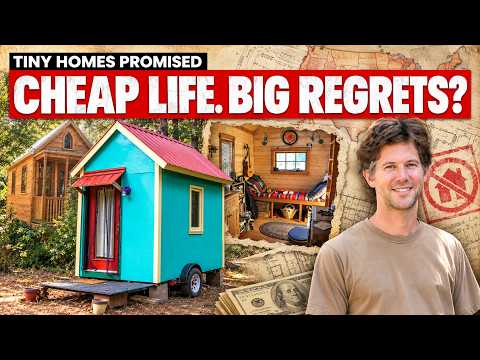
The tiny home movement didn’t start as a product. It began in 1997 with Jay Shafer, an art professor who built a 96-square-foot house on wheels as a protest against building codes that made small living illegal. His act was part architecture, part defiance—a statement that a simpler life should be within reach.
For a decade, it remained a fringe philosophy, embraced by those who valued intentionality over square footage. Then came the 2008 financial crisis. As millions lost their homes to foreclosure, the idea of a tiny, mortgage-free dwelling suddenly seemed not eccentric, but rational. It looked like insurance against a system that had just gutted them.
And that’s when the movement became an industry. HGTV launched Tiny House Hunters and Tiny House Nation, broadcasting soft-focus fantasies of young couples in sage-green cabins, string lights aglow, goats grazing nearby. The message was clear: you can own a home, live debt-free, and still make it look beautiful on Instagram.
America ate it up. By the mid-2010s, tiny homes were a cultural phenomenon. YouTube tours racked up millions of views. Instagram feeds filled with #tinyliving posts of impossibly tidy lofts and Nordic minimalism. The global tiny home market exploded, valued at $21.9 billion in 2024 and projected to reach $29.9 billion by 2033.
But the marketing hid a darker truth. Most buyers were young, first-time homeowners—people who had never navigated the complexities of zoning, financing, and construction. They were sold a dream, but what they got was a legal and financial quagmire.
The first lie was the sticker price. Articles and brochures touted $30,000 to $70,000 for a tiny home, a fraction of the $412,000 median home price. But that number rarely included the land, utility hookups, permits, insurance, or delivery fees. In reality, the total cost often ballooned to $80,000–$150,000—still cheaper than a traditional house, but far from the radical savings promised.
Then came the zoning trap. Most municipalities have minimum square footage requirements that far exceed tiny home dimensions. In Berkeley County, North Dakota, the minimum is over 900 square feet. In some states, it’s 1,700. Even in tiny-home-friendly states, enforcement happens at the county and city level, leaving buyers stranded with a home they can’t legally occupy.
Financing was another nightmare. Traditional mortgages require homes on permanent foundations, exceeding 400 square feet, and with clear resale value—criteria most tiny homes fail. Buyers were pushed into RV loans, personal loans, or credit cards with higher interest rates and shorter terms. And unlike traditional homes, tiny homes depreciate like cars, losing 15–25% of their value in the first year alone.
But the most devastating blow came from fraudulent builders. Matt Sowash, founder of Holy Ground Tiny Homes, promised affordable homes with no credit checks. Hundreds paid deposits, some in full, and waited. And waited. Deliveries fell years behind schedule. By late 2022, police had received 14 reports of potential fraud. Sowash filed for bankruptcy, and buyers were left with nothing.
Even those who received their homes faced unexpected horrors: mold infestations from poor ventilation, social isolation in spaces too small to host friends, and the psychological toll of living, working, and sleeping in the same 200 square feet. One buyer summed it up: “I bought a tiny home on Facebook Marketplace for 25K. We couldn’t connect to utilities. It became a storage unit.”
As the dream crumbled, cities tried to repurpose tiny homes as homelessness solutions, but even that backfired. Los Angeles spent $130,000 per unit on 8×8-foot pallet shelters—far more than promised—and statewide, only 544 of 1,200 promised beds materialized.
So who won? The manufacturers who scaled up during the hype, the media companies that profited from the aesthetic, and the land speculators who sold rural plots at inflated prices. The losers were the buyers—young, hopeful, and often financially ruined.
The tiny home movement began as a genuine critique of American excess. It ended as a product line, sold to those desperate enough to believe in a shortcut out of a broken system. And as the dust settles, one thing is clear: the real solution to the housing crisis isn’t smaller homes—it’s fixing the systemic issues of zoning, financing, and construction that made tiny homes a trap in the first place.
But the story doesn’t end with the buyers who lost everything. It continues in the quiet, unglamorous spaces where the tiny home industry is still operating—and still selling the same dream to a new generation of desperate Americans.
Walk into any tiny home expo in 2025 and you’ll see the same playbook. Vendors with glossy brochures, smiling salespeople promising “financial freedom,” and model homes staged with fake plants and throw pillows to make 200 square feet feel like a luxury suite. The pitch hasn’t changed. The only thing that’s changed is the number of people who’ve already been burned.
What’s striking is how the industry has adapted. After the wave of bankruptcies and fraud cases, some builders rebranded. They stopped calling their products “tiny homes” and started calling them “accessory dwelling units” or “modular guest houses”—terms that sound more legitimate, more bankable, more likely to pass zoning review.
But the fundamental math hasn’t changed. A structure that costs $50,000 to build still needs land, utilities, and permits. And in most of America, that land still can’t legally host a full-time resident in a structure that small.
Here’s what the industry doesn’t want you to think about: the resale problem is getting worse, not better. As more tiny homes hit the secondary market, buyers are discovering that the pool of interested purchasers is shrinking. Why? Because anyone who wants a tiny home can buy a new one for roughly the same price—with a warranty, a builder’s guarantee, and no mold.
One real estate agent in Oregon described the situation bluntly: “I’ve had clients trying to sell their tiny homes for two years. They’ve dropped the price by 40% and still can’t move them. The only people buying used tiny homes are flippers who lowball and then rent them out on Airbnb.”
And that’s the final twist in the tale. The tiny home, originally pitched as a path to homeownership and stability, has increasingly become a vehicle for short-term rentals—a way for investors to extract profit from a housing stock that was supposed to be about living simply.
Meanwhile, the people who bought into the dream are left holding the bag. Some have abandoned their tiny homes entirely, walking away from loans they can’t repay on structures they can’t sell. Others are living in them illegally, hiding from code enforcement, hoping no one notices.
And a few—the lucky ones—have found a way to make it work. They bought land in a permissive county, installed proper utilities, and built to a higher standard than the industry average. They’re the exception, not the rule.
The tiny home movement was never going to solve the housing crisis. It was a pressure valve, a way to channel frustration into a product instead of a demand for systemic change. And as long as the underlying problems—zoning, financing, construction costs—remain unaddressed, the cycle will continue.
New buyers will be drawn in by the promise of freedom. They’ll pay their deposits, wait for their homes, and discover too late that the dream was never quite what it seemed. And the industry will keep selling it, because the dream is profitable—even when the reality isn’t.
The expo circuit itself has become its own small economy. Booths sell solar kits, composting toilets, and collapsible furniture to people who haven’t yet secured land. One vendor at a recent show in Tennessee admitted that roughly half his customers return within a year, asking how to resell a structure they can’t legally occupy. He doesn’t have an answer for them. Nobody does.
What’s emerged instead is a kind of underground market—tiny homes listed on Facebook Marketplace and Craigslist, sold cash-only, with no title, no inspection, and no disclosure requirements. Buyers hand over $20,000 for a structure that may have been sitting in a field for three years, its insulation quietly rotting, its trailer frame rusting from the inside.
There’s no Carfax for tiny homes. No standardized inspection. No way to know if the person selling it built it themselves from a YouTube tutorial or if it came from a builder who went bankrupt mid-order and cut every corner to stay afloat.
And then there’s the insurance problem, which almost no one talks about until it’s too late. Standard homeowner’s policies don’t cover tiny homes on wheels—they’re classified as vehicles, which means you need RV insurance, which often excludes full-time residency. Some insurers won’t touch them at all. Others charge premiums that rival a mortgage payment on a traditional house.
One couple in Colorado told me they pay $340 a month just to insure their 280-square-foot home. That’s $4,080 a year—more than they’d pay to insure a $300,000 house in the same county. The tiny home was supposed to save them money. Instead, it costs them more per square foot to insure than a mansion.
And when something goes wrong—a burst pipe, a roof leak, a fire from a propane heater—the claim gets denied because the policy was written for a recreational vehicle, not a primary residence. The fine print matters, and almost nobody reads it until they’re standing in a burned-out shell of what was supposed to be their escape.
The mold problem, meanwhile, has spawned its own cottage industry of remediation specialists who charge thousands to treat structures that were never properly ventilated in the first place. One specialist in Washington State said he’s seen tiny homes with mold growing inside the walls within six months of construction—built with materials that were never meant to handle the humidity of daily living.
“These aren’t homes,” he said. “They’re campers with better marketing.”
That distinction matters more than most buyers realize. A camper is designed for occasional use. A home is designed for a lifetime. The tiny home industry blurred that line, selling recreational structures as permanent housing, and the consequences are only now becoming clear.
Some states are starting to push back. Oregon and Washington have tightened regulations on tiny home construction, requiring inspections that many builders can’t pass. California passed legislation allowing tiny homes on wheels to be permitted as ADUs, but implementation has been slow and inconsistent. A few counties have created pilot programs, but they’re small, underfunded, and often oversubscribed.
Meanwhile, the waitlists for affordable housing in most American cities stretch for years. The median rent for a one-bedroom apartment now exceeds $1,500 in dozens of metro areas. And the dream of homeownership—real, legal, financed homeownership—remains out of reach for millions.
The tiny home was never going to fix that. But it was a compelling story, and stories are easier to sell than policy. They’re easier to film, easier to hashtag, easier to package into a thirty-minute episode that ends with a couple smiling on a porch, coffee in hand, debt-free and free.
Except the debt didn’t disappear. It just moved—from a mortgage to a personal loan, from a bank to a builder, from a thirty-year commitment to a five-year balloon payment on a structure that’s already worth less than what you owe.
And the freedom? That’s the part that stings the most. Because the people who bought into the tiny home dream weren’t lazy or naive. They were responding rationally to an irrational market. They were told that the system was broken, and they believed it—because it is. They were told that there was a way out, and they took it—because they were desperate.
The tragedy isn’t that they fell for a lie. The tragedy is that the lie was the only option anyone offered them.
So where does that leave the movement Jay Shafer started with a 96-square-foot act of protest? Somewhere quieter, and arguably more honest. The true believers—the ones who build on permanent foundations, who read the zoning codes before they sign anything—are still out there, living small for reasons that have nothing to do with a hashtag.
But for everyone else, the tiny home has become a cautionary tale about what happens when a philosophy gets packaged and sold. The dream wasn’t a lie. The lie was that you could buy your way out of a broken system without ever having to fix it.
So before you put a deposit down on that sage-green cottage on wheels, ask yourself the question nobody on HGTV ever will: are you buying a home, or are you buying a story?
What’s the one thing you’d check before ever buying a tiny home—and would you still do it? Tell us in the comments below.
Report this article
Select a reason for reporting:






