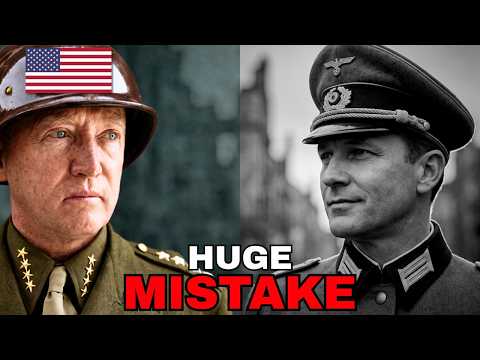
By late 1944, the war was lost for Germany, but the arrogance of its officers remained stubbornly intact. SS Major General Anton Dunckern was the highest-ranking SS officer captured in the sector, and he was certain that his rank still commanded respect. He demanded to surrender to an officer of equal rank, not a lowly sergeant. That demand led him to Patton, the one American general who had built an entire persona for exactly this moment.
Patton had a theory: the arrogance of German officers was the last thing holding their army together. Destroy the myth, and the tanks stopped mattering. So he built a myth of his own—lacquered helmet, ivory-handled pistols, a riding crop, and a studied mastery of crowd psychology. He was a living legend, and he knew exactly how to use it.
When Dunckern stood before him, Patton spoke fluent German but used an interpreter instead. “Negotiating with a man like this directly would have demeaned him,” he later said. Every word Dunckern spoke had to pass through a third party—a small thing that worked like a wall. Patton let him talk first, then used his own expectations against him.
“I have captured a great many German generals,” Patton said through the interpreter. “And this is the first one who has been wholly untrue to everything. Because he has not only been a Nazi, but he is untrue to the Nazis by surrendering.”
Dunckern reached for his only card: “I fought as a soldier. I should be treated as a soldier.” Patton refused to even argue on those terms. “If he wants to say anything, he can,” Patton said. “Unless he talks pretty well, I will turn him over to the French. They know how to make people talk.” He called him a liar and told him that if he’d wanted to die a good Nazi, he’d had his chance—and it would have been a gentler death than the one now coming.
Then, almost as an afterthought, he had the guards take Dunckern outside for a photograph. “Tell him,” Patton added, “that those bayonets on the guards’ guns are very sharp.”
No shouting. No threats delivered like threats. Just a man calmly informed that his rank, his uniform, and his surrender all meant nothing here—and that the only leverage he had left was whether he talked fast enough.
But that kind of control had limits. Weeks after Sicily, American soldiers shot 73 unarmed prisoners near Biscari, later claiming they’d taken Patton’s pre-invasion speeches too literally. An investigation cleared him of ordering it, but not of setting the tone. That same August, he slapped two hospitalized soldiers for cowardice—no interpreter, no careful pacing—and the story nearly ended his career.
Dunckern wasn’t the only officer refusing to admit what he knew. Across the channel, the British housed captured German generals at Trent Park, recording every private word through hidden microphones. Men like General Dietrich von Choltitz described roles in atrocities years before denying them under oath. Dönitz at least lied to Patton’s face. Men like Choltitz didn’t even realize they were confessing.
Patton survived the deadliest war of the 20th century without a scratch. Seven months after Germany surrendered, he was riding to a pheasant hunt outside Mannheim when an army truck turned left in front of his car. The vehicles were barely damaged. Patton wasn’t so lucky. Thrown forward into the partition, his neck broken, paralyzed from the shoulders down, he turned to General Gay beside him. “What a hell of a way to die,” he said. “I think I’m paralyzed.” He was right on both counts. Twelve days later, he died in his sleep.
None of that erases what he actually did. On December 19th, 1944, with the Germans threatening to split the Allied line at the Battle of the Bulge, Eisenhower asked how fast Patton could turn his army north. Every other general was thinking in weeks. Patton’s answer stunned them: “I can attack with three divisions in 48 hours.” Within days, the Third Army had pivoted 90 degrees and moved over 100 miles through the worst winter Europe had seen in years, breaking through to Bastogne on December 26th—exactly a week after that meeting.
By the time Germany surrendered, his Third Army had taken more than 1,250,000 prisoners, among the highest totals of any Allied army in the European theater. And that’s the man who died on a country road outside Mannheim—not from a bullet, not from the war he just finished winning, but from a 2½-ton truck making a left turn.
But here is the part the legend tends to skip. Dunckern did talk. Not because of the bayonets, and not because of the French threat, though both hung in the air of that room like smoke. He talked because Patton had done something subtler than frighten him. He had made surrender itself a betrayal of the thing Dunckern had spent his whole career worshipping. A man who has been told his entire life that he belongs to an elite cannot be broken by pain. He can only be broken by being made to feel he has fallen out of it.
Within days, the interrogators had names. Supply routes. The location of a fuel depot the SS had been quietly moving east. None of it would turn the war. But some of it would save lives, which is the only ledger that ever really mattered.
That was Patton’s real weapon, and it had nothing to do with the ivory grips. He understood that men who have built their identity around rank will defend that identity long after they have stopped defending anything else. You do not defeat such a man by matching his fury. You defeat him by calmly showing him a mirror and letting him see the crack in it.
Yet the same insight that made him lethal in a room made him dangerous everywhere else. The Biscari killings, the slapping incidents—those were not aberrations. They were the same instinct with the brakes off. Patton could not always tell the difference between breaking a myth and breaking a man, and the men around him paid for that blindness in ways the history books tend to footnote.
There is a coda to the Dunckern story that rarely makes the highlight reel. After the war, Dunckern was tried by the French for his role in the deportation of Jews from Metz. He was sentenced to twenty years. He served a fraction of it, released early, and lived quietly in Germany until 1986—a man who had once straightened his spine in front of Patton and insisted on his rank, now reduced to a name in a file cabinet.
Patton never learned how that story ended. He was already gone, thrown forward into a partition on a sunny morning in December 1945, his neck broken by a truck that was barely scratched in the collision. The war that had failed to kill him for four years was replaced by a left turn on a country road.
What survives him is the harder question. Not whether Patton was right to break Dunckern in that room—the war made that necessary—but whether the same tools can be picked up by men who lack his discipline. The mirror that shows a man his own crack is a powerful thing. It does not care who holds it. And the men who learned to hold it in 1944 did not all put it down when the shooting stopped.
That is where the story turns from a portrait of one general into something more uncomfortable. Because the technique worked. The prisoners talked. The depots were found. The myth cracked. And the men who watched Patton do it went home believing they had witnessed something worth repeating.
Some of them did repeat it. In the interrogation rooms of the Cold War, in the police stations of cities nobody in 1944 had ever heard of, the same playbook reappeared—the calm voice, the mirror held up to a man’s own self-image, the quiet suggestion that everything he believed about himself was already a lie. The technique had never belonged to Patton. It belonged to whoever was patient enough to use it.
But patience was the part that rarely survived the trip home. Patton’s gift in that room was restraint—the flat voice, the interpreter as a wall, the bayonets mentioned almost as an afterthought. He had spent years building the machine that could hold that restraint in place. The men who copied him usually kept the menace and dropped the discipline.
There is a reason soldiers who served under him remembered the silence more than the shouting. In the room with Dunckern, Patton barely raised his voice. He did not need to. The uniform, the helmet, the pistols—they had already done the shouting before he ever opened his mouth. All he had to do was stand still and let the legend do its work.
That is the part that is hardest to teach and easiest to fake. A man can buy a helmet and a riding crop. He cannot buy the twenty years of study, the fluency in an enemy’s language, the cold knowledge of exactly which words would land and which would slide off. Strip that away and what remains is a bully in a shiny helmet, and bullies do not crack myths. They only confirm them.
Dunckern, for his part, never understood what had happened to him. In his own account, he had been betrayed by circumstance—captured by a sergeant, insulted by a general, handed to the French. He died still believing he had been a soldier among soldiers, which is precisely the fate Patton had designed for him: not to be broken, but to be made irrelevant, to spend the rest of his life explaining a rank that no longer existed.
And that, in the end, is the colder lesson of the brewery outside Metz. The SS built men like Dunckern to believe they were untouchable. Patton did not touch him. He simply showed him the door and let him walk through it into a world where nobody was watching anymore.
The war ended. The myth did not. It only changed uniforms.
The myth changed uniforms again and again. It wore a suit in a boardroom, a badge in a precinct, a verified checkmark on a screen. The tools Patton sharpened in that room—the mirror, the flat voice, the patient certainty—never went out of style, because they never had to. They work on anyone whose sense of self is doing all the defending.
But so does the countermeasure, and it is almost embarrassingly simple. Dunckern broke because he had built his entire identity on a rank that a truck driver from Brooklyn could ignore with a cocked pistol. The men who survive the mirror are the ones who never needed the rank in the first place.
Patton understood that better than anyone. He built a legend, wore it like armor, and still knew the difference between the legend and the man—at least on his good days. On his bad days, the armor wore him, and men paid for it. That is the whole warning, compressed into one life: the myth will hold weight, but only if you remember it is a bridge and not a house.
So the next time someone calmly informs you that everything you believe about yourself is a lie, watch what you reach for. If your hand goes to your rank, your title, your uniform—you are already walking into the brewery outside Metz. If it doesn’t, you were never the one being interrogated.
Which one are you—the man holding the mirror, or the man still straightening his spine? Tell me in the comments. I read every one.
Report this article
Select a reason for reporting:






