The photograph looked harmless—two boys, arms around each other, smiling as if the world had never been cruel. But Dr. James Porter knew better. As director of the New England Historical Archive, he had examined thousands of Civil War–era portraits, and genuine smiles were almost unheard of. Yet here they were: a white boy with freckles and a black boy with bright, intelligent eyes, both beaming at the camera in June 1870.
Then he turned the frame over and read the handwritten note: “Samuel and Samuel, brothers in all but name.” Two boys with the same first name. James felt a chill. This was no ordinary family keepsake—it was a secret waiting to be uncovered.
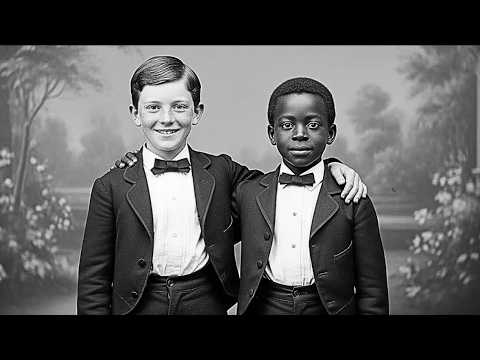
He called Rebecca Chin, a genealogist who specialized in post–Civil War Massachusetts families. Within hours, she sat across from him, her expression troubled. “I found them in the 1870 census,” she said, turning her laptop toward him. “Same household. Samuel Whitmore, age 12, son of Thomas and Elellanar Whitmore. And Samuel Whitmore, age 10—also listed as their son.”
James leaned closer. Two sons with identical first names? That wasn’t just unusual—it was practically unheard of. But the real shock came when Rebecca pointed to the racial designations: one marked W for white, the other B for black. Same last name, same parents, different races.
“Could it be an error?” James asked. “Census takers made mistakes.”
“That’s what I thought,” Rebecca replied. “But I found birth records. Samuel Whitmore, white, was born in Boston in 1858 to Thomas and Elellanar Whitmore. Thomas was a shipping merchant—fairly wealthy. But there’s no birth record for a second Samuel in that family.”
She paused, then pulled up another document. “However, in the Freedmen’s Bureau records from 1865, there’s a registration for a boy named Samuel, age 5, listed as an orphan. His parents, James and Ruth, had been enslaved in Virginia and died shortly after emancipation. The boy was brought to Boston by a relief organization.”
James sat back, stunned. “So the Whitmores took in this orphaned black child and gave him their own son’s name?”
“It appears so,” Rebecca said. “But why? In 1865 Boston, there were orphanages, charitable institutions. Why would a wealthy white family not only take in a black orphan but give him the same name as their biological son?”
James looked again at the photograph—the two boys, their easy familiarity, their genuine smiles. “We need to find out what happened to them,” he said. “Where did they go? Did they stay together?”
Rebecca nodded, but her eyes held a warning. “I’m already searching. But James, there’s something else.” She opened another file. “A newspaper article from 1866. It’s brief, but it mentions Thomas Whitmore being investigated for harboring a fugitive. The charges were dropped, but the article hints at controversy surrounding his household.”
“A fugitive?” James frowned. “The war was over by then. Who would they be harboring?”
“That’s what we need to find out,” Rebecca said quietly. She looked at the photograph once more. “Those boys are hiding something. Something that made it necessary for them to share a name. And I think it might have saved one of their lives.”
James felt the weight of her words. The smiling portrait now seemed less like a family memento and more like a carefully constructed shield. Whatever secrets the two Samuels held, they had been buried for over a century—until now.
Rebecca spent the next week diving deep into the Whitmore family history. What she discovered painted a picture of a family far more complex than initial records suggested. Thomas Whitmore had inherited his shipping business from his father in 1855. The company transported goods along the Atlantic coast—cotton, tobacco, manufactured items. During the 1850s, the business had been profitable, but not exceptional. Then came the Civil War.
“Look at this,” Rebecca said, spreading documents across the archives research table. James leaned in to examine a series of business ledgers she’d obtained from the Massachusetts Historical Society. “In 1861, Thomas’s shipping company started transporting different cargo—medical supplies, weapons, food for Union troops. His profits increased dramatically. But here’s what’s interesting.” She pointed to a handwritten notation in the margin of one ledger from 1863: Special cargo, night transport, no manifest.
“Special cargo with no manifest,” James murmured. “What was he moving?”
Rebecca pulled out another document—a letter from 1864, written in faded ink on thin paper. “This was tucked into the company records. It’s from someone named William, addressed to Thomas. Listen: ‘The package you helped deliver last month arrived safely in Canada. The family sends their gratitude. Three more packages await transport when conditions permit. Your courage serves a greater cause than profit.’”
James felt his breath catch. “He was part of the Underground Railroad. Even during the war, he was helping people escape.”
“Not just during the war,” Rebecca said. “I found records suggesting he continued helping black families relocate even after 1865—which is when Samuel the Younger enters the picture.” She laid out a timeline on the table. “Samuel Whitmore, the biological son, was born in 1858. In 1863, when he was five, Thomas’s wife, Elellanar, became involved with the Boston Ladies’ Freedman’s Aid Society. She helped organize relief efforts for formerly enslaved people arriving in the city.”
“So they had experience working with freed families,” James said.
“More than that,” Rebecca replied. “I found a journal entry from Elellanar dated March 1865. She wrote: ‘Today we received word that James and Ruth, whom we helped reach Boston last autumn, have both passed from consumption. They leave behind a son, not yet six years old, alone in a world that sees him only as a burden. I cannot stop thinking about that child. Thomas says we must consider carefully, but my heart knows what we must do.’”
James read the entry again. “So they knew Samuel’s parents. They had helped them escape. And when the parents died, they took in the child.”
“But here’s where it gets complicated,” Rebecca said. “I found court records from May 1865. Thomas and Elellanar filed papers to become legal guardians of the boy, but the petition was denied.”
“Denied? Why?”
Rebecca pulled out the court document. “The judge wrote that while he commended the Whitmores’ Christian charity, he could not approve a permanent arrangement that would place a negro child in a white household ‘as if he were a natural son.’ He suggested they place the boy in an institution designed for colored orphans.”
“But they didn’t,” James said, looking at the photograph.
“No, they didn’t. And that’s when things get really interesting.” Rebecca opened her laptop. “I found a second birth record for Samuel Whitmore filed in June 1865, claiming he was born in Boston in 1860 to Thomas and Elellanar Whitmore. It’s a forgery—the paper is different, the handwriting doesn’t match other official documents from that year—but it was entered into official records.”
James stared at her. “They created a false identity for him. They made him legally their son by backdating his birth, and they gave him the same name as their biological son.”
“Samuel Whitmore became the legal identity of two different boys,” Rebecca said. “And somehow they made it work for years.”
James discovered the next crucial piece while researching school records from 1860s Boston. He found enrollment records for the prestigious Beacon Hill Academy, a private school for wealthy families’ children. Samuel Whitmore was enrolled in 1868. Just one Samuel. No distinction made. But attendance records told a different story.
James spread them out for Rebecca to see. “Look at this. Attendance is marked every day, but the handwriting changes. Sometimes it’s neat and precise. Other times, it’s messier, more childlike. And look at the academic records.”
Rebecca examined the grade books. “The scores fluctuate wildly. One month, Samuel excels in mathematics but struggles with Latin. The next month, it’s reversed. It’s like two different students.”
“Because it was,” James said. “They were taking turns. One week the white Samuel would attend, the next week the black Samuel would go in his place.”
Rebecca sat back, stunned. “But how? Someone would notice.”
“Not necessarily,” James replied. “Look at the class size—40 students. And remember, this was after the war, when Boston society was in flux. There was social pressure to appear progressive, to support education for freed people, but there were limits. A black child couldn’t simply enroll in Beacon Hill Academy. But if he was legally named Samuel Whitmore, son of a respected merchant, and if he only appeared occasionally, with the real Samuel staying home sick those days…”
“…it could work,” Rebecca finished. “Especially if the boys looked different enough that teachers wouldn’t immediately recognize them as different people, but similar enough that no one questioned the identity on paper.”
James pulled out the photograph again. “Look at how they’re dressed. Nearly identical clothing, similar haircuts. They were trying to make the substitution easier.”
Rebecca found more evidence in school records. Letters home from teachers commenting on Samuel’s inconsistent behavior. “Your son seems like two different children some days,” one teacher wrote in 1869. “On some occasions, he is studious and well-mannered. On others, he seems distracted and struggles to follow lessons he previously mastered.”
“The teachers noticed but didn’t understand what they were seeing,” James said.
“Or maybe they did understand and chose not to say anything,” Rebecca suggested. “Boston was complicated in 1870. There were people who genuinely supported equality and people who performed support for social standing. Some teachers might have recognized what was happening and decided to allow it.”
They found more clues in household records. Bills for clothing showed purchases of identical items in different sizes. Medical records showed both boys catching measles in 1868—on different dates, weeks apart, but both listed as Samuel Whitmore.
“They were living two lives with one name,” Rebecca said quietly. “Both boys were Samuel Whitmore when it suited them. They could swap identities, swap opportunities. The white Samuel could stay home while the black Samuel went to school, gaining an education that would otherwise be denied to him. And when situations arose where being white was necessary—certain social events, business meetings with Thomas—the white Samuel would step in.”
James found a diary entry from Elellanar Whitmore dated November 1868. “The boys have adapted to our arrangement with remarkable grace. Young Samuel—our Samuel by birth—shows no resentment at sharing his name and privileges. If anything, he seems to understand the importance of what we are doing. This morning he insisted that his brother attend the mathematics lecture at the academy because ‘Samuel is better at numbers than I am.’ They have begun to think of themselves as one person with two bodies, two faces, two lives. I pray God forgives us for the deception, but I cannot believe it is wrong to give a child a chance at life.”
“They weren’t just protecting him,” Rebecca said. “They were giving him everything—education, social standing, a future—things that would be impossible for a black child in 1870, no matter how intelligent or capable.”
James nodded slowly. “But it was dangerous. If anyone discovered the truth, they’d lose everything.”
“Thomas could be charged with fraud,” Rebecca finished. “The boys could be separated. The black Samuel could be sent to an orphanage—or worse. And the white Samuel would be socially ruined for his family’s deception.”
They sat in silence, contemplating the risk the Whitmore family had taken. Then Rebecca’s phone buzzed. She looked at the screen, and her eyes widened.
“James, I just got an alert on a search I set up. There’s a newspaper article from 1871—just one year after that photograph was taken. The headline reads: ‘Prominent Boston Merchant Accused of Fraud: Identity Scheme Exposed.’”
Rebecca read the article aloud: Thomas Whitmore was accused of forging birth records and passing a black orphan as his son. “The trial began in April 1871,” she said. “Both boys testified. The white Samuel called the black Samuel his brother. The black Samuel said he wouldn’t apologize for accepting the only family he’d ever known.”
James’s throat tightened. “What was the verdict?”
“Guilty of forgery, but only a fine—no jail time. The judge praised Whitmore’s compassion and urged legislators to reconsider the laws.” Rebecca paused. “The social consequences were brutal, though. The academy expelled both boys. Business partners abandoned Thomas. The family lost nearly everything.”
But the story didn’t end there. Rebecca found records from a Quaker school in Cambridge that welcomed both Samuels. They graduated from Harvard in 1882—one in law, one in medicine. The white Samuel became a civil rights attorney; the black Samuel, now Samuel James Whitmore, opened a medical practice serving Boston’s black community.
“They stayed together,” James whispered. “Through everything.”
Sarah Mitchell, curator of the exhibition that now displayed the photograph, watched visitors pause before the two smiling boys. She had added a final panel: “In 1920, the white Samuel said his only regret was that such deception was necessary. But he never regretted his brother.”
What would you have done—follow the law, or follow your heart?
Report this article
Select a reason for reporting:






