The B-29 Superfortress was a marvel of engineering, but its most feared feature wasn’t its bomb load—it was the deadly web of .50 caliber machine guns that could tear enemy fighters apart before they even got close. In the skies over Japan, Japanese pilots learned to dread the sight of those remote-controlled turrets, which seemed to track them with uncanny accuracy. But how did this system work, and why was it so effective?
At the heart of the B-29’s defensive prowess was a revolutionary integrated gun system designed by General Electric. Unlike traditional bombers where gunners manually aimed and fired, the B-29’s turrets were electrically powered and controlled by analog computers. These computers, weighing around 125 pounds each, calculated ballistic solutions accounting for bullet drop, deflection, lead, and even parallax—the difference between the gunner’s sight and the turret’s position, which could be up to 41 feet away. This meant that when a gunner aimed at an attacking fighter, the computer automatically adjusted the guns to ensure accurate fire.
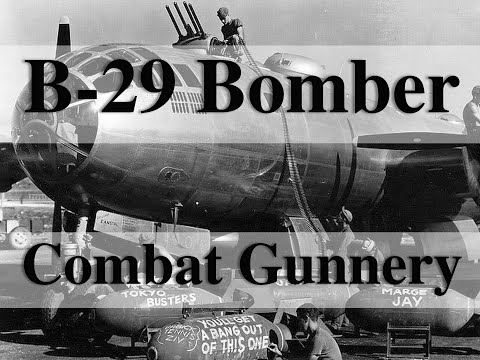
The B-29 was armed with twelve Browning M2 .50 caliber machine guns mounted in five turrets, plus a 20mm tail cannon that was later removed due to weight and ballistic inconsistencies. Each gun was fed by 500 rounds of armor-piercing incendiary ammunition—no tracers, to avoid giving away the bomber’s position. The gunners, stationed at five sighting stations, used optical pedestal gun sights with gyroscopes and position sensors to feed data into the computer. They would dial in the wingspan of the expected enemy fighter—memorized values like the 39-foot wingspan of a Japanese Zero—and track the target by framing its wingtips with the reticle’s outer ring.
“The effective range of the B-29 gun system was 900 yards, while most enemy fighters could only effectively fire from 400 yards,” giving the bomber a 500-yard firing advantage. This meant B-29 gunners could open fire first, often disrupting enemy attacks before they even got in range. The system also allowed a single gunner to control up to three turrets simultaneously, and with 21 different sighting station-turret combinations, the B-29 could adapt to any threat direction.
One of the most common attack directions was head-on, accounting for 46% of interceptor attacks. To counter this, the forward upper turret was modified to carry four guns instead of two, adding 880 pounds of weight and requiring an 1,800-pound reduction in bomb load to maintain range. But the trade-off was worth it: the additional firepower made head-on attacks suicidal for Japanese pilots.
The gun system’s effectiveness was not just about technology—it was also about crew training and coordination. The fire control officer could assign turret control to any gunner, and the gunners used a standardized procedure: call out the threat, dial in the wingspan, track the target, and fire in short 1-2 second bursts when in range. The gunsight even had flip-down sky filters to help against bright skies, and the gunners were instructed to keep both eyes open and maintain a sight base of 2 inches.
But perhaps the most telling statistic is the kill ratio. B-29 gunners were credited with destroying 969 Japanese fighters while losing only 83 bombers to air-to-air combat—a kill ratio of 11.7 to 1. That’s even better than the P-51 Mustang’s 11 to 1 ratio. However, this impressive figure comes with a caveat: by the time the B-29s were deployed, the Japanese pilot corps had been decimated by battles like Midway and the Philippine Sea, leaving many interceptors with inexperienced pilots.
Still, the B-29’s gun system was a technological leap that gave American crews a fighting chance in the hostile skies of the Pacific. And as the war progressed, the system’s reliability only improved—by August 1945, gun system failures were down to just 1.2% per mission. But how did this system perform in the heat of battle, and what were its limitations? Stay tuned as we dive deeper into the stories of the men who operated these deadly machines.
To understand the true effectiveness of the B-29’s defensive system, it’s essential to look beyond the raw kill ratios and examine how the gunnery system performed under actual combat conditions. The analog computers, while advanced for their time, required constant input from the navigator—barometric altitude, indicated airspeed, and outside air temperature—to account for atmospheric effects on the ballistic solution. This human-in-the-loop dependency meant that the system’s accuracy was only as good as the crew’s ability to keep those parameters updated during the chaos of an engagement.
The gunners themselves operated under physical constraints that are hard to appreciate today. At the side blister stations, the gunner’s field of view was limited to 60 degrees up, 90 degrees down, and 105 degrees to either side. The tail gunner, isolated in his own pressurized compartment, had similar restrictions. Yet these sighting station limits were deliberately designed to exceed the turret’s arc of travel, allowing gunners to track interceptors even as the turrets reached their mechanical stops. The forward upper turret could rotate a full 360 degrees and elevate 90 degrees up, while the tail turret was far more restricted—only 30 degrees in any direction.
“Converging crossfire of the forward upper and lower turrets occurred at 200 yards,” a deadly overlap zone that turned head-on attacks into a lethal gauntlet. But the system had its quirks. The upper turrets retained their spent cartridges and metal links, while the lower and tail turrets jettisoned them overboard. Fire cut-off interruptors and cam-following features prevented gunners from shooting their own aircraft—except, notably, the bomb bay doors, which had no such protection.
By mid-1945, the diminishing fighter threat led Bomber Command to strip some B-29s of their forward turrets entirely, loading only the tail, aft upper, and aft lower turrets. This was a calculated gamble born of necessity: with Japanese pilot quality in freefall and fighter escorts available from Iwo Jima after April 1945, the extra guns and ammunition were sometimes more valuable as weight savings for bombs and fuel. Escorted missions saw bomber losses drop by an estimated 20 to 30%, further reducing the need for all-around defensive firepower.
Yet the gunners’ discipline remained remarkable. In a March 1945 engagement summary, Japanese fighters opened fire on bombers in only 43% of encounters, while B-29 gunners opened fire in 83%. More tellingly, 58% of Japanese interceptors started shooting from beyond 1,000 yards—a sign of poor training and desperation rather than tactical acumen. The B-29’s 900-yard effective range meant that many of those long-range Japanese shots were wasted, while the bomber’s computer-aimed bursts found their mark.
The August 14, 1945 mission summary—flown just five days after Nagasaki—showed a gun system failure rate of only 1.2%, a testament to the ruggedness of the General Electric design and the skill of the ground crews who maintained it. But even as the system reached peak reliability, the war was ending, and the B-29’s most iconic missions would be remembered not for their gunfights but for their bomb loads.
For the crews who flew those missions, the gun system was more than a technical marvel—it was a psychological lifeline. The knowledge that an unseen computer was constantly calculating lead and parallax, that the turrets could snap onto a target in seconds, and that enemy fighters had to brave a 500-yard firing disadvantage gave bomber crews the confidence to press on through flak and fighter attacks alike. That confidence was not misplaced, but it was also not unlimited.
The B-29’s defensive system had blind spots. The tail gunner, isolated in his pressurized compartment, could only traverse 30 degrees in any direction—a narrow cone that a skilled pilot might exploit with a high-side diving attack. The side blister gunners could not operate the upper turrets at all, and if the tail gunner was disabled, they had to take over his station remotely, a cumbersome transition under fire. And while the forward upper turret’s 360-degree rotation seemed omnipotent, its guns were useless if the enemy came from below and behind, where only the aft lower turret could reach.
“The B-29 was designed to fight in a three-dimensional bubble, but no bubble is perfect,” one veteran gunner later recalled. “We knew where we were blind, and so did the Japanese. The smart ones—the few who were left—aimed for those blind spots.”
That vulnerability was compounded by the human element. The analog computers were only as good as the data fed into them, and in the violent, freezing air over Japan, the navigator’s atmospheric inputs could lag behind reality. A sudden temperature inversion or an unanticipated wind shear could throw off the ballistic solution by enough to miss a fast-moving fighter. The gunners learned to compensate with experience, leading their targets by feel when the computer’s solution felt wrong, but such improvisation was an art, not a science.
Then there was the ammunition. Five hundred rounds per gun sounded generous, but at a cyclic rate of 750 to 850 rounds per minute, a sustained burst could empty a belt in under a minute. Gunners were trained to fire in short 1-2 second bursts, conserving ammunition and avoiding overheating, but in the chaos of a multi-fighter attack, discipline often frayed. The absence of tracers in the ammo mix—deliberate, to hide the bomber’s position—made it harder for gunners to walk their fire onto a maneuvering target. Some crews reportedly begged for tracer rounds, and a few commanders quietly authorized “headlight tracers” to boost morale and accuracy, though the practice remained unofficial.
The ground crews who maintained the system were the unsung heroes of the B-29’s defensive success. Each turret’s gun guts had to be removed, cleaned, and reinstalled after every mission—a back-breaking job performed in the tropical heat of the Marianas or the bitter cold of forward bases. The M2’s casing group stayed with the turret, but the barrels, bolts, and recoil springs were hauled out, scrubbed, oiled, and tested. A single jammed gun could mean the difference between a fighter driven off and a bomber going down, and the armorers knew it.
By the war’s final months, the B-29’s gun system had evolved into something its designers might not have recognized: a stripped-down, mission-optimized configuration that reflected hard-won combat lessons. Some bombers flew with only three turrets loaded, their forward guns removed to save weight and drag. Others carried the full twelve-gun arsenal, their crews still scanning the skies for a threat that was fading with each passing week.
But the story of the B-29’s defensive system is not just a story of technology and tactics. It is a story of the men who sat in those sighting stations, peering through optical heads at closing fighters, their hands steady on the handwheels, their thumbs hovering over the trigger. It is a story of split-second decisions, of bursts fired and targets framed, of computers humming and turrets slewing. And it is a story that would be tested one final time, in the skies over Hiroshima and Nagasaki, where the B-29’s guns would fall silent—not because they were ineffective, but because the war had changed in ways no gunner could have imagined.
In the end, the B-29’s defensive system was a product of its moment—brilliant, complex, and built for a war that was already slipping away. The kill ratio of 11.7 to 1 remains a testament to American engineering and crew skill, but it was earned against a broken enemy, not a peer adversary.
“We were lucky,” one gunner admitted decades later. “Lucky the Japanese ran out of good pilots before we ran out of bombers.”
That honesty cuts deeper than any statistic. The B-29’s guns were never truly tested against the best the enemy had—and perhaps that is the most important lesson of all.
What do you think—was the B-29’s gun system a genuine revolution, or simply a well-timed advantage? Share your thoughts below.
Report this article
Select a reason for reporting:






