In the dimly lit attic of a sealed Charleston mansion, historical preservationist Dr. Sarah Mitchell shivered—not from the February cold, but from the dirt-covered canvas Marcus held. “Dr. Mitchell, you need to see this,” the young intern whispered. Beneath layers of grime and water damage, the faint outline of a figure emerged. The brass plate read: Portrait, 1870, Charleston. No name. No artist. Just a mystery that would consume her.
Sarah’s trained eye recognized the expensive wood frame, the skilled brushwork barely visible through the decay. “Someone paid serious money for this,” she murmured. In 1870 Charleston—just five years after emancipation—such luxury was unthinkable for most, impossible for a Black woman. Yet something in her gut screamed that this painting held a story worth fighting for.
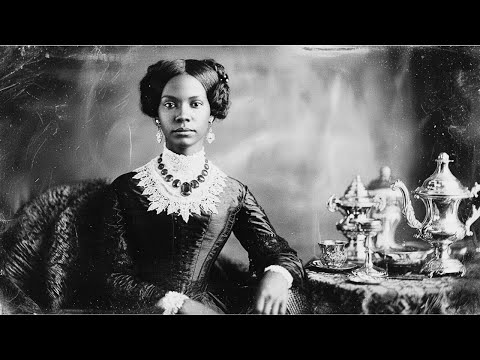
Back at the Smithsonian, Sarah secured approval for cutting-edge AI restoration software from MIT. “It doesn’t invent details,” explained Dr. Jennifer Chen. “It reconstructs what was most likely there.” Sarah watched, breath held, as brown stains faded and cracks dissolved like fog lifting from a forgotten road.
Then the face appeared—a young Black woman, no older than twenty-five, dressed in deep burgundy lace, an emerald necklace blazing at her throat, pearl pins in her elaborate hair. Her posture was regal, her gaze direct and unflinching.
“This can’t be right,” James stammered. “Check the calibration.”
“The calibration is perfect,” Jennifer replied. “The AI is showing exactly what was painted.”
Sarah’s mind reeled. A wealthy Black woman in Reconstruction-era Charleston? It should have been impossible. “Who was she?” Marcus asked quietly. Sarah stared at those knowing eyes. “I don’t know,” she said. “But I’m going to find out.”
Two weeks in the archives led Sarah to a legal notice from March 1869: the Beaumont mansion had been purchased by the Freeman Trust, “established for the benefit of formerly enslaved persons.” The administrator’s name: Miss Elizabeth Hayes, formerly of the Beaumont household.
A former enslaved woman had bought her owner’s mansion. Sarah’s hand trembled as she wrote the name. But standard databases held nothing—Elizabeth had been erased. “That’s not unusual,” explained historian Dr. Angela Roberts. “Many records of Black lives were destroyed, especially for people who threatened the white power structure.”
Yet traces remained. A venomous 1869 editorial in the Charleston Daily News: “This affront to decency and the natural order shall not stand unopposed.” A letter from Margaret Beaumont to her cousin: “The house has been purchased by Elizabeth. Yes, mother’s former ladies’ maid. How she obtained such funds remains a mystery that torments me nightly.”
Sarah booked a flight to Charleston. In the county archives, archivist Thomas Wright helped her trace Elizabeth’s empire: four properties, a dry goods store, a boarding house—all bought between 1867 and 1870. “Where would she get that kind of money?” Sarah wondered aloud.
Thomas leaned back. “There were rumors about enslaved people hiding valuables during the war. Confederate gold, family jewelry. She worked in that house her whole life. She would have known every secret.”
Sarah felt the pieces click. Elizabeth had stayed behind when the Beaumonts fled in 1865. She had four years to search every corner—and she had asked questions. Too many questions.
Robert Beaumont’s diary confirmed it. In 1864 he had written of taking “precautions to secure family assets,” noting that his wife knew nothing of the details—“Only I possess knowledge of the location.” Then came April 1865, in a shaking hand: “Charleston fallen. Everything is lost.” No further entries. He died that August, possibly by his own hand.
Sarah found the final proof in a property inventory from 1869. At the bottom, a handwritten note: Multiple items of value previously recorded in family ledgers could not be located. Estimated loss, $15,000–$20,000. Elizabeth had found the hidden fortune. She had taken what the Beaumonts had stolen from generations of enslaved people and turned it into something else entirely.
But records alone could not tell Sarah who Elizabeth was. Through Thomas’s connections, she was introduced to Dorothy Hayes, an elderly woman living on James Island. “My great-great-grandmother was named Elizabeth,” Dorothy said. “Family stories say she did something remarkable, but the details were always vague. My grandmother said it was safer not to talk about it.”
Sarah asked why. Dorothy’s eyes grew distant. “Because white folks didn’t like it when Black people got ahead. Night riders. Threats. Violence. Elizabeth had to be careful, very careful.”
Then Dorothy reached into a drawer and pulled out a small wooden box. Inside lay a faded tintype and a folded letter. Sarah’s hands trembled as she recognized the face. “That’s her,” she whispered. “That’s Elizabeth.”
The letter, dated 1872, was written in elegant script: My dear niece Rebecca, I have purchased your freedom papers and those of your children. Come to Charleston immediately. What I have built, I have built for us all. Fear only remaining in bondage when freedom awaits. Your aunt, Elizabeth.
“She bought 17 family members out of debt servitude,” Dorothy said, smiling through tears. “Brought them here. Helped them start businesses. That’s why we’re still here.”
Back in Washington, Sarah now knew what to search for. The newspapers of 1870–1875 painted a portrait of defiance. One editorial from August 1871 dripped with venom: “The Negro woman Hayes continues her presumptuous occupation of the Beaumont mansion, entertaining other Negroes in a grotesque mockery of civilized society… This inversion of the natural order cannot be tolerated indefinitely.”
Elizabeth’s own letters revealed the cost of that courage. To her attorney, Samuel Rhodes, in September 1871: “Last night men on horseback circled the property, firing guns and shouting threats. This is the third such occurrence this month. I have hired guards and refused to be intimidated, but I confess concern for the safety of the children.”
Sarah found testimony from a congressional investigation into Klan violence in South Carolina. One anonymous witness described a planned attack on “the uppity colored woman in the big house who thinks she’s white folk.” The attack never came. Elizabeth had hired Union Army veterans—Black and white—as security. She had cultivated Republican politicians. She had made herself too visible, too protected to strike without consequence.
“She survived through courage and strategy,” James observed. But if Elizabeth had been so formidable, why had her story vanished?
The answer lay in the Compromise of 1877. Federal troops withdrew. White Democrats reclaimed power through what they called redemption. A chilling article from November 1876 announced: “The Beaumont property has been returned to the Beaumont family, righting a grievous wrong perpetrated during the dark days of radical Republican rule.”
Sarah pulled the property records. In December 1876, the mansion was transferred back to Margaret Beaumont’s daughter for one dollar. Elizabeth’s other holdings were stripped through deeds declared invalid and titles challenged—legal fraud backed by the threat of violence.
And Elizabeth herself? The 1880 census placed her in Philadelphia, age thirty-eight, occupation: domestic servant. She had lost everything and fled north.
Sarah sat back, the weight of it pressing on her chest. The Beaumonts had hidden the portrait in the attic not out of carelessness, but calculation. They wanted Elizabeth erased. For 145 years, they had succeeded.
Until now. Sarah looked at the restored image on her screen—the emerald necklace, the pearl pins, the unflinching gaze—and understood what she had to do next.
The press conference was set for a Thursday morning in the Smithsonian’s main hall. Sarah had barely slept, rehearsing her words while the portrait—now fully restored and mounted in a simple black frame—watched her from the corner of her living room like a patient ancestor waiting to be heard.
Dorothy Hayes arrived with fourteen family members in tow, their faces carrying a mixture of pride and apprehension. Some had driven through the night from Charleston. One great-great-grandson, a college student named Elijah, kept staring at the portrait with tears streaming silently down his cheeks. “I wrote my thesis on Reconstruction,” he told Sarah. “I never knew. My own family, and I never knew.”
Sarah stepped to the podium, her voice steady but raw. She told them about the AI restoration, the hidden fortune, the Freeman Trust. She told them about the night riders and the hired guards, the one-dollar deed transfer and the Philadelphia census entry. “They buried her,” Sarah said, “but they couldn’t bury what she built. Every descendant in this room is proof of that.”
The story exploded. Within a week, the portrait was on the front page of the New York Times. Historians who had spent careers studying Reconstruction called Sarah’s discovery a watershed. “We knew Black wealth existed during this period,” one Yale professor told a reporter. “But to have the face, the name, the documents—it’s unprecedented.”
Then the letter arrived. It came to Sarah’s office in a plain white envelope with no return address, postmarked from Savannah. Inside was a single sheet of aged paper, folded three times, the ink faded but legible. The handwriting was different from Elizabeth’s—looser, more hurried.
Dear Miss Mitchell, the letter began. I read of your discovery in the newspaper. I believe I possess something that belongs with Elizabeth Hayes’s story. My family has kept it for generations, though we never understood its meaning until now. Please come to Savannah. Ask for the descendants of Rebecca Hayes.
Rebecca Hayes. The niece Elizabeth had purchased out of bondage. Sarah’s pulse quickened. She called Dorothy immediately. “There are more of us?” Dorothy asked, her voice cracking. “There were always more of us,” Sarah replied. “We just didn’t know where to look.”
Three days later, Sarah sat in a modest Savannah living room across from an elderly woman named Constance Hayes-Miller, Rebecca’s great-granddaughter. On the coffee table between them lay a leather-bound journal, its spine cracked with age. “This was Elizabeth’s,” Constance said. “Rebecca kept it until she died. She said it was the only thing that proved what they’d done to us.”
Sarah opened the journal carefully. The first entry was dated January 1866—three years before Elizabeth purchased the Beaumont mansion. The handwriting was shaky, uncertain. I have found the place beneath the root cellar. Mr. Beaumont’s strongbox. I have not opened it yet. I am afraid. But I am more afraid of remaining what I have always been.
Sarah turned the pages, her hands trembling. Elizabeth had documented everything—the gold coins, the jewelry, the Confederate bonds. She had inventoried every item, hidden it in stages, waited patiently as the Beaumonts crumbled. And then, in 1869, she had walked into a bank and opened an account in her own name.
But it was the final entry, dated October 1876, that made Sarah’s breath catch. They are coming for the house. I have three days, perhaps four. I have hidden what I can. The rest I will carry with me. They think they have taken everything, but they have not. What I know, what I have written here, cannot be taken. One day, a woman will come looking. She will find this journal, and she will tell our story. I do not know her name, but I know she will exist.
Sarah closed the journal and looked at Constance, tears blurring her vision. “She knew,” Sarah whispered. “She knew someone would come.”
Constance nodded slowly. “My grandmother said Elizabeth always believed the truth would out. Even when they burned her buildings and stole her deeds, she said the truth was the one thing they couldn’t take.”
Sarah thought of the portrait in Washington, the attic in Charleston, the tintype in Dorothy’s wooden box. Elizabeth had scattered her story across a century and a half, trusting that the pieces would eventually find each other.
“There’s more,” Constance said, reaching beneath the coffee table and pulling out a small velvet pouch. She loosened the drawstring and tipped it into her palm. A single emerald, large and flawless, caught the lamplight. “She left this with Rebecca. She said it was the only piece of jewelry she’d kept for herself. She wanted it to go to the woman who finally told the truth.”
Sarah stared at the stone, the same one that blazed at Elizabeth’s throat in the portrait. The emerald seemed to pulse with a life of its own, a green fire that had survived slavery, Reconstruction, Jim Crow, and a century of silence.
“I can’t take this,” Sarah said.
Constance pressed it into her hand. “Elizabeth wanted you to have it. She knew someone would come looking. She just didn’t know it would take this long.”
Sarah curled her fingers around the emerald, feeling its weight, its history. She thought of the portrait’s unflinching gaze, the journal’s final entry, the seventeen family members Elizabeth had purchased from bondage. She thought of the attic where the Beaumonts had hidden her, and the press conference where her descendants had finally seen her face.
“What happens now?” Constance asked.
Sarah looked up, her jaw set. “Now we find the rest of her. The journal mentions other papers, other hiding places. There are still missing pieces.”
Constance smiled, a slow, knowing smile that reminded Sarah of the portrait. “Then I suppose you’d better get back to work, Dr. Mitchell.”
That night, Sarah sat alone in her hotel room, the emerald on the desk beside Elizabeth’s journal. She opened her laptop and began a new search—this time for the names mentioned in the journal’s pages, the other trustees, the businesses Elizabeth had founded, the family members she had scattered across the country.
The story wasn’t finished. It was only beginning.
Sarah returned to Washington with the journal scanned, the emerald secured in the Smithsonian’s vault, and a new name circled in her notebook: Reverend Morris Jackson. The other trustee. The one who might have known where Elizabeth hid the rest.
Two months later, a package arrived from a church archive in Baltimore. Inside: a letter from Jackson to Elizabeth, dated 1877. “They have taken the house, but they cannot take what we built in the hearts of our people. I have kept the records as you asked. When the time is right, they will speak.”
Sarah read it twice, then smiled at the portrait on her wall. Elizabeth had planned for everything—even the silence.
What other secrets do you think are still waiting to be found?
Report this article
Select a reason for reporting:






