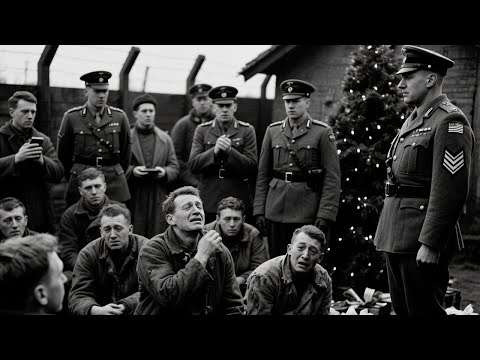
Oklahoma, December 1944. The barracks at Camp Gruber stood dark and silent, breath visible in the cold air, frost creeping across windows like memory. Inside, 300 German prisoners lay awake, listening to the wind rattle through the pines. They expected nothing. Christmas had been dead for them since North Africa, since capture, since the world reduced itself to wire fences and guard towers.
But at midnight, they heard footsteps and voices singing in English, then light flooding through the doorways—warm and impossible. What followed would break something inside these men: not their spirits, but their certainty about who their enemies were.
Among them was Klaus Becker, 26, a former Africa Corps soldier captured in Tunisia 18 months earlier. He had survived Rommel’s retreat, the desperate stands, the ship across the Atlantic, and now the strange, suspended reality of a camp in Oklahoma where the sky was too big and the food too plentiful. He had learned that hope was dangerous. So when the lights flickered on at 11 p.m. and Sergeant James Wilson—a 42-year-old guard from Tulsa—called them out into the freezing night, Klaus felt only confusion.
They filed outside, shivering in the floodlight beams. The recreation building glowed with warm light, and from inside came the unmistakable sound of a Christmas carol. The doors opened, and Klaus saw a fully decorated tree, paper chains, and tables covered with food.
Sergeant Wilson stepped forward. “Gentlemen,” he said, his breath clouding, “it’s Christmas Eve. We know you’re far from home. Tonight, for a few hours, we want to give you Christmas—not as Americans, not as guards, just as men who understand what it means to miss home.”
Silence held for a long moment. Then, slowly, the prisoners began to move forward.
Klaus entered with the third group. Inside, the room had been transformed. A 12-foot pine tree stood in the corner, decorated with wooden ornaments and a tin-foil star. American soldiers held songbooks and began to sing “Silent Night.” After the first verse, a German prisoner joined in, then another, until the room filled with two languages intertwining.
Klaus felt something break inside his chest—not his spirit, but the wall he had built between himself and feeling. He took a cookie, bit into it, and tasted butter and cinnamon from someone’s kitchen in America. Tears welled in his eyes without warning. Around him, other grown men were crying too, weeping into cookies while American guards looked away to grant them privacy.
Hans Müller, a carpenter, touched the wooden ornaments with careful fingers. Friedrich Weber, a schoolteacher, read aloud the lyrics to “O Tannenbaum,” his voice breaking on familiar words. Otto Schmidt ate apple pie with focused intensity, as if tasting his mother’s kitchen.
For one hour, they were not prisoners. They were men remembering Christmas.
When the hour ended, Klaus stepped back into the cold and looked once at the lit window, at the tree glowing behind the glass. He felt something he had not felt in years: gratitude. Not for captivity, not for war—but for this. For a moment, this unexpected kindness had reminded him that humanity could survive even when everything else was stripped away.
The rotations continued through the night. Group after group entered the recreation building and emerged changed in ways they could not articulate. By dawn, all 300 prisoners had passed through, and the exhausted guards stood in the gray light with the quiet satisfaction of men who knew they had witnessed something important.
Christmas Day itself was quieter. The prisoners returned to routine, but the heavy resignation that had shadowed their months was gone. They moved more easily, spoke more freely with guards who no longer seemed quite so much like enemies. The atmosphere of the camp had shifted, subtly but unmistakably.
Klaus spent the day writing letters. He wrote to his mother, though he did not know if she would ever receive it, describing the pine forests of Oklahoma and the American guards who had put up a Christmas tree for German prisoners. He wrote to his sister about the cookies and the carols, about enemies singing together in different languages to the same melody.
“I don’t know what this means,” he wrote. “I don’t know if it changes anything about the war or about going home. But it changed something in me. I had forgotten that people could be kind just for the sake of kindness.”
He sealed the letters knowing they might never be delivered, but writing them anyway, because the act itself mattered—the reaching out across distance and uncertainty and the fog of war that separated him from everyone he had ever loved.
In the guards’ quarters, Sergeant Wilson sat with Captain Morris and the others who had organized the night. They drank coffee and spoke in low voices about what they had seen: the tears, the singing, the transformation of a military building into something approaching sacred space.
“I didn’t expect the crying,” Wilson admitted. “Grown men breaking down over cookies and Christmas trees.”
Morris nodded slowly. “That’s what happens when you remind people they’re human. These men have been living in survival mode for months, maybe years. Then suddenly we give them beauty, kindness—all the things that make life worth living rather than just surviving. Of course they cried. What else could they do?”
One of the younger guards asked whether it really mattered. They were still prisoners. The war was still on. Tomorrow everything would go back to normal.
“It mattered,” Wilson said with certainty. “Maybe not in ways we can measure. But we showed them—and maybe reminded ourselves—that even in war, humanity is a choice we can make.”
The weeks that followed saw subtle changes at Camp Gruber. The relationship between guards and prisoners remained professional, bounded by regulations, but an undercurrent of mutual respect had taken root. Prisoners worked more cooperatively. Tensions diminished, replaced by something approaching peaceful coexistence.
The war, of course, continued. News filtered in about the Battle of the Bulge, about Allied advances, about cities falling and lines shifting. The prisoners remained spectators to their own history, waiting to learn what would become of them when the shooting finally stopped.
But something had changed for them that Christmas Eve. They had been given recognition—that they were men, not just enemy soldiers, that they carried losses and memories and hopes just like anyone else. Recognition that even in the machinery of war there was room for the kind of basic human kindness that makes life bearable.
Then, in early January, a new group of prisoners arrived from a transit camp in France. Among them was a young lieutenant, barely twenty-two, who had been captured during the Ardennes offensive. His name was Werner Hoffmann, and he carried with him the hardened bitterness of a man who had seen friends die in the snow and had expected nothing but cruelty from his captors.
Klaus watched him arrive—the rigid posture, the suspicious eyes, the way he refused to meet anyone’s gaze. He recognized it instantly. It was the same wall he himself had built, the same armor against hope.
That evening, Klaus sat down beside the new arrival in the barracks. “You expect nothing from them,” he said quietly in German. “That is wise. But let me tell you about Christmas Eve.”
Werner looked at him with wary disbelief as Klaus began to speak of the tree, the carols, the cookies baked by American wives, the guards who had looked away to grant grown men their privacy while they wept. He spoke of two languages finding harmony, of enemies choosing kindness when cruelty would have been easier.
When Klaus finished, Werner was silent for a long moment. Then he asked, his voice rough, “Why are you telling me this?”
“Because you need to know,” Klaus said. “Not everything they told us about our enemies was true. And not everything this war has made us believe about ourselves has to stay true either.”
Werner stared at the thin mattress, the wool blanket, the frost on the window. “You are telling me the Americans gave you Christmas.” His voice carried the flatness of a man testing a story for cracks. “Why? What did they want?”
Klaus shook his head slowly. “Nothing. That is the part I cannot explain, even to myself. They wanted nothing.”
For days afterward, Werner watched the guards the way a man watches a dog he has been told is friendly but has seen bare its teeth. He noted the small courtesies—the guard who nodded at him during roll call, the cook who slipped an extra piece of bread onto his tray without comment. He distrusted all of it. Kindness, he had learned in the Ardennes, was often just cruelty waiting for the right moment.
But the moment did not come. The weeks passed, and the camp settled into its quiet rhythms of work and waiting, and still no cruelty arrived to justify his suspicion.
In late January, Colonel Henderson summoned Sergeant Wilson to his office. The commandant sat behind his desk with a letter in his hand, and his expression was difficult to read.
“I received a communication from the provost marshal’s office,” Henderson said. “It seems word of your Christmas Eve gathering has traveled. A newspaper in Tulsa ran a small item. Nothing inflammatory—just a description of the event. But it has attracted attention.”
Wilson felt his stomach tighten. “What kind of attention, sir?”
“The kind that comes with a congressional inquiry.” Henderson set the letter down. “A representative from Oklahoma has requested an explanation of why enemy prisoners were given a celebration at taxpayer expense. He is asking whether regulations were violated and whether disciplinary action is warranted.”
Wilson stood very still. He had known this was possible, had weighed the risk when he first approached the colonel. But knowing a thing might happen and hearing that it had were different burdens entirely.
“Sir, the funds came from donations, not the military budget. The chaplain arranged most of it. The tree was donated. The cookies were baked by officers’ wives. No regulations were violated.”
Henderson nodded slowly. “I am aware. I approved it, and I stand by that approval. But I wanted you to know what we are facing. There may be interviews. There may be questions asked of you directly. I need to know that you can answer them calmly and truthfully.”
“I can, sir.”
“Good.” Henderson picked up the letter again, studying it as though it might reveal something new. “For what it is worth, Sergeant, I do not regret permitting it. I have been in this army for thirty years, and I have learned that the regulations exist to serve decency, not to replace it. What you did was decent. If Washington wishes to make an issue of decency, then Washington will have to explain itself to the American people.”
Wilson left the office with a strange mixture of dread and resolve. The inquiry might come to nothing. It might cost him his rank, his pension, his reputation. But standing in the cold outside the headquarters building, watching his breath cloud and dissolve, he found that he did not regret it either.
That evening he wrote to Margaret, telling her what had happened. Her reply arrived a week later, brief and fierce: “If they punish you for kindness, then let them. I would rather be married to a man who gave Christmas to prisoners than to a man who did nothing and kept his rank.”
He folded the letter and kept it in his breast pocket, close to his heart.
The inquiry came in February, conducted by a major from the inspector general’s office named Ellsworth, a thin, precise man with spectacles and a manner that suggested he had already formed his conclusions and was merely gathering evidence to support them.
He interviewed Colonel Henderson first, then Captain Morris, then several of the guards who had participated. Finally, he summoned Sergeant Wilson.
The interview took place in a small office near the camp headquarters, bare except for a table and two chairs. Major Ellsworth sat with a notebook open before him, pen poised.
“Sergeant Wilson, describe for me the events of December 24th and 25th, 1944.”
Wilson described them plainly. The tree, the decorations, the cookies, the singing. He did not embellish or apologize. He stated the facts as they had occurred.
Ellsworth wrote for a long moment. Then he looked up. “Why did you do it?”
“Because it was Christmas, sir. And they are men far from home.”
“They are enemy soldiers.”
“Yes, sir. They are also men.”
Ellsworth studied him over the rims of his spectacles. “Do you believe your actions undermined military discipline? Made the prisoners more difficult to manage?”
“No, sir. The opposite. The camp has run more smoothly since Christmas than at any time I can remember. The prisoners are more cooperative. There have been no incidents.”
Ellsworth made another note, then closed his notebook. “Thank you, Sergeant. That will be all.”
Wilson stood, saluted, and turned to leave. At the door, Ellsworth’s voice stopped him.
“Sergeant.”
“Sir?”
“For what it is worth—and this is off the record—I have a son in the infantry in France. If he were captured, I would hope someone over there would do for him what you did for these men.”
Wilson nodded, not trusting his voice, and stepped out into the cold.
The inquiry ended without finding or punishment. Major Ellsworth’s report concluded that no regulations had been violated and that the event had, if anything, improved camp discipline. The congressman from Oklahoma issued a brief statement expressing continued concern about the use of resources, but the matter faded from public attention as larger events consumed the nation’s focus.
In April 1945, the war in Europe ended. The prisoners at Camp Gruber gathered around radios to hear the news, and the guards stood among them, no longer quite so separate. Klaus Becker stood beside Werner Hoffmann, and neither man spoke for a long time.
The prisoners were repatriated in stages over the following months. On the day Klaus left Camp Gruber, Sergeant Wilson was there at the gate. The two men looked at each other across the distance that had once been enemy lines.
“Thank you,” Klaus said in careful English. “For the Christmas.”
Wilson nodded. “Merry Christmas, soldier. Go home.”
Klaus returned to Munich to find his mother alive, his sister surviving, the city rebuilding from ruins. He told the story of that Christmas for the rest of his life—to his children, his grandchildren, anyone who would listen. And Werner Hoffmann, who had arrived expecting cruelty and found kindness, told it too.
What do you think—can a single act of kindness in wartime truly change anything, or does it only matter to the men who lived it?
Report this article
Select a reason for reporting:






