Sarah Chen had restored thousands of old photographs, but the moment Margaret Williams placed the faded 1931 portrait on her workbench, something felt different. The image showed a perfect family—a well-dressed couple and three children on the steps of a modest house. But as Sarah examined it under her magnifying lamp, her trained eye caught a faint, ghostly face in the upper right corner, partially hidden by shadows. It was unmistakably human.
Margaret, 78, had brought the photo after finding it in her late grandmother Rose’s jewelry box, along with a note: “Never forget.” She had never noticed the extra figure before. When Sarah pointed it out, Margaret’s face went pale. “I’ve looked at this photograph a thousand times,” she whispered. “I never noticed.”
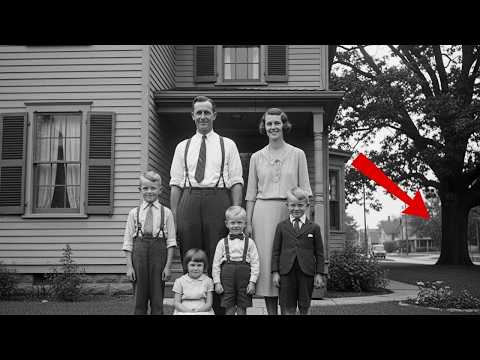
Sarah gently explained that old photos often hide details invisible to the naked eye. She asked if Margaret had any family records. Margaret pulled out her grandmother’s diary and found an entry from October 15, 1931: “Had the family portrait taken today for Henry’s birthday… prayed that Robert would somehow be with us in spirit.” Robert was Rose’s youngest brother, who disappeared in 1929 after the stock market crash, blaming himself for the family’s financial ruin. He left a note saying he would make things right.
Sarah studied the mysterious figure more closely. The facial features—a strong jawline, high cheekbones—matched the other family members. The clothing suggested a dark coat, and the posture seemed guarded, as if the person was trying to stay hidden while still being part of the gathering. “Mrs. Williams, I think we need to do more than just restore this photograph,” Sarah said. “There’s a story here that your family needs to know.”
Three days later, Sarah, Margaret, and Margaret’s nephew David, a journalist, sat in the archives of the Chicago Historical Society. They scoured local newspapers from 1931. Among headlines about bank closures and foreclosures, David found a small article: “Local family reports missing son, Robert Henderson, 24, disappeared from the family home on Elm Street.” Margaret gasped—Henderson was her grandmother’s maiden name.
They kept searching. A December 1931 article revealed that an anonymous benefactor had paid off the Henderson family’s mortgage, saving their farm. “Someone was helping the family,” Sarah observed. “Someone who didn’t want to be identified.”
The next morning, Sarah received a call from Father Timothy McKenzie of St. Mary’s Catholic Church in Milbrook. He had information about Robert Henderson. Within an hour, Sarah and Margaret were driving through the Illinois countryside to the small town. Father McKenzie, who had been pastor for 42 years, led them to his office filled with church records. “Father O’Sullivan, my predecessor, knew Robert,” he said. “Robert didn’t actually disappear. He stayed in town, living in secret, doing odd jobs at night to earn money he anonymously sent to his family.”
He handed Margaret a yellowed envelope—a letter Robert had written to Father O’Sullivan in 1932. “I have managed to save enough money to pay off my family’s debts, but I cannot face them knowing the pain I caused,” Robert wrote. “I will always love them, but I must start a new life where my mistakes cannot hurt them anymore.” Margaret’s hands trembled as she read. “So he was there,” Sarah whispered, thinking of the figure in the photograph. “He was watching his family, protecting them, but couldn’t bring himself to join them.”
Armed with this revelation, Sarah and Margaret spent the afternoon piecing together Robert’s secret life. They visited the local museum, where curator Eleanor Walsh recalled stories of a “mystery benefactor” who left money and groceries for families during the Depression. “People called it the work of an angel,” she said. A photograph of the railroad depot from 1931 sparked an idea—Robert might have worked the night shift. At the county courthouse, they found employment records listing an “R. Hansen” hired in October 1931, just days after Robert’s disappearance. “That’s close enough to Henderson,” Margaret murmured.
Back in Sarah’s studio, digital enhancement revealed the background figure with startling clarity. It was a young man, partially hidden behind an oak tree, wearing work clothes and a cap. “It’s him,” Margaret whispered, tears forming. “It’s Uncle Robert.” But there was more—Robert was holding an envelope thick with papers or money, his expression a mix of love and sadness. “He’s not just hiding,” Father McKenzie observed. “He’s watching his family with such love.” Sarah also spotted a reflection in the window: the photographer, Mrs. Patterson, and an older woman directing her attention toward the tree. The diary entry mentioned Mrs. Patterson, who said, “Family photographs should capture not just who’s present, but who’s in our hearts.”
The final piece fell into place when they visited the former Patterson Photography Studio, now an antique shop run by Mrs. Patterson’s grandson. In a box of 1931 client records, they found a note in the photographer’s handwriting: “Young man observed watching family from distance… Adjusted camera angle and lighting to include him in background without family’s knowledge. Sometimes the camera sees what the heart knows but the mind cannot accept.” Final payment had been received anonymously with a note: “Thank you for including everyone who belongs.” Margaret began to cry softly. “She knew,” she said. “The photographer knew Robert was there and made sure he was part of the family portrait.”
But the story wasn’t over. In Mrs. Patterson’s personal journal, they found an entry from November 30, 1931: Robert had written from California, where he found work in orange groves. “He asked me to watch over his family,” Mrs. Patterson wrote. “Even from far away, I want to witness their lives.” Margaret was quiet for a long time. “My grandmother used to say that some people love so deeply they’re willing to disappear to protect what they love,” she finally said. “I never understood what she meant until now.”
As word of the discovery spread, Margaret received a call from Patricia Henderson Morales, a 67-year-old retired teacher from Los Angeles, who claimed to be Robert’s daughter. “My father kept that same family photograph on his dresser until the day he died,” Patricia said. “He told me it was the most important picture ever taken because it proved that love could be present, even when it couldn’t be seen.” Patricia drove up with a box of her father’s belongings, including a letter he had written to her before his death. In it, Robert explained his decision to leave and his lifelong regret. “I have carried their faces with me every day for 56 years,” he wrote. “And someday someone will discover that love can be hidden but never truly lost.”
Margaret and Patricia met for the first time in Sarah’s studio, two women connected by invisible threads of family love. Six months later, on a warm spring day, four generations of the Henderson family gathered at the same house on Elm Street for a reunion. More than 30 family members attended, including Patricia’s California branch. Sarah had prepared a presentation with the enhanced photograph and a family timeline. Father McKenzie offered a blessing: “Love has a way of revealing itself when we most need to see it.” David had written a book, Never Forget, with proceeds going to a scholarship fund. As the family posed for a new group photo, Margaret whispered a quiet thank you to her uncle Robert, knowing that somewhere in the background, his love would be present too—invisible perhaps, but never forgotten.
But the reunion itself, for all its warmth, was not the end of what Sarah would come to call the Henderson threads. Two weeks after the picnic tables were folded and the last California cousin had driven back toward the airport, Patricia called Sarah with a tremor in her voice. “I found something else in Dad’s box,” she said. “A second envelope. It was sealed inside the lining of his old Bible. I almost threw the Bible away last spring.”
Sarah asked her to read it aloud. Patricia hesitated, then began. The letter was dated 1986, one year before Robert’s death, and addressed not to his daughter but to whoever finds this photograph. Robert wrote that he had kept one secret even from his own family—a promise made to Mrs. Patterson the night he paid for the portrait.
“She told me the camera would remember what I could not say,” Robert had written. “And she asked me for one thing in return. She said, ‘If you ever find the courage to come home, even for a day, come to me first. I will take your picture with your family, and this time you will stand in front.'” He never did. But the letter continued with something that made Sarah set down her pen entirely.
Robert had confessed that in 1955, the year Mrs. Patterson closed her studio, he returned to Milbrook. He arrived after dark, stood across the street from his parents’ house, and watched a light burn in the kitchen window. He could hear laughter inside. He could smell woodsmoke. “I stood there for two hours,” he wrote. “I put my hand on the gate. I did not open it.” The next morning he drove to the Patterson studio, but the door was locked and a sign in the window read Closed—Thank You for Thirty Years. He drove back to California without ever speaking to his mother again.
Patricia’s voice cracked. “There’s a photograph in the envelope, Sarah. It’s faded, but I can see a house at night. And there’s a shadow by the gate. I think he took it himself, just to prove he was there.” Sarah asked her to scan and send it immediately.
When the file arrived, Sarah opened it under her studio lamp and felt the old familiar chill. The image was grainy, poorly lit, the work of a nervous hand holding a camera too low. But the house was unmistakable—the same shutters, the same porch, the same oak tree at the edge of the frame. And by the gate, caught in the spill of a single porch light, stood the silhouette of a man with a cap pulled low, one hand resting on the latch.
Sarah enhanced the image for three hours, coaxing detail out of shadow. What emerged was not a ghost this time. It was a middle-aged man, heavier than the boy in the 1931 portrait, his face lined with years of sun and regret. He was not hiding in this photograph. He was standing in the open, waiting for the courage to be seen.
She called Margaret that evening. “Margaret,” she said slowly, “I think there’s one more picture your family needs to see. And I think Mrs. Patterson left us a way to finish what she started.” Margaret was silent for a long moment. Then, quietly: “What do you mean?” Sarah looked at the two photographs side by side on her workbench—the boy in the shadows, the man at the gate—and felt the next question forming before she could stop it.
“Did anyone ever take a photograph of Robert standing in front?” she asked. “Not hidden. Not in the background. Just… home.” The line went so quiet that Sarah thought the call had dropped. Then Margaret spoke, and her words sent a fresh current through the room. “The 1955 reunion,” she said. “My grandmother’s diary mentions a photographer that summer. I never thought to look.”
Sarah’s heart raced. “Then we haven’t finished,” she said. “We look for it.” Weeks later, in a box of unlabeled negatives at the Milbrook museum, Sarah found it: a 1955 frame of the Henderson house, family gathered on the porch. And there, at the edge of the group, stood a man in a cap, half-turned, as if caught between staying and leaving.
Margaret wept when she saw it. “He came back,” she whispered. “He was home.” They printed the photo and hung it beside the 1931 portrait at the reunion—two images, one hidden love, finally standing in the light.
But Sarah kept staring at the 1955 frame. Something in the window reflection nagged at her. Was that Mrs. Patterson, camera raised, watching from the glass? What do you think she was waiting for?
Report this article
Select a reason for reporting:






