The rain had finally stopped, but the jungle still dripped with menace. At the edge of Kokoda Village, a group of men emerged from the green hell—not soldiers, but scarecrows. Their uniforms hung in tatters, boots tied with vines, faces hollowed by starvation and disease. They were the teenage militia everyone had mocked as ‘chocolate soldiers,’ said to melt at the first sign of real combat.
Yet here they were, after 127 days of unimaginable hell, having just retaken the village from Japan’s most elite warriors. In their eyes burned something no amount of suffering could extinguish. And when news reached General Douglas MacArthur, the man who had predicted they would break and run, he was forced to eat his words.
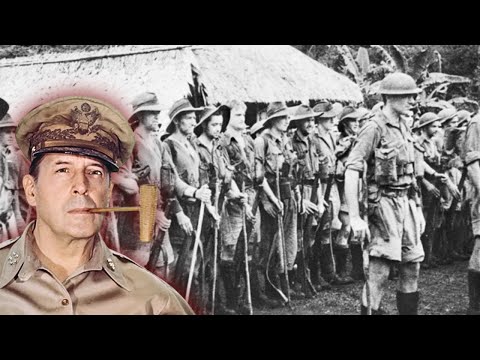
These weren’t professional troops. They were farm boys and clerks, barely trained, who had faced a Japanese army 25 times their size. Against impossible odds, they had done the unthinkable—and saved their nation from invasion. But what MacArthur said next would shock everyone who read it.
November 2nd, 1942. Kokoda Village, Papua New Guinea. The first soldiers entered at 6 a.m., finding a scene of utter desolation. The village had been destroyed and rebuilt and destroyed again. Bullet holes scarred every standing structure. The ground was torn by mortar shells, and the stench of death mingled with the thick jungle air.
But none of that mattered to the men who had just arrived. They had walked 96 miles through mountains and jungle, climbed peaks 7,000 feet high, crossed swollen rivers, and fought the Japanese every single day for over four months. Now, finally, they were back.
One soldier pulled an Australian flag from his pack—stained and torn, but its colors still bright. He tied it to a broken pole and raised it high. Others gathered around, too tired to cheer, too moved to speak. Some cried, some laughed, some just sat in the mud and shook. They had done it. After 127 days, Kokoda was back in Australian hands.
But to understand why this moment mattered so much, you need to know what the world looked like in 1942. By mid-year, Japan had conquered an empire stretching 7,000 miles across the Pacific. They had crushed the British in Singapore, beaten the Americans in the Philippines, and taken islands everyone said could never fall. Their army seemed unstoppable, winning every major battle for six straight months.
Australia stood almost alone. Most of their best soldiers were 12,000 miles away in North Africa. The mainland had barely any defense. If Japan wanted to invade, there was almost nothing to stop them. And Japan did want to invade. Their plan was simple: take Papua New Guinea, use it as a base to bomb and invade northern Australia, and cut Australia off from America.
Papua New Guinea was the key. It sat just 100 miles north of Australia across a thin strip of ocean. If Japan controlled it, Australia would be next. The only thing protecting Australia was a single muddy path through the jungle called the Kokoda Track. It ran 96 miles from the north coast to the south coast over mountains and through jungle so thick you could barely see 10 feet ahead.
Military experts looked at maps and called it impassable. “No army could move through that terrain,” they said. “No supply line could support troops there. It was impossible.” Japan disagreed. In July 1942, 15,000 of their best troops landed on the north coast. They planned to march over the mountains, capture Port Moresby, and use it as a base to attack Australia.
Standing in their way were about 600 Australian soldiers. But these were not the experienced fighters from North Africa. These were militia—part-time soldiers that everyone called ‘Chocos’ or chocolate soldiers because people said they would melt in the heat of real combat. Most were 18 or 19 years old. Most had never fired a gun in battle. They had three weeks of basic training at most. And Australian law said they could not even be sent overseas to fight.
The odds were 25 Japanese soldiers for every one Australian. The Japanese had better weapons, more ammunition, and years of combat experience. They had just conquered half of Asia. What chance did a bunch of teenage part-timers have against them? What chance did 600 boys with old rifles have against 15,000 elite warriors? How could these chocolate soldiers possibly stop the unstoppable Japanese army and save their entire country from invasion?
The men who would fight on the Kokoda Track came from ordinary Australian families. They were farm boys and office clerks, students and shop workers. When Japan attacked Pearl Harbor in December 1941, everything changed. Australia suddenly faced a real threat. Their government called up the militia—part-time soldiers who trained on weekends and evenings. These men joined units like the 39th Battalion. They drilled in local parks. They learned to march and shoot. They thought they would guard docks and bridges in Australia. They never imagined they would end up fighting for their country’s survival in the jungles of New Guinea.
The 39th Battalion became the heart of the Kokoda defense. Their commanding officer was Lieutenant Colonel William Owen, a First World War veteran who knew what real combat looked like. He trained his young soldiers as hard as he could with the little time he had. They practiced shooting their rifles—old weapons left over from the previous war. They learned basic tactics. They went on marches to build up their strength. But three weeks of training could not turn teenagers into warriors. Owen knew that. His men knew that too. They were scared, but they were ready to do their duty.
The soldiers had almost no equipment. Their boots were cheap leather that would rot in the jungle wet. They had no mortars to fire at enemy positions. They had no artillery for support. Each man carried a rifle, some bullets, and whatever food he could pack. That was it. Meanwhile, the Japanese troops preparing to invade had light mountain guns, plenty of ammunition, and supply lines bringing food and medicine. The Japanese soldiers were veterans who had fought in China, Malaya, and Singapore. They knew jungle warfare. They knew how to fight in the heat and rain. They were led by Major General Tomitaro Horii, a smart and experienced commander who had never lost a battle.
The Kokoda Track itself was a nightmare—not a road or even a real path. It was a trail that local Papua New Guinea villagers used to travel between the north and south coasts. The track climbed up and down mountains that rose 7,000 feet into the clouds. It crossed rivers that could rise six feet in an hour when the rain came. It wound through jungle so thick that sunlight barely reached the ground. Temperatures would hit 90 degrees during the day, then drop near freezing at night on the mountain peaks. Rain fell almost every day, sometimes for hours, turning the track into a river of mud.
Medical officers who studied the area reported that it was one of the most dangerous places on Earth for human health. Malaria-carrying mosquitoes swarmed everywhere. Tropical diseases lived in the water and soil. Leeches attached themselves by the hundreds to anyone who walked through the jungle. Cuts and scrapes turned into infected wounds within hours in the heat and wet. Men could die from simple problems that would mean nothing back home. And that was without anyone shooting at you.
General Douglas MacArthur had arrived in Australia in March 1942 after escaping from the Philippines. He was the supreme commander of Allied Forces in the Pacific—the man in charge of stopping Japan. He was famous for his confidence and his bold promises. When he left the Philippines, he declared, “I shall return.” But first, he had to make sure Australia did not fall. MacArthur set up his headquarters in Brisbane and started planning the defense.
When he learned that militia troops would be defending the Kokoda Track, he was not confident. He had commanded professional soldiers his whole career. He did not believe part-time troops could stand up to Japan’s best warriors. He said as much to his staff officers. “The militia boys would break and run,” he predicted. “They were not real soldiers.”
Australian military commanders knew they had no choice. All the experienced troops were overseas. The militia was all they had. In July 1942, they sent the 39th Battalion to Port Moresby on the south coast of Papua New Guinea. From there, the young soldiers would march up the Kokoda Track to defend it against the coming Japanese invasion. The orders were clear and simple: Hold the track. Stop the Japanese. Buy time for reinforcements to arrive. Do not let the enemy reach Port Moresby. The survival of Australia depended on it.
The soldiers said goodbye to their families and boarded ships for New Guinea. Many had never left their hometowns before. Now they were sailing to a jungle island to fight the most dangerous army in the world. Their mothers and fathers waved from the docks, trying to smile, trying to be brave. Everyone knew the truth. Some of these boys would never come home.
The troop ships crossed the Coral Sea and landed at Port Moresby. The heat hit the soldiers like a wall. It was hotter than anything they had felt in Australia. The air was thick and hard to breathe. Insects swarmed around them. This was their new world.
They gathered their equipment and started marching north on the Kokoda Track. The first day was hard. The second day was harder. They climbed steep hills under heavy packs. They sweated through their uniforms. Their feet started to blister. Some men got sick from the water, but they kept going.
After several days of marching, they reached Kokoda Village, a small settlement in the middle of the track. The villagers were friendly. They had helped Australians before. The soldiers set up camp and prepared defensive positions. They dug trenches and set up machine gun posts. They sent patrols north to watch for the Japanese.
On July 21st, 1942, the Japanese landed at Gona and Buna on the north coast of Papua New Guinea. 15,000 troops came ashore from transport ships. They had orders to march south, take Port Moresby, and prepare for the invasion of Australia. Within 24 hours, they were pushing inland toward Kokoda. The war had come to the track.
The 600 boys of the 39th Battalion were about to face the test of their lives. Everything they had trained for, everything they feared, was about to become real. The Japanese soldiers moved fast through the jungle. They were used to this kind of fighting. They had done it in Malaya and in the islands. They knew how to use the trees for cover. They knew how to move quietly on jungle paths. Their scouts pushed ahead, looking for the Australian positions.
On July 23rd, just two days after landing, the Japanese made contact with Australian troops near Kokoda village. The fighting started with rifle shots echoing through the jungle. Then came the sound of machine guns. The battle for Kokoda had begun.
Lieutenant Colonel Owen led his men in the defense. He moved from position to position, directing his soldiers, trying to organize a defense against an enemy that outnumbered them 25 to 1. The Japanese attacked with mortars and machine guns. They had more firepower than the Australians could match. The young militia soldiers fired back, scared but holding their ground. Some had never heard bullets flying past their heads before. Now they crouched in muddy trenches while enemy fire cut through the jungle around them.
The noise was terrible. Men shouted orders. Wounded soldiers screamed. Bullets cracked against trees and rocks. The battle lasted for hours. The Japanese kept pushing forward. They moved around the Australian positions trying to surround them. Owen saw what was happening. His small force could not hold against so many enemy troops, but he refused to give up the village without a fight. He led a counterattack, running forward with his rifle, calling for his men to follow. They charged toward the Japanese positions. For a moment, the enemy fell back.
Then a Japanese sniper fired from the jungle. The bullet hit Owen in the heart. He fell dead instantly. The Australians had lost their commander. Without Owen, the soldiers had to make a choice. They could stay and die, or they could retreat and fight another day. A young officer took command and gave the order to withdraw. The men pulled back from Kokoda village, carrying their wounded with them. They left their dead behind, including their colonel.
It was a terrible moment. These boys had never lost a battle because they had never been in one before. Now they had lost their first fight and their leader. They retreated south on the Kokoda Track back toward Port Moresby, but this was not a panicked run. The militia soldiers did something that surprised everyone, including themselves. They stopped on every ridge and fought. They would set up positions, let the Japanese attack, shoot back, and then retreat to the next ridge. This was called a fighting withdrawal, and it was one of the hardest things for any army to do. It required discipline and courage.
The Japanese kept chasing them, but the Australians made them pay for every mile. Each creek crossing became a small battle. Each hilltop became a defensive position. The chocolate soldiers were not melting. They were fighting like veterans.
The conditions on the track were worse than anyone imagined. Rain fell every single day. The track turned into a river of mud that sucked at boots with every step. Men slipped and fell on the steep slopes. Some fell off the track into ravines. The mud was so deep in places that soldiers sank to their knees. Every step was exhausting. They carried 60-pound packs on their backs, plus their rifles and ammunition. They had not eaten a hot meal since the fighting started. They ate crackers and canned food when they could. Sometimes they went days without food because the supply lines could not keep up.
By late August, reinforcements arrived. The 2/14th and 2/16th Battalions came up the track. These were veteran units with men who had fought in North Africa against the Germans. They were real soldiers with real combat experience. They joined the militia troops at a place called Isurava, a ridge with a good defensive position. Together, they prepared to make a stand. The Japanese were still coming, pushing south, getting closer to Port Moresby with every day.
The Battle of Isurava started on August 26th. The Japanese attacked with everything they had. Mortar shells exploded on the Australian positions. Machine gun fire raked the trenches. The Japanese infantry charged up the hill screaming battle cries. The Australians fired back, cutting down the attackers. Bodies piled up on the slope. The Japanese pulled back, regrouped, and attacked again. The battle went on for six days.
On August 29th, a soldier named Private Bruce Kingsbury saw his company about to be overrun. Japanese troops had broken through the Australian line and were pouring into the position. Men were falling back, scared they would be surrounded. Kingsbury grabbed his rifle and charged straight at the enemy. He fired as he ran, shooting Japanese soldiers at close range. His attack was so fierce and sudden that the Japanese stopped advancing. Other Australians rallied and followed Kingsbury. They pushed the enemy back. For a few minutes, it looked like the line might hold.
Then a Japanese bullet hit Kingsbury. He fell dead. He was 24 years old. Later, he would receive the Victoria Cross, the highest medal for bravery. But that day, he was just another young man who died in the jungle.
Despite Kingsbury’s sacrifice, the Australians could not hold Isurava. Too many Japanese soldiers kept attacking. The defenders were running out of ammunition. They were exhausted from six days of nonstop fighting. The order came to retreat again. The soldiers pulled back, carrying their wounded on stretchers made from tree branches. They counted their losses. 31 officers and 253 men had been killed or wounded at Isurava. But the Japanese had lost over 1,200 soldiers. The Australians were making the enemy pay a terrible price for every mile.
The retreat continued through September. The Japanese pushed the Australians all the way back to a village called Ioribaiwa, just 30 miles from Port Moresby. This was as far as the Japanese would get. Both armies were dying—not just from bullets, but from disease and starvation. The soldiers on both sides were sick with malaria. They had dysentery that left them weak and dehydrated. They had tropical ulcers on their legs—infected wounds that would not heal in the wet and heat. Some men lost 30 or 40 pounds. They looked like walking skeletons. Their uniforms rotted off their bodies. They had to tie their pants up with rope or vines.
The sounds of the Kokoda Track haunted the men. There was the constant sucking sound of mud pulling at boots. There was the hammering of rain on the jungle canopy above. There was the screaming of wounded men being carried over mountain passes on stretchers. At night, men heard the calls of strange birds and animals. They heard the rustle of the enemy moving through the jungle. They heard their friends crying quietly in the dark. Some men broke mentally. They just sat down on the track and refused to move. Others kept going through pure willpower.
The smell was terrible. Bodies could not be buried properly in the rocky mountain soil. Dead soldiers were wrapped in blankets and left beside the track with a rifle stock in the ground as a marker. In the heat, the bodies rotted quickly. The smell of death mixed with the smell of the jungle itself—the rotting plants and muddy earth. Gangrene infected many wounds. That smell, like sweet rot, filled the aid stations where doctors worked on the wounded. It was a smell the soldiers would remember for the rest of their lives.
By mid-September, something changed. The Japanese supply lines had stretched too far. They could not bring enough food and ammunition over the mountains. Their soldiers were starving too. At the same time, MacArthur’s reinforcements were finally arriving at Port Moresby. Fresh Australian troops were coming up the track. The orders changed. On September 26th, the Australians stopped retreating. It was time to push back. It was time to make the Japanese pay for every inch of ground they had taken. The counterattack was about to begin.
September 26th, 1942. The Australian soldiers received new orders that they could barely believe: Stop retreating, start attacking, push the Japanese back over the mountains and retake Kokoda. After two months of fighting withdrawals, losing friends, and barely surviving, they were going on the offensive.
Brigadier John Lloyd took command of the 16th Brigade. He looked at his men and saw what the track had done to them. They were thin and sick and tired. But they were still standing. They were still ready to fight. 7,000 Australian troops were now on the track or heading up from Port Moresby. That was more soldiers than before, but they still faced a hard enemy dug into strong positions.
The Japanese had spent weeks building defenses on every ridge and hilltop they had captured. They cut down trees to make log bunkers that could stop bullets and even small artillery shells. They positioned machine guns to cover the narrow parts of the track. They were not going to give up ground easily. The Australians would have to fight uphill for every position, and fighting uphill is the hardest kind of battle.
The advance began slowly. The track was still a muddy nightmare. Soldiers climbed steep slopes with their heavy packs, slipping and falling. When they reached Japanese positions, they had to attack. The Japanese would wait until the Australians got close, then open fire with machine guns and rifles. The Australians learned to spread out and use the jungle for cover. They learned to flank around enemy positions instead of attacking them head-on. They were becoming jungle fighters themselves.
On October 14th, the Australians reached a place called Templeton’s Crossing. This was a ridge where the track became so narrow that only one man could walk on it at a time. On both sides were cliffs that dropped 200 feet straight down. The Japanese had turned this natural choke point into a fortress. They had log bunkers covering the track. Any soldier trying to cross would be shot before he made it 10 feet. It seemed impossible to take.
The Australian commanders studied the position. They could not go around it—the cliffs were too steep. They had to go through it. They decided to attack at night when the Japanese would have trouble seeing. On the night of October 14th, Australian soldiers crawled forward in the darkness. They moved slowly and quietly. When they got close to the Japanese bunkers, they threw grenades. The explosions lit up the jungle. Then the Australians charged forward with their rifles and bayonets. The fighting was hand-to-hand in some places—men stabbing and clubbing each other in the dark. It was brutal and terrifying.
The battle for Templeton’s Crossing lasted three days. More attacks came during daylight. Artillery shells were carried up the track piece by piece and used to blast the Japanese bunkers. Slowly, the Australian soldiers pushed forward. They lost 46 men killed and 106 wounded. But on October 16th, the position fell. The Japanese pulled back to their next defensive line. The Australians had broken through.
Next came Eora Creek on October 22nd. 1,500 Japanese soldiers defended this position. They had dug in on the high ground with clear fields of fire. Any direct attack would be suicide. The Australian commanders decided to try something bold. They would send soldiers on a flanking march through terrain that everyone said was impossible. The troops would have to climb through jungle so thick they would need to cut their way through with machetes. They would have to climb cliffs by grabbing vines and tree roots. They would carry their weapons and ammunition with them. It would take three days of the hardest marching imaginable.
The flanking force moved out. They hacked through jungle where no path existed. They climbed up and down slopes so steep they had to pull themselves up by grabbing plants. One soldier later said they were climbing waterfalls, hauling themselves up rocks with water pouring over them, carrying 60-pound packs the whole time. It rained the entire three days. The men were soaked and cold and exhausted, but they kept going.
On October 28th, they came out of the jungle behind the Japanese positions at Eora Creek. The Japanese defenders suddenly found Australians attacking them from two directions. They tried to hold both fronts but could not. Their position collapsed. They retreated again, falling back toward Kokoda. The Australian victory at Eora Creek broke the Japanese defensive line. Now the path to Kokoda was open, but the Japanese were not finished fighting. They would contest every mile of the track.
By late October, Japanese commanders realized they could not hold Papua New Guinea. Their supply situation was desperate. Their soldiers were starving. Disease had killed hundreds. General Horii received orders from his superiors to withdraw to the north coast and set up new defenses there. On October 28th, he gave the order for a general retreat. The Japanese would abandon Kokoda and fall back to Gona and Buna where they had first landed.
Australian intelligence officers intercepted Japanese radio messages and decoded them. They learned about the withdrawal order. The race was on. If the Australians could get to Kokoda before the Japanese destroyed everything and escaped, they might trap enemy soldiers and capture supplies. The troops on the track pushed themselves harder. They marched through the night. They ignored their exhaustion and pain. Kokoda was just ahead.
November 2nd, 1942, 6:00 in the morning. The sun was just rising over the jungle. Soldiers from the 2/25th Battalion approached Kokoda Village carefully. They expected a fight. Instead, they found the village almost empty. The Japanese had pulled out during the night. A few rear guard troops fired some shots and then ran. The Australians moved into the village. They looked around at the destroyed buildings and shell-torn ground. This was the place where the war had started back in July. This was where Lieutenant Colonel Owen had died. This was what they had been fighting for all these months.
One soldier pulled out an Australian flag. It was the same flag they had carried all the way from Port Moresby. The cloth was dirty and torn from months in the jungle, but the colors still showed bright. The soldier found a broken pole, tied the flag to it, and raised it high above Kokoda Village. Other soldiers gathered around. Some men stood at attention, some saluted, some just stared at the flag, too emotional to speak.
They had done it. After 127 days of hell, after losing so many friends, after being pushed back almost to Port Moresby, they had fought their way back. They had won.
The men who stood in Kokoda that morning were not the same boys who had started this fight. They looked like old men. Their faces were thin and covered with beards. Their eyes had seen things no teenager should ever see. Their bodies were covered with sores and scars. They had lost an average of 35 pounds each. Some could barely stand from weakness, but they stood anyway. They had become soldiers. They had become warriors. They had saved their country.
Word of the victory spread quickly down the track. Runners carried messages back to Port Moresby. Radio operators sent coded signals to Australia. By that afternoon, General MacArthur in Brisbane received the news. Kokoda had been retaken. The Japanese were in full retreat. The threat to Port Moresby and Australia was over.
MacArthur sat at his desk and thought about what to say. He had not believed the militia could do this. He had doubted them from the start, but they had proved him wrong. These chocolate soldiers had stopped the best army in Asia. Now he had to find the right words to honor what they had done.
The Australian soldiers in Kokoda village knew they should keep chasing the Japanese. The enemy was retreating north toward the coast. Every hour that passed gave them more time to escape and build new defenses. But the men could barely move. They sat on the ground, leaning against trees and broken walls. Some tried to eat the small amounts of food they had. Others just stared into space. Their bodies had nothing left to give.
Medical officers walked among the troops, checking each man. What they found shocked them. Three out of every four soldiers had malaria, dysentery, or both. Many had infected wounds that were getting worse. The average soldier had lost 35 pounds. Some had lost 40 or even 50 pounds from their bodies. The doctors knew these men needed hospitals, not more fighting. They needed clean beds, good food, and medicine. They needed rest for weeks, maybe months.
But the war was not over. The Japanese were still in Papua New Guinea. Someone had to chase them down and finish the job. Fresh troops would have to come up the track to continue the fight. These soldiers who had retaken Kokoda would have to be carried back down to Port Moresby. Many were too weak to walk even one more mile.
Stretcher bearers from Papua New Guinea villages arrived to help. These local men had been helping the Australians throughout the whole campaign. The Australian soldiers called them the Fuzzy Wuzzy Angels because of their hair and their kindness. These Papua New Guinean men carried wounded and sick Australians over the mountains on stretchers made from tree branches. They carried men who weighed as much as they did. They climbed up and down those terrible slopes day after day. Without them, hundreds more Australians would have died on the track. The soldiers being carried looked up at the faces of the men saving their lives and felt grateful beyond words.
Back in Brisbane, General MacArthur sat at his desk with a pen in his hand. He had to write something about the victory at Kokoda. He had to tell the press and the public what had happened. He thought about those militia soldiers he had doubted. He remembered saying they would break and run. He had been wrong. They had not broken. They had bent under terrible pressure, but they had not snapped. They had fought with a courage he had rarely seen in his long military career. Now he had to find the right words.
MacArthur wrote slowly. He crossed out words and started again. Finally, he finished his message. He called for his press officer and handed over the paper. The officer read it and looked surprised. MacArthur usually wrote long, dramatic statements full of big words and grand ideas. This message was different. It was simple and direct. The officer nodded and left to send it to newspapers around the world.
The message said this: “The colors advance.” Then MacArthur added more. “The Australian soldier has achieved a magnificent feat of arms. They have proven themselves worthy inheritors of Anzac tradition.”
That was it. Short and simple. But those first three words became famous. “The colors advance.” It meant the Australian flag was moving forward. It meant the soldiers had not just defended. They had attacked and won. For a general who loved big speeches, these three words said everything that mattered.
But privately, MacArthur told his staff something else. He said he never thought the militia could do it. He admitted he had been wrong about them. He said these part-time soldiers had fought better than some professional units he had commanded. It was the closest MacArthur ever came to saying he was sorry for doubting them.
In Australia, newspapers printed MacArthur’s words on their front pages. People read them and felt proud. Their boys had done it. The chocolate soldiers had stopped the Japanese. Mothers and fathers who had sons on the Kokoda Track cried with relief. Not all their boys would come home, but Australia was safe. The Japanese would not invade now.
General Thomas Blamey was the commander of all Australian forces. He decided to visit the Kokoda Track himself in late November. He wanted to see what conditions were like. He flew to Port Moresby and then started walking up the track. Within a day, he understood. The track was worse than any report had described. The mud, the rain, the steep slopes, the heat, the insects—everything was terrible. He saw soldiers coming down from the fighting and he was shocked at how they looked. These were men from units that had just arrived fresh a few weeks ago and already they looked sick and worn out.
When Blamey reached some of the forward units, he made a mistake. He gave a speech to the 21st Brigade. He told them they had failed to show the fighting spirit Australia expected. He said they had not pushed hard enough against the Japanese. He said they needed to do better. The soldiers could not believe what they were hearing. These men had just fought through hell. They had climbed mountains while sick with malaria. They had attacked enemy positions uphill in the rain. And now their own general was saying they had not tried hard enough.
The anger spread quickly through the ranks. Officers defended their men. They told Blamey he did not understand what the troops had faced. They said he should try attacking a Japanese bunker uphill through mud before he criticized anyone. Some soldiers wrote angry letters that were never sent. Others just felt betrayed. They had given everything and it was not enough for the generals safe in their headquarters. This speech would damage Blamey’s reputation with the soldiers for the rest of the war.
Meanwhile, the soldiers themselves tried to process what they had been through. Letters home to family started to arrive. Men wrote about relief and exhaustion and pride. They wrote about friends who had died. They tried to explain what it had been like, but words were hard to find. How do you describe climbing a mountain while people shoot at you and disease eats at your body? How do you explain the fear and the courage and the awful things you saw? Most soldiers gave up trying. They just wrote that they were okay and asked about home.
The military announced that Private Bruce Kingsbury would receive the Victoria Cross for his charge at Isurava. His parents received the medal at a ceremony in Melbourne in 1943. His mother held the medal and cried for the son who would never come home. He was 24 years old when he died. He never married. He never had children. He was just a young man who did something brave and paid for it with his life.
The Japanese retreat continued. The soldiers who had been so confident in July were now starving and desperate. Their supply ships could not reach them. American and Australian planes bombed any ship that tried to bring food or ammunition. The Japanese soldiers in Papua New Guinea were trapped. They would keep fighting for months, but they had already lost. Over 6,000 Japanese soldiers had been killed or were missing. Many had died not from bullets, but from starvation and disease. Their commanders had sent them on an impossible mission through impossible terrain. Now they were paying the price.
The human cost of the Kokoda Campaign was terrible for both sides. 625 Australians had been killed in battle. 1,055 had been wounded. But the real number was much higher. Over 4,000 men were casualties from disease and exhaustion. Some would recover in hospitals and return to fight again. Others would never fully get better. The malaria would come back for years, making them sick again and again. Some men’s bodies were so damaged, they could never work hard again. The track had taken something from every man who walked it, and some would never get that something back.
The victory at Kokoda changed everything in the Pacific War. For six months, Japan had won every major battle. Their soldiers had seemed unstoppable. They had conquered Singapore, the Philippines, Burma, Malaya, and dozens of islands. Every time they attacked, they won. Every time Allied forces tried to stop them, those forces retreated or surrendered. The Japanese military seemed like a machine that could not be beaten. But at Kokoda, they lost.
A small force of Australian soldiers, many of them part-time militia with almost no training, had stopped Japan’s best troops and pushed them back. This was the first real land victory against Japan in the entire war. The news spread across the Allied world. In America, newspapers printed stories about the Australian diggers who saved their country. In Britain, Prime Minister Winston Churchill sent a telegram to Australian Prime Minister John Curtin. The message congratulated Australia on the magnificent performance of their soldiers. Churchill wrote that the defense of the Kokoda Track would be remembered as one of the great defensive actions of the war. Coming from Churchill, who had seen many battles, these words meant something.
But more important than the praise was what the victory proved. It showed that Japanese soldiers could be beaten in jungle fighting. It showed that cutting their supply lines worked. It showed that Allied soldiers could fight just as hard and just as smart as the enemy. This changed how Allied commanders thought about the rest of the Pacific War. If the Japanese could be stopped in New Guinea, they could be stopped anywhere.
General MacArthur immediately started planning his next moves. He wanted to use the lessons from Kokoda to develop a new strategy for the whole Pacific. Instead of attacking every Japanese position head-on, he would bypass the strong ones. He would cut off their supplies and let them wither. He would use air power to stop their ships from bringing food and ammunition. He would make the jungle and the ocean work for him instead of against him. This became known as island hopping, and it would be used for the rest of the war as American and Australian forces pushed toward Japan.
The Australian army started changing how it trained soldiers. Before Kokoda, jungle warfare was something hardly anyone thought about. Australian troops trained for desert fighting or for defending beaches. Now the army created special jungle warfare schools. They sent soldiers to camps in Queensland where they learned to fight in thick vegetation and heavy rain. They learned small unit tactics, how to move quietly, how to use the jungle for cover. They learned to carry less equipment and move faster. All these lessons came from what the Kokoda soldiers had learned the hard way.
The army also changed how it supplied troops in roadless areas. Before Kokoda, commanders thought you needed roads or railways to supply an army. The Kokoda Track had no roads at all. Everything had to be carried by hand or dropped from airplanes. During the campaign, the Australians developed better ways to drop supplies from planes. They used parachutes for some supplies and just pushed other supplies out of the plane to fall freely. They learned which supplies could survive the fall and which could not. By late 1942, cargo planes were dropping 70 tons of supplies every day to troops in New Guinea. This was more than enough to keep an army fighting. This technique would be copied by armies all over the world.
Medical officers learned hard lessons too. They saw how quickly tropical diseases could destroy an army. They started programs to prevent malaria. Every soldier had to take medicine to stop malaria before it started. They had to use mosquito nets at night. They had to cover their skin to prevent insect bites. Units that followed these rules stayed much healthier than units that did not. The army also developed better ways to treat soldiers in the field. They created aid stations closer to the fighting. They trained more medical officers to handle tropical diseases. All these changes saved thousands of lives in the years to come.
The impact on morale was huge. In Australia, people had been scared since 1941. They worried that Japan would invade. They worried their country would fall just like Singapore and the Philippines had fallen. After Kokoda, that fear started to fade. Australians felt proud. Their soldiers had proven they could fight and win. Newspaper headlines shouted the victory. “Diggers save Australia,” one paper said. “The boys stopped the Japanese,” said another. People walked taller. They felt more confident about the future.
This pride led to more men joining the army. In November and December 1942, 40% more young men volunteered for military service than in the months before. They wanted to be like the Kokoda soldiers. They wanted to defend their country. The government did not have to force men to join. They came on their own because they believed they could make a difference.
The American military also paid attention to Kokoda. American troops were fighting in the Pacific too, but they had not won any big land battles yet. They saw what the Australians did and learned from it. American officers studied reports from the Kokoda Track. They talked to Australian commanders about tactics and techniques. When American soldiers started fighting in the jungles of Guadalcanal and other islands, they used some of the same methods the Australians had developed. The cooperation between American and Australian forces grew stronger. MacArthur, who commanded both, started using Australian troops to lead difficult jungle operations because he knew they were good at it.
The Japanese military had to rethink everything after Kokoda. Their commanders had believed their soldiers were superior fighters who could not be beaten by Western troops. Kokoda proved that was wrong. Japanese officers wrote reports about the battle. They admitted the Australians fought better than expected. They said the terrain was worse than intelligence had suggested. They said the supply problems were worse than planned. These reports went up to the highest levels of the Japanese military. The conclusion was clear: Taking Port Moresby by land was impossible. Japan would have to find another way to threaten Australia, or they would have to give up on invading it altogether.
This changed Japanese strategy in the Pacific. They stopped trying to expand south toward Australia. Instead, they focused on defending what they already had. They built strong defenses on islands across the Pacific. They dug in and prepared to make the Allies pay a high price for every island. This defensive strategy would define the rest of the Pacific War.
The relationship between nations also changed. Britain had always seen Australia as a junior partner, a colony that did what it was told. But Australia’s performance at Kokoda showed they could stand on their own. Australian Prime Minister Curtin had already started pulling away from British control. He focused more on the relationship with America because America was closer and more able to help defend Australia. After Kokoda, this shift became permanent. Australia would remain friends with Britain, but they would make their own decisions about their defense and foreign policy.
The Papua New Guinea people who helped during the campaign started to get recognition, though it took time. The Fuzzy Wuzzy Angels had saved hundreds of Australian lives by carrying wounded men over the mountains. They had acted as guides through the jungle. They had shared their food when supplies ran out. But in 1942, most Australians did not know about them. Only the soldiers who had been there knew what these men had done. It would take decades before Papua New Guineans received proper thanks and recognition for their role in saving Australia.
The numbers tell part of the story. Japan lost over 6,000 men at Kokoda—a 40% casualty rate. Australia lost 1,680 men to battle—a 24% casualty rate. But when you add disease casualties, over 5,600 Australians were put out of the action. Both sides suffered terribly. But Japan could not afford to lose 6,000 veteran soldiers. Those men had combat experience that could not be replaced quickly. Australia, with help from America, could bring in fresh troops. This meant Australia could keep fighting while Japan got weaker.
Military historians around the world studied the Kokoda campaign. They wrote that it was one of the most difficult defensive actions ever fought. The terrain, the weather, the disease, and the strong enemy made it nearly impossible. Yet the Australians had done it. The campaign became a case study in military schools. Officers learning about jungle warfare read about Kokoda. They learned what worked and what did not. Even today, armies study this campaign to understand how to fight in difficult terrain against a determined enemy.
Private Bruce Kingsbury never knew he would become a hero. He was 24 years old when he died at Isurava on August 29th, 1942. Before the war, he had worked in a shop. He liked sports and spending time with friends. He was just an ordinary young man who happened to be in the militia when the war started. When his company was about to be overrun by Japanese soldiers, he did not think about medals or glory. He just saw his friends in trouble and did the only thing he could. He charged at the enemy with his rifle and fought until a bullet killed him. His action saved his company that day.
Later, the government gave him the Victoria Cross—the highest medal for bravery. His parents received the medal at a ceremony in Melbourne in 1943. His mother held it and cried. Her son was never coming home. He would never get married, never have children, never grow old. He was frozen in time at age 24, forever young, forever brave.
Lieutenant Colonel Ralph Honner commanded the 39th Battalion during some of the worst fighting on the Kokoda Track. He saw boys become men and men become heroes. He saw soldiers do things he never thought possible. He watched young militia troops stand up to elite Japanese warriors and refuse to break. After the war, Honner became a politician. He worked in the Australian government, but he never forgot the men he had led. He fought for better treatment of veterans. He pushed for the government to help soldiers who came home with wounds both visible and invisible. In his office, he kept photographs from Kokoda. Sometimes visitors would ask about them. Honner would look at the pictures and say, “Those boys saved Australia and nobody knew it.”
In 1992, 50 years after the battle, Honner published his memories of the campaign. He was 82 years old by then. In the book, he finally told the full story of what the militia troops had done. He described their courage, their suffering, and their victory. He wanted people to know these were not professional soldiers. They were farmers and clerks and students who answered the call when their country needed them. The book became important because Honner did not make the soldiers seem like supermen. He showed them as scared young men who found courage when they needed it most. He died in 1994 at age 84. In his last interview before he died, he said those boys at Kokoda were the bravest people he ever met.
Sergeant Lyle Peterson was one of the soldiers who carried wounded men on his back for miles through the jungle. He was strong and tough, and he used that strength to save lives. During the fighting, he got cerebral malaria—one of the worst kinds. The disease attacks the brain and can kill quickly. Medical officers evacuated him to Port Moresby in October. He survived, but the malaria never really left him. For 30 years after the war, he would get sick with malaria relapses. The disease would come back without warning, making him weak and feverish. He went back to his job as a teacher in a small town in Victoria. He taught children and never talked about Kokoda. People in his town did not know he was a war hero. In the 1980s, a researcher found him and asked to interview him about his experiences. Peterson agreed but said there was not much to tell. “What was there to say?” he asked. “We just did our job.” He died in the 1990s, a quiet man who had done extraordinary things.
The Papua New Guinean carriers became known as the Fuzzy Wuzzy Angels—a name given to them by grateful Australian soldiers. One of these men was Raphael Oimbari. He carried 17 wounded Australian soldiers over the mountains during the campaign. He would strap a soldier to a stretcher made from tree branches, then lift it onto his shoulders with help from other carriers. Then he would climb up and down those terrible mountain tracks. The stretchers were heavy. The wounded men often weighed as much as the carriers themselves. Oimbari would walk all day, stopping only when it was too dark to see the path. He did this day after day, trip after trip.
Australian soldiers who were carried this way never forgot. They were in pain from their wounds, but they remembered the gentle way the carriers moved, trying not to jostle them. They remembered how the carriers would use leaves to keep the rain off their faces. One Australian soldier, Sapper Albert Baros, was so moved by the carriers that he wrote a poem about them. The poem is called The Fuzzy Wuzzy Angels. It says: “Many mothers in Australia pray for angels to protect their sons in the war. Now we see those prayers are answered on the Owen Stanley Track. The angels do not have halos, only holes in their ears from decorations. Their faces have tattoos, and their hair has special pins. They bring back the wounded steady as a hearse, using leaves to keep the rain off, and they are as gentle as a nurse.”
This poem became famous in Australia. Soldiers read it and thought about the men who saved them. But for decades, these Papua New Guinean heroes received no official recognition from the Australian government. Finally, in 1992, 50 years after the battle, a memorial was created for them. Raphael Oimbari was there to see it. He was 89 years old. He died in 1997 knowing that at last people remembered what he and others had done.
Private Jack Wilkinson was 18 years old when he joined the 39th Battalion. His job before the war was working as a clerk in an office. He had never been away from his hometown. His first combat was at Kokoda Village on July 23rd. He wrote in his diary every day during the campaign. On October 15th, he wrote this: Cannot remember the last time I was dry. Socks rotted off my feet three days ago. Still walking. That simple sentence showed what the soldiers endured. Their basic equipment fell apart in the jungle wet. They kept fighting anyway.
Wilkinson was wounded at Templeton’s Crossing. A bullet hit his shoulder. Medical officers evacuated him to an aid station, then to a hospital. He recovered and later returned to combat in Borneo in 1945. After the war, he became a carpenter. He got married and had four children. He never discussed Kokoda with his family. His children grew up not knowing their father was a war hero. They only learned the details after he died in 1998. They found his old diary in a box in the attic. Reading his words, they finally understood what he had been through and why he never wanted to talk about it.
Lieutenant Alan Haddy was a platoon commander in the 2/14th Battalion. He led the same 30 men for 74 days of fighting. Only 12 of those men walked off the track with him at the end. The others were killed, wounded, or evacuated sick. Haddy kept notes throughout the campaign. He wrote short entries about what happened each day. Lost Morrison today. Malaria. Lost Jenkins. Sniper. Lost Cooper. Just gave up. These notes showed the steady loss of men, one by one, day by day.
After the war, Haddy received the Military Cross for his leadership, but he struggled with what we now call post-traumatic stress disorder. He had nightmares about the jungle. He felt guilty about the men he lost. He wondered if he could have saved them. These thoughts haunted him for the rest of his life. He died in 1979. His family published his notes after his death so people could understand what the soldiers went through.
The Japanese soldiers had their own stories. Private Imanishi Sadaharu was a member of the 41st Infantry Regiment. He kept a diary during the campaign. On November 1st, he wrote this: We retreat again. No food for six days. Australian soldiers are everywhere. They are like ghosts in the jungle. Six days later, on November 7th, Imanishi was dead. Australian patrols found his body during the pursuit north. They found his diary with him. Eventually, the diary was sent to Japan. His family received it in 1947, five years after he died. The diary is now kept in the Australian War Memorial in Canberra. It reminds visitors that soldiers on both sides suffered and died far from home.
Major General Tomitaro Horii commanded the Japanese forces at Kokoda. He was an experienced officer who had won many battles, but in New Guinea, he could not win. His supply lines were too long. His men were starving. His enemy was tougher than expected. On November 23rd, while retreating to the north coast, Horii tried to cross the Kumusi River. The river was swollen from rain and moving fast. Horii and several of his staff officers got into a raft. The current caught them and flipped the raft over. Horii drowned. His body was never found. His final orders to his troops showed he understood what had happened. He wrote that the enemy had proven more resourceful than intelligence suggested. The Japanese army had underestimated the Australians. That mistake cost them the battle and cost Horii his life.
Today, the Kokoda Track is protected as a living memorial. The governments of Papua New Guinea and Australia declared it a heritage site in 2009. The track itself looks much the same as it did in 1942. It still climbs over mountains 7,000 feet high. It still winds through thick jungle. Rain still falls almost every day. The mud is still deep and slippery. But now, instead of soldiers fighting and dying, thousands of people walk the track each year as a pilgrimage. Over 5,000 hikers make the journey annually. They come to understand what their grandfathers went through. They come to honor the men who fought there. They come to challenge themselves on one of the hardest walks in the world.
Along the track, plaques and signs mark where battles happened. At Isurava, a memorial was built in 1992 for the 50th anniversary of the battle. Four tall pillars of granite stand on the ridge where the fighting was worst. Each pillar represents a value the soldiers showed: courage, endurance, mateship, sacrifice. The names of all 625 Australians who died on the track are carved into stone.
Every year on Anzac Day, which is April 25th, people gather at this memorial for a service. Veterans who can still make the journey attend. Their children and grandchildren come. Papua New Guinean villagers come to pay their respects. Everyone stands together and remembers. The memorial also includes a section for the Fuzzy Wuzzy Angels. For 50 years after the war, these Papua New Guinean heroes received no official recognition. Finally, in the 1990s, the Australian government acknowledged what they had done. A plaque honors the carriers who saved so many Australian lives. The plaque says they were men who went into the jungle without weapons to rescue the wounded. They risked their lives for strangers from another country. Their kindness and bravery will never be forgotten.
In Canberra, the Australian War Memorial has a whole gallery about Kokoda. It opened in 1999 and quickly became the most visited part of the museum. The gallery has a large display showing what the terrain looked like. Visitors can see how steep the mountains were, how thick the jungle was, how muddy the track became. Original diaries and letters are displayed in glass cases. Visitors can read the actual words soldiers wrote during the campaign. Equipment is on display too. Visitors see the old rifles the militia used, the rotting boots, the thin uniforms that were supposed to protect men in the jungle. Looking at this equipment, people understand how little the soldiers had to work with.
For Australia as a nation, Kokoda became part of the national story. It took time for this to happen. Right after the war, people talked more about Australian troops fighting in North Africa at places like El Alamein. The soldiers who fought in the desert got more attention than the soldiers who fought in the jungle. But starting in the 1980s and 1990s, Kokoda got more recognition. Books were written. A movie was made in 2006 showing the battle. Schools started teaching about Kokoda in history classes. The phrase Kokoda spirit entered the national vocabulary. It meant never giving up even when things seem impossible. It meant looking after your mates. It meant ordinary people doing extraordinary things when their country needs them.
Military leaders still study the Kokoda campaign today. Every officer in the Australian Army learns about it during training. They study the tactics, the mistakes, and the successes. They learn that good leadership at the junior level can make the difference between victory and defeat. They learn that taking care of soldiers’ basic needs—like food, water, and medical care—is just as important as having good weapons. They learn that the side that wants to win more will often find a way even against bigger forces with better equipment. Other countries study Kokoda too. The United States Marine Corps uses it as a case study in their jungle warfare courses. British Army officers read about it when they learn about fighting in difficult terrain. The campaign proves that militia or reserve forces can perform just as well as professional soldiers when properly led and motivated. This is an important lesson for any country that depends on citizen soldiers.
Papua New Guinea gained independence from Australia in 1975. This brought a new perspective on the Kokoda campaign. For years, the story had been told as an Australian story. Now, Papua New Guineans could tell their own story about what happened in their country during the war. The Fuzzy Wuzzy Angels became national heroes in Papua New Guinea—not just helpers in someone else’s war, but brave men who saved lives and showed compassion. The track became a source of national pride and an important source of tourism income for villages along the route.
The children and grandchildren of Kokoda veterans have their own relationship with the track. Many sons of soldiers who fought there have walked the track themselves, trying to connect with fathers who would not or could not talk about what they experienced. Some carried their father’s diary or letters with them, reading the words at the actual places where they were written. This can be a powerful experience. One man, Sam Templeton, walked the track in 2002 carrying his father William’s diary. William had fought with the 39th Battalion and died in 1987 without ever discussing Kokoda with his family. Sam read the diary entries at each location his father mentioned. He said that reading his father’s words on the actual track helped him finally understand what his father could not say.
Third-generation descendants are now walking the track too. Great-grandchildren are hiking with their aging grandfathers, hearing stories directly from men who were there. Some Papua New Guinean families now work as guides, and they lead descendants of both Australian and Japanese soldiers on the same track. Former enemies walk together in peace, remembering the past but building friendship for the future.
The modern perspective on Kokoda acknowledges things that were not talked about for decades. People now understand that Australia’s survival in 1942 depended on ordinary young men doing extraordinary things. People recognize that the Papua New Guinean contribution was essential, not just helpful. People understand that the chocolate soldiers proved to be as brave as any elite unit in the world. People accept that Japanese veterans and families should be welcomed in reconciliation efforts—that the Japanese soldiers were serving their country just as the Australians were.
General MacArthur, who doubted the militia at first, changed his mind completely. In his memoirs published in 1964, he wrote this: “The Australian soldier was the best jungle fighter I ever saw. Their performance at Kokoda was magnificent.” These words from a man who commanded millions of soldiers in his career meant a lot. His famous message from November 1942—“The colors advance”—is now carved into the memorial at Isurava. Those three simple words captured the moment when everything changed, when Australia stopped retreating and started winning.
What does Kokoda teach us today? It teaches that terrain and weather can be as deadly as any enemy. It teaches that supply lines matter more than tactics. It teaches that leadership at the lowest levels is critical to success. It teaches that human beings can endure more than military planners think possible. It teaches that national survival depends on citizens willing to serve, not just on professional soldiers. Most importantly, it teaches that ordinary people, when fighting for their homes and families, can achieve the impossible.
When those sick, starving, exhausted soldiers raised the Australian flag over Kokoda village on November 2nd, 1942, they did more than recapture a village. They proved that a few hundred boys who had never been soldiers could stop the best army in Asia. They saved their nation from invasion. They showed the world that Japan could be beaten. They earned a place in history alongside the greatest warriors who ever lived—not because they were special or superhuman, but because when their country needed them most, they refused to give up.
Lieutenant Colonel Ralph Honner said it best in 1992 when he was 82 years old and dying of cancer. He spoke to a group of schoolchildren and told them this: “People ask what we fought for. We fought for the man next to us. We fought because our country needed us. And we fought because giving up was not in us. Remember that. When things seem impossible, remember Kokoda. Remember that a few hundred boys who had never been soldiers stopped the best army in Asia—not because we were special, because we had to.”
That is the legacy of Kokoda. That is what those 625 names on the memorial represent. That is why people still walk that muddy track through the jungle 70 years later. They walk to remember. They walk to understand. They walk to honor the ordinary people who did extraordinary things. The Kokoda Track claimed Australian lives, Japanese lives, and changed thousands more forever. But those 96 miles of jungle hell stopped an empire and saved a nation. That is something worth remembering. That is something that should never be forgotten.
So now I ask you: when the world says something is impossible—when the odds are stacked against you and everyone expects you to break—will you remember the chocolate soldiers who refused to melt, and find the courage to advance your own colors?
Report this article
Select a reason for reporting:






