The musty scent of old paper and forgotten memories filled the air as Rebecca sorted through the contents of her grandmother’s attic in Salem, Massachusetts. The Victorian house had been in her family for four generations, and now, following her grandmother’s recent passing, Rebecca had inherited both the property and the responsibility of deciding what to do with decades of accumulated belongings.
Among the countless boxes of photographs, documents, and personal effects, Rebecca discovered a leather portfolio carefully wrapped in tissue paper and stored in a cedar chest. Inside were formal portrait photographs from the early 1900s—stiff, serious poses reflecting the long exposure times and dignified nature of the era.
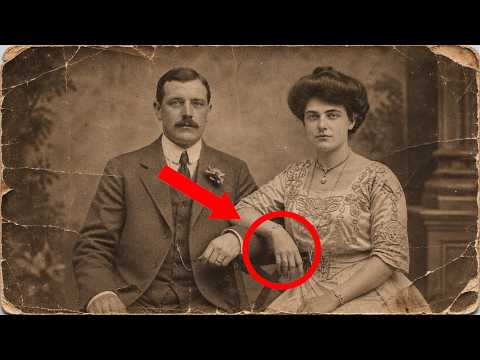
One photograph, however, immediately caught her attention. It was a couple’s portrait dated 1905, showing a man and woman in what appeared to be an expensive studio. The man, in his early 30s with a fashionable mustache and a dark three-piece suit, exuded confidence and wealth. Beside him, a strikingly beautiful woman with dark hair in the elaborate Gibson Girl style wore a richly beaded dress and a substantial diamond necklace.
What struck Rebecca most was their expressions. Both were smiling—unusual for formal portraits of that era, when serious expressions were the norm. Their smiles suggested happiness, as if celebrating an engagement or recent marriage. Yet something about the woman’s smile troubled Rebecca. While the man’s expression seemed genuinely warm, the woman’s smile appeared almost too perfect, too practiced—a carefully crafted mask.
A notation on the back read, “Mr. and Mrs. Harold Whitman, Boston Studio, October 1905.”
Rebecca carried the photograph downstairs to her kitchen, where better lighting would allow her to examine it more carefully. As a graphic designer specializing in digital restoration of historical images, she had developed an eye for subtle details others might miss. Something about the woman’s expression continued to nag at her.
Using her professional-grade scanner, Rebecca created a high-resolution digital copy. When the image appeared on her screen, she was struck by the exceptional quality—the studio photographer had clearly been skilled, capturing sharp detail and subtle gradations of light and shadow.
Rebecca began a systematic examination, zooming in on different areas. The man’s clothing and grooming were impeccable, his hands well-manicured and soft—suggesting someone who worked with his mind rather than his hands. The woman’s attire was even more impressive under magnification: silk with intricate embroidery, and jewelry of exceptional quality. The diamond necklace alone would have represented a substantial investment.
But it was when Rebecca focused on the woman’s face and hands that she began to notice disturbing details invisible at normal viewing distance. The woman’s smile, which had seemed merely artificial at first glance, revealed subtle asymmetries under magnification—a carefully practiced expression rather than genuine emotion.
More troubling were her hands. While her left hand rested elegantly on her lap, her right hand was positioned slightly behind her companion’s chair. Under maximum magnification, Rebecca could see that the woman’s right hand was clenched into a tight fist, her knuckles white with tension. This was completely at odds with the relaxed, happy demeanor she projected.
Even more disturbing was what appeared to be a small dark stain on the woman’s right sleeve, barely visible but clearly present when the contrast was enhanced. The stain had an irregular shape and appeared to have been hastily cleaned, leaving only faint traces.
Most unsettling of all were the woman’s eyes. While her mouth smiled charmingly, her eyes held an expression Rebecca could only describe as predatory. There was a coldness there, a calculating quality completely at odds with the warm, loving expression one would expect from a woman posing with her husband.
Rebecca sat back in her chair, deeply troubled. The cumulative effect of these subtle details created a disturbing impression that this woman was hiding something dark and dangerous beneath her beautiful, charming exterior.
Intrigued and unsettled, Rebecca began researching the Whitman family. Her initial internet searches revealed that Harold Whitman had indeed been a prominent Boston businessman in the early 1900s, involved in successful import and export ventures that had made him quite wealthy.
At the Boston Public Library’s research division, Rebecca found extensive records about Harold Whitman’s business activities and social connections. He had built his fortune through shrewd investments in international trade, particularly importing luxury goods from Europe and Asia for America’s growing wealthy class. Newspaper society pages frequently mentioned his attendance at galas and fundraising events, always describing him as a gentleman of refinement and generosity.
The woman identified as his wife proved more challenging to research. Records showed that Harold Whitman had married a woman named Victoria Ashford in September 1905, just a month before the photograph was taken. Victoria appeared to have no family connections in Boston, and very little information about her background was available in local records.
What Rebecca did find was troubling. Victoria Ashford seemed to have appeared in Boston society quite suddenly in early 1905 with no clear history. She was described in newspaper accounts as a charming widow from Philadelphia who had moved to Boston following the death of her first husband, but Rebecca could find no records of her previous marriage or any family named Ashford in Philadelphia during that period.
The marriage announcement in the Boston Herald had described the wedding as a quiet ceremony attended by intimate friends—unusual for someone of Harold Whitman’s social prominence. Typically, weddings involving the wealthy were elaborate affairs receiving extensive newspaper coverage and attended by hundreds of guests.
Rebecca also discovered that Harold Whitman’s friends and business associates had been surprised by his sudden marriage to a woman none of them had known for very long. Several contemporary letters expressed puzzlement about Whitman’s hasty courtship and marriage to someone about whom so little was known.
One particularly revealing letter written by Whitman’s business partner stated, “Harold seems completely enchanted by his new bride, but I must confess that I find her rather unsettling. There’s something in her manner that strikes me as artificial, as if she is constantly performing a role rather than simply being herself. She asks many questions about Harold’s business affairs and seems unusually interested in financial matters for a lady of supposed breeding.”
Rebecca realized that she was uncovering evidence of a woman who had deliberately constructed a false identity and had targeted Harold Whitman for reasons that were becoming increasingly sinister.
Rebecca’s research took a dark turn when she began investigating what had happened to Harold Whitman after his marriage. What she discovered sent chills down her spine.
According to death records from the Massachusetts State Archives, Harold Whitman had died in February 1906, just five months after his wedding. The death certificate listed the cause as sudden heart failure—a common designation for unexplained deaths during that era when medical knowledge was limited and autopsies were rarely performed.
However, the circumstances surrounding Whitman’s death were suspicious. Newspaper reports indicated he had been in excellent health up until the day of his death, with no history of heart problems. His personal physician, Dr. Edmund Carey, was quoted as saying he was puzzled by the sudden nature of Mr. Whitman’s demise, as he had shown no symptoms of cardiac distress during recent examinations.
More troubling was the timing. Rebecca discovered that just two weeks before his death, Whitman had changed his will to leave his entire estate to his new wife, Victoria. This was unusual because his previous will had divided his wealth among several charitable organizations and distant relatives. The will change had been witnessed by Victoria’s personal attorney, a man named Samuel Morrison, who appeared to have no previous connections to Boston legal circles.
Rebecca’s attempts to find information about Morrison led to dead ends, suggesting he might have been operating under a false identity as well. Following Harold Whitman’s death, Victoria had quickly liquidated his business assets and disappeared from Boston society. The house they had shared was sold within a month of his funeral, and no forwarding address was left with neighbors or business associates.
Rebecca decided to expand her search beyond Boston, looking for other women named Victoria Ashford or similar aliases who might have been connected to suspicious deaths during the early 1900s. What she found was a chilling pattern that suggested Harold Whitman had not been Victoria’s first victim.
In Philadelphia, she found records of a wealthy textile manufacturer named Charles Morrison who had died under similar circumstances in 1904, just six months after marrying a woman described as a charming widow from Baltimore named Virginia Ashworth. The similarities in the names and circumstances were too striking to be coincidental.
Rebecca also found records from Chicago showing that a banker named Robert Patterson had died of sudden illness in 1903 shortly after marrying a woman called Victoria Ashby who had claimed to be from St. Louis. In each case, the pattern was identical: a wealthy, recently married man dying unexpectedly after changing his will to benefit his new bride, who then disappeared with his fortune.
The realization hit Rebecca like a physical blow. She was looking at evidence of a serial killer who had been operating across multiple states, systematically targeting and murdering wealthy men for their money.
Rebecca’s discovery of the pattern of suspicious deaths led her to investigate the specific methods that Victoria might have used to kill her victims. During the early 1900s, forensic science was in its infancy, and many poisons could cause symptoms that would be attributed to natural causes—especially in an era when sudden deaths from heart failure or stomach ailments were commonly accepted without detailed investigation.
At Harvard University’s medical library, Rebecca researched historical accounts of poisoning cases from the early twentieth century. She discovered that several toxic substances were readily available during that period and could be obtained without suspicion by someone who knew where to look. Arsenic was particularly popular among poisoners because it was widely available in rat poisons and agricultural chemicals, and its symptoms could mimic those of common illnesses. When administered in small doses over time, arsenic poisoning would cause gradual weakness, stomach problems, and eventually heart failure—exactly the symptoms reported in Harold Whitman’s case.
Another possibility was digitalis, extracted from foxglove plants, which could cause fatal heart arrhythmias when given in sufficient doses. The drug was commonly used in small amounts as a heart medication, but an overdose would be virtually undetectable without sophisticated chemical analysis that didn’t exist in 1905.
Rebecca also learned about chloroform and other anesthetic substances that could be used to incapacitate victims before administering more lethal poisons. A woman with Victoria’s apparent knowledge of chemistry and human anatomy would have had access to multiple methods for committing undetectable murders.
The more Rebecca researched historical poisoning cases, the more she realized how easy it would have been for someone like Victoria to operate with impunity during that era. Police investigation techniques were primitive, autopsy procedures were inconsistent, and there was a general reluctance to suspect wealthy, respectable-appearing women of serious crimes.
Rebecca found several contemporary medical journals that discussed the challenges of detecting poisoning in cases where symptoms could be attributed to natural causes. One article from 1906 specifically mentioned the difficulty of identifying arsenic poisoning in victims who had died of apparent heart failure, noting that proper chemical analysis required specialized equipment and expertise available in very few locations.
She also discovered that women like Victoria would have had access to information about poisons through medical texts and pharmaceutical guides readily available to the general public. Many household guides of the era included information about the medicinal uses of various plant extracts and chemicals—information that could easily be adapted for more sinister purposes.
The pattern of Victoria’s crimes suggested that she had developed considerable expertise in selecting and administering poisons that would achieve her goals while avoiding detection. Her ability to operate across multiple states and assume different identities indicated a level of planning and sophistication that made her far more dangerous than the typical criminals of her era.
Rebecca realized that she was dealing with one of America’s first female serial killers—a woman who had used society’s assumptions about feminine innocence and respectability to mask a ruthlessly efficient killing operation.
Rebecca’s investigation into Victoria’s background revealed an intricate web of false identities and carefully constructed personas that demonstrated remarkable criminal sophistication for the early 1900s. The woman who had married Harold Whitman was not only a serial killer but also a master of deception who had created an elaborate system for assuming new identities and targeting wealthy victims across multiple states.
Through genealogical databases and historical records, Rebecca traced the various names Victoria had used: Victoria Ashford in Boston, Virginia Ashford in Philadelphia, Victoria Ashby in Chicago, and several other variations that followed similar patterns. Each identity had been carefully crafted with plausible background stories and supporting documentation that would have been difficult to verify in an era before modern communication systems.
At the National Archives in Washington, D.C., Rebecca found evidence that Victoria had been using forged documents to support her false identities. Marriage certificates, death certificates for fictional previous husbands, and even letters of recommendation from non-existent social contacts had all been created with remarkable attention to detail. The sophistication of these forgeries suggested that Victoria was either exceptionally skilled at document creation herself or was working with accomplices who specialized in such activities.
Rebecca found references to a network of criminal associates who operated in major eastern cities during the early 1900s, providing services like false documentation, money laundering, and assistance with disappearing after crimes were committed. One particularly revealing discovery was a police report from New York City dated 1907, which described the arrest of a forger named Samuel Morrison—the same name as the attorney who had witnessed Harold Whitman’s will change. The report indicated that Morrison had been suspected of creating false identity documents for a sophisticated criminal enterprise but had been released when key witnesses failed to appear at his trial.
Rebecca closed the final file and sat in silence, the weight of a century-old secret settling over her. Victoria’s crimes had finally been documented, her victims honored, and the pioneering investigators who stopped her given their due.
She framed the 1905 portrait and hung it in her study—not as a curiosity, but as a warning. The beautiful, smiling woman would forever remind her that evil often wears an attractive mask.
Some evenings, Rebecca still caught herself staring at those predatory eyes, wondering how many other perfect smiles were hiding in the attics of history.
What would you do if you found a killer’s portrait hidden in your own family’s attic?
Report this article
Select a reason for reporting:






