At midnight, in the alley behind a Fifth Avenue mansion, a servant lifts the lid of a wooden barrel and scrapes the remains of a gilded-rimmed plate into it. The plate had returned from the dining room above barely touched—one of a dozen courses that had paraded under the chandeliers and come back almost exactly as it went up. The food was not meant to be eaten. It was meant to be seen, tasted, and then removed to make way for the next dish, in a procession that proved one thing above all: that this house could destroy what the neighborhood could not afford to buy.
For roughly thirty years, from the 1870s to the early 1900s, America’s wealthiest families—and the restaurants and hotels that fed them—prepared, presented, and discarded food on a scale that, set against the hunger in the same streets in the same years, looked like decadence. It was not accidental. It was a rule as fixed as the one dictating which glove a lady removed at dinner. And the barrel at the service door knew more about the family than any painting on the wall.
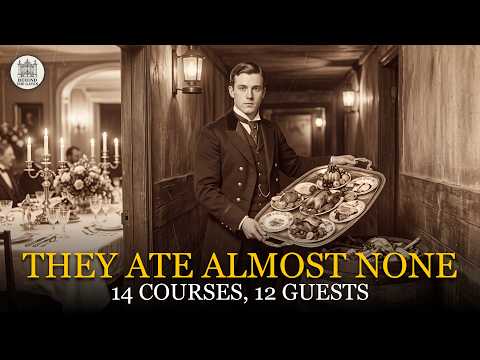
The house was built to be looked at. The eye was meant to travel up the staircase, across the ballroom, through the tall windows to the lawns—never down to the hidden floor below. Yet the true history of one of these houses was not written in its paneling or its porcelain. It was written in that barrel, in what the house rejected night after night, in quantities that would have horrified anyone who had paid for it.
This is the story of a habit hard to see. Not eating, but wasting. And to understand it, you must first understand that the mansion was treated as a living thing, because those who ran it believed it half the time. It had an appetite unrelated to hunger. It had to be fed with extravagance or it would sicken—not in its walls, but in its standing before the Four Hundred who decided who was in and who was out. A house that served a meager table was a house in decline, and decline was the one thing money existed to prevent.
So the house was fed, fed beyond logic, beyond extravagance, beyond the point any human mouth could keep up with. And what the house could not swallow, it passed down through the servants’ floors, until the rest reached the barrel, and the barrel reached the alley, and the alley reached the city—though no one upstairs would have dared say so.
The geography of the house was designed to keep all of this out of sight. There were two of everything. Two staircases—one grand for the family, one narrow for the servants. Two worlds of corridors: bright ones hung with paintings, and plain ones running behind the walls like veins. A guest could spend a week under a great roof without ever once seeing where the food was born or where it died. That was the point.
The servants’ floor, the kitchens, the refrigeration rooms, the ash and refuse of the back entrance—all were carefully designed into the plan to be invisible. So that dinner might seem to come from nowhere, and its remnants seem to leave the same way. Stand for a moment in that unseen part of the house in the late hours. The great rooms above are quiet now. Candles have been carried up, guests have gone to their beds or their carriages. Here below, the work is not finished. A kitchen maid is still at the sinks. A footman still moves between the pantry and the yard. And by the door, the barrel steadily fills, receiving the remnants of a meal that a few people nibbled at while hundreds could have fed on it.
There were dozens of these houses, and they clustered. Along Fifth Avenue in New York, the mansions of the rich stood almost side by side. Along the ocean cliffs of Newport, the summer cottages did the same. Each house ran its own version of the same machine—its own kitchen cooking beyond need, its own rules sending the surplus down, its own barrel at its own alley door. So the waste was not the fault of one house. Across the richest square miles in the country, the same practice repeated itself, from house to house, from night to night, as a shared habit of an entire class. And none who lived inside those walls considered it waste at all. To them, it was simply how a proper house was run; no one thought the barrel a scandal. It was a fact of life so ordinary that no one noticed it—which is the clearest proof of how deeply the habit was rooted.
That barrel is where this story begins and where it will end. Keep it in mind as the story climbs the stairs, because everything above it—the silver, the orchids, the multiple plates, the four hundred names—was found to justify it. The house did not waste because it was careless. The house wasted because waste was the proof. And to see how that proof was manufactured night after night, the starting point is not the kitchen but the table that witnessed the strangest meal in American history—a meal designed from the first oyster to the last sweet to be far more than any person could eat.
The dinner did not look like a meal so much as a parade. What mattered was the quantity of food that passed through the room, and none of it was meant to remain. The lady of the house did not sit down at eight o’clock to satisfy a hunger. She sat down to move slowly and with enormous ceremony through a series of courses so long that finishing any one of them would have been a kind of failure—a sign that she had come to the table to eat rather than to belong.
The shape of that sequence was recorded, taught, and copied across the country. It began almost always with raw oysters or shellfish on ice. Then came soup—often not one but two choices. Then fish, served whole or boned with sauce. Then the light main dishes the French called entrées, arranged so that the heavier dishes came first and the lighter followed. And near the middle, after guests had already eaten more than most families saw in a week, the meal stopped to serve a chilled sherbet—a spoonful of rum-flavored ice whose only purpose was to clean the palate so that eating could resume.
That was the intermission, the halfway mark of a performance only half finished. After the pause came the roasts, the game, the birds presented at the table in their finest dress. Then cold dishes built from the most expensive ingredients the century could import, from truffles dug out of French soil to the fattened liver the French called foie gras. Then sweets, molded creams, fruits forced to grow out of season in glasshouses, small confections set on silver plates. Then coffee, which was never served at the table but carried to the drawing room, so that ending the meal became a change of scene. If you counted, you would find twelve courses or more, often many more.
Each course was a complete dish prepared for the entire table, served in full and then removed, whether it had been eaten or not. In the old style, the food was set out all at once and guests served themselves. In the new style, adopted from the great houses of Europe, the food was presented course by course by a line of servants and carved at the side of the table, away from the guests’ eyes. That new style carried a hidden consequence no etiquette book stated plainly. It meant cooking, presenting, and displaying far more than any guest would ever touch, because each course had to look abundant, complete, and untouched—like a new act in a show.
The books that taught this to America did not hide the scale, though they never called it waste. The most famous American authority on household matters was Sarah Josepha Hale, who edited the magazine that told the rising middle class how the upper class behaved. The English model was the household manual bearing Mrs. Beeton’s name, whose menus ran for pages and pages of dishes for a single evening. From it the hostess learned the order, the timing, the number, and above all the principle. Serve generously. Serve beyond need. Let no guest ever suspect that a calculation was made about how much they might actually consume.
Here you must understand the woman at the head of the table, for she was not foolish, and by the standards of her world she was not cruel. She was afraid. The hostess whose table ran short, whose plates looked thin, whose guests went home saying the evening had been poor, had suffered a wound money existed to prevent. Social death in that world did not come from spending too much. It came from appearing to spend too little. So she instructed her kitchen in the only way her fear allowed. Make more than they can eat. Make so much that the question of scarcity can never be raised. The waste was not the risk she was managing. The waste was the insurance.
And so a rule settled into every great kitchen in the country, unwritten and absolute. Cook for a crowd while the guests are few. Send up abundance and expect most of it to come back. A roast missing three slices returned to the kitchen whole in every way that mattered. A fish barely touched came back down. The dishes that came back down were not seen as food saved. They were seen as food finished, consumed, and disposed of in the only way that counted—being seen.
Consider the hidden arithmetic behind the habit. If one house entertains through a season, each dinner running twelve courses or more, each course cooked for a full table and returning largely intact, then the surplus was not incidental overflow. It was a nightly flood, engineered, expected, and enormous. The kitchen did not fail to plan for it. The kitchen planned for nothing else. Every copper pot and every hour of every cook’s time was devoted to producing more than the house could absorb, because the alternative—a thin table—was unthinkable.
The style of service itself sharpened the waste. Under the newest fashion, food was no longer placed on the table for guests to help themselves. Each course arrived in its turn, arranged and divided outside the dining room, then set before each guest looking full and freshly made. This meant the kitchen had to prepare, present, and stage far beyond what the table could hold, because every course had to look ample, every dish had to arrive complete. The little glass of iced punch in the middle existed only to let guests pause and begin again, a signal that the procession had covered only half its route and more was waiting.
That was the machine—a dinner designed from its first course to overflow, run by a class that feared a thin table more than almost anything except the loss of its social place. But such a machine did not appear in a thousand private houses on its own. Someone had to set the pattern first, in public, on a scale that dazzled everyone, so that every hostess in the city had a temple to imitate. And that temple stood on Madison Square behind a plain door, under a name that meant, to anyone who mattered, the summit of what a rich man’s table should be.
Before the mansions could waste like kings, someone had to teach them how, and the school was on Madison Square. Its name was Delmonico’s, and for more than a century it was not merely the finest restaurant in America. It was the place where wealthy Americans learned how dining at the top was supposed to look, and then carried the lesson home to their own tables. The halls seated roughly 250 guests, a dining room on a scale the young republic had never seen for entertaining. The kitchens behind those halls could send out the full procession—twelve courses, the sherbet interlude, the game birds, the truffles—for hundreds at once.
The subscription banquet, one of the great organized dinners where the city gathered to honor a guest or a cause, cost roughly twelve to fifteen dollars a head in the mid-1880s, a sum that could keep a working family for weeks. And the menus themselves were pieces of theater. Some were printed by Tiffany & Co., so that the card announcing the food was a small object of luxury, kept and admired. To dine at Delmonico’s was to enter the theater of service in its finest form.
In the summer of 1885, the restaurant held a banquet for the French officers who had carried across the Atlantic that great copper statue destined for the harbor—the figure the world now calls the Statue of Liberty. That evening was the ideal expression of the genre. Among its touches was a sherbet served in little boats made of spun sugar, each carrying the flags of France and the United States. A dish whose entire reason for existing was to be looked at and admired before it melted and vanished. Nothing in it was necessary. Everything in it was the point.
The men who ran these houses became famous in their own right. The Delmonico family built the institution across generations, and their rival, the caterer and restaurateur Louis Sherry, built his own grand establishment on Fifth Avenue so that the rich could choose between two temples of the same religion. Between them, they set the standard by which private houses measured themselves. When a hostess planned her dinner, she competed in her mind with what Delmonico’s or Sherry’s could put on a table. And often she simply hired one of them to do it, so that the same hands that decorated public banquets decorated her private ones as well.
This is the thread to hold. The extravagance of the great houses was not invented from nothing in each kitchen. They learned it from a public model, refined it in these famous rooms, printed it on these beautiful cards, and then reproduced it behind closed gates along Fifth Avenue and across the cliffs of Newport. The restaurant taught the pattern. The pattern required the surplus. The surplus filled the barrel.
But notice what the pattern was truly selling, because at its heart it was never the food. The banquet at Delmonico’s was a means of belonging, a way to be seen among the right people, a proof that you could reserve the best rooms and the best tables in America. The dishes were the vehicle. The message was status. And when a class organizes its most extravagant spending around status rather than pleasure, it will always tend toward excess, because there is no natural stopping point in the pursuit of rising above others. You cannot be ranked high enough. You cannot visibly spend too much. You cannot put too much on the table.
Step back and look at the money and the scale for a moment—not as figures on a card, but as the shape of an entire world. A dining room built to seat 250. A banquet costing each guest more than a workman earned in two weeks. Menus printed by a jeweler. Ices served in sugar boats and eaten, if eaten at all, with a single spoon. Two rival temples on the same avenue, each sending out a full procession for hundreds at once. This was the public face of Gilded Age dining—the part written up in the papers and remembered with a smile.
The famous rooms made famous nights, and the newspapers loved them. Delmonico’s lent its kitchens and its name to the greatest occasions of the age. Banquets were how the city honored a visiting hero or celebrated a great event, and they were reported course by course as if the menu itself were the news. The restaurant fed all of New York’s elite society, and the dishes invented in its kitchens entered the language and were copied everywhere afterward. To host a private dinner prepared by Delmonico’s, or later by Sherry’s, was to borrow the prestige of that temple for your own table. And that is precisely what the wealthiest families did, hiring the great caterers to adorn their stone mansions.
What this meant in practice was that the standard of extravagance migrated from a few public halls into a thousand private dining rooms. The same cooks, the same suppliers, the same expectation of limitless abundance passed from the restaurant to the mansion and back again. The hostess planning her evening did not need to invent its scale. She inherited it ready-made from those temples that had already defined the great table. And the great table, at its core, always meant a table carrying many times what any person present could eat.
Behind that facade were mechanisms the guests never saw, and here the story turns. Because the pattern was never really about food. It was about who was allowed into the room. And to keep that room running—to send up the endless courses and clear away the endless remnants—the great houses needed something far larger and far more hidden than a famous chef. They needed an army. An army that woke before the family woke and worked long after the family slept. An army whose entire existence was devoted to feeding a building that could never be satisfied. That army and the rules that governed it are where the story goes now.
The army is gone now. The fires are cold, the servants long since dismissed, the barrels carried away a century ago. What remains is the house itself, standing silent with its bright rooms above and its working rooms below, and a plain iron-hooped barrel that once waited by the service door—remembered only by those who know how such places were run.
Return to that door one last time, on the final night of the season, and watch the servant lift the lid and scrape the gilded plate into the dark. None of that food had been touched to speak of. All of it was the point.
I have one question before you go. Of all the tables in this story, which one would you most want to see cleared at the end of the night—and what do you think you would find in that barrel? Tell me in the comments below.
Report this article
Select a reason for reporting:






