Dr. Maya Richardson’s fingers trembled as she held the sepia photograph up to the dim light of the Philadelphia auction house. Rain drummed against the tall windows, but she barely heard it. Her eyes were fixed on the young Black woman in the portrait—high-collared blouse, hair pulled back, expression serene yet quietly defiant. It was a typical studio portrait from 1903, cataloged simply as “unknown subject.” Maya had almost passed it by. Then she noticed the woman’s hands.
Barely visible on the right palm were faint, deliberate markings—circles, crosses, lines, and what looked like stylized letters. “This isn’t damage,” Maya whispered, her historian’s intuition igniting. “These are symbols. A code.” Her heart raced. She had spent fifteen years searching for untold stories of early Black activism, and now, in a dusty auction house, she was holding a doorway into a hidden history.
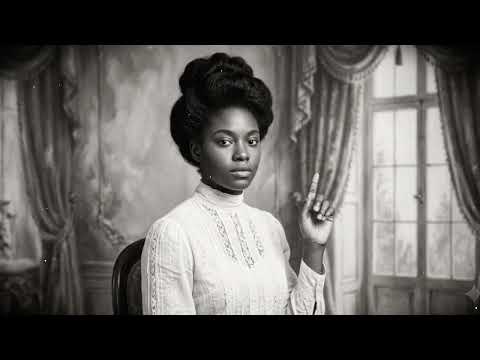
She bought the photograph for $50, outbidding a indifferent dealer. Back in her West Philadelphia apartment, cluttered with archival boxes and research notes, Maya placed the portrait under a digital microscope. The symbols sharpened: a circle with a horizontal line, two crosses at specific angles, a crescent, a vertical line with dots. Seven distinct marks, purposefully drawn. She cross-referenced them against Masonic symbols, fraternal orders, church records—nothing matched.
At 3 a.m., exhausted, she turned the photo over. The photographer’s imprint read: Thornton & Sons, Washington, D.C., 1903. A time when Black women were excluded from mainstream suffrage groups, forced to organize in secret. Maya’s pulse quickened. “What if these symbols were created for a specific, clandestine purpose?” she murmured.
The next afternoon, she sat in Dr. James Chen’s meticulously organized office at Georgetown. A symbology expert, James examined the image under his own equipment. “These aren’t random,” he said, tracing each mark on his tablet. “They’re too deliberate. A private language.” They spent hours developing theories: meeting places, times, warnings. The crescent could mean a lunar phase; the crosses, specific locations. But they still didn’t know who the woman was.
Maya buried herself in the Library of Congress, combing through boxes of records from Black women’s clubs. On the third day, in a box labeled Colored Women’s League of Washington, Correspondence 1902–1905, she found a letter. Dated March 15, 1903, it read: “I have commissioned a portrait at Thornton Studio, as you suggested, to preserve our record… Remember our sign in solidarity. —C.M.” Maya’s hands shook. C.M. Clara Montgomery. A schoolteacher, active in the league, and a member of something called the Citizens Rights Circle—an organization she’d never heard of.
At Howard University’s Moorland-Spingarn Research Center, archivist Dr. Evelyn Harper laid out a fragile scrapbook. “The Citizens Rights Circle was an underground network of Black women advocating for universal suffrage,” she explained. “They developed a symbolic code to identify each other and communicate safely. This scrapbook belonged to Reverend Sarah Watkins.” Maya read an entry: “We have adopted the marks of identification… a means of recognition in times of danger.” Her breath caught. The symbols on Clara’s hand were a secret language.
Dr. Harper retrieved a box labeled Montgomery Family Papers. Inside was Clara’s leatherbound journal. Maya opened it carefully. The first entry, January 10, 1901: “Arrived in the capital today… Silence is a luxury I cannot afford.” Months later: “We will call ourselves the Citizens Rights Circle.” And then, March 12, 1903: “Tomorrow I will have my portrait made… to preserve evidence of our work for future generations, who may wonder if we even existed.”
Maya looked up, tears blurring her vision. Clara Montgomery wasn’t an unknown subject. She was a revolutionary hiding in plain sight. “I need to find her family,” Maya whispered. The journal contained a detailed family tree. Clara had married in 1907, had three children, and lived until 1958. Her great-great-granddaughter, Simone Carter, lived in Silver Spring, Maryland.
Maya sent a careful email that evening, explaining who she was, what she had found, and why it mattered. She attached a digital copy of the portrait, then hesitated before hitting send. What if Simone thought she was a crank, a stranger peddling a sentimental fantasy about a forgotten ancestor?
The reply arrived within hours. “Dr. Richardson, my family has always known that great-great-grandmother Clara was involved in activism, but we have very few details. Please come. Sunday afternoon.”
Sunday arrived cold and bright, snow beginning to fall as Maya drove to Silver Spring. Simone’s split-level house was warm and alive—children’s voices, a kitchen radio, the smell of cooking greens and cornbread. Simone herself was a high school principal in her early forties, with Clara’s same intelligent eyes and determined chin.
In the living room, several family members had gathered. Maya spread her materials across the coffee table: the photograph, copies of Clara’s journal entries, the documents from the Citizens Rights Circle. The room fell silent.
Simone’s mother, Mrs. Angela Carter, picked up the portrait with trembling hands. “I’ve never seen this picture before. Look at her. So young, so serious. We have photos of her from when she was older, but nothing from this time in her life.”
Simone studied the symbols on Clara’s palm. “We had no idea. What did they mean?”
Maya explained the coded network—the marks of identification, the secret meetings, the quiet boycotts, the women who organized below the radar because visibility could mean violence. She described how Clara and her sisters had preserved their own record, leaving proof for a future that might otherwise forget them.
Simone’s teenage daughter, Trinity, leaned forward. “So my great-great-grandmother was basically a spy?”
Maya smiled. “Not exactly a spy. But she was operating in resistance. She and the other women were risking their safety and their livelihoods for rights that wouldn’t be fully recognized for decades. Black women didn’t get the practical right to vote in many places until 1965—more than sixty years after this photograph was taken.”
Mrs. Carter wiped her eyes. “We always knew she was special. She lived with my grandmother for the last years of her life. Even when she was very old, she told us stories about the work. We thought she just meant teaching.”
Simone asked for copies of everything. Maya promised them, then made a proposal: “I’d like to work with your family on a larger project—documenting Clara’s story and the Citizens Rights Circle, bringing this hidden history into the light.”
The family spent the rest of the afternoon sharing stories and old albums, piecing together Clara’s life beyond the activism. She had been a beloved teacher, a devoted mother, a talented baker famous for her peach cobbler. She had loved poetry and sung in the church choir. She had been a complete person—not a symbol, but a woman with dreams, fears, joys, and struggles.
As Maya prepared to leave, Trinity followed her to the door. “Dr. Richardson, why do you think she put the symbols where people could see them, even if it was risky?”
Maya considered the question carefully. “I think she wanted to be seen—not just by her contemporaries, but by us. By people in the future. She wanted us to know that she existed, that she fought, that she mattered.”
Trinity nodded slowly, as if filing the answer away for later. “Then we can’t let her down.”
Back in Philadelphia, Maya sat at her dining table with Harriet purring in her lap and began drafting an email to Kesha Williams, a Washington Post journalist known for historical features with contemporary relevance. Between them, she knew, lay the power to turn one woman’s coded portrait into a national conversation.
She attached the photograph, the journal excerpts, and a short summary. Then she typed a single line in the subject field: “The Secret Code of the Suffragists—a story you won’t believe has been buried for 120 years.”
Her finger hovered over the send button. Outside, the snow fell steadily, softening the city into silence. Somewhere in the archives, Clara Montgomery’s symbols waited—patient, deliberate, certain that someone would eventually look closely enough to see.
Kesha Williams replied within the hour, her email terse but electric: “I’m in. Can we meet tomorrow? Bring everything.” Maya barely slept that night, rehearsing the story in her head, anticipating the questions a seasoned reporter would ask. By morning, she had triple-checked her sources and packed the photograph, the journal copies, and her research notes into a rigid leather portfolio.
The Washington Post conference room overlooked K Street, the winter cityscape gray and sharp beyond the windows. Kesha was a compact, sharp-eyed woman with a reporter’s restless energy. She spread Maya’s materials across the table, studying the portrait with the focused attention of someone who knew a good story when she saw one.
“A secret network of Black suffragists operating underground while history focused on the white suffrage movement,” Kesha murmured. “The timing is perfect. People are hungry for the voices that were deliberately silenced.”
Maya leaned forward. “Clara and the women of the Citizens Rights Circle deserve recognition. Their strategies, their courage, their vision—it all needs to be part of the national conversation about suffrage history.”
Kesha made notes on her tablet. “I’ll need to verify everything independently. Interview the family, consult other historians, confirm the archival sources. But if this checks out—and I believe it will—we’re looking at a major feature. Possibly a series.” She glanced up. “Have you considered the broader implications? This could reshape how we teach suffrage history.”
Maya exhaled. “I’ve been thinking about nothing else. For too long, the narrative has centered white women while erasing or minimizing the contributions of Black women who faced both racism and sexism. Clara and her colleagues weren’t just fighting for the vote. They were fighting for fundamental human dignity.”
Over the next two weeks, Kesha worked the story relentlessly. She interviewed the Montgomery family, Dr. Harper at Howard, and James Chen about the symbols. She cross-referenced census records and traced the Citizens Rights Circle through church archives in Baltimore and Philadelphia. The article grew from a feature into a major investigative piece.
On a cold February morning, the story broke online: “The Secret Code of the Suffragists: How Black Women Fought for the Vote in Plain Sight.”
The response was immediate and overwhelming. Within hours, the article had been shared thousands of times. Historians, educators, and activists wrote to Maya expressing shock that this history had been so thoroughly buried—and pride in the ingenuity of these forgotten women. Other researchers came forward with similar coded photographs from their own collections. Descendants of Citizens Rights Circle members asked for help learning about their ancestors.
The Smithsonian’s National Museum of African American History and Culture called, expressing interest in acquiring the photograph and related materials for its permanent collection. The National Archives proposed a collaborative oral history project. A documentary producer from PBS left three voicemails in a single afternoon.
That evening, Maya sat in her apartment watching the sun set over Philadelphia, Harriet curled in her lap. On her laptop screen, Clara’s portrait glowed in the fading light—that young woman with her quiet defiance and her hidden symbols, finally seen.
Her phone rang. Simone Carter’s voice was thick with emotion. “Dr. Richardson, my family and I don’t know how to thank you. Trinity has been reading everything she can find about Clara. She’s writing a paper about her for her history class. She’s so proud. We all are.”
Maya felt tears welling up. “Clara did the work. I just helped bring it to light.”
“That’s everything, though,” Simone said. “That’s what she wanted—for someone, someday, to look closely enough to see. And you did.”
Maya hung up and sat for a long moment in the quiet. Then she opened a new document and began to type. The first line read: “This is the story of a woman who refused to be unknown.”
She had no idea yet how far that sentence would carry her—or how many other hidden women were waiting, in attics and archives and auction houses, for someone to look closely enough to see them too.
Six months later, the Smithsonian’s Coded Courage exhibition opened to a crowd of hundreds. Maya watched Simone and Trinity stand before Clara’s restored portrait, the symbols now enlarged and legible. “She’s talking to us,” Trinity whispered. “She’s saying, ‘I was here. Don’t forget us.’”
Mrs. Carter wiped her eyes. “And we won’t. Not anymore.”
A graduate student approached Maya, breathless, clutching a trunk of papers from a Baltimore church group. “Some of the correspondence mentions the marks,” she said. “There’s another chapter.” Maya felt hope surge—dozens of women still waiting to be found.
Driving home through the Maryland countryside, Maya thought of all the photographs still sitting in attics and auction houses, all the breadcrumbs left by women who trusted the future to look closely. Clara had smiled for a camera in 1903, positioning her hand to reveal her secrets. A century later, the message was finally received.
She had existed. She had fought. She had mattered.
How many more hidden women are waiting in your family’s attic, hoping someone will finally look closely enough to see them?
Report this article
Select a reason for reporting:






