On the morning of March 11, 1888, New Yorkers woke to a forecast of mild spring weather. Bakers fired their ovens, newsboys stacked papers, and Wall Street clerks pulled on their overcoats. Nobody knew that within 24 hours, the greatest city in the Western Hemisphere would be swallowed whole by a wall of white. 200 people in Manhattan alone would freeze to death, many standing upright in snowdrifts taller than a two-story building. There were no snowplows, no salt trucks, no emergency alerts. When the wind started screaming down Broadway at 85 mph, the most powerful city in America discovered just how fragile modern life really was.
But here’s the strange thing: winter was not new to Americans. For nearly 300 years before the invention of the modern snowplow, cities from Boston to Chicago found ways to keep the mail moving, the markets stocked, and the babies born. How did colonial farmers, 19th-century shopkeepers, immigrant laborers, and horse-drawn streetcars actually survive a blizzard? The answer is stranger, grittier, and far more clever than you might expect. Because before the snowplow, Americans did not fight the snow. They lived inside it.
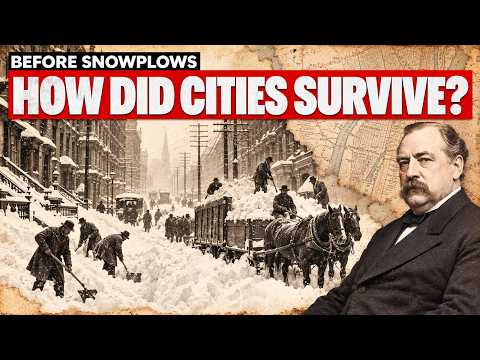
To understand how cities survived winter, you have to understand something obvious but easy to miss: for most of American history, roads were not paved. They were dirt. In summer, they turned to dust. In spring, they melted into mud so deep that wagons sank up to their axles. Then came the snow. And here’s the part that surprises modern readers: snow was not the enemy. Snow was the friend. When a hard freeze locked down the countryside and a good storm laid down 12 to 18 inches of packed snow, wheeled wagons vanished and sleighs came out. Sleigh runners glided over the compacted white surface at speeds no summer wagon could match. Loads that took three horses to pull through October mud could be pulled by one horse in January.
Farmers hauled logs, cordwood, ice blocks, and grain to market on runners. Country doctors made their rounds behind a single trotting horse and a jingling bell harness. Rural New England had a word for the winter economy: sleighing season. They looked forward to it the way modern Americans look forward to a long weekend.
The colonists learned this lesson the hard way. When the first English settlers arrived in Massachusetts, they had no idea what a real North American winter could deliver. Europe was cold, but Europe was also moderated by ocean currents and centuries of cleared roads. New England was something else entirely. The 17th century sat inside a global cold snap that climate scientists now call the Little Ice Age. Winters between the 1600s and the early 1700s were savage. Rivers froze solid, harbors iced over, and then came the storm that seared itself into the colonial memory forever: The Great Snow of 1717.
Between February 27 and March 7 of that year, a series of four back-to-back nor’easters buried New England under snow so deep that even the oldest Native American elders said their ancestors had never described anything like it. Boston received roughly 40 inches. Towns north of the city got over 70 inches. Northern Massachusetts sat under 8 to 16 feet of snow when the last flake finally fell. Drifts climbed to 25 feet, taller than most colonial houses. Livestock froze standing up in the fields. When the snow finally melted weeks later, farmers found cattle still on their feet, dead but upright, held in place by the ice that had entombed them. New England lost an estimated 90% of its deer population. Wolves, foxes, and wildcats, driven by starvation, raided sheep pens and pigsties. It was a catastrophe, and it forced the colonies to think, for the first time, about winter as a systemic problem.
Here is what colonial towns actually did. There were no city snow crews. There were no plow contractors. Instead, every able-bodied man in a New England town was legally obligated to work on the roads. In some towns, the position of surveyor of highways carried the authority to call out every adult male in the community during an emergency. When a nor’easter buried the post roads, teams of men strapped on snowshoes and went out with wooden shovels to open a single narrow trench through the drifts. Sometimes they used oxen and a heavy log to drag a channel through the softer snow. This was called breaking the road. It was brutal, unpaid labor, and it was considered a civic duty as basic as jury service.
In coastal Massachusetts, when the Great Snow of 1717 finally paused, the only man who managed to get the mail through from Boston to New York was a lone postman who abandoned his horse, strapped on snowshoes, and walked. The rest of the postal system simply stopped. Ministers preached to empty churches for two straight Sundays because congregants could not tunnel out of their houses. Cotton Mather, the famous Boston preacher, wrote at length about the storm, describing how families had to climb out of their second-story windows because the first floor was buried. That image of colonial families crawling out of their upstairs windows onto packed snow that reached the eaves tells you everything you need to know about how Americans dealt with winter. They did not clear the snow. They climbed on top of it.
For nearly a century after the Great Snow, this remained the standard approach. Roads were treated as a common resource. Snow was treated as a seasonal fact of life. If you owned a shop in Boston or Philadelphia or New York, you were expected to clear the sidewalk in front of your property. If you did not, you might face a small fine or more likely a scolding from your neighbors. But there was no municipal machine. There was no city hall department of snow. There were just men, shovels, oxen, and horses. And there was the sleigh.
You cannot understand 19th-century urban winter without understanding the sleigh. In New York City, when heavy snow shut down the wheeled omnibuses, the same company simply switched their horse-drawn carriages onto sleigh runners overnight. By 1833, the city had licensed 80 omnibuses to run on fixed routes. By 1854, that number peaked at 683 vehicles. When the snow came, they became sleighs. Large four-horse commuter sleighs ran up and down Broadway, ferrying office workers between their homes and the counting houses of lower Manhattan.
Wealthy families owned private sleighs, hand-built in specialized workshops in Nyack, New York, and in Portland, Maine. The two great American sleigh designs, the Albany cutter and the Portland cutter, were as iconic in their era as the automobile brands of the 20th century. An Albany cutter with its swan-curved sides and bright red paint might cost as much as a small house. A basic work sled, called a pung, hauled goods and children and firewood for the merchant class. In the countryside, doctors ran calls in sleighs. Farmers delivered milk in sleighs. Undertakers carried coffins in sleighs. Weddings, funerals, and elopements all happened on runners.
But sleighs only worked on packed snow. Loose fresh snow, especially the deep drifting kind that came with a nor’easter, was almost as bad for a sleigh as a bare cobblestone street. The runners had to have a hard, smooth surface to glide across. This created a problem. When a town got 24 inches of fresh powder, the sleighs could not run until somebody, somehow, packed it down. And this is where one of the strangest, most forgotten machines in American transportation history enters the story: the snow roller.
Imagine a giant wooden barrel roughly 6 to 8 feet in diameter, sometimes as much as 10 feet wide, mounted on a heavy axle. The barrel is built like a whiskey cask, out of thick oak or pine staves bound with iron hoops. On top of the barrel, there might be a wooden crib filled with rocks for extra ballast. Attached to the front is a long wooden pole called a tongue. Now, hitch six horses to that tongue, or four oxen, or in the deepest snow, a team of 10 animals hauling in tandem. Put two bundled-up men on a small seat above the roller, drape them in bearskins and wool blankets, and send them out into the storm.
As the horses lean into their harness and the barrel begins to roll, it does not scrape the snow away. It flattens it. It presses the loose crystals into a hard, smooth surface, strong enough to hold a fully loaded sleigh. The men on top control the team with reins and voice commands. The horses steam in the cold air. The runners of the roller creak. The harness bells jingle. This was the sound of a New England town waking up after a storm from roughly 1880 through 1930. If you lived on a country road in Vermont or New Hampshire or upstate New York, the arrival of the snow roller was as welcome as the arrival of the mail truck is today. It meant the world was open again.
Snow rollers were run by the towns themselves. A town might own a single roller, kept in a shed behind the town hall. A rotating crew of local farmers was paid a small stipend to run it after each storm. The typical roller could pack a lane about 12 to 15 feet wide. When the drifts got too deep for the roller to climb, a team of shovelers went out ahead of it and cut a channel down to a manageable depth. This was hard, cold, dangerous work. Men died of exposure. Horses collapsed and had to be shot in the traces. But it kept the commerce of rural America moving. And in the growing towns of the interior, snow rollers even worked on Main Street, packing down the market square so that farmers coming in with sleighs could set up their stalls.
Now, here is the key point. The snow roller worked because everybody agreed on the same rules. Rural New England, rural New York, rural Michigan, rural Wisconsin, all of these places had legal and cultural frameworks that treated snow as something you packed down and lived on top of. Even city governments in Milwaukee and Chicago, when they finally started dealing with snow at a municipal level, initially tried to compact rather than remove. But by the middle of the 19th century, something was changing. American cities were growing at a pace no one had ever seen.
Between 1840 and 1880, New York City’s population exploded from 300,000 to nearly 1.2 million. Chicago went from a muddy trading post of 4,000 people to a metropolis of half a million. And with that growth came a new problem that the sleigh economy could not solve: streetcars. Beginning in the 1830s in New York and spreading across every major American city by the 1860s, horse-drawn streetcars ran on iron rails set into the pavement. They were faster than omnibuses. They carried more passengers. They were the backbone of urban mass transit. And they had one fatal winter weakness. They ran on wheels, not runners. Their steel wheels rode in shallow groove tracks. When snow filled those tracks, the streetcar stopped. Not slowed, stopped completely.
A single heavy snowfall could shut down the transportation network of an entire American city for days. And this was no longer a rural problem where you could just wait for the sleighs to break through. This was tens of thousands of factory workers, dock hands, seamstresses, and shop clerks who could not get to work. Which meant employers could not open. Which meant food deliveries stopped. Which meant a city of a million people started running out of bread within 72 hours.
The first American city to say enough of this was Milwaukee. In 1862, in the middle of the Civil War, Milwaukee city fathers approved the first documented use of a horse-drawn snowplow on public streets. It was a simple contraption. Two heavy wooden wedges mounted at an angle behind a team of six horses dragged along the cobblestones to push snow to either side of the street. It did not remove the snow. It just piled it against the curb, sometimes six or seven feet high. Merchants complained bitterly that plow ridges blocked doorways, sleighs could not cross the mounds, and foot traffic had to climb over them. But the streetcars ran. And that was what mattered.
Word spread. Chicago bolted plows onto its streetcars themselves, each departing car shoving a small wedge of snow ahead of it. Boston’s private streetcar companies bought their own plows to clear their own routes. But there was no consistent policy, no municipal budget line, no organized labor pool. Everything was ad hoc.
New York tried a different model. Snow removal belonged to the Metropolitan Police Department. On heavy snow days, uniform officers were sent out with shovels to dig out major intersections. Cops hated it. Political favoritism decided whose blocks came first. In 1881, the city admitted the police model was broken and handed snow removal to a new Department of Street Cleaning, which hired armies of immigrant day laborers at $2 a day.
By the night of March 11, 1888, the American city stood fragile, dependent on horses, shovels, and improvisation. Then came the Great White Hurricane. What would you have done, trapped on an elevated train above a buried Broadway?
Report this article
Select a reason for reporting:






