Dr. Maya Robinson had seen thousands of old photographs in her years as curator of Southern history at the Charleston Heritage Museum. But on that quiet afternoon, as she examined a high-resolution scan of a 1900 portrait of the Whitmore family, something made her pause. The image seemed ordinary—a wealthy family posed stiffly in their parlor, surrounded by the trappings of turn-of-the-century prosperity. Yet a glint in the background mirror caught her eye.
She zoomed in, her heart rate quickening. There, reflected in the glass, stood a figure behind the camera—a black man in his thirties, his face partially visible as he leaned over the large-format equipment. “That’s impossible,” Maya whispered. In 1900 Charleston, black photographers were virtually unheard of in mainstream records. Yet here was undeniable evidence of a skilled artist whose talent had been trusted by one of the city’s most prominent white families.
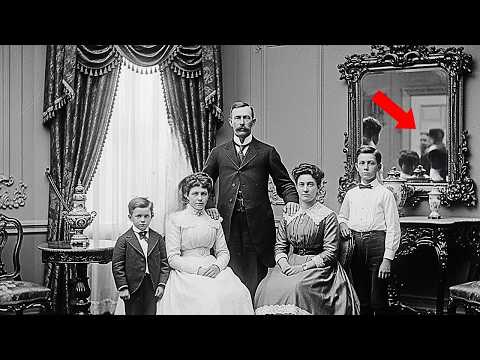
Maya sat back, her mind racing. Who was this man? How had he come to photograph the Whitmores? And what other stories had been hidden in plain sight? She reached for her phone—this discovery was just the beginning.
The next morning, Maya descended into the museum’s basement archive, surrounded by decades of documents. She had barely slept. Starting with city directories from 1895 to 1905, she ran her finger down segregated columns. Under photographers, three white-owned studios were listed. In the colored section, none. “Of course not,” she muttered.
Her colleague James appeared with two cups of coffee. “You’ve been down here since 7,” he said. Maya turned her laptop toward him, showing the enhanced reflection. James’s eyes widened. “Is that who I think it is?”
“A black photographer in 1900 working for the Whitmore family,” Maya confirmed. “I need to find out who he was.”
James pulled up a chair. “The Whitmores kept meticulous records. They donated their papers to the university library years ago.” Maya nodded—that was her next stop.
An hour later, in the special collections room, Maya carefully turned the pages of the Whitmore family ledger. There, dated April 15th, 1900, was a single line: “Payment for portrait services, $3—S. Crawford.” A name. Finally, a name.
She searched genealogical databases for Samuel, Steven, Simon Crawford. Dead ends. Then, buried in a 1900 census record, she found him: Samuel Crawford, 32, occupation listed as laborer. Laborer—the census taker hadn’t even recorded his true profession. Maya photographed the entry, her hands trembling. Samuel Crawford had been invisible in his own time, his artistry hidden behind a generic occupation. But she could see him now, and she was determined to bring his story into the light.
The next morning, Maya drove to the Coming Street corridor, where Samuel had lived. The house was gone, replaced by a community garden. An elderly woman tended tomatoes. “Excuse me, ma’am. I’m Dr. Robinson from the Charleston Heritage Museum. I’m researching the history of this block.”
The woman looked up. “History? Well, you’ve come to the right person. I’m Dorothy. My grandmother lived on this street her whole life.” She gestured to a bench under a magnolia tree. “Sit with me.”
Maya showed her the enhanced photograph. “I’m looking for information about a man named Samuel Crawford. He was a photographer who lived here in 1900.”
Dorothy’s eyes lit up. “Samuel Crawford. Lord, I haven’t heard that name in years. My grandmother mentioned him. Said he was the one who took pictures of folks when nobody else would. The white studios wouldn’t serve black customers back then.”
“Did she say anything else about him?” Maya asked.
“She said he had a studio. Not on this street. Somewhere he had to keep quiet about. White folks didn’t like black men having businesses they didn’t control. But people knew. If you wanted your wedding photographed, your baby’s first portrait, you went to Samuel.” She paused. “Grandmother also said he was brilliant—and that white families would hire him secretly because his work was better than anyone else’s in Charleston.”
Maya felt a chill despite the warm morning air. “Do you know what happened to him? Where his studio was?”
“That I don’t know, but my cousin Robert might. He’s been working on our family tree for years, collecting stories. Has boxes of old papers and photographs.” Dorothy pulled out her phone with surprising dexterity. “Let me call him.”
Twenty minutes later, Maya was driving across town to meet Robert. The investigation was expanding, one connection leading to another, each conversation peeling back another layer of history that had been deliberately obscured.
Robert’s bungalow sat north of downtown, its porch swing creaking gently in the breeze. He answered before Maya could knock—a tall man in his sixties with kind eyes and a historian’s eager energy. “Dorothy called ahead,” he said, ushering her inside. “I’ve been pulling out everything I have on the Coming Street community. Nobody’s ever asked about Samuel Crawford before.”
He led her to a basement transformed into a personal archive. Plastic bins lined the walls, each labeled with family names and date ranges. A large worktable stood at the center, already covered with photographs, letters, and documents. “I’ve been collecting family histories for thirty years,” Robert explained. “Most black families in Charleston lost their records—fires, floods, families scattered during migration. But something survived.”
He opened a particular bin and carefully laid out a series of photographs. Maya’s breath caught. Unlike the formal Whitmore portrait, these showed everyday black life in turn-of-the-century Charleston—a woman in her Sunday dress outside a church, children playing in a yard, a young couple on their wedding day. Each was mounted on heavy card stock with an embossed stamp in the corner: S. Crawford Photography.
“My God,” Maya whispered. “These are his work.”
Robert nodded, pointing to the wedding photograph. “My great-great-grandmother is in this one. She married in 1902. According to family stories, Samuel was the only photographer who would take the time to make everything perfect. He’d arrange people, adjust the lighting, talk to them until they relaxed. Most white photographers treated black customers like they were processing criminals. But Samuel treated everyone like they mattered.”
Maya examined each photograph. The technical quality was extraordinary—sharp focus, thoughtful composition, perfect exposure. Each image captured genuine emotion, dignity, humanity. “There’s more,” Robert said quietly. He pulled out a leather-bound ledger, its pages yellowed but intact. “I found this at an estate sale five years ago. I think it belonged to Samuel.”
Maya opened the ledger with trembling hands. Page after page listed appointments, client names, prices, brief notes—entries running from 1897 through 1903. She recognized names from Charleston’s black community: teachers, ministers, business owners. But interspersed among them were other entries written in different ink, almost code-like. W family, April 15th, 1900. Three dollars. Discretion required.
“He was photographing white families, too,” Maya said, her voice barely a whisper. The pattern was becoming clear. Samuel had operated two separate businesses—one serving Charleston’s black community openly, another serving white clients who sought his superior skills but required absolute secrecy.
Three days later, Maya returned with archival equipment, a 1900 map of Charleston spread across Robert’s worktable. She pointed to a narrow alley behind King Street. “The ledger mentions a rear entrance and a King Street location multiple times. I checked property records. In 1898, a man named Thomas Wright—a black carpenter—owned this building. I think Samuel rented space from him.”
Robert studied the map. “That building still exists. It’s a boutique now, but the structure is original. Want to take a look?”
An hour later, they stood in the alley behind a renovated storefront. The current owner, a friendly woman named Lisa, had agreed to let them explore after Maya explained her research. “The upstairs hasn’t been renovated yet,” Lisa said, unlocking a door that led to a narrow staircase. “Previous owner used it for storage.”
The stairs creaked as they climbed. At the top, Lisa pushed open a door, and they stepped into a long, narrow room with high ceilings and windows facing north—perfect for consistent natural light. The space was filled with decades of accumulated junk: broken furniture, old boxes, dust-covered equipment. Maya’s trained eye went immediately to the windows. North-facing light, essential for portrait photography.
Robert was examining the walls. “Look at this.” He pointed to marks on the wooden floor—indentations where heavy equipment had once stood. “These could be from camera tripods.”
They spent the next two hours carefully moving boxes and furniture, searching for any trace of Samuel’s presence. Maya was photographing the window frames when Robert called out from the far corner. “Maya, you need to see this.”
He was kneeling beside a loose floorboard he had pried up. Beneath it was a hollow space, and inside that space was a metal box, its surface covered in rust and dust. With shaking hands, Maya lifted the box out. It was locked, but the lock was old and corroded. Robert retrieved tools from Lisa downstairs, and together they carefully worked the lock free.
Inside were glass plate negatives—dozens of them, each wrapped carefully in cloth. Maya held one up to the light from the window, and her heart nearly stopped. It was a portrait of a black family, beautifully composed, every detail sharp and clear. Samuel’s signature work.
“There must be fifty plates here,” Robert said, his voice filled with awe. “He hid his negatives.”
Maya worked late into the night in the museum’s conservation lab, unwrapping and cataloging each glass plate. Families in their finest clothes, children with serious expressions, elderly men and women whose faces held the memory of slavery and freedom. Then came the final plates—white families, the Whitmores among them, each marked with a number matching a coded ledger entry. “He documented everything,” Maya murmured. “He kept proof of his own excellence, hidden where no one could deny it.”
Robert’s voice was quiet on the phone. “A black man with evidence that white folks needed his skills? That would have been dangerous.” Maya looked at the negatives spread before her. He had created an archive of black Charleston life that otherwise wouldn’t exist.
Within days, descendants arrived carrying their own family photographs, many bearing Samuel’s embossed stamp. An elderly man named Mr. Thomas brought a letter Samuel had written in 1902. Maya read it aloud, her voice trembling: “When I look through my camera, I see not just faces, but souls. They may not write our names in their history books, but I will capture our light, and someday someone will see.”
She approached the white families carefully. Richard Whitmore, the current patriarch, studied the enhanced reflection in silence. “My grandson is biracial,” he finally said. “He’s been asking difficult questions about our history. Yes—display it. My family benefited from his talent while denying him recognition. That’s a truth we need to acknowledge.” Three other families agreed; two refused.
Eight weeks later, Maya stood in the gallery as the doors opened on Samuel Crawford: The Photographer Hidden in Plain Sight. Dorothy arrived with her entire extended family, tears streaming down her face. “My grandmother always said Samuel deserved recognition.” When Richard Whitmore walked directly to Dorothy and extended his hand, two separate historical narratives suddenly occupied the same space. “Thank you,” he said, “for making sure the truth could be told.”
The exhibition exceeded every expectation. Visitor numbers tripled; scholars arrived to study Samuel’s technical mastery. When a family from Philadelphia sent a glass plate found in an attic—the only known photograph of Samuel himself, standing proudly beside his camera—Maya placed it in a position of honor. Finally visible. Finally credited. Finally home.
That evening, locking up the museum, Maya thought of the chain of coincidences: a mirror positioned just right, a family’s decision to donate an old photograph, her own curiosity to zoom in a little further. One small reflection had opened a window into an entire hidden world. History had tried to make Samuel Crawford invisible—but he had believed that someday someone would see.
She turned off the gallery lights, leaving only the soft glow on the photographs themselves. Faces from more than a century ago seemed almost alive, given dignity and permanence through his art. They had existed. They had mattered. They had been beautiful—and now the world could finally see.
What forgotten story waiting in your own family’s photographs might be revealed if you looked just a little closer?
Report this article
Select a reason for reporting:






