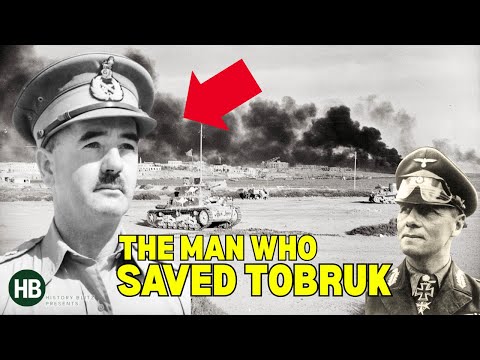
April 1941, North Africa. The British had just crushed the Italian army, taking 30,000 prisoners. Victory seemed certain. Then Rommel arrived. In just 11 days, his Afrika Korps tore through 500 kilometers, shattering British command and sending entire divisions fleeing east. By April 10th, only one fortress remained: Tobruk. Inside, 25,000 men—the green, untested 9th Australian Division—faced the Desert Fox himself. Surrender was expected. But one man refused to yield.
Major General Leslie Morshead stepped in front of his men and delivered a message that would become legend: “There will be no Dunkirk here. If we should have to get out, we shall fight our way out. There is to be no surrender and no retreat.” This is the story of disaster, defiance, and the Australian commander who turned certain defeat into the legend of the Rats of Tobruk.
Three months earlier, the British had achieved the impossible. Operation Compass saw General Richard O’Connor’s Western Desert Force destroy ten Italian divisions with just two of his own. Churchill cabled Wavell: “The situation is transformed.” But London made a fatal miscalculation. When Greece began collapsing under German invasion, the best British and Australian units—veteran armor, artillery, entire infantry brigades—were redeployed to the Balkans, leaving North Africa with skeleton forces.
On February 12th, 1941, Erwin Rommel arrived in Tripoli with the 5th Light Division. His orders from Berlin were clear: hold Tripolitania, await the 15th Panzer Division, and defend only. But Rommel toured the front, saw the British were weak, and decided orders were optional. On March 24th, he launched a reconnaissance in force at El Agheila, prompting a British withdrawal. A week later, a full offensive began.
The British 2nd Armored Division, down to one under-strength brigade, attempted to hold. Mechanical breakdowns, sandstorms, and relentless panzer attacks cost them over half their tanks by April 3rd. Benghazi was evacuated. Derna abandoned. General Philip Neame, newly appointed and unfamiliar with the terrain, lost communication with his scattered units. On April 6th, he was captured alongside O’Connor after taking a wrong turn in the dark. The British command structure collapsed.
On April 10th, the Australian 9th Division occupied Tobruk—the same port they had captured from the Italians just twelve weeks earlier. But now the Italians were back, with panzers. Tobruk’s strategic value was absolute: the only deep-water harbor for 400 kilometers, which Rommel needed to supply his drive into Egypt. Churchill cabled Wavell: “Tobruk must be held to the death without thought of retirement.” Easier ordered than done.
Inside the perimeter were 25,000 men: the 9th Australian Division with the attached 18th Brigade of the 7th Division, British artillery, Indian 18th Cavalry, and Polish Carpathian Brigade detachments. No armored reserve. Limited ammunition. The Luftwaffe owned the sky. Wavell considered evacuation but deemed it too risky, leaving the garrison under one commander: Major General Leslie Morshead.
Fifty-one years old, a former schoolmaster from Sydney, Morshead had survived Gallipoli in 1915 and the Western Front from 1916 to 1918—particularly Pozières, where the AIF learned that trenches, properly maintained, kept soldiers alive when artillery turned the earth to moonscape. He commanded the 9th Division with the charm of a drill sergeant and the standards of a Swiss watchmaker, earning him the nickname “Ming the Merciless” from his men—affectionately, but tempered with respect.
He inspected daily, demanding wire strung at regulation tension, trenches dug to exact depth—deep enough to survive artillery, shallow enough to counterattack from—machine-gun arcs interlocking, and ammunition stored below ground, rotated and inspected. If your fieldcraft failed inspection, you redug until it didn’t. Some officers grumbled, but Morshead didn’t care. He had fought under incompetent British generals in 1916, watching men die because no one checked the fundamentals. He would not repeat that.
On April 9th, 1941, Morshead gathered his battalion commanders at divisional headquarters. The meeting was recorded in multiple war diaries. He spoke plainly: “There will be no Dunkirk here. If we should have to get out, we shall fight our way out. There is to be no surrender and no retreat.” Not rhetoric, but policy. No evacuation plans. No fallback positions. Because if Rommel broke through, you counterattacked. If you were surrounded, you held. And if you died, you died in the wire.
That clarity—brutal and absolute—changed the psychology of defense. There was no hope of rescue, only the work. And Morshead had a plan. Tobruk’s perimeter stretched 40 kilometers of rock and sand, where the Italians had left behind 30 concrete strong points—obvious, static, and pre-registered by their own artillery. Easy targets. Morshead tore up the Italian plan and rebuilt from zero.
The first layer was an outpost line positioned two to three kilometers forward of the main perimeter, lightly held with small patrols and two-man observation posts. Their purpose: see the enemy early, slow the advance, and withdraw before getting overrun. The key principle was simple: don’t die for empty desert. Let the armor come and bleed their tempo, not your men.
The second layer formed the main defensive belt with double-apron barbed wire stapled deep into hardpan. Behind it lay anti-tank mines in staggered rows—Italian, British, improvised—mixed with anti-personnel devices until 15,000 mines were in place by mid-April. But here’s the genius: Morshead left deliberate gaps in the wire as false weak points, marked with subtle terrain cues that German reconnaissance spotted and reported back as exploitable sectors. When panzers funneled through, they hit kill zones of pre-registered artillery and interlocking machine-gun fire from strong points on both flanks. The gap was bait.
The third layer consisted of mutually supporting strong points using reinforced Italian concrete posts. Each held a platoon of 30 men with two Vickers machine guns, a 3-inch mortar, anti-tank rifles, and grenades—positioned so every strong point could support its neighbors with enfilade fire. If the enemy penetrated strong point R7, then R6 and R9 could rake them from both sides. No strong point fought alone. Morshead’s standing order to every platoon commander was unambiguous: “If the enemy breaks through your wire, the immediate counterattack is automatic. Do not wait for orders. Do not wait for support. Counterattack now.”
The fourth layer comprised mobile reserves positioned centrally: Australian infantry companies and British Matilda tanks—slow and obsolete but immune to most German anti-tank guns. Any penetration deeper than the strong-point line triggered a reserve response within 30 minutes. Every company rehearsed this three times a week through night compass marches, live-fire coordination with artillery, and timed assaults with tank support. Morshead didn’t hope the system worked. He drilled it until failure was mechanically impossible.
This wasn’t an Australian-only defense. The Polish Carpathian Brigade—veterans who had escaped Poland via Romania and were desperate to fight Germans anywhere—held the critical western sector and would prove ferocious. New Zealand artillery detachments provided fire support that was precise and devastating. Indian 18th Cavalry patrols screened the southern perimeter. British sappers maintained minefields under fire, repairing wire at night and planting fresh mines in daylight craters. Morshead commanded, but he didn’t fight alone.
On April 11th, 1941, Rommel probed the perimeter with light reconnaissance to test reactions. Tobruk fired back with disciplined accuracy, prompting Rommel to note: “The garrison is alert.” April 13th and 14th brought the first major assault when Rommel committed the 5th Light Division against the southern perimeter near post R7. Stukas plastered the strong points at dawn as German artillery pounded the wire and panzers advanced at 0800 hours.
The outpost line withdrew as planned. Panzers rolled through and hit the weak gap Morshead had left—perfectly marked and perfectly mined. Three tanks were immobilized immediately as Australian 25-pounder field guns and British artillery opened up from hidden positions using pre-registered coordinates they’d rehearsed for three days. Shells bracketed the armor while German infantry dismounted to clear wire under fire. Machine guns from R6 and R9 enfiladed from both flanks. The attack stalled.
At 1400 hours, the 2/17th Battalion—60 men and one captain—launched a local counterattack without orders from above, executing it automatically as drilled. They retook the gap in 18 minutes. Rommel called off the attack at dusk, having suffered over 200 casualties and five panzers destroyed or disabled for zero gain. First repulse.
The siege had begun—and the legend of the Rats of Tobruk was about to be written in blood and wire.
April 16th and 17th saw the Easter Battle, when Rommel escalated with the full commitment of the 5th Light Division, elements of the Brescia Division, and continuous Stuka support against the western perimeter at posts S7 through S11. These were held by the Polish Carpathian Brigade.
Dawn on April 16th brought German guns saturating the Polish positions for two hours. Strong point S8 took a direct hit, half the position collapsing as panzers advanced through smoke and dust. By 1000 hours, German infantry occupied S8 in what appeared to be a real breach.
But Morshead’s system engaged. The 2/48th Australian Battalion deployed northeast of the breach while Polish units on the flanks held and refused to retreat. British Matilda tanks ground forward—slow but unstoppable against German 37mm anti-tank guns. At 1600 hours, the Matildas reached S8 with Australian infantry following to clear bunkers with grenades and bayonets. By nightfall, S8 was retaken.
April 17th saw German probing attacks continue, but all were repulsed. German casualties over two days reached 1,200 men and 17 tanks against Tobruk’s 240 killed and wounded. Rommel wrote in his diary: “Tobruk’s defenses are tougher than expected. The Australians fight with extraordinary stubbornness.”
April 30th through May 4th brought Rommel’s final attempt to crack Tobruk by frontal assault. The 15th Panzer Division, newly arrived at full strength, attacked the southwestern perimeter at dawn. This time, they broke through. German armor and infantry penetrated two kilometers inside the wire, creating a salient that Rommel poured reinforcements into for 72 hours.
But Morshead watched without panicking. He isolated the salient with continuous artillery harassment on supply routes to deny resupply, then organized a deliberate reduction rather than a desperate counterattack. At 0400 hours on May 3rd, the 2/23rd and 2/24th Battalions, supported by Matilda tanks and concentrated mortar fire, attacked the salient from three sides.
Rommel called off offensive operations. Tobruk had broken his tempo. The Blitzkrieg pattern of speed, shock, and collapse didn’t work here.
None of this held without supply. Tobruk’s harbor came under daily attack from Stuka raids at dawn and dusk, plus long-range Italian artillery. But Royal Navy destroyers and fast minelayers ran convoys at night, unloading under blackout while Australian and British dock crews moved ammunition, water, rations, and medical supplies from ship to perimeter in under six hours. One night, a Stuka strike hit a fuel dump, creating a fire visible across the desert. Unloading continued regardless.
The siege became attrition—and Morshead was better at attrition than Rommel. May 1941 saw the Afrika Korps settle into siege mode: encirclement, bombardment, waiting for Tobruk to starve or crack. But Morshead refused the script. His doctrine was clear: the garrison will dominate no man’s land. Translation: aggressive patrolling every single night.
Twelve to twenty men led by officers or senior NCOs used silent approach—no talking, compass navigation, faces blackened, equipment taped to eliminate noise. They targeted German observation posts, artillery positions, supply dumps, and prisoners for intelligence.
On May 24th, the 2/13th Battalion conducted a textbook raid. A patrol slipped through the wire at midnight, infiltrated a German forward position, captured four soldiers without firing a shot, and extracted by 0300 hours. The prisoners talked, revealing unit dispositions, morale problems, and supply shortages that showed Axis forces were exhausted.
June 17th saw Australian sappers demolish a German 88mm flak emplacement with satchel charges while the gun crew never heard them coming. On July 22nd, a combined Australian-British patrol destroyed an Axis ammunition stockpile whose secondary explosions lit up the night. German war diaries recorded heavy losses and significant morale effect.
Australian and British gunners memorized enemy positions—assembly areas, suspected bivouacs, approach routes—for random night bombardments: thirty shells, then silence. Two hours later, sixty shells at a different target. The Germans couldn’t sleep, couldn’t predict, couldn’t rest. New Zealand artillery crews specialized in counter-battery work, silencing German guns that ranged the harbor through precision fire using sound ranging and observation.
By August, the toll was documented in German war diaries: “The Australians raid nightly. Our forward troops cannot rest. Morale is suffering. Requests for relief increasing.” Rommel couldn’t maintain offensive tempo when his forward units were degraded every 72 hours. The siege became a drain—not on Tobruk, but on the Afrika Korps.
Tobruk held because of three factors. First, doctrine matched terrain: Morshead tailored defense in depth to the desert, where minefields channeled attackers into kill zones and every tactic was rehearsed until automatic. Second, command climate mattered: his no-retreat order wasn’t bravado but clarity, eliminating doubt so soldiers focused on the trench, the wire, the gun. Third, Allied integration proved essential—Poles held the west, New Zealanders delivered precise artillery, Indians patrolled the south, British sappers and tankers anchored the reserve. No single nation won Tobruk. They won it together.
October 1941 brought Operation Crusader, the British offensive to relieve Tobruk. By December, the siege was lifted after 241 days. Rommel’s drive into Egypt had been delayed eight months, his supply line overstretched, his divisions worn down by relentless night raids. Tobruk didn’t win the North African campaign—but it bought time, bled momentum, and anchored the line when everything else collapsed.
The cost: 832 Australians killed, over 2,000 wounded, and total Allied casualties exceeding 3,000. Rommel’s losses in direct assaults were estimated at 3,000 to 4,000, plus unknown attrition from raids. The legend of the Rats of Tobruk was coined by German propaganda mocking the trapped garrison—but the Australians adopted it with pride. Rats survive. Rats bite back.
Morshead was knighted in 1942, commanded the 9th Division through El Alamein, returned to Australia in 1943, and died in 1959—largely forgotten outside military circles. But Tobruk remembers the schoolmaster general who turned certainty of defeat into doctrine, proving that discipline, clarity, and relentless fieldcraft could stop even the Desert Fox.
Now, a final question for you: What mattered more at Tobruk—the trenches and drills that made defense automatic, or the daring night raids that broke Rommel’s tempo? Share your thoughts in the comments below.
Report this article
Select a reason for reporting:






