When German prisoners of war first arrived at Canadian detention facilities between 1940 and 1946, they expected harsh treatment, starvation rations, and brutal guards based on everything Nazi propaganda had told them about the degenerate Allied nations. But instead, they found themselves participating in activities so unexpected that many would later describe their captivity as a period of personal transformation that saved them from the ideological poison that had consumed their homeland.
Over 35,000 German military personnel spent years in Canadian POW camps scattered across the country from British Columbia to Nova Scotia. What they experienced there contradicted every assumption they’d carried with them across the Atlantic. The story of what happened inside these camps reveals something profound about the choices democratic nations make even during total war.
It begins with men like Horst Lebeck, a Luftwaffe pilot shot down over the English Channel in 1941, who wrote in a letter home that he’d been allowed to enroll in university courses while imprisoned. A statement his family in Hamburg initially assumed was code for something else because it seemed too absurd to be literally true.
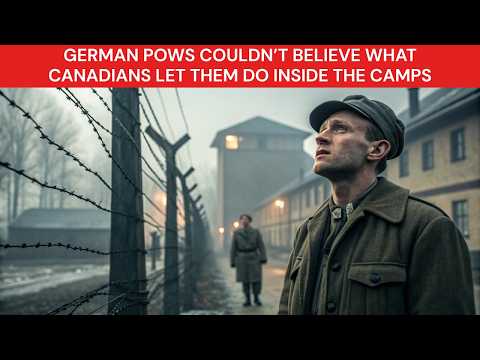
The first shock for arriving German prisoners came not from what they were forbidden to do, but from what they were actively encouraged to pursue. Canadian camp administrators, working under guidelines that exceeded Geneva Convention minimum requirements, had developed a philosophy that idle prisoners were dangerous prisoners who would maintain rigid Nazi hierarchies, plot escapes, and create disciplinary problems that would require extensive security measures.
The solution was to keep prisoners occupied with activities that were productive, educational, or recreational. Creating an environment where men who’d been trained as soldiers could rediscover civilian pursuits and begin the psychological process of separating themselves from the military identity that Nazi Germany had worked so hard to instill.
Documents from the Department of National Defence show that this approach was controversial even within the Canadian government, with some officials arguing that enemy prisoners deserved minimal accommodation rather than opportunities that many Canadian civilians couldn’t access. But the prevailing view held that treating prisoners humanely served multiple strategic purposes, including demonstrating the moral superiority of democratic nations and facilitating the eventual reintegration of these men into post-war society.
The educational programs available to German POWs in Canadian camps were extraordinary by any measure and unprecedented in the history of warfare up to that point. Prisoners could take correspondence courses from Canadian universities in subjects ranging from engineering to literature, could study languages including English and French, and could pursue vocational training in trades like carpentry, mechanics, and agriculture.
The YMCA, working in cooperation with Canadian authorities, provided textbooks, educational materials, even volunteer tutors who came to camps to teach classes. Ernst Florian, whose personal papers were donated to the University of Alberta archives decades after the war, described enrolling in a mathematics course through correspondence with McGill University while imprisoned at a camp in Ontario in 1943.
Florian had been a promising student before the war interrupted his education, and the ability to continue his studies, even in captivity, gave him something to focus on beyond his uncertain future. His letters to his instructor, preserved in the university archives, show a young man grappling with complex mathematical concepts while simultaneously processing the cognitive dissonance of receiving excellent education from people his government had taught him to consider enemies.
The theatrical productions that prisoners were allowed to stage within the camps became some of the most elaborate and unexpected cultural activities of the entire POW program. German prisoners, drawing on strong theatrical traditions from their homeland, organized drama groups that performed everything from classical German plays to contemporary comedies, creating productions that rivaled professional theater in their attention to detail and quality of performance.
At Camp 133 in Lethbridge, Alberta, prisoners constructed an actual theater building with a stage, curtains, lighting systems powered by the camp’s electrical supply, and seating for hundreds of fellow POWs. Historical photographs preserved in provincial archives show prisoners in elaborate costumes and makeup performing scenes from works by Goethe and Schiller—classical German authors whose works connected them to cultural traditions that predated and transcended the Nazi regime.
These productions required Canadian authorities to provide materials ranging from fabric for costumes to lumber for set construction—resources that were officially justified as maintaining prisoner morale, but that also represented a remarkable investment in the cultural lives of enemy combatants.
What made these theatrical activities even more remarkable was that Canadian guards and occasionally local civilians were invited to attend performances, creating strange social situations where captors and captives gathered in the same space to appreciate art. Captain Robert Morrison, whose memoir of his service as a camp administrator was published in 1979, described attending a performance of Shakespeare’s A Midsummer Night’s Dream, performed entirely in German by prisoners at a camp near Gravenhurst.
Morrison admitted to understanding little of the dialogue, but being impressed by the obvious talent and dedication of the performers—men who’d been soldiers weeks earlier, but were now throwing themselves into theatrical pursuits with an enthusiasm that suggested they were grateful for any activity that made them feel human rather than just prisoners.
The willingness of Canadian authorities to not only allow but actively support these cultural activities sent a message that many prisoners found deeply confusing. Their captors seemed to care about their intellectual and cultural development even though they were enemies.
Sports programs in Canadian POW camps went far beyond simple recreation and became organized leagues with elaborate structures, recordkeeping, and fierce competition between teams representing different camps or different branches of the German military. Soccer was the most popular sport, with prisoners clearing and maintaining fields, crafting equipment from whatever materials were available, and organizing tournaments that drew spectators from across camp populations.
Boxing, track and field, volleyball, and in winter months, ice hockey became regular features of camp life, with prisoners training seriously and treating competitions with the intensity of professional athletes. Records from Camp 30 in Bowmanville, Ontario show that prisoners maintained detailed statistics for soccer leagues, recording goals, assists, and standings with meticulous German organizational thoroughness.
Some camps even published sports newsletters documenting results and featuring commentary written by prisoners who’d been sports journalists before the war—creating a sense of normality around athletic competition that must have seemed surreal given the circumstances.
The music programs may have been the most transformative activities available to German POWs, offering men an opportunity to create beauty and express emotions that had no other outlet in the confined world of captivity. Prisoners formed orchestras, jazz bands, choirs, and small chamber music groups, performing concerts that became major events in camp social life.
Instruments were provided through Red Cross packages, donations from Canadian civilians, and in some cases, purchases made with wages that prisoners earned from work programs. The orchestra at Camp 133 in Lethbridge included professionally trained musicians who’d performed with symphony orchestras in Germany before the war—men whose talents would have been wasted if Canadian authorities had taken a punitive approach to prisoner management.
Concert programs preserved in archives show performances of works by Beethoven, Mozart, Bach, and Brahms—German composers whose music represented cultural achievements that transcended the temporary madness of Nazi ideology and connected prisoners to deeper traditions.
What startled many prisoners was that Canadian civilians sometimes requested permission to attend musical performances, creating audiences that mixed captives, guards, and enemy combatants in appreciation of classical music. Margaret Henderson, whose diary was donated to the Saskatchewan Archives Board, described attending a Christmas concert at a POW camp near Regina in 1943, where German prisoners performed Handel’s Messiah with such skill that she found herself moved to tears despite knowing that the performers had been fighting against her country just months earlier.
Henderson’s diary reveals her internal conflict between patriotic duty to hate the enemy and the undeniable humanity of men who could create such beautiful music—a conflict that many Canadians experienced when confronted with the reality that enemy soldiers were individual human beings with talents, families, and inner lives rather than the faceless monsters that wartime propaganda suggested.
The art programs allowed prisoners to paint, draw, sculpt, and engage in various crafts, with materials provided by camp authorities and workspaces designated for artistic pursuits. Some prisoners had been professional artists before the war, while others discovered artistic talents they hadn’t known they possessed.
The artwork produced in these camps, some of which has been preserved in museums and private collections, ranges from portraits and landscapes to abstract works that seem to express the psychological complexity of captivity. Heinrich Mockart, a prisoner who spent three years at a camp in New Brunswick, created a series of paintings depicting Canadian landscapes that he could see from the camp—works that showed meticulous attention to the play of light on maritime coastlines and forests.
These paintings, several of which were donated to provincial art galleries after the war, represent a prisoner attempting to understand and appreciate the physical beauty of the country that held him captive—finding solace in natural scenery, even as barbed wire reminded him of his lack of freedom.
The libraries established within POW camps provided access to thousands of books in German and other languages, creating opportunities for intellectual growth that many prisoners had never experienced even in civilian life. Books were provided by the Red Cross, purchased with camp welfare funds, and donated by Canadian organizations, including universities and religious groups.
These libraries included classical literature, contemporary fiction, technical manuals, textbooks, and periodicals, creating collections that rivaled small-town libraries in scope. Prisoners who’d had limited education before the war could pursue reading programs that expanded their knowledge, while those with university backgrounds could continue intellectual pursuits interrupted by military service.
Alfred Schmidt, whose memoir was published in Germany in the 1960s, described spending months in a Canadian POW camp working his way through the complete works of Thomas Mann—a German author whose books had been banned by the Nazis for his anti-fascist views. Schmidt’s access to Mann’s writing while imprisoned gave him perspectives on German culture and politics that had been systematically denied to him in Nazi Germany, beginning a process of intellectual liberation that accompanied his physical captivity.
Religious services were another area where Canadian authorities exceeded minimum requirements, providing chapels, facilities for worship, and materials for prisoners to practice their faith. Both Protestant and Catholic services were organized, with some camps having permanent chapels constructed by prisoners using materials provided by Canadian authorities.
The ability to practice religion freely was significant for many prisoners who’d come from a society where the Nazi regime had attempted to subordinate religious institutions to state ideology. Church services became not just spiritual gatherings but also social occasions where prisoners could gather in a context that emphasized their common humanity rather than military identity.
Father Wilhelm Kurz, a Catholic priest who’d been conscripted into the Wehrmacht as a medic and captured in North Africa, was allowed to conduct religious services for fellow prisoners and even received theological books sent from Catholic organizations in Canada. Kurz’s letters to his family, preserved in German church archives, express amazement that his captors would support his religious vocation even though he was an enemy prisoner.
The work programs that allowed prisoners to earn wages and purchase goods from camp canteens represented another unexpected freedom that contradicted Nazi propaganda about Allied treatment of prisoners. While the Geneva Convention allowed captors to require prisoners to work, Canada went beyond minimum requirements by establishing payment systems and operating canteens where prisoners could purchase items like cigarettes, chocolate, toiletries, writing materials, and other goods.
The existence of these canteens, stocked with products that were increasingly scarce in wartime Germany, provided daily evidence that Allied economic systems maintained consumer goods availability even during total war. Prisoners who worked in lumber camps, on farms, or in various labor projects earned wages that gave them purchasing power and a sense of agency that contradicted the complete powerlessness that captivity might otherwise have imposed.
Financial records show that some prisoners managed to save substantial amounts during their captivity—money that would later help them rebuild lives when they returned to devastated Germany. The camp newspapers the prisoners were permitted to publish provide fascinating insights into the intellectual and cultural life that developed within Canadian POW camps.
These newspapers, written in German and subject to Canadian censorship to ensure they didn’t contain escape plans or Nazi propaganda, featured articles about camp news, sports results, concert reviews, poetry, short fiction, and essays on various topics. The very existence of these publications suggests a level of intellectual freedom that seems remarkable given that the publishers were enemy combatants held in detention.
One particularly interesting edition from a camp in Manitoba included an essay debating the merits of different philosophical approaches to ethics—an intellectual discourse that would have been dangerous to publish in Nazi Germany, where approved ideology was enforced, but that Canadian censors apparently considered harmless enough to allow.
Photography was another unexpected freedom, with some prisoners being allowed to take photographs within camps using cameras provided by authorities or obtained through purchases. These photographs, many of which survive in archives and private collections, document camp life in intimate detail—showing prisoners engaged in various activities from sports competitions to theatrical performances to simple daily routines.
The decision to allow prisoners to document their captivity photographically suggests a remarkable confidence by Canadian authorities that the treatment prisoners received would stand up to historical scrutiny—that there was nothing to hide about conditions in the camps. This stands in stark contrast to Axis treatment of Allied prisoners, where documentation was tightly controlled and photographs that did exist often showed propaganda staged for international consumption rather than authentic depictions of camp life.
The permission for prisoners to maintain gardens where they could grow flowers and vegetables represented yet another unexpected freedom that contributed to normalizing camp life and giving prisoners agency over their immediate environment. At camps across Canada, prisoners cultivated plots where they grew everything from potatoes and tomatoes to decorative flowers that added color to otherwise austere surroundings.
These gardens became sources of pride, with prisoners competing informally to see who could produce the best vegetables or most beautiful flower displays. The psychological benefit of nurturing living things—watching seeds transform into plants and having some control over food production—cannot be overstated for men who had lost control over virtually every other aspect of their lives.
Christmas celebrations in POW camps became elaborate affairs where Canadian authorities provided materials for decorations and special meals, allowing prisoners to maintain cultural traditions that connected them to homes and families they couldn’t reach. Prisoners crafted Christmas trees from available materials, sang traditional carols, exchanged small gifts made or purchased within camp economies, and enjoyed meals that, while not lavish, exceeded normal rations.
Photographs from Christmas 1944 at various camps show decorated common rooms, prisoners gathered around makeshift Christmas trees, and scenes of men attempting to create normality in profoundly abnormal circumstances. For many prisoners, these celebrations were bittersweet reminders of families they couldn’t be with—but they also demonstrated that their captors recognized their humanity and cultural traditions even during wartime.
The educational lectures organized by prisoners for fellow prisoners created informal universities within camps where men with expertise in various fields shared knowledge with others. A professor of engineering held captive at a camp in Quebec organized a series of lectures on structural mechanics that attracted dozens of prisoner students, while a former schoolteacher at another camp taught courses in geography and history.
These initiatives were entirely prisoner-organized but received support from Canadian authorities, who provided space, materials, and occasionally access to reference books from camp libraries. The intellectual vitality of these informal educational programs suggests that captivity, while certainly unwelcome, provided some prisoners with opportunities for learning they’d never had access to in civilian life or military service.
When the war ended and these men returned to a devastated Germany, many carried with them not just memories of confinement but a transformed understanding of democracy, humanity, and their own place in the world. Some would later credit their Canadian captivity with saving them from the moral ruin of the Nazi regime—a legacy that raises profound questions about how nations should treat their enemies. Was Canada’s humane approach to POWs a model of enlightened wartime policy, or a privilege that came at the expense of justice for the victims of German aggression? Let us know your thoughts in the comments below.
Report this article
Select a reason for reporting:






