David Park had cataloged hundreds of antique photographs in his fifteen years at the Philadelphia Genealogical Society, but the moment he turned to page 17 of the cracked leather album, something cold slithered down his spine. The sepia-toned family portrait, dated 1904, showed a prosperous Victorian household arranged in perfect pyramid formation—stern parents, four well-dressed boys—but it was the small girl standing apart, her hands clasped tightly at her waist, that made him freeze. Her eyes, even through the faded emulsion, seemed to plead with him across the decades. And between her fingers, partially hidden, was a tiny slip of paper.
He reached for his magnifying glass, his breath catching as he saw the faint, cramped letters on the visible edge. Help. The word was unmistakable, written in a child’s shaky hand. David’s heart hammered against his ribs. This wasn’t just a family portrait—it was a desperate cry for rescue, hidden in plain sight for over a century.
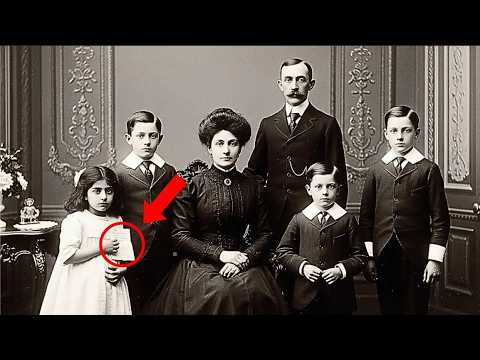
He transferred the photograph to the society’s digital imaging lab and spent the next three hours isolating every fragment of the note. The paper had been folded to conceal most of its contents, but as the enhancement software peeled away layers of noise and degradation, more words emerged. Please. Take me home. And at the very bottom, where the girl’s thumb pressed against the paper, a partial address: 1247 Chester St.
David sat back, his mind racing. Who was this child? Why was she begging for help during what should have been a routine studio session? He pulled up the estate documents from Patricia Brennan’s donation and cross-referenced the photographer’s mark—Morrison & Webb Photography, Philadelphia, 1898–1919. The family was clearly wealthy, but the girl’s dress was noticeably simpler than the boys’, her features darker, her body angled away from the group as if she didn’t belong.
His colleague Margaret Chen stopped by late that afternoon and found him still staring at the image. When he showed her the enhanced note, she went pale. “This is a child asking for help during a family photograph session,” she whispered. “David, this could be evidence of something terrible.”
They spent the next two days digging through census records and city directories, working backward from Patricia Brennan through her grandmother, Catherine Morrison. The 1900 census listed John and Elizabeth Morrison with only two children—Catherine and her brother William—but the photograph showed four boys and a girl. This wasn’t Catherine’s immediate family. They expanded their search and found a match: Edward Morrison, John’s younger brother, living at 1834 Spruce Street with his wife Clara and their four sons. By 1904, the family composition fit the photograph almost perfectly.
But who was the little girl? Margaret pulled up the 1910 census for the Morrison household and gasped. Listed under Edward Morrison’s family was an entry that made David’s blood run cold: Maria Rossi, female, age 11. Relation to head of household: adopted daughter. Birthplace: Italy.
An adopted daughter, Italian, approximately the right age if she had been five in 1904. But the census record raised more questions than it answered. If Maria had been formally adopted, why did she look so terrified in the photograph? Why was she holding a note begging for help? David immediately searched the Philadelphia County Court archives for adoption papers—and found nothing. No legal proceedings, no court approval, nothing that would indicate a legitimate adoption had taken place. The child had simply appeared in the Morrison household sometime between 1903 and 1904, and the family had listed her as adopted without any documentation.
“This wasn’t an adoption,” Margaret said quietly, reading the records over his shoulder. “This was something else entirely.”
David accessed the Library of Congress’s digitized newspaper collection and began searching through fragmented, poorly scanned pages from Philadelphia’s Italian-language newspapers of the period. What he found was heartbreaking: dozens of notices reporting missing children, most of them never resolved. And then, in a June 1903 edition of L’Opinione, Margaret found a small notice that made her hands shake: Missing Maria Rossi, aged 5 years, disappeared from family home at 1247 Chester Street on June 8th. Last seen playing outside our building. She has dark hair, brown eyes, wearing blue dress. Her mother and father are desperate.
David stared at the address. 1247 Chester Street. The same partial address visible on the note clutched in the little girl’s hand in the photograph. “She was trying to tell someone where she came from,” he whispered. “She was trying to give them her real address so they could take her home.”
But the story was about to take an even darker turn. As David and Margaret dug deeper into the Morrison family’s records, they uncovered a journal entry from the studio’s junior partner, James Webb, dated August 1904—a entry that would confirm their worst fears and reveal the chilling truth of what happened to Maria Rossi.
The leather journal had been tucked inside a box of studio receipts, its pages brittle and foxed. James Webb’s handwriting was small and precise, but the entry for August 12, 1904, was uncharacteristically hurried, the ink smudged in places as if his hand had trembled. “Photographed the Edward Morrison family today,” David read aloud. “Four sons, well-behaved. Also a young girl, perhaps five or six, whom they claimed was recently adopted. The child appeared frightened throughout the session and would not smile despite Mrs. Morrison’s increasingly sharp insistence.”
Margaret leaned closer as David continued. “Mr. Morrison grew irritated with the girl’s demeanor. I noticed she kept her hands clasped tightly together and seemed to be hiding something, but I did not press the matter as Mr. Morrison is an important client.” Webb had even noted the sitting took nearly an hour because the child could not remain composed. “I have misgivings about this family’s treatment of the girl,” the entry concluded, “but it is not my place to question my client’s domestic arrangements. Still, something about the child’s eyes troubles me. She looked at me as though begging for help, and I did nothing.”
David read the passage three times, feeling the weight of Webb’s guilt across 120 years. The photographer had seen Maria’s distress, had noticed her clutching something, had recognized that something was wrong—and had done nothing because the Morrisons were wealthy clients. But his conscience had troubled him enough to record it, creating the only contemporary documentation of Maria’s state of mind during that session.
Margaret had been researching Clara Morrison’s social connections and found something equally disturbing. Clara had been active in several women’s charitable organizations focused on “rescuing” immigrant children from poverty. She sat on the board of the Philadelphia Society for Orphan Children and had written letters to newspapers advocating for wealthy families to take in poor children. “She genuinely believed she was helping,” Margaret said. “The ideology of the time taught wealthy people that poverty was a moral failing, that immigrant families were unfit to raise their own children.”
“But Maria wasn’t an orphan,” David said bitterly. “She had parents who loved her and were desperate to find her. The Morrisons stole someone’s child and convinced themselves it was a good deed.”
They still didn’t know exactly how Maria had been taken, but the pattern was becoming clear. She had disappeared from outside her family’s tenement building in June 1903. Within a year, she was living with the Morrisons, who claimed to have adopted her despite no legal paperwork—and she had been terrified enough to hide a note begging for help during a family photograph.
David searched for what had happened to Maria after 1910. The 1920 census showed Maria Rossi, now aged 22, still living with the Morrison family—but no longer listed as an adopted daughter. She was listed as a domestic servant. “Whatever pretense of family relationship had existed in her childhood had been abandoned,” David said. By 1930, Maria had moved out, living in a boarding house on Chestnut Street and working as a seamstress in a garment factory—the same kind of low-wage work her mother, Francesca, had done.
David found her marriage record from 1932. Maria Rossi married Antonio Duca, a construction worker, at St. Mary Magdalene de’ Pazzi Church—the same church her parents had contacted when she first disappeared in 1903. “She returned to the Italian immigrant community,” Margaret said softly. “She never forgot her origins, despite being raised by the Morrisons.”
The 1940 census showed Maria and Antonio living in South Philadelphia with their three children. Maria died in 1968 at age 70 and was buried at Holy Cross Cemetery in Yeadon. But David could find no evidence that she had ever reconnected with her birth parents. Giuseppe and Francesca Rossi had returned to Italy in 1904, and there was no record of them ever coming back—or of Maria traveling to Italy to find them.
Margaret found one more document that brought tears to both their eyes: a 1945 naturalization petition filed by Maria Duca, formerly Rossi. In the section asking for her birthplace, she had written: Philadelphia, Pennsylvania, daughter of Giuseppe and Francesca Rossi. Even after forty years, even though she had probably never seen her parents again, she had claimed them publicly in an official document.
“She never forgot,” Margaret whispered. “Despite everything the Morrisons did, she never forgot her real family.”
David decided the story needed to be told publicly. He wrote a detailed research report documenting everything they had discovered—Maria’s disappearance, her forced placement with the Morrison family, the hidden note, Webb’s journal entry, and Maria’s later life. He contacted the Philadelphia Inquirer, which published the story with the photograph prominently displayed. The article ran on a Sunday in September 2024: “Hidden Message in 120-Year-Old Photo Reveals Child Trafficking in Philadelphia’s Gilded Age.”
The response was immediate and overwhelming. David received hundreds of emails from people moved by Maria’s story. But the most important email came from a woman named Isabella Romano in South Philadelphia. “I think Maria Rossi Duca was my great-great-grandmother,” she wrote. “My grandmother was Maria’s youngest daughter, born in 1939. She used to tell us stories about her mother, how she had been taken from her family as a child and raised by strangers. My grandmother said Maria never talked much about it because it was too painful, but she kept a small photograph of herself as a child that she looked at sometimes and cried. Could this be the same photograph?”
David called Isabella immediately. She was a high school teacher, 52 years old, and had never heard the full story of her great-great-grandmother’s childhood. “My grandmother told us that Maria’s parents were Giuseppe and Francesca Rossi, and that they had come from Italy,” Isabella explained. “She said Maria had been kidnapped or stolen somehow when she was very young, and that her parents had gone back to Italy without her. But we never knew the details.”
David sent Isabella all his research, including the enhanced photographs showing the note in Maria’s hand. When she called back two days later, she was crying. “I showed the photograph to my mother, who’s 83,” Isabella said. “She recognized it immediately. She said Maria had kept a copy of this exact photograph her entire life, hidden in a drawer with her other important papers. After Maria died, the family found it, but we never understood why she had kept a picture that showed her looking so frightened and sad. Now we know it was evidence. She kept it as proof of what had been done to her.”
Isabella asked if she could visit the Genealogical Society to see the original photograph and learn more about her great-great-grandmother’s story. David agreed, and they arranged to meet the following week.
Isabella Romano stood in David’s office at the Philadelphia Genealogical Society, staring at the original 1904 photograph through protective glass. Tears streamed down her face as she looked at her great-great-grandmother, five years old and terrified, clutching a desperate plea for help that no one had seen for 120 years. “She was so small,” Isabella whispered. “Just a baby, really, and she was brave enough to write that note and hide it in her hand, hoping someone would notice and help her. But no one did.”
David had prepared a complete dossier for Isabella—copies of all the records he had found, the timeline of Maria’s life, the enhanced photographs showing the note’s visible text, James Webb’s journal entry, the newspaper notices Giuseppe and Francesca had placed searching for their daughter. It was a complete documentation of a child stolen from her family and the lifetime of loss that followed.
“I want to tell her story,” Isabella said firmly. “Maria couldn’t find her parents and her parents never found her. But she had children and grandchildren and great-great-grandchildren, and we can make sure people know what happened to her. We can give her voice back.”
Over the next three months, Isabella worked with David and Margaret to create a comprehensive exhibit at the Philadelphia Immigration History Center: Maria’s Story: Child Trafficking and Exploitation in Gilded Age Philadelphia. The exhibit centered on the 1904 photograph with the enhanced images showing the hidden note displayed prominently alongside Maria’s life story, but it also contextualized her experience within the broader history of child exploitation in early 20th-century America.
David had found records of dozens of similar cases—poor immigrant children who disappeared from their families and reappeared in wealthy households claimed as adoptions that had no legal foundation, often working as unpaid servants under the guise of being family members. The exhibit included testimonies from descendants of other stolen children, historical documents about the child-saving movement that had justified removing children from immigrant and poor families, and information about the lack of child welfare protections during that era.
On opening day, over 300 people attended. Many were descendants of Italian immigrants who shared their own family stories of children lost to exploitation or suspicious adoptions. Several historians gave presentations about child welfare history and the evolution of adoption laws. Isabella stood beside the photograph of her great-great-grandmother and spoke about Maria’s life, how she had been stolen at age five, raised by strangers who treated her as a servant, and had managed despite everything to build a life for herself in the Italian community that the Morrisons had tried to separate her from.
“Maria never got to go home,” Isabella said, her voice breaking. “She never saw her parents again. Never got to tell them she hadn’t forgotten them. Never got justice for what was done to her. But she survived. She married, she had children, she worked hard, and she held on to her identity as Giuseppe and Francesca Rossi’s daughter. And now, finally, people know her story. That note she held in her hand in 1904, asking for help—it’s finally been seen. It’s finally been answered, even if it took 120 years.”
David watched as visitors stood silently before the photograph, reading about Maria’s life, seeing the enhanced images of the note she had hidden. Many wept. Many asked questions about how such things could have happened, how families could steal children and face no consequences. The exhibit remained open for six months and was visited by over 15,000 people. It was featured in national news coverage about historical child exploitation and the evolution of adoption and child welfare systems. Several universities requested permission to use the materials in teaching about immigration history and child welfare.
But perhaps most importantly, Maria’s story inspired descendants of other stolen children to come forward with their own family histories. David began receiving messages from people across the country who had family stories about children who disappeared or were suspiciously adopted during the early 1900s. He started documenting these cases, building a database of stolen childhoods finally being acknowledged.
One evening after the exhibit had closed, David stood alone before the photograph of Maria Rossi, looking at her small, frightened face and the note clutched desperately in her hands. “They see you now,” he said quietly. “Everyone can see what you were trying to tell them. You’re not forgotten, Maria. You’re remembered.”
And in the silence of the gallery, surrounded by the documented evidence of her stolen childhood and her resilient life, David felt that somehow across the vast distance of 120 years, Maria Rossi would have been grateful that her silent plea had finally been heard, her truth finally acknowledged, and her existence finally honored as it should have been from the very beginning. The photograph that had preserved her desperate message had also preserved her dignity, her courage, and her unbreakable connection to the family that had loved her and lost her. And now no one would ever forget her.
What other hidden stories might be waiting in old family albums, desperate to be seen and heard?
Report this article
Select a reason for reporting:






