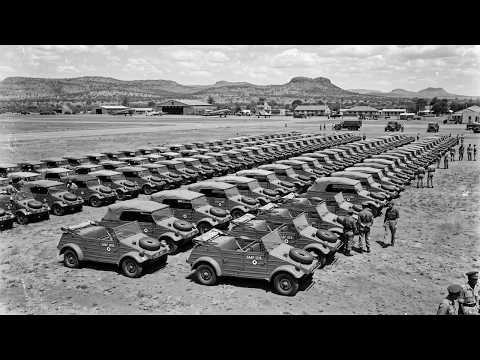
Wolfsburg, Germany. Autumn 1945. The factory that once built the Nazi People’s Car lies in ruins—its roof open to the sky, its floors buried under rubble and stagnant water. Allied bombers had torn it apart. Retreating guards and passing soldiers had stripped its contents. Yet amid the wreckage, a British Army officer stands before a small German military vehicle with a canvas roof and a rear engine, wondering how to make use of it. This is the Volkswagen Type 82, better known as the Kübelwagen. It weighs about 750 kg, its air-cooled engine produces just 23.5 horsepower in early models and 25 after 1943. It has two-wheel drive, no radiator or water pump, and a top speed of about 50 mph. Next to the American Jeep—with its four-wheel drive and 60 horsepower—this car looks like a toy.
Theoretically, the victorious army should have scrapped these machines. Britain had its own trucks, plenty of American Jeeps, and no reason to keep enemy vehicles running. But the British didn’t discard them. Records are sparse, and the commonly cited number is around 300 captured Kübelwagens. Whatever the exact figure, those vehicles were operated, studied, repaired, and driven across a devastated land. What seemed like a weak, underpowered, obsolete German car became, in the hands of a practical army, a surprisingly strategic asset. And the story of what Britain did with them helped save a factory that would go on to build one of the best-selling cars in history.
Let’s start with what any military expert in 1945 would have told you. The right military vehicle required four-wheel drive. The Willys MB Jeep had it, along with a 60-hp four-cylinder engine, a rugged steel body, and a design philosophy built on raw capability. Nearly 650,000 Jeeps rolled out of Willys-Overland and Ford factories during the war, and it became the gold standard. Everyone in the Allied armies knew the Jeep. Everyone trusted it. Compared to that standard, the Kübelwagen seemed wrong in almost every way.
Prevailing military thinking held that without driven front wheels, a vehicle would sink in mud, snow, and sand. Critics argued that an air-cooled engine under 1000 cc—then 1131 after 1943—would be too weak to move men and equipment over rough terrain. They said a light car with a thin body and no heavy frame would fall apart in battle. Even the Germans had their doubts at first. The Wehrmacht already had heavier off-road cars—expensive machines with complex, massive drivetrains. The Kübelwagen was cheap and simple, derived from the civilian Beetle designed by Ferdinand Porsche. Many officers saw it as a compromise, not an achievement.
The critics were right about one thing. The Kübelwagen couldn’t match the Jeep’s raw power or toughness in the harshest conditions. The Jeep could climb steeper slopes and tow much heavier loads. In a contest of brute strength, the Jeep would win. But they were wrong about what really mattered in the field.
The secret lay in the Kübelwagen’s weight. At about 715 kg, it was far lighter than the Jeep’s roughly 1,100 kg. A light vehicle doesn’t sink into loose ground like a heavy one. Its tires spread a small load over a large contact area, so it floats where heavier vehicles bog down. The second secret was the drivetrain. Although the Kübelwagen was rear-wheel drive only, Porsche’s engineers equipped it with a ZF self-locking differential, a design that prevents a spinning wheel from stealing power from the other. They also added reduction gears in the rear wheel hubs. This did two things at once: it doubled torque at the wheels, giving the small engine real pulling power at low speeds, and it raised the axle line, pushing ground clearance to about 28 cm. The car sat high off the ground and could cross obstacles that would stop any lower vehicle.
The third secret was the engine. The Kübelwagen’s flat-four engine sat in the rear, over the driving wheels, so the engine’s weight pressed exactly where traction was needed. And because it was air-cooled, there was no radiator to freeze in Russian winters, boil in North African summers, or puncture from a stray bullet. No coolant to leak, no hoses to burst. The fuel tank held about 40 liters, and fuel consumption was far better than the Jeep’s—important when supply lines stretched thin.
What really mattered was reliability. A soldier whose vehicle starts every morning without a cooling system to watch has an advantage that doesn’t show up on a spec sheet. The Kübelwagen’s engine was simple enough that a mechanic with basic tools could replace major components in the field. The body was a flat-sided tub, easy to repair. Parts overlapped heavily with the Beetle, so the factory could produce them in huge numbers. By the end of production in 1945, about 50,000 Type 82s had been built. It was a vehicle designed around a truth that technical comparisons often miss: most military vehicles spend their lives on bad roads, in bad weather, driven by tired people and maintained by exhausted mechanics. Under those conditions, simplicity beats complexity.
The Kübelwagen’s record proved it. German forces used it in the deserts of North Africa, where fine sand clogged and overheated water-cooled engines. The air-cooled flat-four kept running without fail. They used it across the plains of Russia during the spring and autumn mud seasons, when roads turned to swamps and heavier vehicles stalled. Crews reported that the light Kübelwagen kept moving where other cars couldn’t, simply because it didn’t sink as deep.
British forces saw this firsthand. Allied troops encountered Kübelwagens in North Africa, Italy, and Normandy, and some captured models were used immediately. British soldiers then weren’t shy about seizing a useful enemy vehicle. By 1945, with the war over and the British Army of the Rhine settling into occupation duties across northwest Germany, they had many reasons to keep these cars running. The British zone was in chaos. Roads were cratered, bridges destroyed, fuel scarce, and spare parts for Allied vehicles came from far away. A captured German vehicle, built in Germany with parts available there, was a practical solution. Occupation officers, liaison teams, and engineers used captured Kübelwagens for local transport between units and for touring towns and countryside that were hard for heavier vehicles to navigate.
And there was a deeper reason for British interest—one that went beyond local transport. If you find this deep dive into post-war military history interesting, consider subscribing. We cover the untold stories behind the machines and the people who actually used them, and there are plenty more coming.
The Volkswagen factory fell to American troops in April 1945. In June, the area was transferred to the British zone, and the factory came under British military government control. The Nazi regime had built the plant to produce the Beetle, but wartime priorities turned it to military vehicles, including the Kübelwagen and the amphibious Schwimmwagen and other equipment. By the end of fighting, the factory was severely damaged, most of its machinery scattered or destroyed. Thousands of people, including displaced workers, lived in or near the plant. The man who took charge was Major Ivan Hirst of the Royal Electrical and Mechanical Engineers, an officer with an engineering background who arrived in August 1945. The factory’s future was uncertain. Some officials wanted to dismantle it and ship the machinery away as war reparations. Others thought it should be demolished entirely. The prospect of building cars there seemed unrealistic.
But Hirst saw something different. The British Army needed vehicles, and the factory had the tools, the skilled workers, and a design proven in the field. According to the popular account, he used a Kübelwagen painted in British Army green as a demonstration. It showed what the factory could achieve and proved the design was practical and durable. Whether the details of that story are exactly accurate or not, the broader point is well documented. The military government gave the factory a real purpose. In September 1945, British authorities placed an order for 20,000 vehicles. They weren’t Kübelwagens, but the civilian Volkswagen saloon—the car that would later be known as the Beetle—which shared the engine, body philosophy, and many parts with the Kübelwagen. The order was a lifeline. The British Army needed transport, and the factory could build it faster than any alternative.
Production was painfully difficult. Materials were scarce. The roof leaked. Winter heating was almost nonexistent, and workers were paid partly in food rations. Despite this, the factory produced 1,785 cars in 1945—a remarkable number given the conditions. In 1946, it built over 10,000. Hirst and a small team kept the line running, relying on the workers’ skills and whatever parts and tools remained.
It’s easy to see all this as mere industrial history, but it was a reality lived by people. For a British driver in 1945, a captured Kübelwagen was a strange machine. The controls were unfamiliar. The engine sound was odd—the rear-mounted engine made a distinctive noise unlike anything in the British fleet. It was exposed to the weather with a canvas roof offering limited protection. Occupation duties meant long, cold trips across a ruined country. Yet drivers found they could trust it. It ran in cold weather without trouble. It didn’t overheat. It was light enough that a few men could push it out of a ditch, and it carried a surprising amount of equipment. The flat floor and boxy body let crews load it quickly. For a soldier who needed to get from point A to point B on broken roads, those things mattered more than horsepower.
For the German workers in Wolfsburg, the scene was different. Many were refugees, former forced laborers, or locals with nowhere else to go. The factory gave them work, food, and a reason to stay. Britain’s decision to restart production rather than dismantle the plant entirely shaped the lives of thousands and the economy of an entire region. This is the part of the story that is often forgotten. Captured equipment is frequently remembered as a footnote in history—enemy leftovers, used briefly, then scrapped. But the British decision to keep using German vehicles and to restart the factory that built them reflected a hard practical realism. The leaders weren’t clinging to national pride. They knew a working vehicle was worth more than a perfect one that hadn’t arrived yet.
The Kübelwagen’s true legacy wasn’t speed or power. It was proof that a design built on simplicity, light weight, and reliability could outlast more impressive machines. The same philosophy shaped the Beetle, and the Beetle carried that philosophy to the world. There is another part to the story. In 1947, a Dutch businessman named Ben Pon visited Wolfsburg and saw a practical transport vehicle the factory had improvised for moving parts around the plant. It was built on a Beetle chassis. Pon sketched the idea for a small box-shaped van on the same basis. That sketch became the Volkswagen Type 2, the Transporter, or Microbus. One line of thinking—from Porsche’s Kübelwagen to Hirst’s army cars to Pon’s van—ran straight through a factory the world expected to vanish. This wasn’t a story about a powerful weapon. It was about a humble machine that did its job perfectly. Theoretically, the Kübelwagen should have been forgotten. But in reality, it helped rebuild an entire industry. The Kübelwagen didn’t win a battle on its own. It didn’t need to. What it offered was something quieter: a vehicle that worked, parts that could be manufactured, and a design that survived a war and then the near-total destruction of its factory. Britain’s choice to use it—and to save the factory that built it—turned salvaged scrap into a foundation for post-war recovery.
If you found this video valuable, it explores how Britain’s practical use of captured German Kübelwagens and the decision to restart the Volkswagen factory helped shape post-war Germany and the future of one of the world’s most famous cars. Hit the like button, subscribe to the channel, and turn on notifications for more. Thanks for watching.
For Hirst, the Kübelwagen was never the destination—it was the argument. Every cold morning it started, every ditch it crawled out of, made the same case: this factory knows how to build machines that work. That argument won the order, and the order won the workers their bread.
By the time the last captured Kübelwagen was pensioned off, the Beetle was already rolling out in numbers no one in 1945 would have believed. The toy had saved the toy factory. Simplicity, it turned out, was the most valuable spoil of war.
So here is the question worth arguing over: if Britain had scrapped those 300 German cars and demolished the plant, would the Beetle—and the Microbus, and everything after—have ever existed? What do you think? Tell us in the comments.
Report this article
Select a reason for reporting:






