At 25,000 feet, the temperature inside the ball turret plummeted to minus 50 degrees Fahrenheit. The gunner, curled in a fetal position, had only an electric suit to keep him alive. This was the reality for the men who manned the B-17’s most isolated and deadly station.
The ball turret was a marvel of engineering and a nightmare of confinement. Designed by the Sperry Corporation, it was a spherical hell that dangled beneath the bomber, exposed to enemy fighters and the merciless cold. “The crew member with the smallest stature was usually selected as a ball turret gunner,” and he operated the turret on his back, his knees drawn to his chest, his world reduced to a tiny plexiglas window and the twin .50-caliber machine guns.
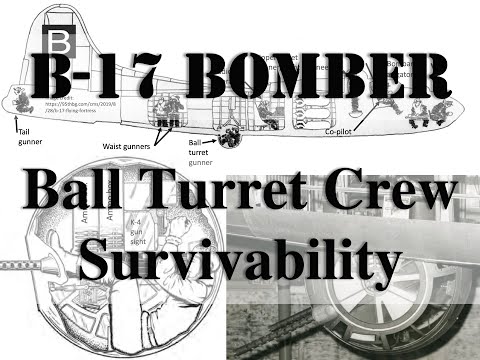
There was no heat, no pressurization, no insulation. At altitudes above 10,000 feet, the gunner relied on mechanically fed oxygen. His electric suit plugged into the turret’s rheostat, a lifeline against the killing cold. But even with supplemental heat, the chill seeped into his bones. Most gunners didn’t wear parachutes or flak armor—too bulky for the cramped space. They wore life vests and parachute harnesses, the parachute itself stowed nearby, a cruel reminder of the escape they might never make.
The armor was meant to stop a standard 30-caliber bullet. The gunner’s seat was a 0.6-inch steel plate; the curved bottom panel and entry hatch were 0.26-inch steel. The machine gun casings and ammo belts added layers of protection. “The gunner’s lower legs were shielded by these machine guns,” and the sight casing offered some defense against cannon splinters. But against a 20mm shell, it was a gamble.
Survivability studies offered cold comfort. Data from 1942-1943 showed ball turret gunners and co-pilots suffered fewer wounds than other positions—but survivor bias skewed the numbers. Other studies placed the ball turret gunner’s survivability “about in the middle of the pack.” The fetal position reduced exposure, but the turret was still a magnet for enemy fire.
Bailing out was a nightmare of its own. The gunner had to rotate the turret guns straight down, open the hatch, and climb into the fuselage. The guns had to be repositioned with barrels facing aft so bomb bay jumpers wouldn’t hit them. Then came the wait by the aft crew door, jumping right after the right waist gunner. In a belly landing, the turret became a hazard—crews had 20 minutes to unbolt it, and another 20 if they tried to salvage the expensive Sperry K3 gunsight.
For the men who rode the ball turret, every mission was a test of endurance and nerve. They were the smallest, the most exposed, and often the most forgotten. But their story is one of incredible bravery in the face of impossible odds.
The Sperry ball turret’s design evolved during the war. The early A2 model featured a collector ring and housing assembly, along with a plexiglas cover over the end bell. The later A2A eliminated these components, simplifying the turret and reducing weight—a critical factor for a bomber already straining under the demands of high-altitude flight. The A2A became the standard for later B-17 variants, its streamlined form a testament to the constant push for improvement.
Operating the turret required a unique kind of skill. The gunner controlled the rotation and elevation with foot pedals and hand grips, his body a human gyroscope within the spinning sphere. He had to track German fighters streaking past at hundreds of miles per hour, leading his shots with the twin .50-calibers while the bomber lurched and bucked through flak-filled skies. The turret’s arc of fire covered the bomber’s belly and lower flanks, a vital blind spot that no other gun position could protect.
But the isolation was absolute. Encased in his metal ball, the gunner was cut off from the rest of the crew, his only contact a headset crackling with terse commands and the roar of engines. He couldn’t see the faces of his comrades, couldn’t share a joke or a nervous glance. He was alone with his guns, his thoughts, and the enemy.
Training for the ball turret was as demanding as the job itself. Gunners practiced in mockups on the ground, learning to contort their bodies into the fetal position and operate the controls by feel. They were taught to recognize enemy aircraft silhouettes, to estimate range and deflection, and to fire in short, controlled bursts to conserve ammunition. The .50-caliber belts were heavy—each round a small, deadly package—and the gunner had to manage his supply carefully during a fight.
Maintenance crews also played a crucial role. The turret’s complex machinery—hydraulic motors, electrical systems, and ammunition feeds—required constant attention. A jammed gun or a frozen mechanism could mean death for the gunner and the crew. Ground crews worked in all weathers, their fingers numb as they serviced the turrets, knowing that the lives of ten men depended on their diligence.
As the war progressed, the threat from German fighters evolved. The introduction of jet aircraft and improved rocket attacks forced the Allies to adapt. Ball turret gunners reported encounters with Me 262s, their speed making them nearly impossible to track. The turret’s effectiveness began to wane, but the gunners never stopped fighting.
For the men who survived, the memories never faded. The cold, the confinement, the terror of watching a fighter close in—these stayed with them. Some spoke of the turret as a coffin, others as a sanctuary. It was both: a place of death and a place of salvation, a sphere of steel that defined their war.
Yet for all its mechanical sophistication, the turret demanded something more than training—it demanded a particular temperament. Not every small man could fold himself into that sphere and stay sane. Some gunners grew to dread the descent into the belly of the bomber, the ritual of squeezing through the hatch while the aircraft sat on the tarmac, the knowledge that for the next eight hours they would be the most alone man in the sky.
Veterans described the sensation of rotation with eerie precision. When the gunner swung the turret to track a target, the entire world turned with him—sky, clouds, and earth all wheeling past the plexiglas in a dizzying blur. “You lose all sense of up and down,” one gunner recalled. The horizon vanished; only the gunsight and the silhouette of the enemy mattered.
Communication was a lifeline. The intercom crackled with the pilot’s calm voice, the navigator’s coordinates, the bombardier’s countdown. But when the fighters came, the chatter dissolved into chaos—shouted warnings, the rattle of guns, the hammering of shells against the fuselage. In those moments, the ball turret gunner fought his war in total isolation, trusting that the men above him were doing their jobs while he did his.
There was a grim arithmetic to the turret’s ammunition supply. Each .50-caliber belt held hundreds of rounds, but a sustained burst could empty the trays in seconds. Gunners learned to fire in disciplined three-to-five-round bursts, conserving ammunition for the moments that mattered. Running dry mid-fight was a death sentence, and every gunner knew it.
The physical toll was relentless. Hours in the fetal position left men cramped and stiff, their muscles locked, their circulation poor. Some gunners emerged from the turret unable to stand, their legs numb and their backs screaming. Medics learned to help them unfold slowly, one limb at a time, as if unwrapping a man from a shell.
And yet, many gunners volunteered for the station. It was a strange kind of pride—the smallest man, the most exposed position, the most vital defense. “Somebody had to do it,” one veteran said simply. “I was the little guy. It was me or somebody else, and I figured I could take it.”
The ball turret’s legacy lives on in the memories of those who rode it and in the engineering that made it possible. It was a weapon, a prison, and a sanctuary all at once—a sphere of steel and glass that carried men through the worst the war could throw at them.
In the years after the war, the ball turret became a symbol of the bomber crews’ quiet heroism. Museums raised B-17s on pedestals, their bellies exposed to curious visitors who peered through the plexiglas and tried to imagine the men who once spun there. Children asked how anyone could fit inside; veterans simply nodded and said nothing.
For the gunners themselves, the memories arrived unbidden. The smell of cordite, the ache in frozen fingers, the sudden silence when the engines droned and the fighters had gone. Some never spoke of it; others could not stop. One survivor described waking in the night, certain he could hear the intercom crackle and the guns rattle.
The turret’s engineering legacy endured too. Its compact design and lethal efficiency influenced later defensive systems, and its lessons in armor and isolation shaped how engineers thought about protecting aircrew. But no machine could ever measure the human cost.
Today, only a handful of operable ball turrets remain, their steel skins polished by restoration crews. They stand as silent witnesses to the smallest, bravest men of the Eighth Air Force—the ones who curled into a sphere of steel and fought the war alone.
And so the ball turret rests, its guns cold, its hatch sealed, waiting for someone to remember the boy who once spun it against the sky. Were you ever moved by the story of these forgotten gunners—or do you know someone who served in one?
Report this article
Select a reason for reporting:






