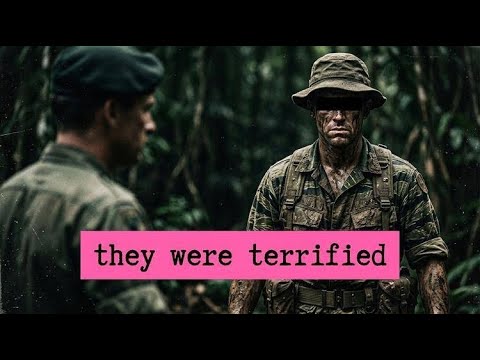
In 1966, a United States Army major sat across a table from four filthy, exhausted men and delivered a sentence that would haunt the classified reports for decades: “You are not soldiers.” It was not a compliment. It was an accusation—one that cut to the heart of a war the Americans were losing despite overwhelming firepower. The four men opposite him had not slept in a real bed for two weeks. They smelled like death in the wet season. Two wore canvas tennis shoes. One had not spoken a full sentence in eleven days. Yet these men had just walked through a Viet Cong battalion perimeter on their stomachs, counted 270 fighters, mapped the camp from inside, and slipped out without a shot fired. They were not soldiers. They were something else entirely—something the US Army had no category for.
What the major did not know was that the enemy already had a name for them. A name that Pentagon analysts would spend nine years pretending did not exist. A name that carried the weight of folklore and fear: Ma Rung—the jungle ghosts.
The numbers are staggering. Over 1,200 patrols, the Australian SAS suffered only two combat deaths while eliminating enemy fighters at a ratio of 500 to 1. The best American units in adjacent provinces were achieving 50 to 1 at their peak. The Australians were ten times more lethal. The Pentagon assumed the figures were errors and sent inspection teams to verify. The teams came back with a single conclusion: the Australians had been understating.
How was this possible? The answer lay in a preparation ritual that began three days before a patrol. Soap was the first thing to go. Then cigarettes. Standard rations were swapped for rice, fish sauce, and local vegetables. The goal was to make their sweat smell Vietnamese—to become invisible in a chemical sense. And then there were the shoes. They threw away their military jungle boots and laced up cheap canvas tennis shoes, the kind Australian teenagers wore to the beach. American special forces laughed at them—until they stopped laughing six weeks later, when Viet Cong trackers found footprints that read like those of local farmers, not soldiers.
But camouflage was only the beginning. The Australians moved through the jungle with a technique observers called ghost walking. They rolled their feet from the outside edge of the heel, distributing weight so gradually that no twig snapped, no leaf rustled. Their hands parted vegetation instead of pushing through it. A four-man patrol might spend an entire morning advancing just 200 meters. This was not a tactic; it was a hunting method, its roots 40,000 years deep. Several troopers had trained with Aboriginal elders in the Northern Territory, learning to read the landscape like a paragraph. A broken spiderweb told them a man had passed within six hours. The silence of certain birds signaled human presence more reliably than any electronic sensor.
The Australians did not search the jungle—they listened to it. And then they went exactly where it told them the enemy would be.
By 1968, captured Viet Cong documents revealed a standing order that stunned American intelligence: “Americans can be defeated. They depend on air support and artillery. Australians avoid. They are worse than us. They live in the jungle.” The Viet Cong—who had defeated the French and were grinding down the mightiest military in history—were telling their own men to avoid a four-man patrol from Western New South Wales. Prisoners spoke of the Ma Rung in the same tone a Western soldier might describe a haunting. Sentries found at first light with their throats opened, no shot fired, no footprints. Patrols that entered the jungle in groups of six and returned in groups of three, survivors unable to give a coherent account.
American military psychologists later coined a term for the effect: accelerated combat fatigue driven by uncertainty. Conventional combat had a shape—you knew when a battle was happening. Fighting the Australians offered none of that. They never used the same ambush site twice. They struck from directions that should have been safe and vanished before counterfire could be organized. Entire Viet Cong base camps were abandoned in panic after a single confirmed sighting of an Australian four-man team. Commanders chose to forfeit stockpiled food and ammunition rather than risk one more night with whatever was in the trees outside.
And yet, the men who lived inside this doctrine carried a cost no statistic could capture. To move at 100 meters an hour for two weeks in enemy territory, knowing any noise above the jungle’s baseline meant death, required the elimination of the internal monologue—the constant background noise of human consciousness. The Australians learned to switch it off entirely, existing for days in pure sensory awareness. They became, in their own description, animals. Not metaphorically—literally. And when the patrol ended, the switch did not always come back on.
The major retired in the early 70s and never wrote about what he saw at Nui Dat. The four men opposite him went back to the jungle the next morning, walked into Viet Cong territory without a sound, and disappeared into the trees, indistinguishable from the country itself. They were not soldiers because soldiers come home whole—and these men had agreed to a different deal long before they ever set foot in Vietnam.
But the story does not end with the men who came home. It continues with what they left behind—and with what the jungle left inside them. Because the doctrine that produced a 500-to-1 kill ratio did not stay in Phuoc Tuy. It traveled. Quietly, unofficially, and without a single line of acknowledgment in any American field manual.
By the early 1970s, instructors at Fort Bragg were teaching a foot-placement technique they called “soft-step movement”—a method of distributing weight across the sole to eliminate audible compression of leaves and twigs. No one in the curriculum office could say where it had come from. The paperwork simply said “Allied observation, Vietnam.” The Australians had a different word for it. They called it walking.
And then there was the matter of the shoes. In 1983, a young captain at the US Army Ranger School submitted a proposal to replace standard jungle boots with a softer-soled, low-profile canvas shoe for reconnaissance operations. His justification cited “recent allied experience in Southeast Asia.” The proposal was rejected twice before being quietly approved. The captain never learned that seventeen years earlier, four men in Phuoc Tuy had already proven the concept—and had been laughed at for it.
But the most disturbing legacy was not tactical. It was human. The Australian SAS veterans who returned from Vietnam carried something the military medical establishment had no framework for. In 1970, the term “post-traumatic stress disorder” did not yet exist in the Diagnostic and Statistical Manual. What existed instead was a generation of men who could not sit in a restaurant with their backs to the door, who could not tolerate the sound of a car door slamming, who could not explain to their wives why they woke at 3 a.m. with their hands already reaching for a weapon that was not there.
One veteran, interviewed decades later under a pseudonym, described it this way: “I spent two years learning to be invisible. Then I came home and discovered I couldn’t be visible anymore. I’d trained myself out of being a person.” Another said simply: “The jungle didn’t let me go. I just stopped being in it.”
The Australian military, to its credit, eventually acknowledged what its men had endured. But acknowledgment came slowly, and compensation came slower. The same government that had recruited trackers and bushmen from remote communities—men whose skills had been honed over tens of thousands of years—would not formally recognize the psychological toll for another three decades.
And here is the detail that rarely makes it into the histories. The Aboriginal elders who had trained some of these troopers before deployment had warned them about this exact cost. They had a word for it too—a concept the Western military had no equivalent for. They described it as leaving a piece of your spirit in the country you hunted. The land, they said, does not give back what it takes. You can walk out of the jungle, but the jungle does not walk out of you.
The Australians learned to move like ghosts. What no one told them was that ghosts do not always find their way back to the living.
The Viet Cong, meanwhile, carried their own scars out of Phuoc Tuy. Captured documents from 1969—translated years later by the NSA—included a directive from a provincial political officer that read: “Do not sleep in the same place twice. Do not leave tracks near water. Do not assume the trees are empty.” This was not standard counter-insurgency advice. This was a people who had fought the French, the Japanese, and the Americans, writing rules for survival against something they could not see.
One Viet Cong veteran, interviewed in the 1990s for a Vietnamese oral history project, described the Australians with a phrase that translators struggled to render: “They were not men who fought. They were men who hunted. And we were the animals.” The interviewer noted that the man’s hands shook as he said it—thirty years later.
The psychological shadow fell on both sides. American liaison officers who spent time at Nui Dat reported a strange phenomenon: they began to feel watched, even in secure compounds. One major wrote in his diary: “I have started checking my boots for scorpions every morning. The Australians don’t check. They already know.” The Australians, for their part, found the Americans loud, careless, and dangerously predictable. The cultural gap was not just tactical—it was existential. One side believed in overwhelming force. The other believed in becoming the jungle itself.
By 1970, the Australian SAS had begun withdrawing from Vietnam. The official history would record the deployment as a success—1,200 patrols, two combat deaths, a kill ratio that Pentagon analysts never fully believed. But the men who came home did not feel successful. They felt hollowed out. A 1971 Australian military psychiatrist, writing in a classified report, noted: “These men have undergone a personality change that is not reversible. They have learned to suppress the very cognitive functions that make them human. They cannot simply switch them back on.”
The psychiatrist recommended long-term monitoring. The recommendation was filed and forgotten. It would be another twenty years before the Australian government formally acknowledged the psychological injuries of Vietnam veterans—and longer still before the specific cost of the SAS doctrine was recognized.
One of the four men who sat across from that American major in 1966—the one who had not spoken in eleven days—eventually settled on a remote property in Queensland. He lived alone. He kept the curtains drawn. He told a visiting journalist in 1985: “I can still hear the jungle. Not with my ears. With my skin. It never stops.” He died in 2003. His obituary mentioned his military service but not the Ma Rung. The jungle ghosts do not get obituaries that tell the truth.
And yet, the doctrine lived on. In the 1990s, US Navy SEALs began training in a technique they called “silent infiltration”—moving through vegetation without disturbing it, distributing weight to avoid sound. The instructors cited “lessons from Southeast Asia.” No one mentioned the Australians. No one mentioned the tennis shoes. No one mentioned the men who had learned to walk like the land itself, and then could not walk back.
The Ma Rung were not soldiers. The American major was right about that. But he was wrong about what they were. They were hunters who had become the hunted—not by the enemy, but by their own memories. They were ghosts who had learned to disappear so completely that they could not reappear. The jungle took them, and the jungle did not give them back.
So here is the question that remains, decades later, as the last of those men fade into history: if a war can be won by becoming something other than human, is that victory—or is it just a different kind of defeat?
What do you think? Leave a comment below.
Report this article
Select a reason for reporting:






