The night was thick with terror. Inside the stockade walls of Fort Lee, a hundred souls huddled in fear as Shawnee warriors prowled the forest beyond, their war cries echoing through the darkness. But the true horror lay within: the powder magazine was nearly empty. Without ammunition, surrender meant certain death—or worse, capture and torture at the hands of a merciless foe. Colonel George Clinton gathered the garrison, his voice steady despite the dread that gripped his heart. “I need volunteers to ride to Lewisburg for powder,” he called out. “A hundred miles through hostile wilderness. Who will go?” The silence that followed was deafening. Brave men looked at each other, seeing their own fear reflected back. Then, from the back of the crowd, a voice rang out, clear and resolute: “I will go.” Every head turned. It was Anne Bailey—the woman they called “Mad Anne,” the fearless rider who had already proven her mettle time and again. At forty-nine years old, she was no stranger to danger, but this mission would test even her legendary courage.
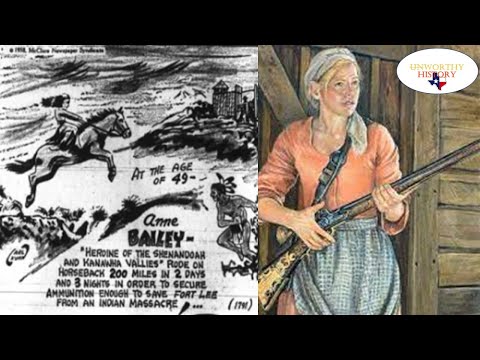
The gate swung open, and horse and rider vanished into the ink-black forest. The fleetest horse in the stockade, a powerful black with white feet and a blaze face, thundered beneath her. She named him Liverpool, after her birthplace in England, and together they raced against time. Up the Kanawha Valley she sped, crossing the Gaulley, leaving the Kanawha Falls behind. The Hawks Nest loomed ahead, its summit offering a fleeting glimpse of the silvery New River before she plunged back into the shadows. Darkness was her ally and her enemy—she knew the route by heart, but every rustle of leaves could signal an ambush. There could be no stop, no rest. The howl of wolves and the scream of panthers accompanied her, but she pressed on, her ears straining for the dreaded war whoop that would mean discovery.
As dawn broke, the Greenbrier Mountains stood out against the eastern sky, and the walls of Fort Savannah rose before her. A familiar voice called out, and the gates swung open. Anne Bailey had covered a hundred miles in a single night. She quickly relayed the dire situation at Fort Lee, and the commandant wasted no time. She was given a fresh horse and both were loaded with precious powder. The officer offered a guard, but she refused. “I ride faster alone,” she said, and with that, she began the perilous return journey.
Night and day she pressed on, the weight of the powder a constant reminder of the lives depending on her. Exhaustion gnawed at her bones, but the hope of saving her friends fueled her resolve. She rode through the same hostile territory, her eyes scanning the treeline for any sign of danger. The Indians were still out there, and she knew they would not hesitate to kill her if they caught her. But Anne Bailey was not just any rider—she was a phantom, a legend among the Shawnee, who believed her to be a charmed being, protected by the Great Spirit. That superstition had saved her life before, and it would save her again.
As she neared Fort Lee, the stockade walls came into view, and a shout went up from the sentries. “She’s back! Mad Anne is back!” The gates flew open, and she rode through amid cheers that echoed off the surrounding hills. The powder was distributed, and the garrison’s spirits soared. The next morning, they sallied forth and, after a spirited fight, forced the Shawnee to raise the siege. Fort Lee was saved—and with it, the future capital of West Virginia. Anne Bailey had accomplished the most daring feat recorded in the annals of the West, and her name would be forever etched in the hearts of the frontier.
But her story was far from over. The garrison, in gratitude, voted her the horse she had ridden, Liverpool, and he became her constant companion in the years that followed. She continued to roam the wilderness, a solitary figure of courage and compassion, delivering messages, carrying supplies, and defying the dangers that lurked at every turn. The Indians called her the “White Squaw of the Kanawha,” and her legend grew with each passing year.
She was no longer a woman of any fixed home. From Point Pleasant to Staunton, from Gallipolis to the Greenbrier, she rode with Liverpool at her side, carrying news, medicine, powder, and hope. Where there was no post office, no store, no doctor within a hundred miles, Anne Bailey became all three. She brought coffee to one cabin, lead to another, a pocket knife to a boy who never forgot her, and always—always—she was honest to the cent.
Mrs. Mary McCulloch of Mason County remembered her well. “Oh yes, she would bring anything that a horse could carry—just like an Express company.” And so she was, decades before Adams, Fargo, or any other name ever thought to stitch itself onto a stagecoach. The Bailey Express Company needed no signboard. It needed only a woman on a black horse with a blaze face, and the will to ride through anything.
She drove geese, too. Captain William Clinton of Mercer’s Bottom once contracted her to bring exactly twenty tame geese from the Greenbrier Valley—the first ever seen in the Kanawha country—and specified that the count must be exact or he would not pay. When one died near Charleston, she bagged the carcass, delivered nineteen squawking birds into his yard, then threw the dead one at his feet. “There’s your twenty.” The captain, seeing the flaw in his own contract, paid in full.
But biography must be honest, and so it must be said: Anne Bailey was not a saint. She took a drink when a drink was offered, and in a new country a hundred years ago, that was not the scandal it might seem today. Yet those who knew her best—her own granddaughter among them—insisted she never swore, kept the Sabbath, and prayed. “Grandma did not belong to any church, but she was a good woman.”
One thing she could not bear was the thought of ceasing to exist. She said often that in the hereafter she would rather suffer in misery than not exist at all. It was a strange confession from a woman who had stared down death a hundred times—but perhaps it explained her. She had ridden against annihilation all her life, and she would not surrender to it at the end.
Age came upon her at last. By 1817, at seventy-five, she was still walking the road to Charleston, still welcomed at every hearth. But her son William had gone north across the Ohio into Gallia County, and though she cursed the move—fifty-seven years in Virginia, both her husbands buried there—she could not let an only son go alone. She followed him into the wilderness, then refused to live under his roof, building instead her own little rail-and-thatch pen on a hill above Gallipolis, overlooking the river.
She kept her rifle. When asked how well she could shoot, she would tell in her broad English accent how she once sat atop Liverpool and shot an owl from a hickory tree across the mouth of the Elk. Children called her “Mad Anne,” but none dared say it to her face. The French settlers of Gallipolis welcomed her, and her canoe lay often at rest beneath the willows on the Virginia shore while she visited old friends at Mercer’s Bottom.
Then came the morning of November 22, 1825. She walked from her cabin to her son’s and told her daughter-in-law she meant to go to Gallipolis that day, though she complained of feeling ill. They persuaded her to lie down and go tomorrow. She rose late in the evening, insisted on returning home, and asked that her two granddaughters—Phoebe, eight, and Jane Ann, six—come stay the night with her.
The little girls ran ahead down the path, giddy at the adventure. A fire was built, and the three sat close around it while Grandma told stories the children loved. There was but one bed, so it was spread upon the floor before the hearth, and the little ones nestled in the middle. The wind of November blew fierce outside. The fire smoldered down. All slept.
But Phoebe grew cold, and half awake she called to her grandmother. No answer. She called again. All was still. In terror she shook her sister awake and told her Grandma was dead—and then, barefoot and without clothing, beneath the starlight and across the sparkling frost, the two children ran screaming toward home.
The parents heard the wails and came running. Mr. Trotter and the men who had been helping him gather corn rushed to the cabin, and there they found the great heart that had throbbed with patriotism for eighty-three years—stilled forever. Anne Bailey, the heroine of the Kanawha Valley, had passed to her eternal rest.
Neighbors gathered from miles around to pay their last respects. George Wagg, who lived nearby, fashioned a rustic coffin from rough-hewn boards. No minister was near, so no funeral service was preached. All that was mortal of her who saved the garrison at Fort Lee was laid to rest in what is still known as the Trotter graveyard, in an unmarked and almost nameless grave.
England gave her birth. Virginia gave her a field for action. Ohio held her dust. But the memory of Anne Bailey belongs to all who cherish heroism. She was a stranger to fear, a tower of adamant against hardship, danger, and the rage of the wilderness. The Indians called her a charmed being, a phantom rider, the White Squaw of the Kanawha—and even her enemies held her in awe.
Today a steel statue stands near the Ohio River at Point Pleasant, sculpted by Bob Roach, watching over the valley she once rode alone. But is a statue enough for the woman who rode a hundred miles through hostile forest to save a fort? Should the school children of Gallia County and the Kanawha Valley raise the marble shaft that was never built?
What do you think—does Anne Bailey deserve a grander monument, or does her true memorial live on in the stories we still tell? Share your thoughts in the comments below.
Report this article
Select a reason for reporting:






