Imagine standing in a small Ethiopian village in 1906. You are seven years old, playing a game on the dirt path with the other children. Your mother is cooking somewhere behind you. Then strangers arrive—men you have never seen before. They grab you, drag you away from everything you have ever known, and within days, you are bleeding on a filthy floor in the port town of Masawa, part of a group of boys where only one in ten will survive the next two weeks.
If you do survive, you will be shipped across the Red Sea, sold again in a market in Arabia, and eventually marched through the gates of the Topkapi Palace in Istanbul. From that day forward, your life belongs to the Sultan of the Ottoman Empire. You will never see your village again. You will never see your mother again. You will never have a family of your own. And one day, when the empire that bought you finally collapses, you will be left standing in the ruins of a world that no longer needs you.
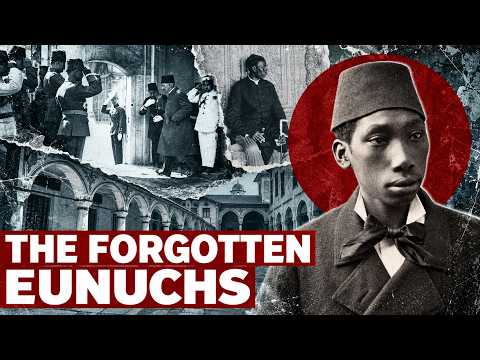
That was the life of an Ottoman eunuch. For almost 400 years, these men were the invisible machinery of one of the largest empires in history. They guarded the Sultan’s wives and concubines. They raised future sultans from infancy. They controlled the richest religious endowments in the Islamic world, including the stewardship of Mecca and Medina. Some of them, at their peak, were more powerful than grand viziers. Some died owning fortunes that would translate into tens of millions of dollars today.
And then, in a single generation, their entire world dissolved. The Sultanate was abolished. The harem was emptied by armed revolutionaries. The caliphate was buried. The Ottoman royal family was packed onto trains and sent into permanent exile. And a few hundred elderly men who had been castrated as children for a palace that no longer existed had to figure out what on earth to do with the rest of their lives.
So what actually happened to them? Where did they go? How did they survive? And is it really true that the last powerful eunuch of the Ottoman court ended up as one of the founding fathers of the modern Turkish dairy industry? Yes, as unbelievable as that sounds, we have the records to back it up.
Let me walk you through the strange, sad, and sometimes surprisingly uplifting final chapter in the story of the Sultan’s eunuchs. Before we get to the fall, we have to understand what these men actually were and why their fate mattered so much to the empire that created them.
The word eunuch tends to flatten everyone it touches into a single stereotype. The reality in the Ottoman court was far more layered. There were two distinct corps of eunuchs inside the palace. And the difference between them is important.
The white eunuchs, usually taken as boys from the Christian populations of the Balkans and the Caucasus, originally held the top positions in the imperial household. They supervised the pages in the third court of the palace, trained the empire’s future administrators, and were headed by the Kapi Aghasi, the Aga of the Gate of Felicity. For over a century, the chief white eunuch was effectively the chief of staff of the Sultan’s household.
Then there were the black eunuchs, drawn almost entirely from East Africa, especially Ethiopia and present-day Sudan and the surrounding regions. They had served alongside the white eunuchs in the palace for a long time. But something changed near the end of the 16th century. By 1587, the chief black eunuch had broken free of the chief white eunuch’s authority. By 1592, he had completely eclipsed him.
The black eunuchs took over supervision of the Sultan’s private apartments and the women of the harem, and the white eunuchs were pushed into a shrinking corner of the palace, overseeing the male pages and almost nothing else. The reasons for this flip are not fully understood, but it stuck. From then on, the man who really ran the inner palace was the Kizlar Aghasi, the chief black eunuch, formerly titled the Aga of the House of Felicity.
Now, calling him a guard or a chamberlain does not begin to describe what this man actually did. The chief black eunuch was in practice one of the most powerful officials in the entire Ottoman state. He held the rank of Pasha with three horsetails, the same military dignity as the top field commanders of the empire. In court protocol, he came right after the Grand Vizier and the Sheikh-ul-Islam. He stood next to the Sultan during every important ceremony. He controlled the Evkaf-ul Harameyn, the vast network of pious endowments that funded the holy cities of Mecca and Medina.
He was the gatekeeper between the private world of the harem and the political world of the Sultan’s cabinet. Any petition from a mother or a wife or a concubine that reached the Sultan had almost certainly been read, filtered, and sometimes rewritten by him first. He oversaw the schooling of the Sultan’s own sons. He controlled a network of spies within the black eunuch corps that reached into every corner of the household. He was, in the words of one Orientalist scholar, in practice the principal officer of the whole palace.
And some of them became astonishingly wealthy. Take Hajib Beshir Agha. Enslaved in his native Ethiopia as a boy, castrated somewhere in Egypt, he was eventually bought into the imperial palace and worked his way up through the harem bureaucracy. By 1707, he was the harem treasurer. By around 1716, he was chief black eunuch, a post he would hold for roughly 30 years under two sultans, Ahmed III and Mahmud I.
When Ahmed III was overthrown in a Janissary rebellion in 1730, Beshir Agha simply carried on under his successor, which tells you how indispensable he had made himself. He shaped the Ottoman interpretation of Sunni Islam through his control of the Hanafi legal rite in Mecca and Medina. He endowed mosques, Quran schools, libraries, and madrasas across the empire. At times, his authority was essentially second only to the Sultan and the Grand Vizier themselves. He died in his 90s in 1746 in the Topkapi Palace, one of the wealthiest and longest-lived chief eunuchs in Ottoman history.
But power never came for free. Nothing in the Ottoman court ever did. The chief black eunuch was also one of the most expendable officials in the empire because he had no family, no faction, no province he could retreat to and raise troops from. He belonged entirely to the Sultan. If the mood of the palace turned against him, there was no one to protect him.
Take Lala Suleyman Agha, the chief black eunuch who played a direct role in the assassination of Kösem Sultan in 1651. The next year, when the political winds shifted, Suleyman was shipped off to Egypt into forced retirement. He eventually tried to return to Istanbul in 1676. He never made it. He was executed on the island of Lemnos. Even for the most powerful eunuch in the court, the rope was always within reach.
So already you can see something important about how this institution worked. Even in its glory years, the eunuchs had no safety net outside the palace. If the palace continued, they were dignitaries, kingmakers, builders of mosques. If the palace rejected them, they were cargo. They would be exiled to Cairo, where they would live on a modest stipend of money and grain, usually in a townhouse they had bought while in office. Some of them did very well in that retirement since many of them had built massive commercial networks in Egypt during their careers. A deposed chief black eunuch did not necessarily end up in poverty, but he did end up on the margin.
And this is the detail that becomes crucial later. The empire had always treated its eunuchs as a kind of currency that could be moved around, deposited in different locations, cashed out when needed. When the whole system that minted that currency collapsed, nobody knew what to do with the coins that were left.
The decline, when it came, was slow at first. The real turning point happened in the 1820s and 1830s under Sultan Mahmud II. Mahmud is remembered for two spectacular acts of modernization. He wiped out the Janissaries, the old elite infantry corps, in a bloody massacre in 1826. And he began a long campaign of westernizing reforms that would eventually be known as the Tanzimat.
Part of that campaign was the closure of the Enderun, the palace school that had trained generations of Ottoman administrators and had been the natural home of the white eunuchs for centuries. With the Enderun gone, the white eunuchs effectively vanished as an institution. There was no more supply line, no more career ladder, and no more reason for the palace to keep training them. By the middle of the 19th century, the chief white eunuch had become a historical footnote.
The chief black eunuch’s office held on longer, but his power was draining away. The westernizing reforms of the mid to late 19th century stripped him of most of his political functions. Historians who have studied the office in detail describe the chief harem eunuch’s position as effectively in abeyance from the 1830s onward. He still existed. He still had a title. He still stood near the Sultan at ceremonies, but he was now a ceremonial relic rather than a shaper of policy.
The pious endowments of Mecca and Medina were increasingly managed by other bureaucracies. The harem itself was shrinking in importance as the empire’s center of gravity moved from Topkapi to the new European-style palaces of Dolmabahce and Yildiz. The age of the kingmaker eunuch was over before any of the men who had lived through the empire’s final collapse had even been born.
And then came 1908 and after that 1909. And here at last we arrive at the real break. In July 1908, a movement of military officers known to history as the Young Turks forced Sultan Abdul Hamid II to restore the constitution he had suspended three decades earlier. For a few months, there was an uneasy balance. Then in April 1909, there was a counterrevolution against the Young Turks, a brief restoration of absolute rule, and then a swift and brutal response.
The so-called Action Army marched on Istanbul from Thessaloniki. Abdul Hamid was deposed. His younger brother was placed on the throne as Mehmed V. And the Yildiz Palace, the fortress-like compound from which Abdul Hamid had ruled for over 30 years, was stormed.
The ransacking of Yildiz is one of those events that does not get enough attention in general histories of the fall of the Ottoman Empire. It was not a riot. It was not opportunism by an angry crowd. It was a calculated, almost gleeful dismantling of the old regime by soldiers who had been told, in effect, that the palace was theirs now. Jewels were carted off. Furniture was broken. The private rooms of the Sultan’s family were torn apart. And the harem, which at that point reportedly housed around 1,500 kadins, meaning enslaved palace servants and concubines, plus around 150 eunuchs, was simply ordered to disband.
The witnesses who were there described it as surreal. Hundreds of women who had spent their entire adult lives inside a sealed compound were suddenly standing in a courtyard being told to go home. Some of them had been in the palace since childhood and no longer had any home to go to. The new government, in a gesture that was partly humane and partly bureaucratic, invited the women’s families to come to Istanbul and reclaim their daughters. In a lot of cases, families actually did show up. Fathers from Circassia, brothers from the Caucasus, relatives who had sold their daughters or sisters into the harem decades earlier arrived to collect them. By many eyewitness accounts, these reunions were emotional and, in a strange way, happy. The women went home.
And then, when the dust settled on that first wave of releases, there was a group of people left standing in the courtyard with nowhere to go. The African eunuchs. Because here is the thing that the historian Jane Hathaway has emphasized in her research. These men, unlike the women of the harem or the devshirme boys who had grown up in the Ottoman administration, had essentially no contact with their birth families. They had been seized as small children in East Africa, often in Ethiopia, sometimes in the regions that are now Sudan or Kenya. They had been castrated in secretive workshops in places like Upper Egypt or along the Red Sea coast. They had been sold again, often two or three times, before arriving at the palace. By the time any of them had grown into dignified adults in silk robes, they had no idea where their villages were, no idea if their families were alive, no idea, in many cases, what language they had originally spoken. There were no relatives traveling to Istanbul to collect them. There was no home to go to.
So in April 1909, when the harem was dissolved, the eunuchs ended up scattered. Some followed Abdul Hamid himself into his first exile in Thessaloniki. The deposed Sultan was permitted a small household in exile, and he specifically requested that two more black eunuchs named Nureddin and Shehriar Agha be sent to him along with his chickens, his two cows, and his dog. That request was granted. The old man, now a prisoner of the state, kept a tiny domestic version of the harem system around him right up until his death in 1918.
Others were simply let go. Two eunuchs named Zulkil and Said, both of whom had been expelled from Yildiz Palace in 1909, were later found living in a shanty house, essentially homeless. These were men who had once worn silk robes in the private rooms of the richest man in the Islamic world. By their old age, they were in a shack.
And then there were the ones who tried to carve out a life for themselves in the vacuum. This is where the story takes a turn that nobody who read the history of the empire a century earlier could have predicted.
The most famous of these survivors was Nadir Agha. Enslaved in East Africa as a child, he rose to become Abdul Hamid II’s private secretary—widely considered the second most powerful eunuch in the court. When the palace fell, he walked out with money in hand and bought a garden in Göztepe on the Asian side of Istanbul.
Then he did something nobody expected. He went into dairy farming. He bred Crimean cows, studied the craft, and introduced what accounts describe as the first bottled milk ever sold in the Turkish market. The last powerful eunuch of the Ottoman court ended up as a milkman—and a very successful one.
Others found different endings. Some retired to Cairo. A handful joined the Aqawat, the ancient corps of African eunuchs guarding the Prophet’s tomb in Medina—an institution that survived the empire itself. And then there was Hayrettin Efendi, taken from Ethiopia around 1906, who lived quietly in a small house in Bostancı with a Circassian woman he loved. In 1975, he finally told his story out loud. He died the next year—the last black eunuch of the last Ottoman Sultan.
So what do you think—were these men victims of a cruel system, or survivors who found dignity in its ruins? Let me know in the comments below.
Report this article
Select a reason for reporting:






