The photograph was unremarkable at first glance—a young Black girl in a plain cotton dress, holding a bouquet of wildflowers, standing before a weathered wooden house. But Dr. James Mitchell, a historian specializing in the Jim Crow era, had learned to look closer. And when he zoomed in on the girl’s hands, his breath caught in his throat.
Between the stems, partially hidden by petals, was a folded piece of paper. In 1923 Mississippi, a Black child carrying a secret message could be killed for it. Yet there she was, smiling a quiet, determined smile, as if she knew exactly what she was doing.
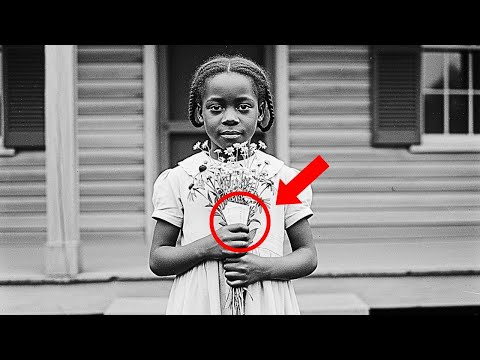
The back of the photo read: “Ruby, spring 1923, before the delivery.” Before the delivery. The words echoed in James’s mind. What delivery? And why had someone photographed her just before?
He spent the next morning digging into the history of Holmes County, Mississippi—a place where the Klan rode freely, where Black families were lynched for minor offenses, and where land was stolen through violence and legal trickery. But amid the darkness, he found whispers of an underground network: the Land Trust. A secret coalition of Black farmers, veterans, and church leaders who helped families buy and protect land, using white intermediaries and coded messages. Children were their messengers—invisible to white eyes.
James drove to Holmes County and met Mrs. Dorothy Washington, the 87-year-old director of the local heritage museum. When he showed her the photograph, her hands trembled. “Lord have mercy,” she whispered. “This is Ruby Anne. My grandmother’s cousin. We thought all her pictures were destroyed.”
Ruby, she explained, was one of the Land Trust’s most trusted messengers. The paper in her flowers contained the names and locations of five Black families buying land—information that could get them all killed. On that spring day in 1923, Ruby made four deliveries before the Klan caught wind. She sent the Turner boys ahead with the paper while she walked straight into the riders’ path, using her tears and a child’s innocence to divert them. She never came home.
But Ruby didn’t die. She ran north, alone, and survived. She built a life in Chicago, opened a dress shop, and raised a daughter—but she never spoke of Mississippi. Her story might have vanished forever, if not for a single photograph and a historian who looked closely enough to see what she was hiding.
Now, a century later, James stood before an exhibition honoring Ruby and the Land Trust. Descendants of the five families she saved filled the room, their land still in their names. “She was just a girl with flowers,” Mrs. Washington said. “But she carried the future in her hands.”
As the applause faded, James turned back to the photograph. Ruby’s eyes seemed to meet his—still determined, still brave. And he knew the story was far from over.
Patricia Fletcher Williams lingered by her mother’s photograph long after the crowd had thinned, her fingers resting on the frame. James approached quietly, not wanting to break the spell. “There’s something I haven’t shown you yet,” she said, turning to him. “Something I found in Mama’s box that I didn’t understand until tonight.”
She pulled a small envelope from her purse, its paper brittle with age. Inside was a single sheet—a letter, written in a child’s careful hand, never mailed. “Dear Grandma Esther,” Patricia read aloud, her voice steady. “I am safe. I am in St. Louis with good people. I think of you every day. The flowers were pretty that day. I hope you got to see them. Your Ruby.”
James felt the words land like stones in still water. Ruby had written the letter in 1929, the same year she’d scribbled her note on the coded list. But this one had never left her possession. “She wrote it and couldn’t send it,” he said. “The risk was too great.”
Patricia nodded. “Mama kept it her whole life. She told me once that she wrote a hundred letters in her head, but only this one made it onto paper.” She looked up at the exhibition walls, at the descendants of the families her mother had saved. “I want to finish what she started, Dr. Mitchell. I want to find Esther’s grave.”
The search took them three weeks. Esther Anne had died in 1944, and the county’s Black burial records were scattered across church ledgers and family Bibles. It was a groundskeeper at a small cemetery outside Lexington who finally pointed them to an unmarked plot beneath an old magnolia tree.
Patricia knelt in the grass and placed a bouquet of black-eyed Susans and wild daisies against the trunk. “She never knew, Grandma,” she whispered. “But Ruby made it. She made it, and she never stopped loving you.”
James stood back, letting her have the moment. When she rose, her eyes were wet but clear. “There’s one more thing,” she said. “Mama’s notebook ends with a question. She wrote, ‘Did the land stay with the families?’ I want to answer her.”
So they did. Over the following months, James and Patricia tracked down every deed, every parcel, every descendant. Of the five families Ruby had protected that day, four still held their land. The fifth had sold it in the 1970s—but used the proceeds to send six children to college. “The land stayed,” Patricia wrote in a final entry in her mother’s notebook. “Your delivery worked, Mama. It’s still working.”
Word of the exhibition spread beyond Mississippi. A producer from a national documentary series called James’s office. A publisher asked Patricia if she would consider a memoir. And a young historian at Howard University wrote to say she was building a database of child messengers across the South—Ruby’s story had inspired her.
James sat in his office late one evening, the original photograph of Ruby propped against his lamp. He thought about the thousands of children who had carried secrets through hostile country, their names never recorded, their courage never acknowledged. Ruby was one. But she was not the only one.
His phone buzzed. A text from Patricia: “Found something else. A second photograph. Same house, same girl—but this time she’s holding a different bouquet. On the back it says ‘Ruby, fall 1923.’ She went back, James. After everything, she went back.”
James stared at the message, his pulse quickening. Fall 1923. Months after her flight, after the Klan had burned her grandmother’s house. Ruby had returned—or someone had photographed her standing in front of that same weathered porch. The story he thought he’d finished was opening again, like a door he hadn’t known was there.
He picked up his phone and called Patricia. “Send me everything,” he said. “I’ll be in Chicago by morning.”
Patricia’s email arrived at 2:17 a.m. James opened the attachments before his coffee had finished brewing. The second photograph was smaller, creased down the middle, but the image was unmistakable: Ruby Anne, maybe six months older, standing before the same sagging porch. This time her hands were empty. The house behind her was a blackened skeleton, its roof collapsed, windows gaping like empty eye sockets.
But it was the back of the photo that made James set down his cup. In the same careful handwriting as the first, someone had written: “Ruby, fall 1923. She came back to say goodbye.”
He caught the first flight to Chicago. Patricia met him at a diner near her mother’s old Bronzeville shop, now a nail salon. She slid a third item across the table—a page from Ruby’s notebook, dated decades later, that Patricia had overlooked.
“I went back in the fall,” Ruby had written. “Not to stay. Just to see. The house was gone. The magnolia was still there. I left the flowers on the step and I said what I had to say, and then I walked away for the last time. I was eleven years old and I knew I would never see Mississippi again.”
James read it twice. “Who took the picture?” he asked. “She couldn’t have been alone.”
Patricia pulled out a typed letter, dated 1987, from a woman named Lula Mae Turner. “I found this in Mama’s things too,” she said. “Lula Mae was one of the Turner boys—the ones Ruby sent ahead with the paper. She wrote to Mama after the exhibition made the news up here.”
The letter explained everything. Lula Mae had been twelve in 1923, and after the Klan burned Esther’s house, her own father had forbidden her from speaking Ruby’s name. But Lula Mae never forgot. In the fall of 1923, she’d spotted Ruby slipping through the woods near the old place—thin, ragged, but alive. She’d followed her, and when Ruby stood before the ruins of her grandmother’s house, Lula Mae had stepped out of the trees.
“She didn’t run,” Lula Mae wrote. “She just looked at me and said, ‘I had to see it one more time.’ My brother had a camera he’d gotten from a soldier. I took her picture because I knew nobody would believe me otherwise. I wanted proof that she survived.”
James felt the hair on his arms rise. “So the second photo wasn’t a return to stay,” he said. “It was a farewell. And Lula Mae kept it secret for sixty-four years.”
Patricia nodded. “Lula Mae died in 1991. But her daughter still lives in Jackson. She called me last week. She has something else—something Lula Mae said was meant for Esther’s family, if anyone ever came looking.”
James leaned forward. “What is it?”
Patricia’s eyes glistened. “A locket. Ruby gave it to Lula Mae that day in the woods. Told her to keep it safe until someone from her family came back for it. Lula Mae tried to return it in 1929, but by then Esther had fled the county and nobody knew where she’d gone.”
James sat back, the weight of the discovery settling over him. Ruby had left a trail of breadcrumbs across a century—a photograph, a coded list, a letter never sent, and now a locket. Each one a small act of defiance against the erasure that had been intended for her.
“We need to see that locket,” he said. “And we need to find out what’s inside it.”
They drove to Jackson the next morning. Lula Mae’s daughter, a soft-spoken woman named Carolyn, met them on her porch with a velvet box in her hands. “Mama kept this in her Bible,” she said. “She told me it was a promise she never got to keep.”
Inside the locket was a tiny photograph of Esther, and on the other side, a lock of hair tied with a thread. Ruby had carried her grandmother with her all those miles—through the woods, through St. Louis, through a lifetime of silence.
Patricia closed her hand around it and wept. “She never lost her,” she whispered. “Not really.”
James watched the magnolia leaves stir outside the window. A girl with flowers, a paper hidden in plain sight, a locket that crossed a century to find its way home. History wasn’t just what was written down. It was what survived.
Before he left, he asked Patricia one last question. “What will you do with all of this?”
She smiled through her tears. “What Mama would have done. I’ll tell the truth, and I’ll pass it forward.”
And what about you—if you found a hidden message in an old photograph, would you follow it as far as it led?
Report this article
Select a reason for reporting:






