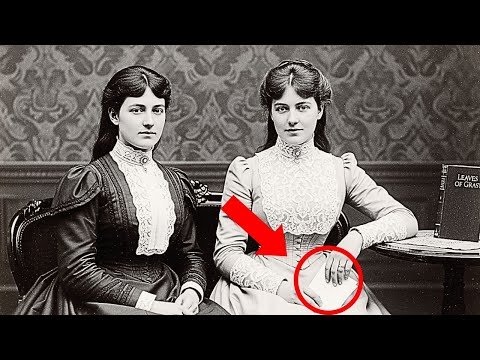
The autumn light filtered through the dusty windows of the old Victorian house in Philadelphia, casting long shadows across the wooden floor. Dr. Sarah Mitchell carefully lifted another box from the pile, her hands protected by white cotton gloves. As a historian specializing in 19th century American women’s lives, she had been called to catalog the estate of the deceased owner, a woman who had left behind generations of family history.
The attic smelled of aged paper and forgotten memories. Sarah had spent three days sorting through documents, letters, and photographs. Each item was a window into lives long past. Most of what she found was ordinary—receipts, business correspondence, formal family portraits. Nothing particularly remarkable.
Then she opened a leather portfolio tucked beneath a stack of ledgers. Inside was a photograph, sepia-toned and remarkably well preserved. Two young women, perhaps in their mid-20s, sat side by side in an elegant parlor. Their dresses were typical of 1874, high-necked with intricate lace details and long sleeves. One woman had dark hair pulled back severely, her expression serious and dignified. The other, lighter-haired, held a subtle smile that seemed to hide something beneath its surface.
Sarah almost returned the photo to its portfolio when something caught her eye. The lighter-haired woman’s right hand rested in her lap, partially obscured by the folds of her dress. But between her fingers, barely visible, was the corner of what appeared to be a folded piece of paper.
At first glance, it seemed like nothing—perhaps a handkerchief or a calling card. But as Sarah brought the photograph closer to the window, using natural light to examine the detail, she noticed something unusual. There was writing visible on the exposed corner of the paper. Not just any writing. It appeared to be in a flowing, intimate script, and Sarah could make out what looked like the beginning of a sentence.
My dearest, her breath caught.
In 1874, formal photography sessions were expensive and carefully staged. Every element in a portrait was deliberate. Why would someone hold a personal letter during such an important sitting?
Sarah pulled out her magnifying glass and leaned closer. Her hands trembled slightly as she positioned it over the photograph. The detail was remarkable for a picture taken nearly 150 years ago. Whoever had taken this portrait had been skilled, capturing not just faces but the smallest textures—the lace on the collars, the pattern of the wallpaper behind them, and yes, the faint words on that partially visible paper. She could make out three more words now: my dearest. Never forget, always yours.
The phrasing struck her immediately. This was not business correspondence. This was not a family letter written in the formal, distant style common to the Victorian era. This was intimate, personal—the kind of language used between people who shared something private.
Sarah photographed the portrait with her high-resolution camera, knowing she would need to examine it more closely later. But even now, questions flooded her mind. Who were these women? Why had one of them chosen to hold this letter during their portrait sitting? And most intriguingly, what was the relationship between them?
She turned the photograph over. On the back, in faded pencil, someone had written: Eleanor and Catherine, Philadelphia, October 1874. Just two names. No family connection indicated. Not sisters, not cousins. Nothing to explain why they would sit for a portrait together. In that era, formal photographs of two unrelated women were unusual unless they were part of a larger group or family arrangement.
Sarah carefully placed the photograph in a protective sleeve and set it aside. She needed to find more information about Eleanor and Catherine. Who were they? Where did they live? What happened to them after this portrait was taken?
She spent the next hour searching through the remaining contents of the portfolio. There were other photographs—family groupings, children, elderly relatives—but none featuring either Eleanor or Catherine. Again, it was as if this single portrait existed in isolation, disconnected from everything else in the collection.
Then, at the bottom of the portfolio, Sarah found a small bundle of letters tied with a faded blue ribbon. Her pulse quickened as she carefully untied the ribbon. The bundle contained seven letters, each carefully folded and preserved.
Sarah’s fingers moved delicately as she opened the first one. The paper was brittle with age. The ink faded to a soft brown, but the handwriting was still legible—elegant, flowing script that belonged to someone educated and deliberate in their words. The letter was dated September 15th, 1874, just weeks before the photograph was taken.
My dearest Catherine, it began. The hours since we parted feel like years. I find myself looking out the window, hoping to see you walking down the street, knowing it cannot be. My mother has been watching me with suspicious eyes, asking why I seem so distracted, why I smile at nothing. How can I tell her that I smile because I am thinking of you?
Sarah’s breath caught. The intimacy of the words was unmistakable. This was not friendship in the casual sense. This was something deeper, more profound.
She continued reading. I keep your last letter pressed against my heart beneath my dress where no one can see. Reading your words makes me feel less alone, less strange for feeling what I feel. You told me not to be afraid, that what we share is real and good, regardless of what the world might say. I am trying to be brave, Catherine. Truly I am.
The letter was signed simply, Yours always, Eleanor.
Sarah sat back, her mind racing. Eleanor and Catherine—two women in 1874 Philadelphia, writing to each other with language that transcended friendship. In an era when even acknowledging such feelings could lead to social ruin, they had found each other.
She opened the second letter. Dated a week later, Catherine’s handwriting was slightly bolder, more confident than Eleanor’s. My beloved Eleanor, it read, Do not fear your mother’s watchful eyes. What we have cannot be seen by those who do not understand it. When I hold your hand, when we sit together in your parlor, the world sees two friends. Only we know the truth.
Sarah felt a chill run down her spine. She opened the third letter, dated October 10th, 1874—just days before the photograph was taken. Catherine’s handwriting filled the page with an urgency that was almost palpable.
Eleanor, I have made arrangements for us. There is a photographer on Chestnut Street, a man who came recommended by a colleague of my father’s. I have commissioned a portrait of the two of us together. I know this frightens you, but please hear my reasoning.
Sarah leaned forward, her eyes scanning faster now.
We live in a world that will not allow us to be what we are. We cannot walk openly together as our hearts desire. We cannot make promises in churches or sign documents that bind us legally to each other. But this portrait, Eleanor, this portrait can be our declaration. Years from now, when we are old and gray, we will look at this photograph and remember. We will have proof that we existed, that this was real, that we loved each other when the world said we should not.
The letter continued with practical details about the sitting—the time, the location, what dress Eleanor should wear. But it was the final paragraph that made Sarah’s hands tremble.
I am enclosing with this letter the one you wrote to me last spring. The first time you told me how you felt. Bring it with you to the portrait sitting. Hold it in your hand where only we will know it is there. Let it be our secret hidden in plain sight. When people look at this photograph in years to come, they will see two respectable women sitting properly for a formal portrait. But you and I will know the truth. We will know what you hold in your hand and what I hold in my heart.
Sarah set the letter down carefully. Now the photograph made sense. The partially visible corner of the letter, the intimate words barely readable—it had all been intentional. Catherine had planned it carefully, creating a record of their love that could survive in a world determined to erase it.
But what happened next? Why were these letters here, separated from their owners?
Sarah spent the remainder of the afternoon documenting everything she had found. She photographed each letter carefully, noting the dates, the handwriting, the condition of the paper. The portrait of Eleanor and Catherine sat propped against a box, the two women gazing out at her across 150 years of silence.
She needed to know more. Who were Eleanor and Catherine? What were their full names? What happened to them after October 1874?
The next morning, Sarah arrived at the Philadelphia City Archives. The building was a repository of the city’s history—birth records, death certificates, property deeds, census data. If Eleanor and Catherine had lived in Philadelphia, there would be traces of them here.
She started with the 1870 census, searching for women named Eleanor in the city. There were dozens. Adding Catherine to the search helped narrow it down, but she still needed more information. She returned to the photograph, studying every detail. The wallpaper behind them, the style of furniture, the quality of their dresses—all suggested wealth, or at least comfortable middle-class status.
Then she noticed something she had missed before. On the small table beside Eleanor, barely visible in the photograph, was a book. Sarah zoomed in on her digital copy of the image. She could just make out the spine—a title in gold lettering. She grabbed her magnifying glass. The letters were tiny but legible: Leaves of Grass.
Sarah’s pulse quickened. Walt Whitman’s Leaves of Grass had been published in 1855 and had quickly become controversial for its frank discussion of the body, sensuality, and emotion. It was exactly the kind of book that would appeal to women like Eleanor and Catherine—women who lived outside conventional expectations, who sought words that validated feelings society deemed inappropriate. This was another clue, another deliberate choice. Nothing in that photograph was accidental.
Armed with this information, Sarah returned to the census records. She cross-referenced women named Eleanor and Catherine who lived in the same neighborhood, whose families had the means to own books and commission photographs. After three hours of searching, she found them.
The census record from 1870 showed Eleanor Anderson, aged 21, living with her parents and two younger siblings on Spruce Street in a fashionable neighborhood of Philadelphia. Her father was listed as a physician—a profession that placed the family solidly in the educated upper middle class. Four blocks away, Sarah found Catherine Morrison, age 22, living with her widowed father, a professor of literature at the University of Pennsylvania. No siblings were listed. Catherine was recorded as a teacher at a private girls’ academy.
Sarah’s mind raced with possibilities—a professor’s daughter and a physician’s daughter, both educated, both living close enough to have met through social connections. Catherine, as a teacher, would have had more independence than most women of her era. Eleanor, the eldest daughter in a traditional family, would have been expected to marry well and manage a household. But they had found each other instead.
Sarah pulled the city directory for 1874, the year of the photograph. Eleanor still lived with her parents, but Catherine’s entry showed a change. She had moved to a boarding house for unmarried women on Locust Street, apparently no longer living with her father. Why the move? Had Catherine’s father discovered the nature of her relationship with Eleanor? Had she been forced to leave, or had she chosen independence?
Sarah returned to the letters, rereading them with new context. She noticed now that Catherine’s tone was often protective, encouraging Eleanor to be brave, to not fear what others might think. Eleanor’s letters, in contrast, were filled with anxiety—worry about her mother’s suspicions, fear of what might happen if their relationship was discovered.
Sarah found the city directory for 1875, the year after the photograph. Eleanor was no longer listed at her parents’ address. Instead, there was a notation that made Sarah’s heart sink: Married now—Mrs. Eleanor Patterson. She searched for Catherine in the same directory. The entry was brief: Morrison, Catherine, teacher, residence unknown. Catherine had vanished from the public record.
Sarah sat in the archives reading room staring at the directory entry. Eleanor had married. Catherine had disappeared. The story she had been piecing together—of two women who loved each other in an unforgiving era—seemed to be heading toward the tragic ending she had feared. But she could not stop now. She needed to know what had happened.
She requested marriage records for Eleanor Anderson, married 1875. The certificate arrived within an hour. Eleanor had married Thomas Patterson, a banker, on March 3rd, 1875. The ceremony had taken place at her family’s church. Everything about it was conventional, expected, proper.
Sarah pulled the 1880 census. Eleanor Patterson now lived in a large house in Rittenhouse Square with her husband and two young children—the life of a respectable Philadelphia matron, exactly what her family would have wanted for her. But what about Catherine?
Sarah expanded her search beyond Philadelphia. If Catherine had left the city, where would she have gone? She checked teaching registries, city directories for New York, Boston, Baltimore—cities where an educated woman might find work. Nothing. Catherine Morrison seemed to have vanished.
Then Sarah remembered the letters. She returned to her photographs of them and reread each one carefully. In Catherine’s last letter, the one describing the portrait sitting, there had been a line she had not given much attention to before: Whatever happens, Eleanor, know that I will always carry you with me. Distance cannot separate what we have shared. Distance. The word felt significant now.
Sarah returned to the estate where she had found the photograph and letters. The deceased owner had been named Margaret Anderson—the same surname as Eleanor. She requested the genealogical records the estate lawyer had provided. Margaret Anderson had been Eleanor’s great-great-granddaughter. The photograph and letters had been passed down through Eleanor’s family for generations—kept hidden, perhaps, but preserved nonetheless.
Sarah felt a surge of hope. If Eleanor had kept these letters, if she had preserved them despite marrying and living a conventional life, then perhaps the story did not end in complete tragedy.
Sarah requested Eleanor Patterson’s personal papers from the historical society. As the wife of a prominent banker, Eleanor had been involved in charitable work and women’s civic organizations—the kind of activities that left paper trails. Among the records, Sarah found something unexpected: a diary written in Eleanor’s hand, covering the years 1874 to 1876. Her hands trembled as she opened it to the autumn of 1874.
October 14th, 1874. Today, Catherine and I sat for our portrait. I was terrified someone would notice the letter I held, would ask questions I could not answer. But the photographer said nothing, only positioned us carefully and told us to remain still. Catherine squeezed my hand when he was not looking. I wanted to cry, but I kept my expression neutral as Mother taught me. The letter in my hand felt like it was burning through my glove.
Sarah continued reading. The entries that followed were filled with Eleanor’s anguish. Her mother had begun arranging meetings with eligible men. Her father had made it clear that he expected her to marry within the year.
November 2nd, 1874. Catherine tells me we could leave together, start a life somewhere else where no one knows us. She has saved money from her teaching salary. She speaks of California, of the frontier territories where society is less rigid. But I am a coward. I cannot imagine leaving my family, facing the world’s judgment, living in poverty and exile. Catherine deserves better than a coward.
December 20th, 1874. Mother found one of Catherine’s letters today. I had hidden it poorly, distracted by my despair. She did not read it, thank God. But she asked questions. Why does this friend write to you so often? Is it proper for an unmarried teacher to correspond so intimately with a young woman of good family? I lied. I said Catherine was lonely, that I was being kind to someone less fortunate. The words tasted like poison.
January 15th, 1875. Catherine is leaving Philadelphia. She says she cannot stay and watch me marry someone else.
Sarah turned the page with careful fingers, her heart heavy with the weight of what she was reading.
January 18th, 1875. Catherine came to say goodbye. She waited until the afternoon when she knew my parents would be out making social calls. We sat in the parlor—the same room where we had our portrait taken—and I could not stop crying. She held my hands and told me she understood, that she did not blame me for choosing safety over uncertainty. But I saw the pain in her eyes.
The entry continued for another page, Eleanor’s handwriting becoming less controlled, more emotional. She gave me a package before she left—all my letters to her, every one I had ever written. She said she could not take them where she was going, that it would be too painful to keep reading them. She asked me to keep them safe along with hers. Someday, she said, when we are both old and this pain has faded, perhaps you will look at these and remember that once someone loved you exactly as you were. Then she left, and I watched from the window as she walked down the street carrying a single traveling bag. She did not look back.
Sarah found herself blinking back tears. The grief in Eleanor’s words was palpable, reaching across centuries.
February 10th, 1875. Mother is pleased. I have agreed to marry Thomas Patterson. He is kind enough, and he will provide the life my family expects for me. At night, I take out the photograph of Catherine and me. We look so young in it, so hopeful. I touch the corner of the letter visible in my hand and remember what it said. I wonder if Catherine is looking at her copy of the photograph tonight, wherever she is.
March 4th, 1875. I am married. My name is now Eleanor Patterson. The woman I was—the one who loved Catherine Morrison—feels like someone from another life. But late at night, when Thomas is asleep, I open the hidden drawer in my writing desk and read Catherine’s letters. I will never stop reading them.
Sarah closed the diary. Eleanor had chosen convention over love, security over authenticity. But she had kept the letters. She had kept the photograph. She had preserved the evidence of what she and Catherine had shared, even as she lived a life that denied it. But what had happened to Catherine?
Sarah’s search for Catherine Morrison’s fate took her across multiple archives and records collections. For weeks, she found nothing. Then, on a cold November morning, she discovered a reference in an unexpected place—a collection of personal papers donated to the Library of Congress by a women’s suffrage organization. Among letters discussing voting rights and women’s education, Sarah found correspondence from Catherine Morrison postmarked from Denver, Colorado, dated 1876.
In the letter, Catherine described her work establishing a school for girls in the growing frontier city. She wrote about the freedom she felt in the West, where society’s expectations were less rigid, where a woman could own property and run a business without constant scrutiny. She wrote about the mountains, the clear air, the sense that she was building something new.
Sarah found more records. Catherine had never married. She had spent thirty years running her school, becoming a respected educator in Denver. When she died in 1905, the local newspaper published an obituary celebrating her contributions to women’s education in Colorado. Among Catherine’s possessions donated to the Colorado Historical Society after her death, Sarah found one item that made her stop breathing: a photograph—the same photograph—Eleanor and Catherine sitting side by side in that Philadelphia parlor in 1874, the letter barely visible in Eleanor’s hand. Catherine had taken her copy of the photograph with her. She had kept it for thirty years.
Sarah arranged to have the photograph and letters included in an exhibition on 19th-century women’s lives. She wrote about Eleanor and Catherine carefully, respectfully, letting their own words tell their story. On the opening night of the exhibition, Sarah stood before the display. The photograph was mounted prominently, with selected passages from the letters transcribed beside it. Visitors moved slowly past, reading, pausing, reflecting.
An elderly woman stopped beside Sarah. “They loved each other,” she said quietly. “It was not a question.”
“Yes,” Sarah replied. “They did.”
The woman nodded. “My grandmother had a friend like that. She never married either. Lived with the same woman for forty years, and everyone called them companions.” She smiled sadly. “I’m glad someone is finally telling these stories.”
Sarah looked at the photograph. Eleanor and Catherine gazed back at her, frozen in time, but no longer forgotten. The letter Eleanor held—that small, deliberate act of rebellion—had done exactly what Catherine had hoped. It had preserved their love, kept it alive, waiting for a time when the world was ready to see it.
In the margin of the exhibition notes, Sarah had included Catherine’s words from her final letter: Distance cannot separate what we have shared. One hundred fifty years later, those words still rang true.
What secrets might be hiding in your own family’s attic, waiting for someone to finally see them?
Report this article
Select a reason for reporting:






