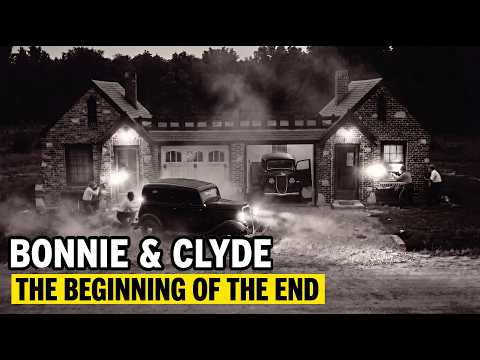
It was supposed to be a quiet night. The kind of night where tired outlaws could rest, count their stolen coins, and disappear before dawn. But on July 19, 1933, at a modest tourist court called the Red Crown, Bonnie Parker and Clyde Barrow drove straight into a trap set by thirteen lawmen—and somehow, they lived to tell the tale.
This is the story of the shootout that should have ended it all. A story of arrogance, luck, and a blind escape that would become legend.
The day had started with a string of petty robberies. Three gas stations in Fort Dodge, Iowa, hit in just fifteen minutes. They even stole bubble gum machines. But it wasn’t the money that made this day different. It was the hostages—gas station attendants forced into the back seat of a stolen Ford V8, used as human shields against the police.
By nightfall, the car was crowded. Bonnie, Clyde, Clyde’s brother Buck, his wife Blanche, and seventeen-year-old W.D. Jones. Five people, one stolen car, and a trail of law enforcement closing in.
Clyde needed a place to hide. He chose the Red Crown Tourist Court outside Kansas City—two brick cabins connected by a garage, sturdy walls that felt safe. What he didn’t know was that the Red Crown was a favorite hangout for lawmen. Highway patrolmen ate there. The county sheriff, Holt Coffey, was a regular. It was the worst possible choice.
But Clyde was nothing if not bold. He had W.D. lie down in the back seat and covered him with blankets. Blanche rented the cabins, claiming only three people. She paid with a fistful of coins—four dollars in change, heavy and suspicious.
The clerk, Neal Houser, noticed everything. The jodhpurs Blanche wore, the way the driver backed the car into the garage—gangster style. The pile of coins. The five meals ordered for three people. He called Sheriff Coffey.
By midnight, thirteen officers surrounded the cabins. They had Tommy guns, steel shields, an armored car. They were ready for war. But Bonnie and Clyde were ready too—with Browning Automatic Rifles stolen from a National Guard armory.
The first shot came from Clyde. Then all hell broke loose.
The lawmen had planned it perfectly. The armored car blocked the garage doors. Two deputies were positioned on the roof of the tavern, watching the cabins from above. Sheriff Coffey and Captain Baxter had walked across the open ground with their shields held high, ready to demand surrender.
But the plan fell apart in seconds. When Coffey knocked on the door of the left cabin, Blanche shouted back that she wasn’t dressed. Her voice carried loud enough for Clyde to hear every word from the other cabin. He grabbed his rifle and moved through the garage door.
Through the glass panel, he saw Coffey and Baxter standing in the yard. “Who’s there?” Clyde called out. “The sheriff—open the door,” Coffey replied. “Just a minute,” Clyde said. Then he fired.
Baxter took the shots on his steel shield and staggered backward, unhurt. Coffey ran for cover. From the far end of the driveway, White Cotton saw a man sprinting away from the cabin and assumed it was an outlaw trying to escape. He shouted at Officer Leonard Ellis to take him down.
Ellis raised his shotgun and fired. The pellets caught Sheriff Coffey in the neck—two grazing wounds from his own men. It was friendly fire, pure and simple.
Inside the cabins, the gang was moving. Bonnie, Clyde, and W.D. slipped through the inner door into the garage. Buck came out of the left cabin with his BAR, firing wildly to cover their escape. Captain Baxter seized the moment and aimed his Thompson at Buck. The bullet struck Buck in the left temple and exited through his forehead.
Blanche, all eighty-one pounds of her, ran across the open ground and grabbed her wounded husband. She dragged him to the car and laid him in the back seat, climbing in beside him. She was about to lose her husband, and she knew it.
But the armored car still blocked the garage. Clyde began firing at it with his 30-06 rifle. The armor plating wasn’t built to stop those rounds. The bullets punched through and hit Deputy George Highfield in both knees. One shot struck the horn, and it began blaring nonstop.
Some officers heard the horn and thought it was a ceasefire signal. They began to pull back. Highfield, bleeding and in agony, decided he wasn’t staying alone. He reversed the armored car away from the garage doors.
Then a tear gas canister was fired. It sailed over the cabins and landed in the parking lot of Slim Castle’s gas station across the road. The wind pushed the gas back into the faces of the lawmen. They were blinded by their own weapon.
Clyde didn’t wait. He gunned the Ford V8 out of the garage, past Coffey and the others, and onto Highway 71. The police fired a final volley. A Thompson round shattered the rear window, spraying glass into Blanche’s face. Shards tore into both her eyes. Her left eye was destroyed. She would be blind in it forever.
When the smoke cleared—and there was plenty of it—the lawmen counted their injuries. Coffey had two scratches on his neck from Ellis’s shotgun pellets. His son Clarence had a bullet wound in his arm. Highfield had two shattered knees. No one was dead. But the Barrow gang was gone.
Inside the cabins, officers found five sandwiches and five empty soda bottles. They found a medical kit—stolen from a doctor in Enid—and speculation ran wild in the papers that the gang were drug addicts. It was just burn supplies for Bonnie’s leg.
They recovered a Browning Automatic Rifle, five Colt .45 automatics, and forty-seven empty shell casings. One of those Colts had belonged to Marshal Henry Humphrey, shot dead by Buck in Alma, Arkansas, just weeks earlier.
Somewhere on Highway 71, heading north into the Iowa darkness, a bullet-riddled V8 carried a dying brother, a half-blind sister-in-law, a teenage boy in the passenger seat, and a man who had just driven through an impossible trap.
They had escaped. But everyone knew how this story would end.
The Ford V8 tore through the night, its engine roaring over the whine of the blaring horn that still echoed in their ears. Clyde pushed the pedal to the floor, his knuckles white on the wheel. In the back seat, Buck’s breathing was shallow, a wet rattle that cut through the wind rushing through the shattered window.
Blanche held her husband’s head in her lap, blood soaking through her jodhpurs. She couldn’t see out of her left eye—it was a hot, stinging darkness—but she could feel the warmth of Buck’s blood seeping into her clothes. “Stay with me, Buck,” she whispered, her voice cracking. “Just stay with me.”
W.D. Jones sat in the passenger seat, his face pale, his hands trembling. He was seventeen years old, and he had just seen a man shot in the head. He kept his eyes fixed on the road ahead, afraid to look back.
Clyde didn’t speak. His jaw was set, his eyes scanning the rearview mirror for headlights. The lawmen would be behind them soon—if they weren’t already. He knew they had to get off the main road, find someplace to hide, to tend to Buck’s wound. But Buck’s wound was beyond tending.
They drove for hours, zigzagging through backroads, avoiding towns. The sky began to lighten, a gray dawn creeping over the Iowa hills. Buck’s breathing grew quieter, then stopped altogether. Blanche let out a sound—not a scream, but a low, animal moan that seemed to come from somewhere deep inside her.
Clyde pulled off the road into a grove of trees. He sat there for a moment, staring at the steering wheel. Then he got out and walked to the back of the car. He looked at his brother’s body, and something in his face changed. It was as if a light had gone out behind his eyes.
They buried Buck that morning, in a shallow grave they dug with their bare hands and a tire iron. Clyde said a few words—not a prayer, just a promise. “I’ll make them pay,” he said. “Every last one of them.”
Blanche was never the same after that. She had lost her husband, her eye, and her nerve. The woman who had once worn jodhpurs and paid in coins was now a ghost, her face half-hidden by a bandage, her spirit broken. She would leave the gang soon after, captured by police in a motel room, and she would never see Clyde or Bonnie again.
But that was later. For now, there was only the road, and the silence, and the blood that wouldn’t wash off.
Bonnie sat beside Clyde, her leg throbbing from the burns that hadn’t healed. She looked at his face, at the hard line of his jaw, and she knew what he was thinking. He was already planning the next robbery, the next escape, the next battle. He was already thinking about how to kill the men who had killed his brother.
She reached over and touched his arm. He didn’t respond. He just kept driving, his eyes fixed on the horizon, as if he could see something she couldn’t. Maybe he could. Maybe he could see the end, and he was driving toward it anyway.
The Red Crown shootout made headlines across the country. “Barrow Gang Escapes Death Trap,” the papers screamed. “Thirteen Lawmen Outgunned by Desperadoes.” The legend grew, but so did the pressure. J. Edgar Hoover was furious. He ordered his agents to hunt the Barrow gang with renewed fury.
And in the quiet moments, when the car was silent and the road was empty, Clyde would think about Buck. He would think about the promise he made at the grave. And he would press his foot harder on the gas, as if he could outrun the memory.
Clyde kept that promise. Over the next year, he and Bonnie left a trail of robbery and blood across the Midwest. But the law was closing in, and the pressure was mounting.
On May 23, 1934, on a lonely road in Bienville Parish, Louisiana, the end came. Six officers, led by former Texas Ranger Frank Hamer, lay in ambush. They didn’t intend to take the outlaws alive.
When Clyde’s stolen Ford V8 appeared, the officers opened fire. The barrage was relentless—over 130 rounds in less than a minute. Bonnie and Clyde died in a hail of bullets, their bodies riddled with wounds.
In the car, officers found an arsenal: three BARs, shotguns, pistols, and thousands of rounds of ammunition. They also found a saxophone, a box of cigars, and a love poem Bonnie had written.
The legend of Bonnie and Clyde was sealed in blood and bullets. They had escaped the Red Crown, but they couldn’t escape their fate.
So, what do you think? Was their death inevitable, or could they have changed their path? Share your thoughts in the comments below.
Report this article
Select a reason for reporting:






