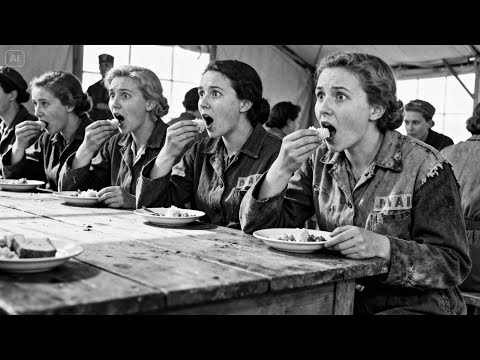
September 14th, 1944. The transport truck rumbled through the pine forest of southern Mississippi, carrying cargo that would change the lives of everyone it touched. Inside sat 23 German women—members of the Helerinan, the women’s war helper corps—captured during the Allied advance through France. Their gray auxiliary uniforms were torn and stained from weeks of transit across the Atlantic. Their faces reflected exhaustion, fear, and a stubborn pride that refused to acknowledge defeat.
Among them was 24-year-old Greta Hoffman from Munich, a former radio operator who had joined the corps in 1942, believing she was defending her homeland from barbaric invaders. She clutched a small tin containing a photograph of her family, the only possession she had managed to keep through her capture and the long journey to America. Beside her sat Leisel Weber, 19, from a small village outside Hamburg. She had worked as a typist for Wehrmacht officers, translating intercepted communications. Her hands still trembled from the shock of capture, from the realization that everything she had been taught about American soldiers had prepared her for brutality and violence, not for the strange courtesy with which they had actually treated her.
The truck slowed as it approached the gates of Camp Shelby. Through the canvas covering, the women caught glimpses of their new reality. Rows of neat barracks stretched across cleared land. American soldiers walked with an ease that seemed almost casual compared to the rigid military bearing the women had known in German service. Everything looked clean, organized, and surprisingly calm.
Captain James Morrison, a 32-year-old officer from Georgia assigned to oversee the women’s section, stood waiting at the processing area. He had received his orders with mixed feelings. The United States had captured thousands of German soldiers, but female prisoners remained rare and complicated. There were no established protocols, no clear guidelines for how to handle women who had served the enemy war machine.
The truck came to a stop and the canvas flap was pulled back. Sunlight flooded the dim interior, causing the women to squint and shield their eyes. They climbed down slowly, their legs stiff from hours of travel, their eyes darting nervously around the compound. American soldiers watched from a respectful distance, their expressions curious rather than hostile.
Greta was struck immediately by how young many of the guards looked—boys really, not much older than her younger brother Klaus. She had expected hardened veterans with hatred in their eyes. Instead, she saw uncertainty, even awkwardness, as if these American soldiers were as unsure about the situation as the prisoners themselves.
Captain Morrison stepped forward and addressed them through an interpreter, a middle-aged German-American corporal named Heinrich Bauer. His words were formal but not cruel, explaining the camp rules and what would be expected of them. The women listened in silence, trying to process this strange new world where their enemies spoke of rules and routines rather than punishment and revenge.
As they were led toward their assigned barracks, none of them could have imagined what awaited them in the camp mess hall, or how a simple meal would begin to unravel everything they thought they knew about America and Americans.
The barracks assigned to the German women was a long wooden structure with rows of metal cots on either side. It was sparse but clean, far better than the conditions many of them had endured during their final weeks in Europe. Each woman received a thin mattress, two wool blankets, and a small foot locker for personal belongings. Most had nothing to put inside except the clothes they wore and a few scraps of paper—letters from home that had found them before their capture.
Greta claimed a cot near the window, wanting to see outside to maintain some connection with the world beyond the barracks walls. Leisel took the cot beside her, grateful to stay close to someone who seemed to possess a calm strength she herself lacked. The other women settled in with minimal conversation, speaking only in hushed German when necessary. They moved with the mechanical precision of people too exhausted and overwhelmed to process their emotions.
As evening approached, a bell rang across the compound. Corporal Bauer appeared at the barracks door and announced in German that it was time for the evening meal. The women exchanged nervous glances. They had been fed minimal rations during their journey, mostly bread and thin soup. Their expectations for prison food were low, shaped by stories they had heard about how the Allies treated their captives.
They formed a line and walked toward the mess hall, a large building at the center of the compound. American soldiers moved in the same direction, their conversations and laughter carrying across the warm evening air. The contrast was jarring. These men seemed relaxed, almost carefree, while the German women walked in tense silence, bracing themselves for whatever degradation or deprivation awaited them inside.
The mess hall doors opened, and the women stepped into a space that defied everything they had anticipated. Long tables filled the room, already occupied by American soldiers who glanced up with curiosity, but without obvious hostility. The air carried smells that were foreign yet unmistakably appetizing—rich and savory aromas that made empty stomachs clench with sudden hunger.
A serving line had been set up along one wall. American kitchen staff, including several black soldiers, which many of the German women had never seen before, stood ready with serving utensils. Captain Morrison gestured for the women to join the line, to take trays and move through just as the American soldiers did.
Greta stepped forward first, her natural leadership asserting itself even in captivity. She picked up a metal tray, noting its weight and durability. These were not the thin tin plates she had expected. As she moved down the line, kitchen staff placed food on her tray without comment, without ceremony, but also without the contempt she had braced herself to receive.
When she reached the end of the line and looked down at her tray, her breath caught in her throat. What she saw there would become the first crack in the wall of everything she believed about her enemies and about the war she thought she had been fighting.
Greta stared at her tray in disbelief. Piled high were portions that seemed impossibly generous for prison rations. There was meat—actual meat—golden brown and glistening with what appeared to be some kind of coating. Beside it sat mashed potatoes with a pool of rich brown gravy, green beans that looked fresh rather than from a tin, and a thick slice of white bread with a pad of butter. Her mind struggled to reconcile what her eyes were seeing with what she had been taught about American treatment of prisoners.
Behind her, Leisel made a small sound of surprise when she received her own tray. The other women moved through the line in stunned silence, each receiving the same generous portions. They gathered at a table near the back of the mess hall, as far from the American soldiers as possible, and sat down with their trays before them, like offerings they did not quite believe they were allowed to accept.
No one moved to eat at first. They simply stared at the food, waiting for some trick to reveal itself, some cruelty to emerge from this apparent kindness. Greta picked up her fork with trembling fingers. She had not held proper silverware in months. During the chaos of retreat and capture, meals had been eaten with hands or crude utensils, if meals came at all. The weight of the fork felt strange, almost formal, as if she were sitting down to dinner in her mother’s house in Munich, rather than in an enemy prison camp.
She cut a small piece of the meat and brought it to her mouth. The moment it touched her tongue, her eyes widened. It was chicken, she realized, but unlike any chicken she had ever tasted. The outside was crispy and seasoned with flavors she could not identify—salt and pepper certainly, but other spices that created a complexity she had never experienced in German cooking. The inside was tender and moist, practically melting in her mouth. For a moment, she forgot where she was, forgot that she was a prisoner, forgot everything except the extraordinary taste filling her senses.
Across the table, Leisel took her first bite, and tears began streaming down her face. She was not crying from sadness, but from the overwhelming sensation of eating real food after so long without it, and from the confusion of receiving such food from people she had been taught to hate and fear. One by one, the other women began to eat. The mess hall filled with the quiet sounds of forks on metal trays, of women rediscovering what it meant to have full stomachs. Some ate slowly, savoring every bite. Others ate quickly, as if afraid the food might be taken away before they could finish.
Captain Morrison watched from across the room, his own dinner forgotten. He had wondered how the German women would react to their first American meal. What he witnessed was not what he expected. These were not hardened enemy soldiers sneering at their captor’s hospitality. These were hungry, frightened young women whose entire understanding of the world was beginning to shift with every bite of fried chicken they took.
That first night after dinner, the women lay in their cots, unable to sleep. Their bodies were exhausted, but their minds raced with questions that had no easy answers. Greta stared at the ceiling, her stomach full for the first time in months. Yet that fullness brought no comfort. Instead, it brought confusion and a creeping sense of betrayal, though she could not identify who had betrayed whom.
She had been told that Americans were wasteful and cruel, that they hoarded resources while the world starved, that they treated prisoners with calculated brutality designed to break spirits and extract information. Yet the meal she had just eaten contradicted every element of that narrative. The chicken had been prepared with care, seasoned with attention to flavor rather than simply boiled for sustenance. The portions had been identical to what the American soldiers received, suggesting no hierarchy of privilege between captives and captors. Most troubling of all, the kitchen staff had served them without hostility, without making them feel less than human.
Beside her, Leisel whispered in German, “Greta, why would they feed us like that? What do they want from us?” It was the question they were all thinking, but afraid to voice. In their experience, kindness always came with conditions, with expectations of something in return. But what could these Americans possibly want from a group of captured auxiliary workers? They possessed no valuable intelligence, no military secrets worth extracting. They were, in the grand scheme of the war, utterly insignificant.
Greta had no answer to give. She thought about the chicken, about how the crispy coating had crunched between her teeth, about the way the seasoning had lingered on her tongue long after she swallowed. She thought about her mother’s kitchen in Munich, about the careful rationing that had defined the last years of her life in Germany. Butter had become a luxury. Real coffee had disappeared. Meat had been reserved for special occasions, and even then the portions had been modest. Yet here, in an enemy prison camp, she had eaten better than she had eaten at her own family table in years.
The cognitive dissonance was almost physically painful. How could the enemy feed their prisoners so well? How could the people her government had described as barbaric and uncivilized produce food that spoke of abundance and generosity? The questions spiraled through her mind, each one undermining another piece of the worldview she had constructed over years of Nazi propaganda and wartime desperation.
She heard quiet crying from other cots in the darkness. Some women wept from homesickness, from fear of an uncertain future, but others, Greta suspected, cried from the same confusion that kept her awake. They had crossed an ocean expecting one reality and had instead encountered something that made no sense within the framework they had been given for understanding the world.
Tomorrow they would wake in this strange place and face another day of captivity. Tomorrow there would be another meal in that mess hall. And with each meal, each small kindness, each moment that contradicted what they had been taught, the foundation of their beliefs would crack a little more. Greta was not sure she was ready for what would happen when those cracks became too wide to ignore.
Years later, Greta stood in a Mississippi kitchen teaching another displaced person to season fried chicken. The recipe card in her hand was worn soft at the edges, the handwriting her own. “The secret isn’t the spices,” she said. “It’s that someone believed you were worth teaching.”
She thought of Leisel, who had returned to Germany carrying the cookbook and a letter from Sergeant Hayes, and of the four who had stayed to build new lives from the ruins of old beliefs.
The chicken that had shocked her that first evening had become something more than food—a symbol of second chances, of enemies who became teachers, of hearts cracked open by a single meal prepared with care. “Identity is not fixed,” Greta whispered to herself. “It is chosen, one plate at a time.”
And somewhere across the ocean, in a rebuilt Munich kitchen, another woman was frying chicken and remembering.
What would you have chosen—to return to the ruins of home, or to stay and build something new? Tell us in the comments.
Report this article
Select a reason for reporting:






