In November 1978, Sarah Henderson stepped into her late grandmother’s study in the family’s Lincoln Park mansion, a Victorian relic that had held the Henderson secrets for over seventy years. The room smelled of old paper and lemon polish, and Sarah, a graduate assistant in history, had spent days methodically sifting through decades of accumulated documents. She never expected to find a leather-bound photograph album hidden beneath a stack of financial papers in the bottom drawer of the mahogany desk.
The album’s brass clasp was tarnished, its pages filled with sepia-toned images of Chicago’s high society from the early 1900s. One photograph stood out: a formal family portrait from Christmas 1904, showing five members of the Henderson family arranged in the grand parlor. Cornelius Henderson, Sarah’s great-great-grandfather, stood beside his wife Margaret and their three children, an ornate fireplace and gilded mirror behind them. It seemed like a typical portrait of wealth and privilege—until Sarah brought it to Northwestern University’s digital enhancement lab.
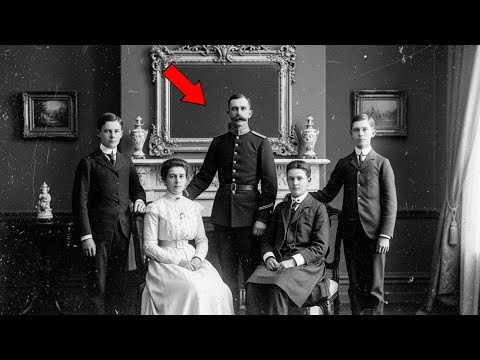
Under the high-resolution scanner, the image revealed textures and details invisible to the naked eye. Professor Michael Chen watched as Sarah systematically examined each section. Then she focused on the mirror above the fireplace. Reflected in its surface was a sixth figure—a man standing behind and to the left of the photographer, watching the scene unfold. In his hands, he held a long, thin object that seemed distinctly out of place. Sarah’s heart raced. Who was he? And why was he holding what looked like a rifle?
Multiple printed copies confirmed the figure was present in the original 1904 photograph, captured inadvertently in the mirror’s reflection. The object appeared to be roughly three feet in length, its nature unclear. Sarah took the enhanced images to the Chicago Historical Society, where head archivist Margaret Kowalski helped her dig into the Henderson family records. Cornelius Henderson had made his fortune in steel and railroad investments, but 1904 was a year of social tension—labor disputes, threatening letters, and hired security for the wealthy elite.
Margaret discovered a chilling connection: in February 1905, police had questioned Cornelius about the disappearance of his business associate Thomas Garrett. Garrett was last seen on January 15th, 1905—just three weeks after the Christmas celebration. He had been investigating financial irregularities in the construction company he co-owned with Henderson. Garrett’s wife insisted he had never mentioned leaving Chicago, contradicting Henderson’s claim that Garrett was planning a move to California. The case went cold, and Garrett’s body was never found.
Sarah returned to the enhanced photograph with new urgency. She brought it to Dr. Robert Sterling, a forensics expert at the University of Chicago. His analysis suggested the object in the reflected figure’s hands was most likely a rifle or shotgun. The man’s formal but less elaborate clothing, his deliberate positioning—hidden from the family but visible in the mirror—indicated he was not a guest but someone with a specific purpose. Sterling concluded the figure’s presence was intentional, not accidental.
Digging deeper, Sarah uncovered police records mentioning Vincent “Vinnie” Torino, an enforcer known to handle problems for corrupt businessmen. His description matched the figure: about six feet tall, formal attire, known to carry concealed firearms. Torino had been employed by a group involved in the same corruption scheme Garrett was investigating—a scheme that embezzled city contract money and involved several of Henderson’s associates. The timing was damning: Garrett disappeared just days before he was to meet a Tribune reporter with evidence of the conspiracy.
Sarah realized the Christmas portrait had captured more than a family gathering—it had documented the planning of a murder. The Henderson fortune had grown dramatically after 1905, funded by corrupt contracts, while Garrett’s family slipped into poverty. Now, faced with this sinister truth, Sarah had to decide: bury the past or expose it. She chose to contact the cold case unit, hoping to bring closure to Garrett’s descendants. But as she held the photograph, she couldn’t shake the feeling that some secrets were never meant to be found.
Detective Maria Alvarez of the Chicago Police Department’s cold case unit listened without interruption as Sarah laid out the evidence across a conference table: the enhanced photograph, Margaret Kowalski’s archival findings, and Dr. Sterling’s forensic report. When Sarah finished, Alvarez was quiet for a long moment, her pen tapping against a yellow legal pad.
“You understand what you’re telling me,” Alvarez said finally. “You’re accusing your own great-great-grandfather of orchestrating a murder.” Sarah nodded. She had rehearsed this conversation a dozen times in her head, but nothing prepared her for hearing it spoken aloud in a police station.
Alvarez explained the limits of what the department could do. The suspects were dead, the evidence was circumstantial by modern standards, and the case had been officially closed for over seventy years. But she agreed to reopen the file—not for prosecution, but to formally document the finding and attempt to locate Thomas Garrett’s living descendants.
That search took six weeks. Garrett’s wife Elizabeth had returned to Pennsylvania, where she raised their two children under her maiden name. Her son, Thomas Jr., had served in the Second World War and settled in Ohio. He had passed away in 1968, survived by a daughter: Ruth Garrett, now fifty-three, a retired schoolteacher living outside Columbus.
Sarah insisted on making the call herself. She owed the Garrett family that much. When Ruth answered, Sarah introduced herself carefully, then told her about the photograph, the mirror, the man with the rifle. There was a long silence on the line.
“My grandmother never believed the story about California,” Ruth said at last, her voice steady but thin. “She told my father the truth would surface one day. She said the Hendersons would answer for it.” Sarah felt her throat tighten. Seventy-four years, and Elizabeth Garrett had been right.
Ruth agreed to travel to Chicago. She wanted to see the photograph for herself. She also wanted to visit the mansion—the house where her great-grandfather’s fate had been decided. Sarah hesitated before agreeing. There was something she hadn’t yet mentioned to the police, something she had found only days earlier while clearing out the last of her grandmother’s belongings.
In the back of the study’s built-in safe, behind a false panel her grandmother had never mentioned, Sarah had discovered a small iron lockbox. Inside was a single item: a tarnished brass key, tagged with a paper label in faded ink. The label read simply, “Garrett — do not discard.”
Sarah had no idea what the key opened. But the fact that her grandmother had hidden it—deliberately, separately, as though protecting it—suggested Elellanena Henderson had known more about the family’s dark history than anyone had ever guessed.
Sarah waited until Ruth had settled into the mansion’s parlor—the same room where the 1904 portrait had been taken—before she brought out the lockbox. Ruth turned the brass key over in her hands, her expression unreadable. “My grandmother kept a key just like this,” she said quietly. “She wore it on a ribbon around her neck until the day she died. My father always assumed it was sentimental.”
That changed everything. If Elizabeth Garrett had possessed a matching key, then the two women had been connected by more than grief—they had shared a secret. Sarah and Ruth carried the key through the mansion, testing it against every lock they could find: the study cabinets, the wine cellar, the old servants’ quarters. Nothing fit.
It was Ruth who noticed the fireplace. Not the ornate marble hearth in the parlor, but the smaller one in the back library, half-hidden behind a bookshelf. The key slid into a brass fitting beneath the mantel, and a section of paneling swung inward. Behind it lay a narrow compartment, no larger than a hatbox, lined with velvet that had long since rotted to dust.
Inside were three items: a bundle of letters tied with string, a leather ledger, and a photograph identical to the one Sarah had found—except this copy had been marked. A small ink circle had been drawn around the mirror’s reflection, and in the margin, in a spidery hand, someone had written a single word: Torino.
The letters were from Cornelius Henderson to Vincent Torino, dated between 1904 and 1907. They were careful, coded, never explicitly incriminating—but the ledger was something else entirely. It listed payments: to Torino, to building inspectors, to aldermen, and to a name that made Sarah’s blood run cold. Elellanena Henderson. Her own grandmother, then a young woman of nineteen, had been paid a monthly sum for “correspondence and discretion.”
Ruth read over Sarah’s shoulder in silence. When she finally spoke, her voice was barely a whisper. “She knew. Your grandmother knew, and she took the money.” Sarah wanted to argue, to defend the woman who had raised her, but the ledger was in her grandmother’s own hand—she recognized the looping cursive from a hundred birthday cards.
Then Ruth picked up the last letter in the bundle, one that had never been sent. It was addressed to Elizabeth Garrett, dated 1931, and signed by Elellanena. In it, Sarah’s grandmother confessed everything: that she had discovered the truth as a young woman, that Cornelius had bought her silence, and that she had spent decades searching for a way to make amends without destroying the family she loved. “I have kept the key,” the letter read, “and I have kept the ledger. When the time comes that someone in this family asks the right questions, they will find what I could not bring myself to say aloud.”
Sarah sat down heavily on the library floor. Her grandmother had not been a keeper of dark secrets—she had been a prisoner of them, waiting her whole life for someone to come looking. Ruth folded the letter carefully and placed it in her purse.
“She waited for you,” Ruth said. “That has to count for something.” But as Sarah looked at the ledger, at the neat columns of blood money, she wasn’t sure forgiveness was hers to give. The cold case unit would need to see this. And somewhere in the back of her mind, a new question was forming—one she wasn’t ready to ask aloud: if her grandmother had kept the ledger hidden for fifty years, why had she left the album out where anyone could find it?
The answer came three days later, when Sarah returned to the study alone. She pulled the album from the shelf and examined its spine—really examined it, for the first time. The leather was worn smooth at the edges, but the binding was loose in a way that suggested it had been opened and closed a thousand times. Her grandmother hadn’t hidden this album. She had read it, over and over, for fifty years.
Sarah understood then. Elellanena had left the album in the drawer because she had wanted it found—but only by someone who would look closely enough. Someone who would ask the right questions. The lockbox was the confession; the album was the invitation.
Ruth Garrett took the ledger and letters back to Ohio, but not before the two women stood together in the parlor one last time. “My grandmother never got justice,” Ruth said. “But she got the truth. That’s more than most people get.” Sarah watched her go, the brass key now on a ribbon around Ruth’s neck—where Elizabeth’s had once hung.
The cold case unit officially reopened the file that spring, documenting the photograph and ledger as historical evidence. No one would ever be charged. But Thomas Garrett’s name appeared in the Chicago Tribune again, seventy-four years later, in a small article that corrected the record at last.
Sarah kept the photograph. She hung it in her apartment, the mirror’s dark reflection visible only to those who knew where to look. Some inheritances are made of money. Hers was made of questions.
And she still wondered, late at night: if her grandmother had waited fifty years for someone to look into that mirror—how many other family albums, in how many other attics, are holding their breath right now?
Report this article
Select a reason for reporting:






