Dr. Lavra Hendris had spent fifteen years studying Victorian family photography, but she had never seen anything like this. The photograph, dated May 1908, showed a prosperous Philadelphia family posed in a stiff, formal arrangement. But while everyone else stared dutifully at the camera, the eldest daughter, Elizabeth, fixed her gaze on her father with an intensity that made Lavra’s skin prickle. It was not affection—it was something far more unsettling.
Lavra magnified the image, her heart racing. The girl’s eyes burned with longing, desperation, and a hunger that seemed wildly inappropriate for a family portrait. “What were you thinking?” Lavra whispered, as if the photograph could answer. She turned it over. Faded ink read: The Fletcher family, May 12th, 1908. William, Margaret, Elizabeth, Robert, and Charles.
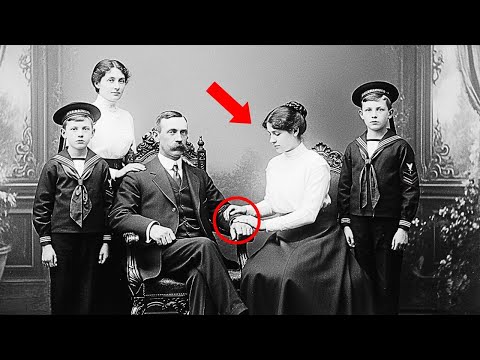
Little did Lavra know, this single image would lead her into one of the most disturbing family secrets she had ever uncovered—a story of obsession, betrayal, and a young woman erased from history.
She began with census records. William Fletcher, born 1866, was a successful attorney; his wife Margaret came from a prominent Quaker family. Their children: Elizabeth, born 1891; Robert, born 1896; and Charles, born 1900. They lived on Rittenhouse Square, one of Philadelphia’s most prestigious addresses. By all accounts, the Fletchers were respected and unremarkable.
But Lavra knew that the darkest secrets often hide behind the most respectable facades. She searched newspaper archives and found a brief announcement from June 1908: “Miss Elizabeth Fletcher, daughter of Mr. and Mrs. William Fletcher, is to be married to Mr. Theodore Hartwell, aged 42, of the Hartwell Manufacturing Company.” Elizabeth was barely seventeen; Hartwell was twenty-five years her senior. Such matches were not uncommon when wealth was involved, but the timing intrigued Lavra. The portrait was taken in May, the engagement announced in June, the wedding planned for August—everything had happened with startling speed.
Then she found another notice, dated August 14th, 1908: “The marriage of Miss Elizabeth Fletcher to Mr. Theodore Hartwell, scheduled for tomorrow, has been postponed indefinitely due to the bride’s sudden illness.” No further mention of the wedding ever appeared. Elizabeth Fletcher had vanished from the public record.
Lavra spent two days searching for any trace of Elizabeth after August 1908. Nothing—no marriage, no death certificate, no society column mentions. It was as if the girl had simply ceased to exist. She expanded her search to other cities, checking New York, Boston, Baltimore. Finally, she found a lead in an unexpected place: the admission records of the Kirkbride Asylum for the Insane in West Philadelphia.
Elizabeth Fletcher had been admitted on August 13th, 1908—one day before her scheduled wedding. She was seventeen years old. The diagnosis: “hysteria with melancholic and obsessional features.” The next of kin: William Fletcher, father.
Lavra’s hands trembled as she read the intake notes. Dr. Morrison’s precise handwriting documented a young woman in severe emotional distress, characterized by “inappropriate attachment to male family member” and “obsessional thoughts, refusal to accept arranged marriage, and threats of self-harm.” The final line made her stomach turn: “Patient’s attachment appears fixated on father. Patient claims father reciprocates her feelings, though father vehemently denies any inappropriate behavior.”
Lavra sat back, staring at the photograph once more. Elizabeth’s gaze—that hungry, desperate look—now seemed deeply disturbing. What had seemed merely unusual was, in fact, a window into a devastating psychological crisis. And this was only the beginning.
Lavra obtained permission to review Elizabeth’s complete patient file through the hospital archives, now housed at the Pennsylvania Historical Society. Dr. Morrison’s notes from August 1908 described a young woman convinced of her father’s romantic affection. She interpreted his normal paternal concern as evidence of deeper feelings, recalling with elaborate detail moments of supposed intimacy—a hand on her shoulder, a word of praise, a glance across the dinner table—and constructed from these ordinary interactions an entire narrative of mutual but forbidden love.
Dr. Morrison had interviewed William Fletcher extensively. His notes recorded Fletcher’s account: “Mr. Fletcher appears genuinely distressed by daughter’s condition. He states that Elizabeth has always been his favorite child, perhaps because she was the eldest and only daughter. He admits he may have indulged her more than was wise, but vehemently denies any improper behavior.” According to Fletcher, Elizabeth’s troubling behaviors began around age fifteen—jealousy toward her mother, insistence on sitting next to him at meals, monopolizing his time, writing passionate, inappropriate letters that confused affection with romantic love.
Fletcher had attempted to address the situation by spending less time with Elizabeth, hoping distance would correct her misconceptions. Dr. Morrison wrote, “This intervention proved counterproductive.” Elizabeth interpreted his withdrawal as evidence that society was forcing him to hide his true feelings. Her obsession intensified.
The breaking point came when William Fletcher arranged Elizabeth’s engagement to Theodore Hartwell, a wealthy widower known to the family. He hoped marriage would redirect her inappropriate attachment. Instead, the announcement triggered a crisis. Elizabeth locked herself in her room for three days, refusing food, writing page after page of letters begging her father not to force her to marry another man. When her parents finally gained entry, they found the walls covered with her writings—declarations of love, fantasies about running away with him, threats of suicide.
“The situation became untenable,” Dr. Morrison noted. “Family reputation at stake. Patient’s behavior threatening to become public scandal. Commitment to asylum necessary both for patient’s welfare and family’s protection.”
Lavra read through the treatment records with growing horror. In 1908, psychiatry was in its infancy, and treatments for hysteria were crude and often brutal. Elizabeth had been subjected to hydrotherapy—hours-long immersion in cold baths meant to shock the system back to normalcy. She’d been given heavy sedatives—chloral hydrate, bromides—that left her drowsy and compliant but did nothing to address her underlying psychological state.
Dr. Morrison documented his attempts to reason with Elizabeth, to convince her that her feelings for her father were pathological. “Patient refuses to accept that her attachment is inappropriate,” he wrote in September 1908. “She insists that society’s rules are arbitrary, that love cannot be controlled or judged. She believes her father shares her feelings but is prevented by social convention from acknowledging them. This delusion is firmly entrenched and resistant to logical argument.”
The asylum allowed William Fletcher to visit once, hoping a direct conversation might break through Elizabeth’s delusions. The visit was a disaster. “Patient became hysterical upon seeing father,” Dr. Morrison recorded. “She attempted to embrace him inappropriately, declared her love, begged him to take her away from the asylum. When Mr. Fletcher firmly stated that her feelings were not reciprocated and that she must accept treatment, patient collapsed and required sedation.” Mr. Fletcher was visibly shaken and requested no further visits.
Margaret Fletcher visited several times, but these visits were equally difficult. Elizabeth viewed her mother as a rival, blamed her for keeping William away, accused her of jealousy and cruelty. “Patient’s relationship with mother is characterized by hostility and paranoid beliefs,” Dr. Morrison noted. “Patient believes mother has conspired to separate her from father. Reality testing remains severely impaired.”
Over the months, Elizabeth’s condition gradually stabilized—not because she recovered, but because the sedatives and isolation broke her spirit. By December 1908, she was quieter, more compliant. But Dr. Morrison noted that “patient continues to harbor obsessional thoughts regarding father, though she has learned not to express them openly. This represents behavioral compliance rather than true recovery.”
Lavra found the final entry in Elizabeth’s Kirkbride file, dated February 1909: “Patient transferred to private sanitarium in upstate New York. Family arrangement. Patient remains mentally unsound but manageable with continued supervision and medication.”
Tracing Elizabeth’s path after Kirkbride proved challenging. Private sanitariums kept their records confidential, protecting the wealthy families who used them to hide embarrassing relatives. But Lavra had become skilled at following historical paper trails. She found the sanitarium through a reference in William Fletcher’s estate records. After his death in 1925, his will included a trust fund designated for “the continued care and maintenance of my daughter, Elizabeth, at Riverside Sanitarium, Pikipsy, New York.”
Riverside Sanitarium had operated from 1895 to 1954, catering to affluent families with mentally ill relatives. It was euphemistically called a rest home or nervous disorders clinic, but it functioned as a permanent institution for patients whose families could afford private care rather than state hospital confinement. Lavra contacted the New York State Archives, which had acquired Riverside’s records after the facility closed. After weeks of bureaucratic navigation, she obtained Elizabeth’s file.
Elizabeth had lived at Riverside for forty-three years—from age seventeen until her death at age sixty in 1952. The file contained annual reports from the sanitarium’s medical director documenting a life of medicated stability punctuated by occasional crisis. “Patient remains convinced of father’s romantic attachment to her,” read a report from 1915. “She speaks of him constantly. Rereads his infrequent letters obsessively. Interprets his continued financial support as evidence of his true feelings. Patient’s fantasy life appears more real to her than actual circumstances.”
William Fletcher had written to Elizabeth occasionally over the years—brief, formal letters that a father might write to any daughter. He’d updated her on family news: Robert’s graduation from university, Charles’s marriage, the births of grandchildren. He’d never visited, but he’d ensured she was well cared for, paying substantial fees to keep her in a private room with comfortable furnishings and adequate staff attention. Elizabeth had interpreted these gestures as proof of his devotion.
“Patient treasures father’s letters, has them memorized, constructs elaborate interpretations of his words,” a 1920 report noted. “She believes he cannot visit because mother forbids it or because society prevents their reunion. Patient’s delusional system has become more complex and internally consistent over time, making intervention increasingly difficult.”
When William Fletcher died in 1925, Elizabeth had a complete breakdown. “Patient inconsolable, refuses food, states repeatedly that she should have been with him at the end, that she was his true companion,” the report read. “Required increased sedation and supervision to prevent self-harm.” She had never accepted that her father hadn’t loved her as she’d loved him.
Lavra investigated what had happened to the rest of the Fletcher family, trying to understand how they had lived with this devastating secret. Margaret Fletcher died in 1930, her obituary mentioning only two children, Robert and Charles. Robert became a physician, married, and had three children; Charles followed his father into law. Neither ever spoke publicly about their sister.
A diary kept by Robert’s wife, Helen, offered a glimpse. In 1932 she wrote: “Robert still refuses to discuss his sister Elizabeth. He says only that she was ill and had to be sent away, and that it’s best forgotten. But I see the pain in his eyes when he thinks I’m not looking.” The family maintained the fiction that Elizabeth had died young—a lie repeated so often it became truth.
Yet someone had kept the 1908 portrait, passing it down through generations until it surfaced in an estate sale in 2023. Lavra wondered who had preserved it, and whether they had understood what they were seeing: a seventeen-year-old girl staring at her father with an obsessive intensity that would destroy her life just months later.
She found one final document—a letter from Margaret to her sister in 1910, preserved in a family collection. “I blame myself every day. I saw how William doted on Elizabeth, how he indulged her every whim. I should have intervened sooner, but I told myself it was natural for a father to adore his daughter. I never imagined it would become… this. Our beautiful girl lost to us forever because neither William nor I understood what was happening until it was too late.”
Lavra consulted Dr. James Morrison, a psychiatrist and historian of mental health at Johns Hopkins. “In 1908, they would have called it hysteria or melancholia with obsessional features,” he explained. “Today we’d recognize it as erotomania—a delusional belief that another person is in love with you. The person constructs an entire narrative from ordinary interactions.” He emphasized there was no evidence William behaved inappropriately; Elizabeth’s condition was a psychological disorder, not the result of abuse.
Elizabeth’s letters, preserved in her file, were heartbreaking. “Dearest Papa,” one from 1940 began. “The gardens here are lovely this spring. I think of you constantly and await the day we can be together as we were meant to be. With all my love, your devoted Elizabeth.” She wrote similar letters for decades, never accepting her father’s death, never accepting that the relationship she’d imagined had never existed.
Elizabeth Fletcher died on November 3rd, 1952, at age sixty, of heart failure. Her gravestone bore only her name and dates—no epitaph, no mention of family. The sanitarium’s final report noted she died peacefully, still maintaining her delusional belief system. Among her effects were dozens of unsent letters and pressed flowers from her sixteenth birthday, treasures she had kept for nearly forty years.
Lavra created a public exhibition centered on the portrait, enlarged so visitors could clearly see Elizabeth’s gaze. “This isn’t a story about a scandalous secret or forbidden feelings,” she wrote. “It’s about a young woman with a treatable psychological disorder who was born at the wrong time. Elizabeth’s tragedy was being seventeen in 1908 instead of 2008.”
Descendants of the Fletcher family contacted Lavra, most having never known Elizabeth existed. One, Jennifer Fletcher, met with her privately. “She was so young,” Jennifer said, staring at the portrait. “My daughter’s age. If my daughter developed a mental illness, we’d get her treatment—therapy, medication. She’d have a chance. But Elizabeth had none of that.”
Lavra nodded. “That’s exactly the point.”
She added one final image to the exhibition: a photograph of Elizabeth’s simple grave in Pikipsy. The caption read: “Elizabeth Fletcher, 1891–1952. Lost at seventeen to a mental illness her era could not treat and her family could not acknowledge. May her story remind us of the importance of compassion, understanding, and evidence-based treatment for those suffering from psychological disorders.”
The portrait no longer showed just a respectable Philadelphia family. It showed the precise moment a young woman’s devastating secret was captured on film—a gaze preserved forever as a reminder of how far medicine and society have come, and how much further we still have to go.
What do you think—should historical medical records like Elizabeth’s be made public for education, or do families have a right to keep such secrets buried forever?
Report this article
Select a reason for reporting:






