Thomas Quick Sr. had every reason to believe he had found paradise. A Dutch immigrant of indomitable spirit, he carved a home out of the Pennsylvania wilderness in the 1730s, his fields of wheat and rye flourishing where ancient forests once stood. The local Delaware Indians, initially wary, became frequent guests at his table, fed and clothed by his generosity. They seemed to admire his firstborn son, Tom Jr., often presenting the boy with plumes of feathers and other gifts. Young Tom grew up speaking their tongue as fluently as they did, learning to trap beaver and hunt deer alongside them. He was more Indian than white in his habits, and the peace between the Quicks and the Delawares appeared unbreakable.
But beneath this tranquil surface, tensions simmered. The Delawares had been swindled by the infamous Walking Purchase of 1737, losing twice the land they had agreed to sell. They watched the encroaching white settlers with growing resentment, their ancient hunting grounds shrinking year by year. When the French War erupted, the Indians saw their chance to reclaim what was theirs. They withdrew from the valley, their visits to the Quick household ceasing altogether.
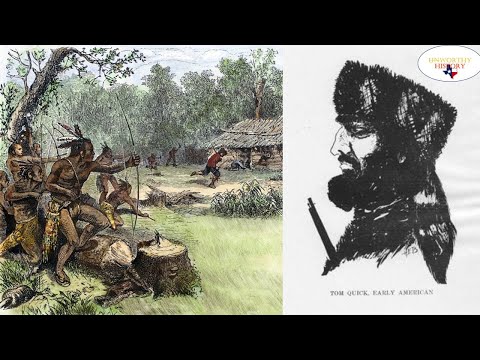
The Quicks, lulled by years of friendship, grew careless. They ventured into the woods unarmed, trusting in a goodwill that no longer existed. Then came the day that would change everything. Thomas Sr. needed hoop poles from the riverside and set out with Tom and his brother-in-law, none of them carrying firearms. They walked leisurely into a trap. Hidden in the woods, a band of Delawares watched their approach—men who had once dined under Quick’s roof, now plotting his death.
A single shot shattered the stillness. The father fell, mortally wounded, a ball tearing through his body. Tom and his brother-in-law seized him, dragging him as they fled, but the old man, knowing he was dying, urged them to leave him and save themselves. With heavy hearts, they abandoned him to the mercy of their pursuers.
The Indians gave chase, their war cries echoing through the frozen forest. Tom and his companion raced toward the Delaware River, now frozen solid. They had no choice but to cross, exposed on the ice, with the Indians closing in behind them. A dozen rifles fired, the bullets whizzing past. Tom fell, his pursuers shouting in triumph, “There lies Tom Quick!” But the ball had only struck his heel, tripping him. He scrambled up and ran on, zigzagging to evade the deadly aim.
They reached the far bank, safe for the moment. But from across the river, they heard the scalp whoop—the chilling cry of victory as the Indians scalped the dying man and celebrated over his body. Something inside Tom Quick snapped. Grief and rage consumed him, and he swore an oath that would define the rest of his life: he would never be at peace with the Indians as long as one remained on the banks of the Delaware.
The oath was not an idle threat. From that day forward, Tom Quick became a man possessed by a single purpose. He abandoned the farm and the mills, leaving them to his industrious brothers Cornelius and James. The wilderness that had once been his playground now became his hunting ground, and the Indians who had taught him to track and trap became his prey.
He moved through the forest like a ghost, silent and patient. The skills he had learned as a boy—the ability to read a trail, to vanish into the underbrush, to wait motionless for hours—were now turned to a terrible use. He knew every path and stream above Milford, and he used that knowledge to ambush the very men who had once been his companions.
The first to fall was a warrior named Nenatcheehunt, a man who had often shared meat at the Quick table. Tom found him alone near the river, fishing with a spear. He shot him from behind a fallen log, then scalped the body with the same knife the Indian had once used to skin beaver. It was the first of many. The settlers of Milford began to whisper that Tom Quick had become something more than a man—a spirit of vengeance that could not be stopped.
But his methods grew darker with each killing. He did not distinguish between warriors and elders, between women and children. To Tom, every Indian carried the blood of his father. He set traps in the woods, not for animals but for people, and waited with the patience of a spider. The Delawares, already crushed by the Iroquois and betrayed by the Walking Purchase, now faced a new terror—a white man who moved like an Indian and hated like a demon.
Word spread among the tribes that the son of Quick was on the warpath. They began to avoid the eastern bank of the Delaware altogether, but Tom followed them into their own territory. He would disappear for weeks at a time, returning gaunt and hollow-eyed, with fresh scalps hanging from his belt. The settlers, who had once pitied him, now feared him almost as much as the Indians did.
Yet even as his legend grew, so did the danger. The Delawares, desperate and angry, began to hunt him in turn. And somewhere in the deep woods, a warrior who had once called Tom friend was sharpening his tomahawk, waiting for the moment when the hunter would become the hunted.
The hunter became the hunted on a cold morning in 1756. Tom had been tracking a small band of Delawares for three days when he realized the trail had turned. They were no longer running—they were circling back. He crouched behind a hemlock, his breath misting in the frosty air, and counted the shadows moving through the trees. There were five of them, spread wide, closing in like a net.
He could have fled. He knew every deer path and hidden hollow within twenty miles. But Tom Quick had never run from an Indian, and he would not start now. He raised his rifle and fired, and the first warrior fell without a sound.
The woods erupted. A musket ball tore through his left shoulder, spinning him against a tree. He drew his knife and met the second warrior head-on, the two of them crashing to the frozen ground in a tangle of limbs and blood. Tom drove the blade home and rolled free, but the remaining three were already upon him.
What happened next passed into legend. Some say he killed two more before the last warrior struck him down. Others swear the Indians, recognizing the son of Quick, dragged him to the river and drowned him in the icy Delaware, returning the cruelty he had shown their people. His body was never found.
But the story of Tom Quick did not end with his death. In 1851, James Quinland wrote that the Indians of the region believed his spirit still haunted the riverbanks, that they would not camp near Milford for fear of the ghost of the Indian slayer. And in 1997, nearly two and a half centuries after he vanished, a group of protesters took a sledgehammer to his statue in Milford, calling him a murderer.
Others defended him, calling him a grieving son driven to madness by the murder of his father. Both sides were right. Tom Quick was a man shaped by a brutal frontier, where kindness could be answered with a bullet and grief could curdle into a lifetime of vengeance. His oath was kept to the letter—he never made peace with the Indians, not until the day he died.
The statue was repaired and returned to its pedestal, but the debate never faded. Was Tom Quick a hero defending his family, or a monster created by his own hatred? The old book offers no easy answer, only the story of a boy who learned to hunt and trap from the very people he would spend his life destroying.
What do you think—was Tom Quick a victim of his time, or a man who chose vengeance over every other path? Let us know in the comments below.
Report this article
Select a reason for reporting:






