The rain tapped against the classroom windows like a secret no one wanted to hear. Inside Humes High School, the air was thick with chalk dust and the quiet humiliation of a boy who had learned to disappear. Elvis Presley, fourteen years old, sat in the back row, hoping the floor would swallow him whole. His shirt was faded, his shoes were falling apart, and his only guitar had been sold to pay the bills. But none of that hurt as much as the moment Mrs. Katherine Gilmore called his name.
“Mr. Presley, come to the front of the class.” Her smile was not kind. It was the smile of a teacher about to make an example. The other students whispered and laughed. Elvis felt every step toward the blackboard like a stone added to his shoulders. He knew what was coming. He just didn’t know how much it would break him.
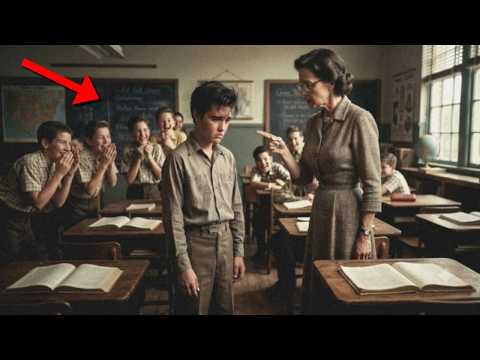
Mrs. Gilmore folded her arms. “Today we’ll discuss the difference between confidence and genuine musical ability.” She turned to Elvis. “You claim you can sing. So sing.” The room went silent. Thirty pairs of eyes stared at him. His throat tightened. His palms sweated. He thought of his mother, Glattis, who always whispered, “Baby, don’t ever let the world decide who you are.” He closed his eyes and began to sing “Old Shep.”
At first, a few students laughed. But then something strange happened. The laughter died. The whispers stopped. His voice wasn’t perfect—it was real. Every note carried the pain of poverty, the hope of a dream, the love of a family that never had enough. Even the teachers in the hallway stopped to listen. For one impossible moment, Elvis felt free.
The final note faded. Silence. Then Mrs. Gilmore began to clap—slowly, mockingly. “Thank you, Mr. Presley.” She wrote three words on the board: Technique. Discipline. Control. “What you just heard was exactly what happens when emotion replaces education.” She looked him in the eye. “You don’t possess talent. Find another path before disappointment finds you first.” The words hit harder than any punch. Elvis nodded once, turned, and walked back to his desk. He didn’t cry. Not there. Not in front of them.
After school, he rode the bus home in silence, watching raindrops race down the glass. Maybe she was right. Maybe dreams belonged to people with money and perfect voices. When he walked into the small apartment at Lauderdale Courts, his mother took one look at his face and knew. He collapsed into her arms. “I’m sorry, Mama. I’m just not good enough.” Glattis held him tighter. “No, you don’t get to say that.” She listened as he told her everything. Then she lifted his chin. “I don’t care if that woman has taught music for twenty years or two hundred. No one gets to decide what God placed inside your heart.”
That night, Elvis stood outside under the Memphis stars and made a promise. Not to Mrs. Gilmore. Not to his classmates. To himself. “I’ll never stop singing. No matter how many doors close, I’ll keep knocking.” The wind rustled through the trees. Somewhere in the distance, a train whistle echoed. He smiled for the first time that day.
Seven years later, that promise would change music forever. But first, he had to face the voice that tried to silence him—and decide whether to prove her wrong or become something greater.
The years between the promise and the spotlight were not kind. Elvis worked odd jobs—driving a truck, ushering at a movie theater, anything that kept the lights on at Lauderdale Courts. At night, he lingered outside Beale Street clubs, listening to bluesmen pour their souls into cheap microphones. He studied them the way Mrs. Gilmore had once demanded he study scales, but with his heart instead of a ruler.
Then came Sam Phillips and Sun Records. Phillips had said he could make a million dollars if he found a white boy who sang like a black man. When Elvis walked through that door, nervous and polite, Phillips heard something the classroom had never measured. He heard a voice that didn’t fit anywhere—and that was exactly the point.
“That’s All Right” hit the radio like a match in a dry field. Phone lines lit up. Listeners demanded to know who this singer was. Was he black? Was he white? Nobody could tell, and nobody cared. For the first time, Elvis’s difference became his power.
Back in Memphis, Mrs. Gilmore sat alone in her music room after the final bell. The radio on her desk played that strange new song. She recognized the voice instantly—the same raw honesty she had once called a weakness. Her hand trembled as she turned the dial down. For twenty years she had taught rules. Now a boy she had failed was breaking every one of them.
A few mornings later, a newspaper landed on her desk. Above the fold, Elvis Presley smiled beneath a headline that called him Memphis’s newest star. A student rushed in, holding her own copy. “Mrs. Gilmore, wasn’t he one of your students?” The room went quiet. She stared at the photograph—the same shy eyes, the same determined jaw. She nodded slowly. “Yes. He was.”
Another girl smiled. “You must have known he’d be famous.” The class waited, expecting a teacher’s proud confirmation. Mrs. Gilmore set the paper down and folded her hands. “No. I was wrong.” The words landed like a dropped book. Teachers were not supposed to admit mistakes, least of all ones that large.
That afternoon, she stayed behind after everyone had gone. She opened her desk drawer, drew out a blank sheet of paper, and began to write. Each sentence was harder than the last. Dear Mr. Presley, you may not remember me the way I remember you. I mistook originality for confusion and emotion for weakness. Today I realized I was listening with my ears instead of my heart. For that I am truly sorry.
She sealed the envelope and whispered to the empty room, “I hope he forgives me.”
Weeks later, backstage after another sold-out show, Elvis flipped through a stack of fan mail. One envelope stood apart—simple, neat handwriting, no return address except Humes High School. He opened it slowly. As he read, the dressing room fell silent. His band watched him reach the final line. Then he smiled—not a smile of victory, but of peace.
His guitarist leaned over. “What are you smiling about?” Elvis folded the letter carefully and tucked it into his jacket. “There was a teacher who once told me I’d never become a singer.” The room waited. “What are you going to do?” He looked toward the window. “I’m going to forgive her.”
The decision did not sit quietly. For three days the letter stayed folded in his jacket, and for three nights Elvis lay awake in hotel rooms that were far too grand for a boy from Lauderdale Courts. Forgiveness was easy to say backstage. It was harder to mean. Every time he closed his eyes, he heard the chalk tapping against the blackboard and saw those three underlined words: Technique. Discipline. Control.
Colonel Parker, of course, had other ideas. He paced the hotel suite waving a cigar, his voice a gravelly hum. “A teacher? Who cares about a teacher? We’ve got a movie to shoot, two singles to cut, and the Ed Sullivan people are calling every hour.” He jabbed the cigar toward Elvis. “You don’t owe that woman a thing, son. You owe her nothing.”
Elvis said nothing. He simply looked out the window at the city lights and thought of his mother’s hands, flour-dusted and steady, lifting his chin on the worst night of his life. Glattis would have known what to do. She always knew.
It was a phone call home that finally settled it. His mother’s voice came crackling down the line, warm as cornbread. When he told her about the letter, there was a long pause. Then: “Baby, the people who hurt us are usually the ones who need forgiving the most. But you don’t have to go alone. Go home first. Stand in that hallway. See how small it really is.”
So he went home. Not with cameras, not with a press agent trailing behind him, but quietly, on a Tuesday afternoon when the Memphis sky was the color of old pewter. The halls of Humes High smelled exactly as he remembered—floor wax, chalk, the faint sweetness of cafeteria rolls. His footsteps echoed, and for one dizzy moment he was fourteen again, hugging his books to his chest, praying nobody would look at him.
But people did look. A janitor dropped his broom. A cluster of girls froze mid-giggle, then burst into shrieks. Word traveled through the building faster than any bell. By the time Elvis reached the music room door, a small crowd had gathered behind him, whispering, craning their necks.
He raised his hand to knock—then stopped. Through the narrow window he could see her. Mrs. Gilmore sat at the old piano, her back straight, her hair now more silver than brown. She was playing something slow and simple, a hymn he half-remembered from church. Her hands moved carefully, precisely, exactly as she had always taught. And yet there was something in the way she lingered on the final chord—a softness, a searching—that he had never heard from her before.
Elvis lowered his hand. She was practicing. After all these years, she was still practicing. The sight of it undid something in him. This was not a monster. This was a woman who had spent her whole life loving music and had mistaken her love for a set of rules.
He knocked. The piano stopped. A chair scraped. The door swung open, and Mrs. Catherine Gilmore stood there, older, smaller, her eyes wide with something between terror and hope. For a long moment neither of them spoke. The hallway behind Elvis had gone utterly silent.
Then she whispered, her voice cracking on the first word, “I’m sorry.” Tears spilled down her cheeks. “I should have encouraged you. I should have listened. I almost convinced a young boy to give up on his dream.”
Elvis stepped into the room. The same room. The same blackboard, wiped clean now, though he could still see the ghost of those three words if he looked hard enough. He smiled gently. “No, ma’am. You gave me something I needed.” She blinked, confused. “Courage,” he said. “I spent years trying to prove you wrong. But somewhere along the way, I stopped proving you wrong and started becoming myself.”
Mrs. Gilmore wiped her eyes with the back of her hand, then laughed—a small, broken, grateful sound. “I’ve changed how I teach,” she said. “Every student now. I tell them, never confuse being different with being untalented.” She gestured toward the piano. “I even let them sing songs that aren’t in the books.”
Elvis walked to the blackboard. He picked up a piece of chalk, and the old familiar weight of it in his fingers made him smile. Slowly, deliberately, he wrote four new words beneath where the others had once been: Heart. Courage. Truth. Voice. Then he set the chalk down and turned to her.
“You were wrong about me,” he said quietly. “But you were right about one thing. Music is discipline. It’s just not only discipline.” He extended his hand. Mrs. Gilmore looked at it for only a moment, then took it. The handshake was simple, quiet—but the small crowd in the hallway saw it, and somehow word of it would travel farther than any song.
As Elvis walked out of the classroom, he glanced back one final time. The frightened fourteen-year-old boy who had once stood trembling in that spot was gone. In his place stood a man who had learned that success is not about proving your critics wrong. It is about refusing to let them decide who you become.
Outside, the October rain had finally stopped, and the Memphis sky was breaking open into gold. But the story was not finished. Because on the far side of the country, a young man named Johnny Cash was about to walk into a recording studio for the very first time—carrying a voice, and a wound, of his own.
Johnny Cash had his own Mrs. Gilmore once—a choirmaster who told him his voice was too rough for gospel. He carried that wound into a Memphis studio and sang about it. When Elvis heard the playback, he recognized the same raw honesty Mrs. Gilmore had once called a weakness. “That boy sings like his heart’s been broken and mended,” Elvis said quietly. “Like mine.”
Years later, Johnny Cash stood in a school hallway in Arkansas, facing the teacher who had doubted him. He didn’t go to prove her wrong. He went because Elvis had told him the secret: forgiveness is the only song that never goes out of style.
Two boys from nothing, two voices the world almost silenced—both choosing to heal instead of harden. That was the real revolution. Not the music. The mercy.
And what about you—whose voice are you still trying to silence, and is it time to finally let it sing?
Report this article
Select a reason for reporting:






