In the chaos of battle, when bullets fly and explosions roar, there is one figure every Marine relies on—a sailor who wears the same uniform but carries a different burden. They are not called Medics; they are Navy Corpsmen, the silent guardians of the battlefield. Without them, the Marine Corps would be a shadow of its fighting strength.
These men and women run toward the sound of gunfire, not away. They patch wounds under fire, stop bleeding with their bare hands, and drag wounded Marines to safety. Their heroism has earned them 22 Medals of Honor—the most of any Navy rating. Yet, most people have never heard of them.
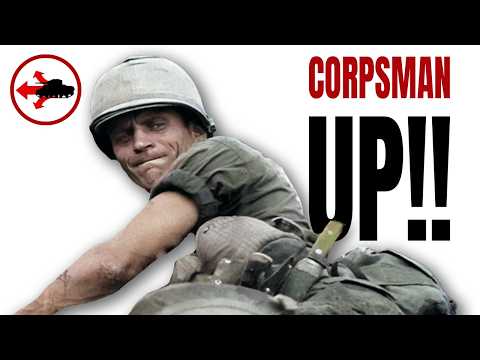
Why does the Marine Corps rely on Navy Corpsmen instead of its own medics? The answer lies in a tradition dating back to 1898, when the Navy Hospital Corps was born. Marines were fighting in distant lands like Guam and the Philippines, and wounded needed care. Rather than build its own medical branch, the Marine Corps leaned on the Navy’s expertise—a practical choice that became a legendary partnership.
But being a Corpsman is more than a job. It’s a calling. To serve with Marines, they must pass the Fleet Marine Force qualification—a grueling test of physical fitness, combat skills, and Marine Corps doctrine. They earn the title “Doc,” a word spoken with deep respect. And they earn it every day, on bases and on battlefields.
In World War II and Korea, Corpsmen wore red crosses on their helmets and armbands—symbols of neutrality. But in Vietnam, those crosses became targets. Snipers aimed for the red cross, and Corpsmen began to abandon it. Today, they blend in with their Marine brothers, wearing the same camouflage, carrying the same weapons. But every Marine knows who they are.
So next time you see a Marine, remember the sailor beside them—the one who saves lives, who runs into the fire, who wears no red cross but carries the weight of every life they’ve saved. They are Navy Corpsmen, and they are the Marine Corps’ most critical asset.
That weight is not abstract. It has a name, a face, and a memory for every Corpsman who has served. Ask any Doc about the Marines they couldn’t save, and you’ll see it in their eyes—a burden carried silently, long after the fighting stops. The bond between Marine and Corpsman is forged in moments no training can replicate.
Take the story of a young Corpsman in Afghanistan, attached to a rifle platoon. When an IED tore through the patrol, he sprinted through a hail of Taliban fire, applied tourniquets with shaking hands, and dragged three Marines to cover. He was wounded himself, but he refused evacuation until every Marine was treated. That night, the platoon commander called him “the bravest man I’ve ever met.” He shrugged it off. “I was just doing my job,” he said. But everyone knew it was more than that.
This is the unwritten contract between Marines and their Doc. Marines protect the Corpsman; the Corpsman protects the Marines. It’s a two-way street of trust that begins in training and is sealed in blood. When a Marine shouts “Corpsman up!” it’s not just a call for medical help—it’s a plea to the one person who will never hesitate to answer.
But the role has evolved far beyond battlefield trauma. Modern Corpsmen are trained in advanced trauma life support, tactical combat casualty care, and even veterinary medicine for the working dogs that serve alongside Marines. They are medics, counselors, and sometimes the only friend a Marine can confide in. On long deployments, the Doc often becomes the unit’s unofficial therapist—listening to fears, treating stress, and keeping morale alive.
And the numbers speak for themselves. With over 24,000 active duty and Reserve Hospital Corpsmen, they remain the largest enlisted rating in the Navy. One-third of all Corpsmen are women, breaking barriers in a field long dominated by men. They serve on ships, with Marine units, and in joint commands around the globe.
Yet, the legacy of the red cross lingers. Old photographs show smiling Corpsmen with bright red symbols on their helmets—a stark contrast to today’s camouflaged warriors. Some veterans argue the red cross should return as a symbol of protection under the Geneva Conventions. Others shake their heads. “The enemy doesn’t care about conventions,” one retired Corpsman said. “They see a red cross, they see a target. I’d rather blend in and live to save another Marine.”
The debate continues, but the reality on the ground is clear. Modern Corpsmen wear no red cross. They carry rifles, not just bandages. They are warriors first, healers always. And when the bullets stop flying, they are the ones who sit with the wounded, holding their hands, whispering that help is on the way.
So the next time you see a Marine, look closely at the sailor beside them. The one with the medical bag and the steady hands. The one who runs toward the fire. They may not wear the eagle, globe, and anchor, but they are every bit a part of the Marine Corps legacy. They are Navy Corpsmen—the silent guardians, the lifesavers, the Docs. And they wouldn’t have it any other way.
That legacy is not just a matter of history books and medal citations. It lives in the small, quiet rituals of daily life on a Marine base. When a platoon forms up for a morning run, the Doc is always at the back—watching, counting heads, ready to fall out with the slowest Marine. Nobody orders them to do it. They just do.
Walk into any chow hall and you’ll see it. A young lance corporal slides a tray across the table to his Corpsman without a word—an extra piece of fruit, a stolen dessert. It’s a wordless thank-you, a small tribute paid daily to the person who will one day hold their life in their hands. Marines don’t say thank you often. They show it.
And the Corpsmen learn to read their Marines the way a doctor reads an X-ray. They notice the Marine who’s gone quiet, the one who flinches at loud noises, the one who stopped eating. Long before a Marine admits something is wrong, the Doc already knows. That’s the part of the job no school in San Antonio can teach.
There’s a reason Marines say the Corpsman carries two bags—one for bandages, one for burdens. On a deployment, the Doc is the keeper of secrets. Marines tell them things they’d never tell their squad leader, their chaplain, or their spouse. The Doc listens, nods, and files it away—sometimes saving a career, sometimes saving a life.
But the weight cuts both ways. Corpsmen carry their own ghosts too, and there’s no one assigned to patch them up. The suicide rate among combat medics and Corpsmen is a quiet crisis the military rarely discusses openly. They give everything to their Marines, and sometimes there’s nothing left for themselves.
That’s why the tightest bond of all is between Docs. A Corpsman who meets another Corpsman—even a stranger from a different unit—shares a look that needs no words. They know. They’ve seen what the other has seen. They’ve held the same kinds of hands, heard the same kinds of last words.
There’s an old saying passed down through generations of Navy Hospital Corpsmen: “No Marine left behind—and no Doc left alone.” It’s not official. It’s not written in any manual. But every Corpsman who has ever served will tell you it’s the truest thing they know.
So when the fighting ends and the dust settles, when the medals are pinned and the flags are folded, remember this. Behind every Marine who came home, there is a Corpsman who made sure of it. They don’t ask for glory. They ask for one thing only—that their Marines come back safe.
And for every Marine who didn’t come home, there is a Corpsman who carries their name forever. “I did everything I could,” they whisper in the dark, and sometimes it’s true, and sometimes it’s not enough. That’s the burden no medal can lighten.
But still they serve. Still they volunteer. Still they run toward the fire. Because the Corpsman’s calling is not about glory or recognition—it’s about the Marine beside them. It’s about the promise that no one fights alone, no one dies alone.
So the next time you hear “Corpsman up!”—whether on a battlefield or in a barracks or in a hospital ward—know that someone is already moving. Someone who has trained for years, who has carried the weight of lives in their hands, who will not stop until the job is done.
They are Navy Corpsmen. They are Docs. And they are the heartbeat of the Marine Corps.
What’s the one thing you’ll remember about these silent guardians? Share your thoughts in the comments below.
Report this article
Select a reason for reporting:






