Dr. Rebecca Foster had restored hundreds of Victorian portraits, but the moment she zoomed in on the youngest child’s face, her coffee cup slipped from her fingers and shattered against the desk. The girl’s eyes were closed—not in a blink, not in the fleeting way a child might squeeze her eyes shut during a long exposure. They were closed with the terrible finality of death.
And yet the family had posed her as if she were alive, a lit candle clutched in her small, pale hand.
The photograph had arrived that morning at the Portland Historical Society, donated in an estate clearance from rural Maine. A family of five arranged in a parlor: a stern father, a distant mother, three children frozen in unnatural stillness. The plate was dated 1907, the estate of the Harrison family. Rebecca’s assistant, David, had shrugged it off as another dusty relic. But something about the composition felt wrong—too stiff, too deliberate.
Now, with the grime and water stains stripped away pixel by pixel, the truth emerged. The youngest girl, no more than four years old, sat in a small chair at the front, her white dress pristine, her head tilted at an angle that suggested it was being supported from behind. The candle’s flame was captured in a bright blur, a tiny beacon frozen in time.
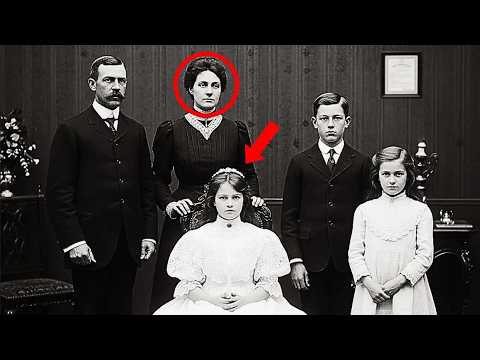
“Oh god,” Rebecca whispered, her hands trembling as she fumbled for paper towels. She had seen post-mortem photographs before—common in an era when child mortality was devastating and photography offered grieving families their only keepsake. But those images were obvious: the deceased posed alone, or held in a coffin. This was different. This family had propped their dead daughter among them, as if she were merely sleeping.
Rebecca canceled her afternoon meetings and sent David home early. She needed to be alone with the image. Zooming in on the background, she noticed a framed document on the parlor wall, partially obscured by time. She enhanced the contrast until letters emerged: a death certificate. Age 4 years. Cause of death—the rest dissolved into blur.
Her pulse quickened. The family had hung their daughter’s death certificate on the wall and then photographed themselves with her body, a lit candle in her hand. Why? What were they trying to preserve—or conceal?
The next morning, Rebecca drove to Brunswick, the photograph’s origin. At the local historical society, an elderly volunteer named Mr. Carson studied the image and his eyes widened. “This is the Harrison family from Cooper Road,” he murmured. “Tragic story. The youngest died in the winter of 1907. But there was talk in town… strange things.”
He hesitated, then added, “They kept her in the house for days before the burial. The mother wouldn’t let anyone take the child away.”
Rebecca’s skin prickled. Nine days, she would later learn. Nine days between death and burial. What had happened in that farmhouse while the family waited?
Back in her studio, she pulled up the restored image again. The candle. The death certificate. The mother’s distant stare. Each detail screamed of a grief that had curdled into something darker. Rebecca made a decision: she would visit Riverside Cemetery, where Ellanar Harrison was buried. Perhaps the grave would offer answers the photograph refused to give.
But as she reached for her coat, her phone rang. An unknown number. A woman’s voice, sharp and urgent: “Dr. Foster? My name is Margaret Brennan. I think I have something you need to see.”
Margaret Brennan’s apartment smelled of lavender and old paper, the same scent that clung to the historical society’s archive. She led Rebecca past shelves crammed with leather-bound volumes and gestured to a cluttered desk where a single journal lay open beneath a lamp.
“Dr. Samuel Whitmore was the town physician in 1907,” Margaret said, her voice low. “He kept detailed notes on his cases. When Mr. Carson called about your photograph, I remembered this.”
Rebecca sat down and turned the fragile pages, her breath catching as she found the entry dated February 15th. The handwriting was cramped, the ink faded, but the words were unmistakable: Called to the Harrison residence. The child Ellanar passed in the night. Mrs. Harrison refused to allow me to take the child. She had dressed her in her Sunday best and placed a lit candle in her hand, saying it would guide her back.
Rebecca looked up, her throat tight. “She believed the child would wake.”
Margaret nodded, settling into a worn armchair. “It gets worse. Keep reading.”
The entries spanned nine days. Each visit, Dr. Whitmore found Catherine Harrison speaking to her dead daughter as if she were merely sleeping, changing the candle daily, forbidding the other children from mentioning death. The father, Joseph, had withdrawn into silence. The county authorities declined to intervene—it was a family matter, they said. The cold Maine winter preserved the body.
Then came the entry that made Rebecca’s stomach lurch: Tomorrow, a photographer is coming at Mrs. Harrison’s request. She wishes to have a family portrait made while Ellanar is still with us.
“She wanted proof,” Margaret said quietly. “Proof that her daughter had existed, that she had been loved. And proof of the death itself—that’s why the certificate hung on the wall. Even in her denial, some part of her understood.”
Rebecca closed the journal. Outside, the February wind rattled the windows. “What happened to the family after the burial?”
Margaret sighed. “Joseph died in 1909—heart failure, officially. Catherine spent her last fifteen years in an institution in Augusta. The boy, Thomas, moved to Boston and changed his name. Never married. The daughter, Sarah, married and moved to New York. She never spoke of her family again. Her descendants knew nothing until now.”
Rebecca thought of Sarah, forced to stand motionless while her dead sister sat among them. “The photograph came from Sarah’s line,” she said. “Her great-granddaughter’s estate.”
“Packed away for generations,” Margaret agreed. “Perhaps Sarah couldn’t bear to look at it, but couldn’t bring herself to destroy it either.”
The next morning, Rebecca drove to Riverside Cemetery. The air was crisp, patches of old snow clinging to the shadows beneath the pines. She found plot 47 without difficulty—a small, weathered stone bearing the inscription: Ellanar Harrison, beloved daughter, 1902–1907. Her light still shines.
Rebecca knelt and brushed away dead leaves. The same metaphor as the candle. Catherine must have chosen those words, a final echo of her desperate hope.
Nearby lay Joseph Harrison, 1870–1909, and several plots away, Catherine, 1872–1934. The family plot had space for the surviving children, but neither Thomas nor Sarah had returned. They had fled this place and its memories.
“I thought I might find you here.”
Rebecca turned. An elderly man approached, leaning on a cane, his face deeply lined but his eyes bright. “Robert Whitmore,” he said, extending a gloved hand. “Dr. Whitmore’s grandson. Margaret called me. I wanted to meet you.”
They sat on a nearby bench, and Robert stared at Ellanar’s stone. “My grandfather talked about the Harrison case until the day he died. It haunted him—the way that family fell apart. He blamed himself for not intervening more forcefully.”
“He tried,” Rebecca said gently. “The journal makes that clear.”
“Did it make clear why he didn’t force the issue?” Robert’s voice was bitter. “He was the doctor. He had the authority. But he hesitated out of respect for their grief—and those other children suffered for it.”
Rebecca thought of Thomas and Sarah, frozen in that terrible tableau. “Did your grandfather ever see the photograph?”
“No. But he heard about it. The photographer was so disturbed he moved away from Brunswick not long after. My grandfather said the man couldn’t forget the mother’s eyes—the way she looked at that dead child and saw life.”
They sat in silence, listening to the wind. Then Robert asked, “Now that you know the whole story, what will you do with the photograph?”
Rebecca hesitated. The image was extraordinary—technically perfect, historically significant. It deserved to be seen. But it was also a record of trauma, of children forced to participate in their mother’s breakdown. “I don’t know yet,” she admitted. “But I think the family deserves to have a say.”
Back in her studio, Rebecca spent days wrestling with the question. She called a meeting with the historical society’s board, projecting the restored image onto a large screen while she explained its history. The debate was fierce. Dr. James Chen, the society’s president, argued for preservation and display. Board member Lisa Thompson countered that the surviving children had been traumatized—did they have the right to exhibit that trauma?
“Everyone in the photograph has been dead for decades,” another member pointed out. “There’s no legal privacy concern.”
Rebecca listened, her own feelings conflicted. Finally, she spoke. “I think we should preserve and display the photograph, but with full context. We tell Ellanar’s story honestly and completely. We don’t sensationalize the tragedy, but we don’t hide from it either. And we find the descendants first. They deserve to know.”
The board agreed. Finding Sarah’s descendants proved challenging—the trail led through New York, New Jersey, and finally California. Rebecca located Jennifer Marshall, Sarah’s great-great-granddaughter, a software engineer in San Diego. Their first phone conversation was awkward.
“My grandmother never talked about where she came from,” Jennifer said. “She was terrified of death—couldn’t attend funerals, couldn’t even talk about people who had passed. We thought it was just anxiety.”
“It was trauma,” Rebecca said softly. “Passed down through generations.”
She emailed the restored image and waited. When Jennifer called back, her voice was thick with tears. “Thank you for finding this. It’s horrible, but it’s also my history. It’s part of who I am.”
The exhibition opened on a gray April morning, exactly 118 years after Ellanar’s burial. The restored photograph was the centerpiece, displayed in a climate-controlled case with subtle lighting that captured every detail. Surrounding it were Dr. Whitmore’s journal entries, census records, and information about Victorian mourning practices.
Jennifer flew in from California for the opening, bringing her teenage daughter. Together they stood before the photograph of their ancestors—three generations of women connected to that long-ago February day.
“She was four years old,” Jennifer’s daughter said, staring at Ellanar. “The same age as my little cousin.”
“Pneumonia was a death sentence back then,” Rebecca explained gently. “Parents lost children all the time. They had to find ways to cope.”
“The candle,” Jennifer said. “Why the candle?”
Rebecca had thought about this often. “I think it was Mrs. Harrison’s way of believing her daughter’s spirit was still present. The light that still shines, like her gravestone says. In her grief, she needed to believe Ellanar hadn’t truly left.”
The exhibition drew crowds beyond anything the society had expected. But what surprised Rebecca most were the stories visitors began to share—parents who had lost children, speaking quietly about their own irrational thoughts and behaviors. The photograph had become a catalyst for conversation about death and grief.
One afternoon, an elderly woman approached Rebecca in the gallery, tears streaming down her face. “I lost my daughter fifty years ago,” she said, her voice breaking. “For weeks afterward, I couldn’t accept it. I kept her room exactly as she’d left it. Seeing what that poor mother did—it helps me forgive myself.”
This, Rebecca realized, was why the photograph mattered. Not as a curiosity, but as a mirror reflecting the universal human struggle with loss. She stood before the image and studied the faces she had come to know so well: Ellanar, pale and still, the candle burning in her small hand. Catherine, staring into emptiness. Joseph, already broken. Thomas and Sarah, terror barely concealed behind their forced stillness.
But she also saw love—desperate, distorted, ultimately destructive, but love nonetheless. A mother who couldn’t bear to release her child into the darkness. A father who couldn’t deny his wife’s final request. Siblings forced to say goodbye in the most terrible way imaginable.
As Rebecca turned to leave, her phone buzzed. A text from David: Another estate donation just came in. You’re not going to believe what’s in it.
She paused, her hand on the gallery door. Behind her, the candle in Ellanar’s hand seemed to flicker in the dim light, though she knew it was only a trick of the display.
Rebecca stepped back into the gallery and called David. “Tell me it’s not another Harrison.” A pause, then: “Not Harrison. But it’s a post-mortem. A little boy, 1904. And there’s a note tucked behind the plate.”
Her heart sank. Another family, another grief frozen in silver. She glanced once more at Ellanar’s candle, at Catherine’s hollow stare. The story had ended, yet it kept reaching forward, generation after generation.
She thought of Jennifer and her daughter, standing before their ancestors, choosing to remember rather than bury the past. “Bring it in tomorrow,” Rebecca said quietly. “We’ll restore it too. Someone has to.”
The candle had long since burned out, but its light still traveled. That was the strange mercy of it—grief preserved becomes grief understood. Rebecca switched off the gallery lights and walked into the gray afternoon, wondering how many more candles waited in the dark.
What would you do—display the photograph, or let the dead rest?
Report this article
Select a reason for reporting:






