For generations, the word ‘Viking’ has conjured a single, unshakable image: a tall, blonde, blue-eyed warrior from the frozen fjords of Scandinavia. It’s a picture painted by movies, television, and textbooks—a picture so deeply ingrained that we rarely stop to question it. But what if that image is not just slightly off, but fundamentally, spectacularly wrong?
In 2020, a groundbreaking study shattered everything we thought we knew. Scientists analyzed 442 ancient genomes from Viking burial sites across 14 countries, spanning six centuries. The results were nothing short of revolutionary. They didn’t just challenge the Viking myth—they demolished it.
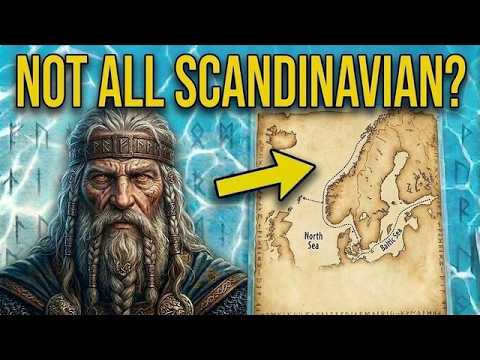
The story we grew up with was clean and satisfying: pure-blooded Norse warriors from isolated fjords, raiding and dying with their long ships. Their genetic roots ran deep into ancient northern Europe, unbroken. And when the Viking Age ended, their descendants stayed put, becoming the modern Scandinavians we know today.
But genetics doesn’t work that way. When researchers at the University of Copenhagen pulled ancient DNA from teeth and bones that had lain untouched for a thousand years, the picture that emerged looked nothing like the poster.
The 2020 Nature study, led by over 100 researchers across Europe and North America, analyzed remains from burial sites in Norway, Denmark, Sweden, Iceland, Greenland, the British Isles, Poland, Ukraine, and Russia. Some individuals buried with Viking weapons, jewelry, and grave goods—people any archaeologist would confidently label Viking—had DNA that pointed not to Scandinavia, but to the British Isles, southern Europe, and the eastern European steppe.
And that wasn’t even the most surprising part. The most surprising part was what was happening inside Scandinavia itself.
Researchers found that during the Viking Age, Scandinavia received a massive inflow of foreign DNA from the British Isles, southern Europe, and the continent. So much foreign genetic input that the DNA of Viking Age Scandinavians actually looks less Scandinavian by modern standards than the people who had lived there before them.
Stop and think about what that means. The people we call Vikings weren’t the ancestors of modern Norwegians. In many cases, they were descended from people who had already left Norway behind.
If you want to find people who carry the highest concentration of ancient Viking genetic markers today, the last place you’d look is Oslo or Stockholm. The highest concentrations are found in Iceland, in the Scottish Islands—particularly Orkney and Shetland—in parts of Ireland, and in pockets of northern Russia, along the old Varangian trade routes.
Iceland was settled almost entirely by Norwegian Vikings and their Irish and Scottish thralls—slaves taken during raids. The genetic blend that resulted has stayed largely isolated for a thousand years. Modern Icelanders carry something close to a frozen snapshot of late Viking Age Norse DNA.
The Orkney Islands, under Norse control for over 500 years, still show some of the highest levels of Scandinavian ancestry in the entire British Isles, even after centuries of mixing with Scottish populations. And in Russia, along the river routes that Viking traders used to reach Constantinople, researchers found ancient burial sites with Scandinavian genetic signatures hundreds of miles inland from the Baltic coast.
The Vikings didn’t stay in Scandinavia—they seeded their DNA across an enormous geographic range. And ironically, in many of those places, it survived better than it did back home.
Now, let’s talk about the look. Because this is where the study produced its most uncomfortable finding for popular culture. Many of the people buried in Viking Age Scandinavia, particularly in Denmark and southern Sweden, carry genes for dark hair and brown eyes. Not all of them, but enough to fundamentally complicate the idea that Vikings were uniformly pale, blonde, and blue-eyed.
The blonde hair and light eyes we associate with Scandinavia are real, but they’re a feature of northern Scandinavia, particularly Norway. They appear consistently in Viking Age Norwegian samples, but the genetic diversity across the Viking world was far broader than the Hollywood image suggests.
The researchers also found something fascinating about gene flow and appearance. As Vikings raided and traded across Britain, Ireland, and southern Europe, they brought back not just treasure, but people—partners, children. And those genetic contributions changed the physical profile of Scandinavian populations over the course of just a few generations.
The pure Viking image that popular culture has built wasn’t just wrong—it was the opposite of what the archaeological record shows. The Vikings were uniquely cosmopolitan for their era. A warrior buried in Denmark might carry Scottish ancestry. A raider from Norway might have been born to an Irish mother. That’s not a footnote—that’s the story.
So, if genetics didn’t define who was a Viking, what did? The study’s lead author, Professor Eske Willerslev, put it clearly: Being a Viking was a profession, not a bloodline. The Norse word vikingr referred to someone who went on a sea voyage—a raider, an explorer, a trader. It was a role you could take on, not a heritage you were born into.
Non-Scandinavian men joined Viking crews. There is DNA evidence of individuals from the British Isles and continental Europe buried in full Viking warrior regalia in Scandinavian graves. They had adopted the culture completely. They were Vikings—just not Scandinavian ones.
The study also overturned another long-held assumption: that Viking raids were a male-only activity. Ancient DNA from several high-status Viking burial sites, previously assumed to be male, were found on genetic analysis to be female. Women traveled with Viking expeditions. Women were buried as warriors. The field is still working through the implications.
What this study really proved is that our image of the Vikings was never really about history. It was about a story we wanted to tell—about ethnic purity, about genetic destiny, about the idea that blood determines identity. The actual Vikings were messier, more diverse, and far more interesting than that story allowed.
Ancient DNA doesn’t just rewrite individual stories—it rewrites the assumptions that stories are built on. For centuries, we looked at historical groups—Vikings, Romans, Egyptians, Native Americans—and projected modern ideas about ethnicity and identity backwards onto them. We assumed that people who shared a culture must have shared a bloodline. Genetics keeps proving that assumption wrong, repeatedly, across every civilization we study.
The Vikings weren’t a race—they were a movement: maritime, aggressive, adaptive, and astonishingly connected to the wider world for a people living in the 8th century. And the DNA of the people they mixed with, traded with, raided, married, and had children with is still out there, carried quietly in the genomes of people in Iceland, in Orkney, in Ireland, in Russia—people who may have no idea they’re walking around with a piece of Viking history inside them.
If you’ve ever done an ancestry test and seen unexpected Scandinavian results show up, there’s a real chance that’s exactly what it is—not a computer error, but a Viking. And this is just one of dozens of cases where genetics has completely overturned what we thought we knew about the ancient world. The next one is even more surprising.
But the Viking story doesn’t end with the 2020 study. If anything, that landmark paper opened a floodgate. Since its publication, follow-up research has pushed the analysis even further, and the findings have grown stranger and more intimate.
One of the most striking threads concerns the varangians—the Norse warriors who traveled east into what is now Russia and Ukraine, down the great rivers to the Black Sea and beyond, eventually serving as elite guards for the Byzantine emperor in Constantinople. For decades, historians debated whether these eastern Vikings were truly Scandinavian or merely a cultural label applied to local Slavic elites.
The DNA settled it—and complicated it at the same time. Burial sites along the Dnieper and Volga rivers contained individuals with unmistakable Scandinavian ancestry, side by side with individuals of pure local descent, all buried with identical Viking-style grave goods. The crews were mixed. The culture was shared. The bloodlines were not.
And then there’s the question nobody expected the genetics to answer: what happened to the Vikings’ descendants after the Viking Age ended? The traditional story says they simply stayed put and became modern Scandinavians. But the DNA tells a more restless tale.
Researchers tracking genetic continuity across the medieval period found something odd. In parts of Scandinavia, the genetic signature of the Viking Age population actually fades in the centuries after 1066. New waves of migration—from the continent, from the east, from the south—reshaped the peninsula yet again. The Viking Age was not the end of Scandinavian history; it was one chapter in a story of constant movement.
The people of modern Norway, Sweden, and Denmark are not the direct, unchanged heirs of the Vikings. They are the product of a thousand more years of mixing, migration, and change—just as the Vikings themselves were.
Perhaps the most human finding of all came from the family graves. At several sites, researchers identified entire households—parents, children, grandparents—buried together. And in a handful of cases, the genetics revealed something that stopped the archaeologists cold: individuals buried as family members who shared no biological relation at all.
They had been adopted, or taken in, or simply claimed as kin. The Viking family, like the Viking crew, was a social construct as much as a biological one. You belonged because you were claimed, not because you shared a bloodline.
It’s a small detail, easy to overlook in a study of 442 genomes. But it may be the most important one. Because it suggests that the Vikings themselves—the real ones, not the poster versions—already understood something we’re still struggling to learn: identity is not a matter of purity. It is a matter of belonging.
And that idea, carried across a thousand years in teeth and bones and ancient DNA, is still rewriting the story we tell about who we are.
So when you picture a Viking, don’t picture a single face. Picture a crew: a Norwegian captain, an Irish oarsman, a Slavic trader, a Scottish woman with a sword. That was the real Viking world—not a bloodline, but a gathering.
The DNA didn’t just correct a historical error. It quietly dismantled a story we’ve been telling ourselves for centuries—that identity is inherited, fixed, and pure. The Vikings, it turns out, were living proof of the opposite, a thousand years before we had the science to see it.
And the strangest part? They never thought they were unusual. To them, a mixed crew was just a crew. A chosen family was just a family. The categories we cling to today would have baffled them.
Maybe that’s the real discovery buried in those 442 genomes. Not that the Vikings were diverse—but that our obsession with purity is the anomaly. The past was always messier, more connected, more human than the myths we build.
So the next time you see a blonde warrior on a movie poster, remember what the teeth and bones actually say: the Vikings were never who we imagined. They were who we’ve always been.
What does your own family story look like—pure and simple, or unexpectedly, wonderfully mixed? Share it in the comments below.
Report this article
Select a reason for reporting:






