The digital archive room at the Charleston Heritage Museum felt unnaturally quiet on that October afternoon. Rain streaked the windows as Dr. Emma Torres scanned the 47th image of the day—a portrait labeled simply “Two Women, Charleston Residents, 1888.” Two young women sat side by side on an ornate settee, dressed in the height of 1880s fashion. The woman on the left was white, her posture serene and confident. The woman on the right was black, her smile more restrained, her posture slightly rigid. Emma began the high-resolution scan, noting the exceptional clarity of the original print.
As the digital image loaded, she zoomed in systematically. The texture of the wallpaper, the reflection in a distant mirror, the intricate beading on both dresses—all remarkably sharp. Then she moved to the black woman’s hands, folded gracefully in her lap. Her breath stopped. There, on the left wrist, partially hidden by the sleeve but unmistakable in the high-resolution scan, was a circular scar. A band of lighter tissue circling the wrist like a bracelet. Emma had seen similar marks before—in photographs of formerly enslaved people. She knew exactly what caused scars like that.
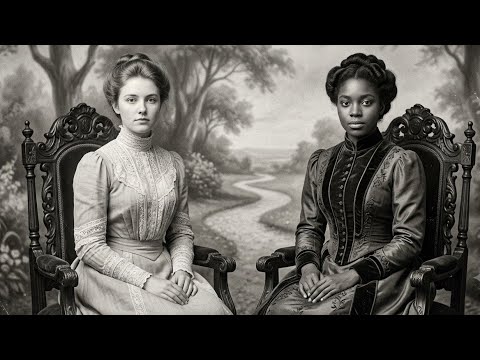
She sat motionless, staring at the magnified image. The scar was perhaps an inch wide, the edges distinct—the kind of permanent marking left by metal restraints worn over time. This wasn’t a photograph of mistress and servant posed with clear hierarchical distance. They sat close together, almost touching. What was the relationship between these two women? And why had no one in 136 years noticed the scar?
Emma checked the acquisition records. The photograph came from the estate of Mrs. Virginia Ashford, who had died six months earlier at age 93. The album was labeled “Family Portraits, 1880 to 1900,” with no names, no identification—just a date: 1888. Emma calculated quickly. The 13th Amendment had abolished slavery in December 1865. This photograph was taken 23 years after emancipation. The woman would have been born around 1863 or 1864, possibly into slavery. But that scar told a different story—those marks developed over time from iron shackles worn repeatedly.
Emma saved multiple high-resolution captures and began drafting an email to Dr. Marcus Webb, a colleague who specialized in post-Civil War African-American history in the South. She needed expertise beyond her own. This photograph held secrets that demanded investigation.
Dr. Webb arrived the next morning, his usual energetic demeanor subdued. They met in the conservation lab, where Emma had the image displayed across a large monitor. Marcus leaned close, studying the wrist scar silently for nearly a minute before speaking.
“Charleston, 1888. Do we have any provenance beyond the estate donation?”
Emma spread out the acquisition paperwork. “The Ashford family. They’ve been in Charleston since before the Revolution. The estate included extensive documentation—land deeds, business records, personal correspondence. I haven’t gone through most of it yet.”
Marcus nodded slowly, his eyes never leaving the image. “That scar is definitely from shackles or manacles. See the uniform width, the way it circles completely? That’s consistent with iron restraints. Probably worn over an extended period during childhood or adolescence when the bones were still growing.”
“But this is 1888,” Emma said. “23 years after abolition.”
“Legally, yes. But you know the reality was far more complex.” Marcus pulled up a chair. “After the Civil War, many formerly enslaved people remained on the same plantations and in the same households where they’d been held in bondage—sometimes by choice, sometimes because of debt peonage, sharecropping arrangements, or outright coercion.” He gestured to the photograph. “Look at this setting. This is an upper-class Charleston home. The furnishings, the wallpaper, the quality of light. This is wealth, old wealth most likely.”
Emma saw what he meant. Every detail spoke of privilege and status. “So what are you thinking?”
Marcus zoomed in on both faces. “I’m thinking we need to find out who these women were and how they were related, because they were related somehow. I’d stake my reputation on it. The question is whether that relationship was chosen or imposed, loving or exploitative—or most likely some complicated mixture of both.”
Emma spent the next three days systematically working through the Ashford estate papers. She found plantation records from the 1850s listing enslaved people by first name only—their ages, skills, and monetary values recorded with the same clinical detachment used for livestock. The lists made her stomach turn. Lucy, age 24, house servant, $800. James, age 19, blacksmith, $200. Sarah, age 16, seamstress, $700.
Then she found a leather-bound journal dated 1863-1865, kept by someone named Eleanor Ashford. The handwriting was elegant. The entries initially focused on mundane domestic matters, but as Emma read chronologically, the tone shifted dramatically. June 12th, 1864: “Father has taken ill again. He has confessed something to me that I scarcely know how to comprehend or accept.” June 15th, 1864: “I have met her. Father insisted, though mother would not come downstairs. Her name is Clara. She is a year younger than I, born in this very house to one of our—I cannot write the word. Father says she is my sister, half-sister.”
Emma grabbed her phone and called Marcus immediately. “I found something. The Ashford family—there were two daughters. Eleanor, the legitimate white daughter, and Clara, the mixed-race daughter born to an enslaved woman. They lived in the same house.”
Marcus’s response was immediate. “Get me everything you can find about both of them. This is the connection.”
The next day, Marcus arrived with census records spread across his laptop. “I found them both. Eleanor Ashford appears in the 1870 census as daughter of Robert and Margaret Ashford, age 26, living in the family home on Meeting Street. And here, in the same household, Clara Ashford, listed as domestic servant, age 25, race marked as mulatto.”
Emma pulled up more journal entries from Eleanor’s diaries, these from 1865. April 20th, 1865: “The war has ended. Father died three months ago and now this news. Clara is legally free now, but where would she go? This house is the only home she has known. Mother insists she remain as paid household help. The distinction seems meaningless to me. She’s still here, still serving, still trapped by circumstances beyond her choosing.”
The entry painted a complex picture. Eleanor seemed genuinely conflicted about her half-sister’s situation, aware of the injustice, yet unable or unwilling to fundamentally change the arrangement. Clara appeared in the margins of Eleanor’s writing—teaching Eleanor to sew fine stitches, nursing her through an illness, sitting with her during their mother’s final days in 1872.
May 14th, 1872: “Mother is buried. Clara and I are alone now in this house. Two sisters divided by everything society deems important. We maintain the fiction that she is my employee, but in truth, we are simply two women living together, bound by blood and circumstance.”
Emma found financial records showing regular payments to Clara Ashford beginning in 1866—modest wages for domestic work. But she also found something else: a deed from 1880 transferring ownership of a small property on the outskirts of Charleston from Eleanor to Clara. The transaction included a handwritten note: “Given freely to my sister, that she might have security independent of my household.”
Marcus examined the deed carefully. “This is unusual. White women transferring property to black women in 1880s Charleston? That would have raised eyebrows. The fact that she’s identified as ‘my sister’ in the note is extraordinary—acknowledging that relationship in legal documentation.”
“So Eleanor was trying to help Clara?” Emma asked.
“Maybe. Or maybe trying to assuage her own guilt. Or both.”
Emma found the answer in a letter dated March 1888, tucked into Eleanor’s correspondence file. It was addressed to a photographer named William Barnett. “Mr. Barnett, I wish to commission a portrait photograph to be taken at my residence. The subjects will be myself and my sister, Clara. I understand this may be an unusual request given the current social climate, but I am willing to pay double your standard rate for your discretion and professionalism. The photograph is for private family purposes and will not be publicly displayed.”
Marcus read the letter over Emma’s shoulder. “She wanted documentation of their relationship—something private, just for them.”
The date matched: March 27th, 1888. Emma pulled up Eleanor’s journal entries from that period. March 27th, 1888: “Today we sat for a portrait, Clara and I, together as we have lived these past 24 years since mother’s death. I wanted something to acknowledge what we are to each other, even if the world can never know. Clara was hesitant at first, concerned about the propriety, but I insisted. We are sisters. Whatever else divides us, that truth remains.”
March 28th, 1888: “Mr. Barnett brought the wet plate proof today. Clara looked at it for a long time without speaking. ‘We look like equals in this,’ she finally said. I told her we should be equals, that the accident of birth and circumstance that made our lives so different is an injustice I have never known how to remedy. She touched my hand and said, ‘You have done what you could, Eleanor. That is more than most would do. But is it enough? Can it ever be enough?'”
Emma felt tears prickling her eyes. This wasn’t a simple story of exploitation or a simple story of sisterly love. It was both, neither—something far more complicated.
Marcus pointed to the screen. “The scar. Did Eleanor know about it? Did she understand what it meant?”
Emma searched through more entries and found it. January 1866: “I saw Clara’s wrists today when she reached for something high on a shelf. The scars there. I knew what they were, though I’d never seen them clearly before. Evidence of what was done to her before the war ended, before freedom came. I wanted to ask, wanted to understand, but the words would not come. How does one ask one sister about the chain she wore?”
Emma contacted Dr. Patricia Coleman, a specialist in the material culture of slavery at the University of South Carolina. Dr. Coleman arrived the following week, bringing extensive documentation of restraint devices used in the antebellum and Civil War periods.
“Shackles and manacles left very specific scarring patterns,” Dr. Coleman explained, examining the magnified image of Clara’s wrist. “The circular formation, the uniform width, the slight indentation of tissue—these are consistent with iron manacles, likely worn during adolescence. The scar tissue suggests they were worn over an extended period, not just once or occasionally.”
Emma had found more fragments in Eleanor’s journals. March 1864: “Father explained to me that Clara, though he is his daughter, could not be acknowledged as such during the years of slavery. She was listed in his property records as belonging to mother, legally enslaved despite her paternity. He says he kept her in the house, had her educated secretly, but there were times when appearances had to be maintained, when his overseer or business associates visited. Times when Clara had to be—I cannot bear to write it clearly—restrained like any other enslaved person to maintain the fiction.”
Dr. Coleman’s expression was grim. “This was not uncommon in situations involving enslaved people who were blood relatives of their enslavers. The cognitive dissonance was profound. They might be treated with relative favor in private—educated, given better clothing and housing—but still subjected to the apparatus of bondage when necessary to maintain social appearances or control.”
“So Clara was shackled even though she was his daughter?” Emma asked.
“Exactly. The legal system recognized no familial relationship between enslaved people and their enslavers, even when paternity was obvious and acknowledged privately. Clara would have been property in the eyes of the law until 1865, regardless of her father’s feelings or private arrangements.”
Marcus had been quietly reviewing documents. “I found something else. Robert Ashford’s will, dated November 1864, two months before he died. He made specific provisions for Clara. She was to be freed immediately upon his death, given a sum of money, and Eleanor was instructed to provide for her continued residence and well-being as befits her station as a member of this family.”
“But he didn’t free her while he was alive?” Emma asked.
“No. The will suggests he was afraid of social repercussions, of what acknowledging her would mean for Eleanor’s reputation and marriage prospects. So Clara remained enslaved, wearing those manacles when necessary, until his death freed her legally in January 1865—just months before the war ended and emancipation came to everyone.”
Dr. Coleman pointed to the photograph again. “And look at how she’s positioned her hands in this portrait. They’re visible, resting in her lap, the scarred wrist partially showing. That’s a choice. She could have hidden her hands in the folds of her dress, positioned her arms differently. She chose to let this evidence remain visible.”
Emma understood. The photograph was documentation, testimony, witness.
Marcus traced Clara’s life through city directories and church registries. She stayed with Eleanor until 1895, then finally moved to the property Eleanor had deeded her, living alone until her death in 1903. “You gave me what you could, Eleanor,” Clara said before leaving. “We were both trapped by the world we were born into.”
Eleanor died in 1911, and the photograph passed through generations, its story forgotten. Emma contacted Virginia Ashford’s granddaughter, Rebecca, who read the journals with tears streaming down her face. “They were sisters,” she whispered. “Real sisters, trapped in a system that made their relationship impossible to acknowledge publicly.”
Four months later, the museum opened Sisters in Blood and Bondage. Visitors stood before the portrait, many weeping. An elderly Black woman studied Clara’s image for a long time. “She’s looking right at us, through time, saying: this happened. Remember this happened.”
Emma stood beside Marcus that evening. “Do you think we did right by them?”
“We told the truth as fully as we could recover it. We didn’t simplify or sanitize. Yes—I think we honored them both.”
Eleanor and Clara sat side by side in perpetuity, their complicated truth finally told. But how many other family albums still hold silent witnesses, waiting 136 years for someone to finally look closely?
Report this article
Select a reason for reporting:






