Every time you sit down at a restaurant in the United States, there is an invisible contract waiting for you at the end of the meal. It is not printed on the menu. It is not part of the bill. And yet, if you violate it, you will be judged. You might even be chased out the door by an angry server. That contract is the tip. But what makes it so fascinating is not that Americans tip. It is that Americans once despised the very idea of it. They called it un-American. They called it a cancer on democracy. They formed societies to abolish it. They passed laws to make it illegal. And yet, here we are more than a century later, living in a country where you’re now asked to tip at self-checkout kiosks, at drive-thrus, and even at establishments where no human being has served you at all.
So, what happened? How did a practice that was once considered the hallmark of European aristocratic servility become so deeply embedded in the American way of life that it now accounts for billions of dollars in annual income for millions of workers? The answer to that question is far darker, far more political, and far more engineered than most people realize. Because the story of tipping in America is not really a story about generosity or gratitude. It is a story about power, about race, about corporate greed, and about a system that was deliberately designed to shift the cost of labor from the people who profit from it onto the people who consume it. And once you understand how that system was built, you will never look at that little line on the receipt the same way again.
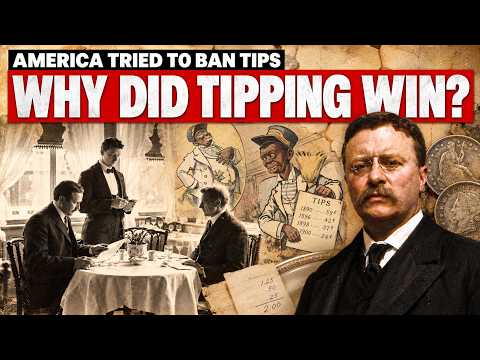
To understand how tipping conquered America, you first need to understand where it came from. And to do that, we need to go back several centuries to medieval Europe, where the feudal system was the law of the land. In this world, society was divided sharply between those who owned and those who served. Lords controlled vast estates. Peasants worked the land. And between them existed a rigid hierarchy that governed nearly every aspect of daily life. Within that hierarchy, it became customary for wealthy landowners to give small sums of money to the servants who attended to them. These were not wages. They were gestures, tokens of favor from a superior to an inferior, and they had a name. They were called vails.
The practice of giving vails became especially common in Tudor England, roughly from the late 1400s through the early 1600s. During this period, it became expected that guests visiting noble households would leave money for the host’s servants, particularly those who had gone above and beyond their usual duties. It was a way of acknowledging the invisible labor that made the visit comfortable, but it was also, and this is important, a way of reinforcing the social order. The person giving the vail was demonstrating their wealth. The person receiving it was demonstrating their dependence. There was nothing egalitarian about it. It was a transaction wrapped in the language of gratitude, but at its core, it was about hierarchy.
Over time, this practice migrated out of private homes and into public establishments. Taverns, inns, coffee houses, and coaching stops all became sites where customers were expected to leave a little something extra for the staff. By the 17th century, some English coffee houses even placed brass urns near the entrance with an inscription that read, “To ensure promptitude.” Some historians believe this is actually where the word tip originated, as an acronym derived from that phrase. Others argue the word comes from the Dutch word tippen, meaning to tap, referring to the sound a coin makes when placed on a table. And still others believe it comes from old English thieves’ slang, meaning simply, “Give me money.” Whatever the true etymology, the custom was firmly established across Europe by the 1700s. And it was, for the most part, understood as a feature of class-based societies. The rich tipped the poor. The powerful tipped the powerless. It was not a wage. It was a gift. And like all gifts, it came with strings attached.
Now, here is where the American chapter of this story begins. And it starts, as so many American stories do, with wealth and imitation. After the Civil War, the United States entered a period of extraordinary economic growth known as the Gilded Age. Fortunes were being made in railroads, steel, oil, and banking. And a new class of American millionaires was emerging, people who had more money than they knew what to do with. Many of them began traveling to Europe, touring the great capitals of London, Paris, and Vienna. And when they returned home, they brought something back with them. Not just souvenirs and stories, but customs. European customs. And one of the customs they adopted was tipping.
For these wealthy Americans, tipping was a way to signal sophistication. It was a way to show that you had traveled, that you understood European culture, that you were a person of refinement and worldly experience. When you tipped a waiter or porter or hotel attendant, you were performing a small act of aristocratic theater. You were saying, “I know how things are done in the civilized world.” But here’s the irony: the average American absolutely hated it. To most people, tipping was not a sign of sophistication, it was a sign of servility. It was a sign of everything that America was supposed to have left behind when it declared independence from the British Crown. The whole point of the American experiment was that all men were created equal. There were no lords and serfs in this country. There were no masters and servants. And yet here were these wealthy elites importing a custom that required one person to grovel before another in exchange for a few coins.
The backlash was immediate and fierce. Newspaper editorials condemned the practice. Social commentators railed against it. One writer in the New York Times in 1916 called tipping, “Viciously un-American.” And the argument was not just about manners, it was about democracy itself. Critics argued that tipping created a two-tiered system of citizenship. The tipper held power over the tipped. The customer became a kind of temporary master and the server became a kind of temporary servant. And in a country that had just fought a bloody Civil War to end the institution of human bondage, that dynamic felt uncomfortably close to something the nation was trying to leave behind.
And that brings us to the racial dimension of this story, which is the part that most people never learn about. Because tipping did not spread through America randomly. It spread through very specific channels, driven by very specific economic incentives. And those incentives were deeply intertwined with race. After the Civil War ended in 1865, roughly 4 million formerly enslaved people were suddenly free. They needed jobs. They needed income. And they entered a labor market that was hostile to their very existence. Many of them found work in the service industry as waiters, as porters, as hotel staff, as domestic workers. These were jobs that white employers were willing to give them, but only under certain conditions. The most important condition was this: they would not be paid a real wage. Instead, they would be paid in tips.
This was not an accident. It was a deliberate strategy. Employers, particularly in the hospitality and railroad industries, realized that tipping gave them a way to hire workers without actually paying them. If the customers were footing the bill through gratuities, then the business could pocket the savings. And the workers who bore the brunt of this arrangement were overwhelmingly black.
The most notorious example of this was the Pullman Company. George Pullman was a Chicago businessman who built a vast empire of luxury sleeping cars for America’s railroads. His cars were elegant, well-appointed, and famous for their exceptional service. And the people who provided that service were almost exclusively black men, many of them formerly enslaved. Pullman was open about why he hired them. He believed that former slaves would know best how to cater to his wealthy white passengers. He believed they would be deferential, obedient, and willing to work long hours for next to nothing. And he was right, at least about the last part, because Pullman paid his porters a pittance. The real money, such as it was, came from tips.
Porters were expected to earn their living from the generosity of the very passengers they served. They worked 400 hours a month. They poured drinks. They made beds. They cleaned toilets. They shined shoes. They pressed clothes. And they did all of this with a smile because their income depended on it. If a passenger did not tip, the porter went home with almost nothing. The Pullman Company became the single largest employer of black men in post-Civil War America. And the tipping model it pioneered became a template for the entire service industry. Restaurants, hotels, and other establishments saw what Pullman was doing and followed suit. Why pay your workers a fair wage when you could have the customers do it for you?
And the degradation went beyond just low pay. Pullman porters were subjected to daily humiliation. Passengers called them “boy.” They called them “George” after George Pullman himself, regardless of what their actual names were. It was a throwback to the era of slavery, when enslaved people were often named after their owners. And the porters endured it because they had no choice. Their livelihood depended on keeping the customer happy. If you smiled wide enough, if you bowed low enough, if you anticipated the passenger’s every whim before they even spoke it, then maybe, just maybe, you would get a decent tip. And if you did not, you went home to your family with empty pockets.
As Malcolm X, who himself worked for the Pullman Company in his younger years, once reflected on the experience: “All you had to do was give white people a show and they would buy anything you offered them.” That was the cruel calculus of tipping. It turned human dignity into a performance, and it put a price tag on servility.
The Brotherhood of Sleeping Car Porters, the first major black labor union in American history, organized by A. Philip Randolph in 1925, fought for over a decade to change these conditions. Their petition to the Pullman Company made the dynamic painfully clear. They wrote that the tip is really tipping the company for not paying its workers decent wages. It took 12 years of organizing, but the Brotherhood eventually won recognition and better conditions. That struggle, born directly from the injustice of the tipping system, became one of the foundational chapters of the American Civil Rights Movement.
But by the time those victories came, the damage was already done. The tipping model had spread far beyond the railroads. It had become the standard operating procedure for the entire American service industry. But here is the thing: people noticed. And they were not happy about it. By the turn of the 20th century, a full-blown anti-tipping movement had taken root in the United States. And it was not a fringe movement. It was mainstream. It was vocal. And for a brief, shining moment, it actually had the power to change things.
In 1904, the Anti-Tipping Society of America was founded in the state of Georgia. And within a short period of time, more than 100,000 people had joined. Members signed pledges vowing never to tip anyone, for any reason, under any circumstances. They saw tipping as a moral issue, not just an economic one. To them, it was an affront to the principles of equality and self-respect that the nation was supposed to stand for.
The movement attracted some high-profile supporters. When William Howard Taft ran for president in 1908, he was widely seen as the anti-tipping candidate, in part because he famously refused to tip his barber. Samuel Gompers, the legendary labor leader who founded the American Federation of Labor, called tipping a nuisance that, quote, “often borders on blackmail.” And perhaps the most famous voice of the movement belonged to a writer named William Rufus Scott, who in 1916 published what became the definitive anti-tipping manifesto. It was called The Itching Palm. The title itself was a reference to the outstretched hand of the worker, waiting, hoping, itching for a customer to drop a few coins into it.
Scott’s argument was devastating in its simplicity. He wrote that in an aristocracy, a waiter may accept a tip and be servile without violating the ideals of the system. But “in the American democracy, to be servile is incompatible with citizenship.” He called tipping a cancer in the breast of democracy, democracy’s mortal foe. Every tip given, he said, was a blow at the American experiment itself.
And for a moment, the movement won. Between 1909 and 1915, six states actually banned tipping outright. Washington went first, then Mississippi, Arkansas, Iowa, South Carolina, and Tennessee. It was illegal to give or receive a gratuity. The laws were real. They were on the books. It looked like the anti-tipping crusade might actually succeed.
But it didn’t. The laws were nearly impossible to enforce, and the restaurant and hospitality industries fought back hard. They had built their business models around customers paying their workers’ wages. If tipping were banned, they would have to actually pay their employees, and that would cut into profits. So they lobbied, they pressured, they argued. And one by one, the laws were repealed. By 1926, every single one of them was gone.
Prohibition delivered the final blow. When the 18th Amendment banned alcohol in 1920, restaurants lost a major revenue stream. Tipping became a lifeline, letting establishments keep menu prices low while customers covered the payroll directly. The anti-tipping movement was dead. William Scott’s manifesto gathered dust on library shelves. And tipping, the practice Americans had once condemned as feudal servitude, was now an accepted part of daily life.
But the system built on top of it would only grow more entrenched. In 1938, the Fair Labor Standards Act established the first federal minimum wage, but it excluded agricultural and domestic workers, jobs held overwhelmingly by black Americans. Then, in 1966, Congress created a special sub-minimum wage for tipped employees. The tip credit was born, officially sanctioning the shift of labor costs from employers to customers.
For decades, the tipped minimum was tied to the regular minimum, rising together. But in 1996, President Clinton signed a law raising the standard minimum wage, and as part of the deal, the tipped minimum was frozen permanently at $2.13. The entity most responsible was the National Restaurant Association, the other NRA, which has spent millions every year keeping that number as low as possible. And as of this recording, it has not changed. Not a single penny.
For more than three decades, millions of American workers, disproportionately women and people of color, have earned a base wage so low that their entire livelihood depends on the voluntary generosity of strangers. When the tipped minimum was frozen, a gallon of gas cost about $1.20. The world has changed beyond recognition since 1991. The tipped minimum wage has not moved at all.
Some argue tipped workers do quite well, that servers at high-end restaurants earn hundreds a night, that the system rewards good service. There is some truth to that, for workers at busy, upscale establishments. But most tipped employees do not work at fine dining restaurants. They work at diners, chain restaurants, coffee shops, pizza joints. They work split shifts, weekends, holidays. Their income fluctuates wildly, and studies consistently show they experience poverty at significantly higher rates than non-tipped workers.
Research has also shown that tipping is not a reliable measure of service quality. The size of a tip is only tenuously related to performance. Instead, it is influenced by the customer’s mood, the weather, the day of the week, and disturbingly, the server’s race, gender, age, and physical appearance. Studies have found that servers receive different gratuities based on factors as arbitrary as hair color and body type. The tipping system does not reward good service. It rewards conformity to the customer’s biases.
And here is what makes the American system even more baffling. The rest of the developed world largely moved on. In Japan, tipping is considered rude, an insult to a worker’s professionalism. In most of Western Europe, service charges are built into the price and workers earn a living wage. In Australia, the minimum wage is high enough that tipping is genuinely optional. The United States stands virtually alone among wealthy nations in maintaining a system where millions of workers earn a base wage that might as well be zero.
The irony is staggering. The same country that once rejected tipping as a relic of European aristocracy is now the only major Western nation that has built its entire service economy around it. The Europeans moved on. The Americans doubled down. And the reason is not cultural preference. It is institutional design, the result of specific political and economic decisions made by specific industries for specific reasons. And those decisions have never been reversed.
Then came the pandemic, and everything got worse. When the world shut down in early 2020, restaurants and hospitality were among the hardest hit. Millions were laid off. Those who kept working did so under dangerous conditions. And something interesting happened. Customers, grateful for the bravery of frontline workers, began tipping more generously. Average tip percentages surged. People who had never tipped at takeout counters started tipping at takeout counters. There was a genuine, if temporary, wave of goodwill.
But the pandemic also accelerated a trend that had been building for years: the digitization of tipping. As restaurants shifted to contactless payment, digital ordering, and tablet-based checkout, customers were suddenly confronted with tip screens everywhere. Not just at sit-down restaurants, but at coffee shops, bakeries, fast-food counters, self-serve frozen yogurt places, airport newsstands, even retail stores. These screens typically presented preset options, often starting at 18% and climbing to 25 or even 30%. And the social pressure was immense. The screen was right there. The cashier was watching. Other customers were in line behind you. Saying no felt rude. Saying yes felt coerced.
And so people tipped, even when they had received no real service, even when they had simply picked up a bag of pastries, even when the entire transaction had been handled by a machine. This phenomenon earned a name: tipflation. And it quickly became one of the most talked-about consumer frustrations in the country.
A 2023 survey by Bankrate found that 66% of Americans now have a negative view of tipping. An April 2024 study by Talker Research found that 76% of respondents feel put on the spot when confronted with a tipping screen, and 56% feel increasingly pressured to tip. Yelp reviews mentioning tipflation increased by nearly 400% between May 2023 and April 2024. And average tip percentages, after surging during the pandemic, have started to decline. On the Square digital payment platform, the average tip on food and beverage transactions fell to about 15% by mid-2025. Nearly half of respondents in a 2026 survey said they are tipping less than they used to. People are exhausted. They are confused. They do not know when to tip, how much to tip, or why they are being asked to tip at all. The system has expanded so far beyond its original boundaries that it has lost any coherent logic, and the resentment is palpable.
And yet, for all the frustration, for all the backlash, for all the surveys showing that Americans are sick of tipping, the system endures. Just as it endured when six states tried to ban it over a century ago. Just as it endured when writers like William Scott called it a moral disease. Just as it endured when labor leaders condemned it as exploitation. Because the fundamental dynamics that sustain tipping have not changed. Businesses still benefit enormously from a system that allows them to pay workers less than minimum wage. The restaurant lobby still wields enormous political power. And workers, trapped in a system they did not create, are understandably reluctant to give up the one source of income that, however unreliable, sometimes pays better than the alternative.
Seven states, Alaska, California, Minnesota, Montana, Nevada, Oregon, and Washington, have eliminated the tipped subminimum wage entirely. In these states, tipped workers earn the full state minimum wage before tips. And the data tells a very interesting story. The restaurant industry has not collapsed. Employment has not plummeted. Restaurants have not disappeared. In fact, studies have found that restaurant industries in states without a subminimum wage perform at least as well as, and in some cases better than, those in states that still use the $2.13 federal tipped minimum. Workers in these states experience lower poverty rates, and the racial and gender pay gaps in tipping are smaller. In other words, the argument that eliminating the tipped subminimum wage would destroy the restaurant industry is not supported by the evidence.
But try telling that to the National Restaurant Association, which continues to spend millions every year fighting any attempt to raise or eliminate the tipped minimum wage. They have perfected the art of fear-mongering. Every time a bill is introduced, the lobby warns of mass layoffs, restaurant closures, and economic catastrophe. And enough politicians listen to keep the status quo in place. Because at the end of the day, the tipping system is not about rewarding good service. It never was. It is about who pays for labor in America. And right now, the answer is you, the customer.
You are the one subsidizing the payroll of every restaurant, every hotel, every coffee shop that pays its workers $2.13 an hour. You are the one filling in the gap between what the business pays and what the worker needs to survive. And the business? The business keeps its menu prices low, its profit margins intact, and its lobbyists well-funded.
What makes this story so compelling and so maddening is how clearly the pattern repeats. Over a century ago, Americans recognized that tipping was exploitative, undemocratic, and fundamentally at odds with the values the country claimed to stand for. They organized against it. They wrote books about it. They passed laws to stop it. And every single time, the forces of industry and inertia won. The anti-tipping laws were repealed. The subminimum wage was created. The subminimum wage was frozen. And the system grew and grew and grew until it reached the absurd proportions we see today, where you are asked to tip 20% for a cup of coffee that a machine poured.
And the most remarkable thing about all of it is how normalized it has become. Most Americans do not think about the history of tipping when they leave a gratuity at a restaurant. They do not think about the Pullman porters. They do not think about the Anti-Tipping Society. They do not think about William Scott’s itching palm. They do not think about the National Restaurant Association’s lobbying campaigns. They just tip. Because that is what you do. Because that is what everyone does. Because the system has been engineered so thoroughly that opting out feels not like a political statement, but like a personal failing. Like a moral deficiency. Like cruelty.
And that is the genius of the system. It has taken a structural problem, the refusal of employers to pay fair wages, and turned it into an individual obligation. It has taken a political question, who should bear the cost of labor, and turned it into a social one. It has made the customer feel responsible for the worker’s survival, while letting the employer walk away clean. And as long as that dynamic holds, as long as tipping remains a moral duty imposed on individuals rather than a systemic failure addressed by institutions, nothing will change. The screens will keep spinning. The percentages will keep climbing. And the workers will keep depending on the kindness of strangers, just as they have for more than 150 years.
So the next time you see that screen flip around with its cheerful buttons suggesting 18, 20, or 25%, take a moment. Think about where this custom came from. Think about the medieval lords and their vails. Think about the Gilded Age millionaires trying to seem European. Think about the freed slaves who were told they would be paid in smiles and coins instead of wages. Think about the 100,000 Americans who joined the Anti-Tipping Society and pledged to end this practice forever. Think about the six states that banned it. Think about the lobbyists who brought it back. Think about the $2.13 wage that has not changed since the year the Soviet Union collapsed. And then ask yourself the question that has haunted this country for over a century:
If tipping was once considered the most un-American custom imaginable, then how did it become the most American custom of all?
If you made it this far, I would love to know your thoughts. Drop a comment below and let me know whether you think tipping should be abolished, reformed, or left alone. And if you have not already, please subscribe to this channel and hit the notification bell. It means more than you know. Thanks for watching, and I will see you in the next one.
Report this article
Select a reason for reporting:






