August 15th, 1945. The war had been over for three months, but in the women’s barracks at Camp Shelby, Mississippi, twenty-seven German prisoners still waited to learn their fate. They had been captured in the final chaotic weeks of fighting in France—members of the Women’s Auxiliary Corps who had served the Reich as radio operators, clerks, and medical assistants. Now they existed in a strange limbo between enemy combatants and displaced persons, uncertain whether they would be sent home to a Germany that no longer existed or remain indefinitely in this humid southern landscape that felt like another planet.
Gertrude Becker stood at the mess hall window watching something that made no sense. An American soldier, a young corporal with sun-darkened skin and an easy smile, was cracking eggs into an enormous metal bowl. Not one egg, not two eggs carefully rationed for an entire week’s worth of meals. He was cracking them by the dozen, the shells falling carelessly into a waste bin as golden yolks pulled together in quantities that would have fed Trudy’s entire family in Cologne for a month.
She pressed her palm against the window screen, her breath catching in her throat. This had to be some kind of mistake, perhaps a special occasion she didn’t understand. In Germany, even before the bombing intensified, eggs had been precious commodities distributed through ration cards that allowed one egg per person per week if you were lucky.
Behind her, Annelise Fischer’s voice broke the silence. “Trudy, what are you looking at?”
Leisel moved to the window, her thin frame still showing the effects of the lean months before their capture. At twenty-two, she should have been in the bloom of youth, but hunger had carved hollows beneath her cheekbones that even weeks of regular American meals hadn’t quite filled. When she saw what had captured Trudy’s attention, she made a small sound of disbelief.
Hedwig Vogle joined them, and the three German women stood together watching this incomprehensible display of abundance. Hedi, at twenty-eight, had seen more of the war than the younger women. She had worked in a field hospital near Frankfurt, had witnessed the steady deterioration of everything Germany claimed to have. She had learned to make broth from potato peels and to stretch a single can of condensed milk across an entire ward of wounded soldiers. Now she watched an American soldier casually crack what must have been three dozen eggs as if they were worth nothing at all.
“He’s making breakfast,” Trudy whispered in German, her voice carrying a mixture of wonder and something close to anger. “Just breakfast, not for officers or special guests. For everyone.”
The three women had been at Camp Shelby for six weeks, but they still couldn’t reconcile what they saw with what they had been taught about America. The propaganda had promised them that the Americans were suffering just as much as Germany, that their own rationing was equally severe, that the war had impoverished everyone equally. Yet here was proof that everything they’d been told was a lie, cracked open one golden egg at a time.
Six weeks earlier, in late June, the transport truck had rumbled through the gates of Camp Shelby carrying its unusual cargo. Twenty-seven German women stepped down onto Mississippi soil, their gray auxiliary uniforms dusty and wrinkled from the long journey from the east coast processing center. The heat hit them like a physical wall, thick and wet in a way that European summer never was. Trudy had never experienced anything like it. The air itself seemed to have weight, pressing against her skin and making her regulation wool uniform cling uncomfortably to her back.
Captain Dorothy Reynolds stood waiting for them, a tall woman with steel-gray hair pulled back in a practical bun. She had been assigned to oversee this unusual addition to Camp Shelby’s population, a facility that primarily housed Italian and German male prisoners who worked in the surrounding pine forests and farms. The addition of women prisoners had required separate facilities and presented unique challenges that the War Department was still figuring out how to handle.
“Welcome to Mississippi, ladies,” Captain Reynolds said in careful, slow English. “I know this isn’t home, but we’ll do our best to make your stay here bearable.”
She gestured toward the barracks that would house them—simple wooden structures that looked identical to the hundreds of other buildings scattered across the vast camp. What the German women didn’t yet know was that these barracks had been hastily modified to accommodate female prisoners, with locks on the doors and separate washing facilities that offered more privacy than the male prisoners received.
Trudy stood in formation with the others, trying to maintain the military bearing that had been drilled into them during their service. She was twenty-four years old and had joined the Women’s Auxiliary Corps in 1943, believing she was contributing to Germany’s defense. She had worked as a communications specialist in occupied France, operating radio equipment and translating intercepted messages. She had been good at her job, efficient and dedicated, never questioning the larger purpose of the war—until the day American forces overran their position, and she found herself standing with her hands raised, her entire worldview about to collapse.
Beside her, Leisel swayed slightly in the heat. The younger woman had been an administrative clerk in Dresden, managing supply records and personnel files. She had been evacuated westward as the Soviets approached, eventually ending up in France, where she’d been captured alongside Trudy. The two had become friends during the chaotic weeks of processing and transport, drawn together by their shared sense of dislocation and confusion.
Hedi stood at the end of their line, her posture perfect despite the oppressive heat. She had been a medical assistant, and her experience with maintaining composure during crisis served her well now. She had learned long ago to hide her emotions behind a professional mask, a skill that would prove invaluable in the coming months as they navigated their strange new reality as prisoners in a land of impossible plenty.
The first night in the barracks, the women spoke in hushed German, sharing stories they had kept private during the transport. Trudy learned that many of them came from cities that no longer existed in any recognizable form. Leisel’s Dresden had been destroyed in the firebombing of February, though Leisel herself had been reassigned westward before that terrible night. She had received no word from her family since January, had no way of knowing if her mother, father, and younger brother had survived.
Hedi’s Frankfurt had been bombed repeatedly. The beautiful old city center reduced to rubble over the course of countless Allied raids. She spoke little about her family, but Trudy noticed how her hands trembled slightly when anyone mentioned the city’s name. Later, Trudy would learn that Hedi’s husband had been killed on the Eastern Front in 1943 and that her parents had died in a bombing raid the following year. Hedi had nothing and no one waiting for her in Germany—a fact that would shape every decision she made in the coming months.
Trudy’s own story was less tragic, but no less disorienting. Her family in Cologne had survived the war physically intact, though their neighborhood had been heavily damaged. She had received one letter from her mother just before her capture, describing how they were living in the basement of what remained of their apartment building, sharing space with three other families. Her father, too old for military service, worked clearing rubble from the streets. Her younger sister had been sent to live with relatives in the countryside, away from the constant bombing. Reading that letter, Trudy had felt relieved that they were alive, but also guilty that she was eating regular meals while they scraped for food.
The women represented a cross-section of German society, united only by their service to the Reich and their current status as prisoners. Some had been enthusiastic supporters of the Nazi regime, true believers who still struggled to accept that Germany had lost. Others had been swept along by circumstances, joining the auxiliary corps because it seemed like the right thing to do or because their families expected it. A few, like Hedi, had joined simply because it offered steady employment and purpose after personal tragedy.
What none of them had expected was to end up here—in a prisoner of war camp in Mississippi, surrounded by a level of material abundance that contradicted everything they had been taught about the struggling American economy. They had been told that America was weak, that its people were soft and divided, that the war effort had brought them to the edge of collapse. Yet the evidence of their own eyes told a different story, one that would force them to question everything they thought they knew about the world.
Corporal James Butler had grown up on a cotton farm outside Mobile, Alabama. He was twenty years old, had never been more than fifty miles from home before joining the army, and had certainly never expected to find himself serving as a guard for German women prisoners. His mama had raised him to be polite to ladies regardless of circumstance, and he found himself struggling with how to treat these women who were technically enemies, but who seemed more lost than dangerous.
The first time he interacted with Trudy was during morning inspection of the barracks. She had been attempting to communicate with another guard about a problem with the water pump in their washing facility, but her limited English and the guard’s impatience had created a frustrating impasse. James, overhearing the exchange, stepped in with the easy courtesy that was as natural to him as breathing.
“Ma’am, if you’ll show me what’s not working right, I’ll see if I can fix it,” he said, speaking slowly and clearly.
Trudy looked at him with surprise, unused to being addressed as ma’am by her captors. She led him to the pump, where he quickly identified the problem—a simple mechanical issue that took him less than five minutes to resolve. When he finished, he tipped his cap to her in a gesture so instinctively polite that Trudy found herself automatically responding with a small nod of thanks.
This small interaction set a pattern that would repeat itself in various forms over the coming weeks. The southern guards, most of them farm boys like James who had been raised with strict codes of manners and hospitality, found it difficult to treat the women with the cold formality that military regulations suggested. They held doors open. They spoke respectfully. They offered help with heavy objects without being asked. These gestures confused the German women, who had expected harsh treatment and instead found themselves navigating a strange landscape of courtesy that made it harder to maintain the psychological distance they thought they needed.
Leisel noticed it, too. When she stumbled on the steps of the mess hall, her ankle twisting slightly, a guard named Private Thomas Warren immediately offered his arm to steady her, asking with genuine concern if she needed to see the camp doctor. She had declined, flustered by the kindness, but the moment had stayed with her. These were supposed to be their enemies. Yet they treated the German women with more consideration than some of their own officers had shown during their service.
Hedi, ever observant, watched these interactions with a clinical eye. She recognized something important happening—a slow erosion of the categories that war required. Enemy and friend, captor and prisoner, victor and defeated. These southern boys, with their earnest courtesy, were making those boundaries harder to maintain, one small gesture at a time.
The mess hall became the site of daily confrontations with reality three times a day. The German women filed into the large wooden building and faced evidence that systematically dismantled everything they had been taught about the war. Breakfast brought plates of eggs—not the carefully rationed single egg they might have received once a week in Germany, but eggs scrambled in butter, served alongside bacon, toast with jam, and coffee with real cream and sugar. The first morning, several women had stared at their plates in confusion, certain there had been some mistake in the distribution.
Trudy had approached the serving line with her metal tray, expecting the thin gruel or watery soup that had become standard fare in Germany. Instead, a cheerful black woman in a white apron had loaded her plate with so much food that Trudy had involuntarily taken a step back.
“Go on now, honey,” the woman had said with a warm smile. “You’re too skinny. We’ll get some meat on those bones.”
The casual abundance in her voice, the assumption that there would always be more food available, had been more shocking than the food itself. Lunch brought sandwiches made with thick slices of ham or roast beef, accompanied by fresh vegetables, fruit that wasn’t bruised or rationed, and desserts that seemed impossible—cookies made with real butter and sugar, cakes with frosting, pies filled with apples or berries. The German women ate slowly at first, half expecting the food to be taken away, waiting for someone to announce that there had been an error, that this was meant for the officers or for some special occasion.
Leisel found herself crying during the third day’s lunch, overwhelmed by the simple presence of a fresh apple on her tray. In Dresden, an apple had been a luxury reserved for the sick or for children. She had not tasted fresh fruit in over a year before her capture. Now she held this perfect red apple in her hand, unblemished and sweet-smelling, and felt anger mixing with her gratitude. Why had they been lied to so completely? Why had they been told that everyone was suffering equally when clearly America had never experienced the deprivation that had defined German life for years?
Hedi watched the younger women grapple with these realizations and felt her own certainties crumbling. She had worked in a hospital where they had reused bandages because they had no supplies. She had watched soldiers die from infections that proper medicine could have prevented. She had learned to perform triage based not on who needed help most urgently, but on who they had enough resources to possibly save. Yet here in this enemy prison camp, they threw away food. She had seen it with her own eyes—guards scraping uneaten portions into waste bins without a second thought. An act that would have been criminal in Germany.
The abundance spoke louder than any propaganda could. It told them they had been on the wrong side of a war fought against a nation that had never truly been threatened, that had resources so vast it could feed its prisoners better than Germany had fed its own soldiers.
During their training in the Women’s Auxiliary Corps, they had attended mandatory lectures about the enemy. American society was collapsing, they had been told. The mongrel nation was divided by race and class conflicts, its economy devastated by the war effort, its people surviving on rations even more severe than Germany’s. The lectures had included photographs—carefully selected images of American bread lines from the Depression, of poverty in rural areas, of strikes and labor disputes. Look at our enemies, the instructors had said. They are weak, disorganized, already defeated by their own internal contradictions.
Trudy remembered those lectures now with a bitter clarity. She remembered believing them—because why wouldn’t she? The instructors were officials, educated people who supposedly had access to intelligence reports and classified information. She had absorbed their teachings without question, had even repeated them to other women during her service, spreading the lies with the confidence of someone who believed she was sharing important truths. Now those lies sat in her stomach like stones, heavy and indigestible.
The cognitive dissonance created a constant state of mental tension. Every meal became an accusation. Every kindness from the guards became evidence of deception. If America was so rich, so powerful, so secure in its resources, then what had Germany been fighting for? The official narrative had always positioned Germany as the defender, the nation forced into war by threatening enemies who sought to destroy its way of life. But how could a nation struggling for survival produce the abundance they witnessed daily while the supposedly desperate Americans served eggs by the dozen?
Leisel struggled with it differently. She had been younger when she joined the auxiliary corps, more idealistic, more willing to believe in the righteousness of Germany’s cause. She had volunteered enthusiastically, seeing her service as a patriotic duty and a contribution to protecting her homeland. The discovery that her patriotism had been built on lies felt like a personal betrayal. She found herself angry—at the propagandists, at the officials who had lied, but also at herself for being so easily deceived.
The other women in the barracks dealt with the revelation in various ways. Some clung to denial, insisting that this camp must be exceptional, that surely the rest of America was suffering as they had been told. Others grew quiet and withdrawn, processing their disillusionment privately. A few became angry, their rage directed at the German leadership that had deceived them so thoroughly. But all of them felt the ground shifting beneath their feet as the worldview they had constructed collapsed under the weight of evidence.
Hedi found herself thinking about the wounded soldiers she had treated, the ones who had died because they lacked basic medical supplies. She thought about the children she had seen in Frankfurt, hollow-eyed and stunted from malnutrition. She thought about the propaganda that had sustained morale even as everything crumbled—the promises that victory was near, that their sacrifices mattered—and she felt a cold fury building in her chest.
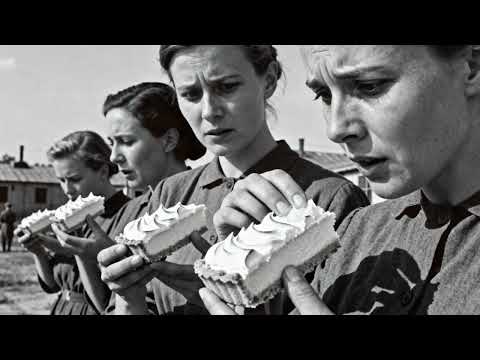
The pie appeared on a Tuesday afternoon in mid-July during what should have been an ordinary lunch service. The German women had already been served their main meal—portions that continued to astonish them with their generosity—when the camp cook emerged from the kitchen carrying a creation that seemed to belong in a fantasy rather than reality. It was a pie, golden-crusted, with peaks of white meringue browned to perfection, and the cook began slicing it into generous portions for distribution to everyone in the mess hall, guards and prisoners alike.
Trudy watched as a slice was placed on her tray. The meringue towered three inches high, the filling underneath a vibrant yellow that could only mean one thing. Lemons. Real lemons. Not the ersatz flavorings that had been used in Germany for years. But more than the lemons, more than the sugar that had been used to create the glossy meringue, what struck her was the sheer extravagance of the eggs. A proper meringue required egg whites—multiple egg whites beaten to stiff peaks—and that meant the yolks had been used for the filling, meaning this single pie had consumed more eggs than her entire family in Cologne would have seen in a month.
She lifted her fork with trembling hands and took a bite. The sweetness exploded across her tongue, so intense after months of deprivation that it almost hurt. The meringue was light and sweet, dissolving into a texture like clouds. The filling was tart and rich, balanced perfectly against the sweetness of the topping. The crust was buttery and flaky, made with real butter that had been abundant enough to use lavishly in pastry. Every element of this pie represented a level of food security that seemed obscene in its abundance.
Leisel sat beside her, staring at her own slice with an expression that Trudy couldn’t quite read. Tears were streaming down the younger woman’s face, though she made no sound. She took a bite, then another, eating with a mechanical precision that suggested she was no longer tasting the pie, but rather calculating the resources it represented.
“My brother,” she whispered finally in German, her voice barely audible. “My little brother Hans. He was twelve when I last saw him. He loved sweets so much. Before the war, our mother would make him a cake for his birthday every year. Nothing fancy—just a simple cake with a little icing. By 1943, there wasn’t enough sugar for cake. By 1944, there wasn’t enough flour.”
Hedi set down her fork after two bites, unable to continue. The pie was delicious—that wasn’t the problem. The problem was that it existed at all. In Frankfurt, eggs had been so scarce that the hospital had used them exclusively for the most critical patients. She had seen children die of malnutrition while adults went hungry, trying to feed them from increasingly barren resources.
That evening in the barracks, Leisel finally spoke about what had been building inside her since that first breakfast of impossible abundance. The other women gathered around as she sat on her bunk, her hands twisting the fabric of her uniform skirt, her voice raw with emotion that had been suppressed for too long. She spoke in German, the words tumbling out in a confession that had been waiting for release since the moment she first saw those dozens of eggs being cracked without ceremony.
“In Dresden, in the winter before I was transferred west, we were eating wallpaper paste,” she began, her voice steady but her eyes fixed on some distant memory. “I’m not speaking metaphorically. The paste that held wallpaper to walls. It was made from wheat flour. People were carefully peeling off wallpaper from abandoned buildings and boiling it to extract whatever nutrition might be left in the paste. We ate that. We were grateful for it.”
The barracks fell completely silent. Even the women who had survived similar deprivations listened with the attention of witnesses to testimony. Leisel continued, her voice gaining strength as she spoke truths that had been too painful to articulate before.
“My mother developed a system. She would take our daily ration of bread—two hundred grams per person if we were lucky—and she would slice it so thin you could almost see through it. She would toast these thin slices to make them seem like more, to make them last longer in your mouth. My father stopped eating his portion. He would claim he wasn’t hungry, that he had eaten at work, but we all knew he was giving his share to Hans and me.”
Trudy found herself crying silently, recognizing elements of her own family’s struggle in Leisel’s account. Hedi reached over and took Leisel’s hand, saying nothing but offering the solidarity of shared understanding. Leisel looked down at their joined hands before continuing.
“Hans was always hungry—always. He was at that age where boys grow so fast, where they need so much food, and there was nothing to give him. He stopped complaining about it after a while. That was worse, somehow. When he stopped asking for food because he understood there was no point. He was twelve years old and he had learned to stop hoping for enough to eat.”
She described the elaborate fantasies her family had developed—the detailed conversations about meals they would prepare when the war was over. Her mother would describe recipes in minute detail, the exact measurements and techniques for dishes they no longer had ingredients to make. They would plan imaginary feasts, discussing what they would serve and in what order, how they would set the table, who they would invite. These conversations had been a form of torture and comfort simultaneously, keeping alive the memory of abundance while highlighting its absence.
“And now,” Leisel said, her voice breaking, “now I sit in an enemy prison camp and eat better than I ever ate at home.”
The silence that followed was profound. No one offered platitudes or false comfort. They simply sat together, three women bound by shared loss and a growing sense of betrayal that would take months, even years, to fully process.
That night, Trudy wrote a letter she never sent. “We were told America was starving,” she wrote in German. “Tonight I watched a guard throw away half a pie because it had sat out too long.” She stared at the words, then folded the page and tucked it inside her pillowcase, a private record of the moment her old world finally died.
Hedi broke the silence first. “We cannot undo what we believed,” she said quietly. “But we can decide what we do next.” Leisel looked up, her eyes still wet. “And what is that?” Hedi squeezed her hand. “We survive. We learn. And maybe, someday, we teach our children not to believe lies so easily.”
Outside, the Mississippi night hummed with crickets, indifferent to the collapse of empires. Three women sat together in the dark, no longer certain who they were—but for the first time, not entirely afraid of the answer.
What would you have chosen in their place—to return to the ruins of home, or to build something new from a lie you had just learned to see?
Report this article
Select a reason for reporting:






