The basement archive of the Boston Historical Society smelled of old paper and dust that had settled for decades. Dr. Emma Richardson pulled another cardboard box from the metal shelf, her fingers leaving trails in the grime. It was her third month cataloging the Victorian photograph collection, and most days blurred into an endless stream of stern faces and faded sepia tones. This particular box had been mislabeled, marked as “Agricultural Equipment, 1880s,” but filled with family portraits. Emma sighed, making a note to update the database.
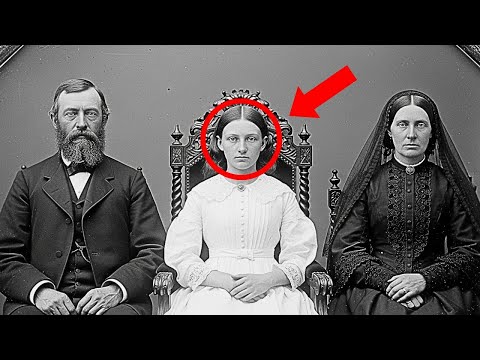
She lifted each photograph carefully, her cotton gloves gentle against the fragile surfaces. Then she saw it. The daguerreotype was smaller than most, roughly 4 by 5 inches, housed in a deteriorating leather case. A young girl sat rigidly in an ornate wooden chair, her hands folded in her lap. She wore a white dress with lace collar, her dark hair parted in middle and pulled back. On either side stood a man and woman, both dressed in black, their faces carved with grief.
Emma recognized it immediately—a memorial photograph. What Victorians called a sleeping portrait. Families would pose with their deceased loved ones, creating a final image to preserve their memory.
She turned the frame over. Written in faded ink on the back: “Sarah R. Angel, March 15th, 1871. Scarlet fever took her from us.”
Emma set the photograph under her desk lamp and reached for her magnifying glass. Something about the girl’s face drew her attention. The eyes were closed, as expected in these portraits, but there was something odd about the shadow patterns across her features. She adjusted the lamp angle and leaned closer.
Then she stopped breathing.
In the reflection of the window behind the family—visible only in the glass—was the silhouette of a fourth person, someone who shouldn’t have been there.
Emma’s hand trembled slightly as she positioned the photograph under the museum’s digital microscope. The device, acquired just last year, could capture details invisible to the naked eye and magnify them up to 50 times their original size. She centered the image on the girl’s face and began to zoom.
The girl’s features emerged with startling clarity. The daguerreotype process, an early form of photography using silver-plated copper, captured extraordinary detail when properly preserved. Sarah’s face appeared peaceful, her skin pale, her expression serene. Everything about the image confirmed what the inscription claimed—a child at rest photographed in death.
But then Emma zoomed in on the eyes.
The eyelids, which had appeared fully closed at normal magnification, were actually slightly parted—just barely a millimeter gap that would be invisible without modern technology. And through that gap, the girl’s pupils were visible. More impossibly, they were focused.
Emma pulled back from the screen, her heart hammering. In death, eyes relax completely, pupils dilating, all muscle tension gone. But Sarah’s pupils were constricted—the way living eyes responded to bright light, the way a photographer’s flash powder would have caused them to react.
She zoomed in further, focusing on the reflective surface of the pupils themselves. Daguerreotypes captured everything, including tiny reflections. It was one of the remarkable qualities of the medium.
In Sarah’s right pupil, barely discernible but undeniably there, was the reflection of a standing figure. Not the photographer, who would have been behind the camera, but someone else—someone standing to the left side of the frame, out of the photograph’s main composition.
Emma captured the digital image and enhanced it. The figure was male, tall, wearing what appeared to be a dark suit. His posture suggested he was watching intently.
She grabbed her notebook and began writing furiously. The implications were staggering. If Sarah’s eyes had been open during the exposure, if her pupils had reacted to light, then she had been alive when this photograph was taken.
But why would a family photograph a living child as though she were dead?
Emma spent the next morning in the records room, pulling everything she could find about memorial photography practices in 1870s Massachusetts. The library’s collection included several journals from the era, advertising circulars from photography studios, and most importantly, a ledger from the Boston Photographic Society listing member photographers and their specialties.
Memorial portraits had been common, but controversial. Some clergy condemned them as morbid, while others saw them as comforting. Photographers who specialized in these portraits had developed specific techniques—propping the deceased in chairs, painting open eyes on the closed lids in the final print, or in rare cases, using thin wires to hold the body upright.
None of the techniques explained focused pupils.
She found a name in the ledger that made her pause. Thomas Garrett, studio located on Beacon Street, specialty listed as memorial and family portraiture. An annotation in different handwriting added years later noted: “Studio closed abruptly, 1872. Whereabouts unknown.”
Emma photographed the page with her phone, then searched the city directory archive. Garrett’s studio had been at 147 Beacon Street, now occupied by a modern office building. But the historical property records might still exist.
By noon, she had the building’s history. The photography studio had operated from 1868 to 1872, then the space was sold to a textile merchant. The sale documents noted: “Abandoned property. Previous tenant departed without notice.”
Emma’s phone buzzed. Her colleague David, who specialized in Civil War history, responded to her earlier message: “Found something interesting. There was a Sarah Miller, age 12, died March 1871 in Concord. Parents were James and Catherine. But here’s the strange part—there’s a second death certificate filed 6 months later claiming administrative error on the first one. Never seen that before.”
Emma stared at her phone screen. Two death certificates. One in March, one in September.
She pulled up the daguerreotype image on her laptop and zoomed in again on that mysterious reflected figure. Who was he? And why had he been there when this photograph was taken?
The Concord Public Library’s genealogy section occupied a quiet corner on the second floor, where afternoon light filtered through tall windows. Emma spread her materials across a wooden table—printouts of the death certificates, her enhanced images of the daguerreotype, and a notepad already filled with questions.
The librarian, an elderly woman named Patricia, brought over three boxes. “Everything we have on the Miller family. They were farmers originally, owned land near Walden Pond. The family line died out in the 1920s, but there are some descendants through the maternal side.”
Emma opened the first box carefully. Inside were letters, land deeds, and a family Bible with birth and death records inscribed in the front pages. She found Sarah’s entry. Born April 3rd, 1859. Died March 15th, 1871. But beneath it, someone had attempted to scratch out the death date, leaving the paper rough and damaged.
The letters proved more revealing. Catherine Miller had written to her sister in Philadelphia throughout 1871. Emma found the March letter first.
“Our darling Sarah has taken ill with the scarlet fever. The doctor holds little hope. James is beside himself with worry. We have called for the photographer should the worst come to pass.”
But then, dated April 30th:
“Sarah improved slowly. The crisis is past, though she remains weak. The doctor is puzzled, as he had pronounced her beyond saving. James believes it is a miracle.”
Emma’s hands shook as she photographed each letter. Sarah had survived. So why had the memorial photograph been taken? Why had her parents posed as mourners beside a living child?
She found another letter dated September 12th, 1871.
“We have made the terrible decision. Sarah will go to live with James’s brother in Ohio. Here, everyone believes her dead. It is the only way to protect her. The truth would destroy us all.”
Patricia appeared beside the table. “Finding what you need?”
Emma looked up. “Do you know if there are any living descendants? Anyone who might have family stories?”
“There’s a woman in Cambridge—Helen Foster. Her great-great-grandmother was Catherine Miller’s niece. She’s done extensive family research. I can give you her contact information.”
Helen Foster’s apartment overlooked the Charles River. Its walls were covered with framed family photographs spanning generations. She was 73, with sharp eyes behind wire-rimmed glasses and a historian’s careful way of speaking. She set a teacup in front of Emma and settled into a worn armchair.
“My grandmother told me the story when I was 16,” Helen began. “She made me promise never to write it down, never to tell the Historical Societies. She said some secrets should stay buried.”
Emma leaned forward. “But you’re willing to tell me now?”
“Everyone who could be hurt is long dead. And perhaps it’s time the truth came out.”
Helen pulled a small wooden box from the bookshelf behind her. Inside was a stack of letters tied with faded ribbon. “These were Catherine’s letters to my ancestor, her niece Mary—the one she couldn’t risk sending through regular mail.”
Emma’s heart raced as Helen untied the ribbon and selected a letter dated June 1871. Helen read aloud:
“Mary, I write to you in desperation and in secret. You know that we announced Sarah’s death in March. The funeral was attended, the grave marked. But Sarah lives. She recovered from the fever, but in her delirium, she spoke truths that endangered us all. She saw things during her illness—things that happened in this house, things that James did during the war that he swore never to reveal.”
Emma interrupted. “What things?”
Helen continued reading:
“James served as a field surgeon for the Union Army. In the final months of the war, he was captured by Confederate forces and held in a prison camp. To survive, to secure medicine for dying men, he made arrangements with a Southern doctor—arrangements that involved providing information about Union troop movements. He saved lives, but it was still treason. If Sarah’s fever-ridden confessions reached the wrong ears, James would be hanged.”
The words hung in the air. Emma understood now why a family would stage a death, would photograph their living daughter as a corpse.
“They sent her away?”
Helen nodded. “To Ohio, to James’s brother. She lived under a different name, married, had children. My grandmother descended from Sarah’s daughter.”
“The second death certificate?”
“James filed it to make everything official, to close any questions. He claimed the first one had errors.”
Emma left Helen’s apartment with copies of the letters and a new lead—the name of James Miller’s brother in Ohio, Robert Miller, who had lived in Cleveland. But one question still burned in her mind. What role had the photographer, Thomas Garrett, played in this deception?
Back at the museum, she contacted the Cleveland Historical Society. Within two days, they sent scanned records of the Miller family in Ohio. Robert Miller had taken in a niece named Sarah in April 1871. She appeared in the 1880 census as Sarah Bennett, married to a shopkeeper. She had lived until 1923.
But Emma needed to understand the photograph itself—the technical aspects that had allowed this deception. She called her friend Marcus, a photography historian at MIT who specialized in 19th-century processes. They met at his campus office, cluttered with antique cameras and chemical bottles. Emma showed him the enhanced images on her laptop.
Marcus whistled low. “This is extraordinary work. Garrett was one of the best daguerreotypists in Boston. But this,” he pointed to Sarah’s pupils, “this required absolute precision. The exposure time for a daguerreotype was typically 15 to 30 seconds. The subject had to remain completely still. Could a child pretend to be dead that long? A trained one, perhaps. But look at her parents’ faces. That grief is real. They’re not acting.”
Emma studied James and Catherine’s expressions again. Marcus was right. The anguish in their faces was genuine.
“There’s something else,” Marcus said, zooming in on the mysterious figure reflected in Sarah’s pupil. “See the way he’s standing? That’s the posture of someone controlling the scene, not the photographer. He would be behind the camera. This is someone directing the subjects. Who? I’d guess Garrett himself—directing from the side. But that means he was actively complicit in creating this false record. He knew she was alive.”
Emma felt pieces clicking into place. Garrett’s studio closed abruptly a year later. What if someone discovered what he’d done? What if he had to run?
Marcus sat back. “Then you need to find out what happened to Thomas Garrett after 1872.”
Emma spent three days tracking Thomas Garrett’s trail. The Boston city records showed nothing after 1872. No death certificate, no forwarding address, no property sales. It was as if he had vanished completely. Then she found a newspaper clipping from the Springfield Republican, dated November 1872.
“Local photographer arrested in connection with forged documentation. Thomas Garrett, formerly of Boston, charged with creating false photographic evidence for payment. Investigation ongoing.”
The article was brief, but it opened a new path. Emma traveled to Springfield and searched through the county courthouse records. Garrett had been arrested, but released after two weeks. The charges were dropped. The records sealed. Someone with influence had intervened.
A note in the margin of the arrest record, barely legible, gave her the next clue: “Released at request of War Department.”
The War Department. James Miller’s wartime secrets.
Emma contacted the National Archives and requested any records related to James Miller’s military service. The response came ten days later—a thick envelope containing photocopies of service records, field reports, and one document marked classified until 1945.
The classified document detailed an investigation into suspected intelligence leaks from Union Field Hospitals in late 1864. James Miller’s name appeared three times, always with the notation “insufficient evidence.” The investigation had been closed without charges in January 1865, weeks before the war’s end.
But there was an addendum dated March 1871—the same month as Sarah’s supposed death. Someone had reopened the investigation based on new testimony from an unreliable source. The source wasn’t named, but Emma knew. Sarah, delirious with fever, had spoken about her father’s secrets. The investigation had been closed again within weeks, this time with a different notation: “Matter resolved. No further action required.”
Emma understood now. Someone had threatened to expose James unless he cooperated with something. The staged death photograph wasn’t just about protecting James from old war crimes—it was proof of the family’s compliance with someone’s demands. But whose? And what had they demanded in return for silence?
Emma returned to the museum basement with new purpose. The daguerreotype itself might hold more clues. She retrieved it from the climate-controlled storage and examined the leather case under bright light. The case was standard for the era—black leather with a velvet-lined interior, brass clasp tarnished with age. But as Emma carefully removed the daguerreotype from its housing, something shifted inside the frame’s backing.
Her fingers found a seam in the leather. Someone had created a hidden pocket.
Using archival tools, she carefully opened the pocket. Inside was a folded piece of paper, yellowed and brittle. Emma’s hands trembled as she unfolded it on the conservation table. It was a receipt dated March 20th, 1871—five days after Sarah’s supposed death.
The handwriting was precise: “Received payment of $500 for services rendered. Photographic documentation completed per agreement. Additional silence guaranteed. T. Garrett.”
$500 in 1871 was a fortune—equivalent to perhaps $15,000 today. Someone had paid Garrett handsomely not just to take the photograph, but to keep quiet about it.
Below the receipt was another note in different handwriting: “Insurance secured. Miller family cooperation confirmed. Evidence preserved for future leverage. W. C.”
Emma photographed everything, then called Helen Foster. “I found something. Do the initials W. C. mean anything in connection with your family?”
Helen was quiet for a moment. “William Carrington. He was a business associate of James’s father. The family owed him money—a debt from before the war. After James’s father died, William tried to collect from James, but there was nothing to collect. The farm barely produced enough to feed the family.”
“What kind of business?”
“Shipping, I think. Import-export. But there were always rumors that William dealt in less legal goods. During the war, there was talk of blockade running—selling supplies to both sides.”
Emma’s mind raced. What if William discovered James’s wartime activities? What if he used that information to pressure James? Into doing what?
“I don’t know yet. But this photograph wasn’t just about protecting James’s secret. It was leverage. Physical proof that the family would do anything—even fake their daughter’s death—to keep that secret hidden.”
Emma stood in front of the museum’s director, spreading documents across the conference table. Three months of research culminated in this moment—the full story of the photograph that had started as a catalog entry and become an obsession.
“Sarah Miller didn’t die in March 1871,” Emma began. “She recovered from scarlet fever, but during her delirium, she revealed that her father had cooperated with Confederate forces during the war. A businessman named William Carrington discovered this and blackmailed the family. He demanded they stage Sarah’s death—creating documentary evidence of their compliance and desperation. The photograph was both proof and leverage. It showed they would sacrifice anything to protect their secret.”
The director studied the enhanced images. “And the photographer?”
“Thomas Garrett was paid $500—a massive sum—to create the false documentation and remain silent. But a year later, he tried something similar for another client and was caught. The War Department intervened to keep him quiet, probably to protect James Miller and others whose wartime activities were questionable but not quite treasonous.”
Emma pulled out her final piece of evidence: a property deed from 1872, six months after the photograph was taken. “James Miller sold his family farm to William Carrington for significantly below market value. Carrington used the land for a warehouse operation that we now know was a front for smuggling. The family’s cooperation gave him a legitimate property in their name—one that couldn’t be easily traced back to him.”
“And Sarah?”
“She lived in Ohio under a new identity for 52 years. She married, had children, and died in 1923. Her descendants never knew the truth. They believed the family story—that she was an orphaned cousin.”
The director leaned back. “This is remarkable research, Emma. But what do we do with it now?”
Emma had thought about this for weeks. “We tell the truth. We display the photograph with its full story—not as a memorial portrait, but as evidence of how far a family went to protect themselves. It’s a story about the long shadow of war, about blackmail and desperation, and about a little girl who had to die on paper so her father could live.”
The exhibition opened on a cool October morning—Hidden in Plain Sight: The 1871 Photograph That Wasn’t What It Seemed drew crowds from the first day. Visitors stood before the daguerreotype, now displayed with digital screens showing the enhanced images—the focused pupils, the reflected figure, the hidden receipt.
Helen Foster attended the opening, bringing three of her grandchildren. They stood together in front of Sarah’s image—four generations removed from the girl in the photograph.
“She was brave,” Helen said quietly. “Twelve years old, asked to pretend to be dead, to hold perfectly still while her parents grieved over her living body, and then sent away to live with strangers, never to see her home again.”
Emma stood beside her. “I keep thinking about that moment—the photograph being taken. Sarah lying there, hearing her mother crying, feeling her father’s hand trembling as he stood beside her. What must that have been like?”
“Terrifying,” Helen said. “But also an act of survival. They all survived in their own ways.”
A journalist from the Boston Globe interviewed Emma for an article that ran the following Sunday. The story went viral—shared across social media, picked up by national news outlets. Other historians reached out with similar cases—photographs that held secrets, images that had been misunderstood for generations.
But for Emma, the most meaningful moment came two weeks after the opening. A woman in her 80s walked into the museum and asked to speak with her. She introduced herself as Margaret, a descendant of Thomas Garrett.
“My family never talked about him,” Margaret said. “We knew he’d been a photographer, but his work was lost, his name forgotten. Seeing this—understanding what he did, both the deception and the craft—it’s complicated, isn’t it?”
Emma nodded. “History usually is.”
They stood together in front of the photograph. Sarah’s face—peaceful and pretending—looked back at them across 153 years. A girl who had died on paper but lived in secret, whose story had been buried until someone finally looked closely enough to see the truth hidden in her eyes.
The photograph remained ordinary—a family portrait from another era. But now, when visitors zoomed in on those eyes, they saw not just a reflection, but a reminder that every image holds more than what first appears. Sometimes you just have to look closer.
Months later, a package arrived at Emma’s office with no return address. Inside was a small daguerreotype—a young woman in her twenties, dark hair parted in the middle, a faint smile on her lips. On the back, in careful script: “Sarah Bennett, Cleveland, 1885. For the kind stranger who saw me.”
Emma’s eyes filled as she realized the truth. Sarah had known. Somehow, across decades, she had left this final message—proof that she had lived, loved, and chosen to be seen at last.
She placed it beside the 1871 portrait in the exhibition case. Two photographs. One girl. A death that never happened, and a life that finally did.
What would you have done, if your silence could save your family—but cost you your name?
Report this article
Select a reason for reporting:






