In the dense jungles of Vietnam, a weapon emerged that defied all expectations—a relic from a bygone era, transformed into an instrument of primal terror. It was a machine so devastating that enemy commanders issued a chilling standing order: “Do not fight it. Run.” This is the story of Puff the Magic Dragon, a weapon that turned the night itself into a nightmare.
By the mid-1960s, the Viet Cong ruled the darkness. Under the cover of night, they launched relentless assaults on isolated outposts, their tactics simple and brutally effective. American defenders, outnumbered and desperate, found their conventional weapons inadequate. Jets screamed overhead for mere seconds, dropping bombs before vanishing, while flares illuminated the battlefield only briefly. The Viet Cong adapted, waiting out the fleeting attacks and resuming their assault. A new solution was needed—something that could stay overhead for hours, delivering an unbroken stream of fire. The answer came from the most unlikely source: an obsolete cargo plane from World War II.
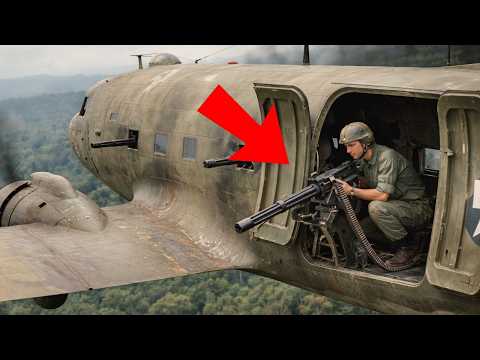
The Douglas C-47 Skytrain, once a workhorse of D-Day, was reborn as the AC-47 gunship. Mounted with three 7.62mm miniguns that could fire 6,000 rounds per minute, it unleashed a torrent of fire that turned the night into day. The concept was revolutionary: a side-firing gunship that could orbit a target, pouring continuous fire onto a single spot. In late 1964, Captain Ron Terry’s team converted two C-47s at Bien Hoa Air Base, and the legend was born. On the night of December 23rd, 1964, an AC-47 broke a Viet Cong attack in minutes, and over the next weeks, it flew 16 missions with a 100% success rate. The dragon had arrived.
For the Viet Cong, the experience was a multi-sensory assault designed for pure terror. The low drone of the C-47’s engines signaled impending doom. Then, flares ignited with the intensity of 2 million candles, turning midnight into artificial noon. And then came the fire—a solid river of red light pouring from the sky, earning the aircraft its nickname, Puff the Magic Dragon. The psychological impact was immediate and devastating. The combination of blinding light, the deafening roar, and the inescapable stream of tracers shattered morale. Viet Cong commanders, in captured documents, explicitly ordered their men not to engage the AC-47. From the ground, with an AK-47, it was an impossible target, orbiting at 3,000 feet. Firing at it only created a muzzle flash, a perfect target for the gunners above. So the order was not to fight, not to hide, but to run for their lives.
This was a stunning admission of defeat. Guerrilla warfare is built on morale, and the AC-47 attacked that belief directly. The mere sound of its engines often caused attackers to abandon their positions and melt back into the jungle. Over its service, the AC-47 defended thousands of outposts, and in over 6,000 documented defense missions, not a single outpost protected by an AC-47 was ever overrun. It was an astonishingly successful record, a testament to the absolute battlefield dominance of this strange aircraft.
But the legend was ultimately written by the men who flew it. These were not easy assignments. The inside of a Spooky during a firefight was chaotic, violent, and dangerous. The airframe shuddered from the recoil of the guns, and despite its effectiveness, the AC-47 was a slow, unarmed cargo plane flying in predictable circles. Over its career, 19 AC-47s were lost, with 12 in combat. What happened aboard Spooky 71 on the night of February 24th, 1969, perfectly shows the heroism at the heart of the machine.
That night, Spooky 71 was diverted to support a base under heavy mortar attack. The loadmaster, 23-year-old Airman First Class John Levitow, was hit by 40 pieces of shrapnel when an 82mm mortar round slammed into the right wing. Through a haze of pain, Levitow saw a crewmate thrown perilously close to the open cargo door. Despite his wounds, he began to drag the unconscious airman away. It was then that he saw the real nightmare: an armed Mark 24 flare, its safety pin pulled by the explosion, rolling freely around the cabin, spewing smoke. The cabin was filled with thousands of rounds of live ammunition. If that flare ignited, its 4,000° burn would detonate everything, destroying the plane and everyone in it. Weakened by blood loss, Levitow knew he was the only one who could act. He threw his own wounded body onto the 27-lb canister to stop it, hugged it to himself, and began to crawl toward the open cargo door, leaving a trail of blood behind him. He reached the door and hurled the flare out into the night. Just as it cleared the plane, it ignited in a blinding white flash. Levitow then collapsed. For his actions, John Levitow received the Medal of Honor, the only enlisted Air Force member to be so honored in Vietnam. He saved the lives of his entire crew.
The reign of the AC-47 Spooky was relatively short. Its final US combat mission was in late 1969. The very vulnerabilities it had—its slow speed and lack of armor—were becoming too risky as the North Vietnamese deployed better anti-aircraft guns. But the Dragon’s legacy wasn’t about its longevity. It was the proof of concept. The AC-47 had demonstrated so convincingly the effectiveness of the fixed-wing gunship that it changed air support doctrine forever. The Air Force immediately began work on its successor, which led to the far more powerful AC-130 Spectre. The AC-130 was a true monster based on the larger C-130 Hercules, with heavier armor, better sensors, and an even more devastating armament, including cannons and a 105mm howitzer. The AC-47s were passed on to Allied Air Forces, but the AC-130 became the new apex predator of the night sky, a lineage that can be traced directly back to that first jury-rigged C-47 over Vietnam.
The story of Puff the Magic Dragon is a perfect example of military innovation born from desperation. It took an old, reliable tool and repurposed it for a new and terrifying problem, and it proved that overwhelming, persistent firepower could be a psychological weapon just as much as a physical one. It was a friendly nickname for a true nightmare, an obsolete plane that became a battlefield legend, and the unlikely father of one of the most feared weapon systems in the modern arsenal. But the full story of how this weapon changed the face of war—and the men who flew it—is still unfolding.
To truly grasp the revolution, you have to picture the cramped, roaring interior of a Spooky on a live mission. The crew was a tight-knit family of six: pilot, co-pilot, navigator, flight engineer, loadmaster, and the gunners who fed the insatiable guns. In the darkened cargo bay, the miniguns’ electric whine and the stench of cordite became the air they breathed. The loadmaster, perched near the open door, had the most visceral job—kicking out flares and watching the tracers arc down like a fiery waterfall. It was a dance of precision and chaos, executed thousands of feet above the jungle.
Word of the dragon spread far beyond American lines. Captured Viet Cong diaries and after-action reports revealed a pattern of pure dread. One prisoner described the sound as “the sky tearing itself apart.” Another confessed that seasoned fighters would break and flee at the first thrum of the C-47’s engines, abandoning weapons and wounded alike. The AC-47 didn’t just kill—it unmade the night itself, robbing the guerrillas of their greatest ally.
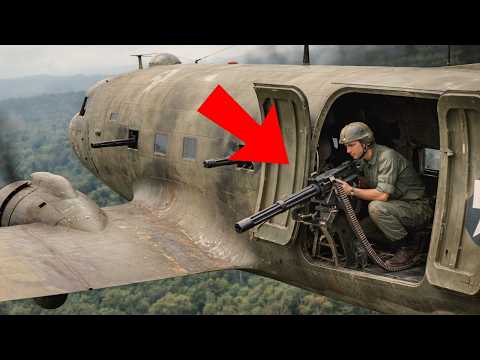
Yet the Spooky’s success came at a steep price. The planes were crewed by volunteers who knew the odds. Flying a slow, unarmored cargo plane in tight circles over hostile territory was an act of calculated bravery. Each mission was a gamble against ground fire, mechanical failure, and the sheer exhaustion of hours-long sorties. The men who flew them developed a fatalistic humor, naming their aircraft with grim affection—”Puff,” “Spooky,” “The Dragon.” They knew the enemy had a price on their heads.
By 1969, the AC-47’s limitations were undeniable. North Vietnamese anti-aircraft crews, equipped with heavier guns, learned to track the predictable orbit. Losses mounted. The Air Force began phasing the Spooky out of US service, handing the remaining airframes to the South Vietnamese and other allied forces. But the dragon’s fire didn’t die—it simply changed shape.
The AC-130 Spectre, born from the AC-47’s DNA, carried the fight into a new era. With armor plating, advanced sensors, and a devastating mix of cannons and howitzers, it became the nightmare of a new generation of enemies. From the jungles of Vietnam to the deserts of Iraq and the mountains of Afghanistan, the lineage of Puff the Magic Dragon endured. Every time a Spectre circled overhead, its ghostly predecessor flew alongside it.
But the story isn’t just about machines. It’s about a lesson written in fire and blood: that in war, the most terrifying weapon is often the one that attacks the mind. The AC-47 proved that a single, obsolete plane, crewed by ordinary men in extraordinary circumstances, could change the course of battle—not through technological superiority, but through sheer, unrelenting psychological force. The dragon’s roar still echoes in the annals of military history, a reminder that fear itself can be forged into a weapon.
For the men who flew the Spooky, the war never truly ended. Many returned home carrying the roar of the guns in their ears and the faces of saved comrades in their hearts. John Levitow’s Medal of Honor became a symbol not just of his courage, but of every crew member who ever crawled through a burning cabin to save a friend. Their stories, passed down through generations of airmen, kept the dragon’s spirit alive long after the last AC-47 left American service.
Today, the AC-130 Spectre and its successors still prowl the night skies, their crews trained in the same brutal arithmetic of orbiting fire. Every gunship pilot learns the legend of Puff—the slow, fragile cargo plane that terrified an army into retreat. The dragon’s DNA is woven into the very doctrine of close air support, a testament to how one desperate improvisation can echo through decades of conflict.
But perhaps the most enduring legacy isn’t tactical. It’s the simple, haunting truth that the AC-47 revealed: war is fought in the mind as much as on the battlefield. A weapon that makes soldiers run—that turns the night from sanctuary to slaughterhouse—wields a power beyond any bullet. The dragon didn’t just kill; it conquered fear itself, and in doing so, it became immortal.
So the next time you hear the low drone of a cargo plane overhead, remember the men who turned a relic into a nightmare, and the enemy commanders who whispered a single, desperate order into the dark. What other forgotten weapons might be hiding in history’s shadows, waiting for their moment to roar?
Report this article
Select a reason for reporting:






