Sara Williams had scanned dozens of old photographs before, but none had ever made her breath catch like this one. The daguerreotype was crisp for its age, a family portrait from 1862 showing the Whitfield family on their plantation veranda. James Whitfield stood rigid in his Confederate uniform, his wife and children arranged like porcelain dolls. But as Sara zoomed in on the background shadows, she noticed something that made her pulse quicken: a figure, barely visible, with hands folded in a deliberate, unnatural configuration.
The signal was unmistakable. Sara had studied enough Underground Railroad history to recognize the pattern—fingers interlaced in a specific way that meant “safe house” or “friend.” Her colleague Marcus Chen confirmed it: the woman in the shadows was communicating in plain sight, leaving a message that had survived more than 160 years.
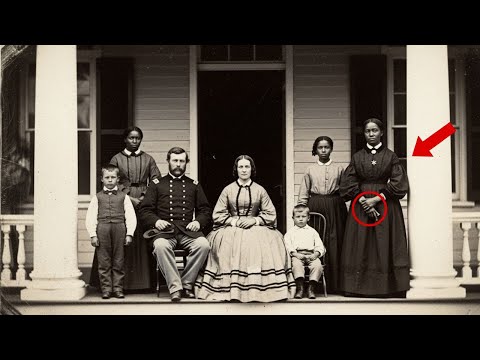
But who was she? The museum’s archives held the Whitfield estate papers, including annual inventories that listed enslaved people by name, age, and value. Sara’s hands trembled as she read the entry: “Eliza, age approximately 35, house servant seamstress, valued at $900.” The dehumanizing record felt like a punch to the gut, but it was a start.
Digging deeper, they found a 1938 WPA interview with Ruth, an elderly woman who had been enslaved on Edisto Island. She spoke of “Aunt Eliza,” a seamstress who sang certain songs when it was safe to move, who left signs for those who understood. “She knew things, heard things,” Ruth had said. “When the paddy rollers were coming, she’d sing ‘Wade in the Water.’” The pieces began to fall into place.
Then Marcus found it: a Freedman’s Bureau record from April 1865. “Eliza Freeman, age 38, formerly enslaved on Edisto Island, occupation seamstress.” She had survived. She had lived to see freedom. And she had registered two children—Hannah, age 12, and Isaac, age 8. The surname “Freeman” was a declaration of identity, a rejection of bondage.
But the most extraordinary discovery came from Dorothy Bennett, a retired teacher whose great-great-grandmother was Hannah Freeman. In her living room, Dorothy produced a small leather-bound journal. “The life and courage of my mother, Eliza Freeman, as told to me and witnessed by me, her daughter Hannah Freeman, written in Charleston, South Carolina in the year of our Lord 1877.”
Sara’s hands shook as she turned the brittle pages. Hannah had recorded her mother’s covert activities: the hand signals, the coded quilts, the hidden cellar beneath the sewing room. And then, an entry dated 1862: “A traveling photographer came to take a picture of the Whitfield family. Mother saw an opportunity. She knew the photograph would last, would survive even if she did not. She wore her North Star pin hidden in the shadows where only someone looking closely would see it. And she positioned her hands in the signal Samuel had taught her, the sign that meant freedom house.”
Eliza had known exactly what she was doing. The photograph was not accidental documentation—it was deliberate testimony, a message planted in the historical record like a time capsule. And now, 162 years later, Sara had found it.
Dorothy turned another page of the journal, her finger resting on a passage near the end. “Mother never learned to write her own name,” Hannah had recorded. “But she could read the world around her better than any educated person I ever knew. She said freedom was not a place you reached. It was a thing you carried inside you, and you passed it to others like a light from one candle to the next.”
Sara photographed the page, then sat back and let the silence of Dorothy’s living room settle around them. Outside, a church bell rang the hour. Marcus was the first to speak. “If Hannah wrote this in 1877, there could be more. Other journals, letters, maybe photographs from after the war.”
Dorothy shook her head slowly. “Hannah had three children. Only one of them—my grandmother—kept the box. The others moved north, to Philadelphia and Boston. We lost touch with those branches a long time ago.” She paused, then looked at Sara with an expression that was half hope, half challenge. “But you found us. Maybe you can find them too.”
That night, Sara sat alone in the conservation lab with the journal scans open on her monitor. The museum was empty, the only sound the low hum of the climate control system. She scrolled through Hannah’s careful script until a name caught her eye—a name she had skimmed past earlier without registering.
“Samuel,” Hannah had written. “The free black man from the docks who first asked Mother to help. He was a sailor on the schooner Lydia Ann. After the war, he came to Charleston and asked Mother to marry him. She said no. She said she had too much work still to do.”
Sara’s fingers flew across the keyboard. The Lydia Ann. She searched maritime records, port registries, ship manifests. The schooner appeared in Charleston harbor records throughout the 1850s and early 1860s, listed as a coastal trader carrying rice, cotton, and naval stores. But in the margin of one 1861 manifest, an annotator had scrawled a note: “Crew suspected of transporting contraband. Watch.”
Contraband. The wartime euphemism for enslaved people who had escaped to Union lines. Samuel wasn’t just a dockworker—he was running people out of Charleston by sea, hiding them among cargo, moving them north along the coast.
Sara leaned back in her chair, the implications cascading. Eliza had passed information from the plantation house to Samuel. Samuel had arranged passage on ships. The network stretched from the veranda of a cotton plantation to the decks of coastal schooners, and every link was forged by people whose names had been reduced to line items in ledgers.
She picked up her phone and called Marcus, even though it was nearly midnight. He answered on the second ring, his voice alert. “I found something,” she said. “We’ve been thinking about Eliza as a lone actor. She wasn’t. There was a whole chain. And I think I know where the next link is.”
The next morning, they returned to Dr. Johnson’s office at the Avery Research Center. She listened to their findings without interrupting, her expression grave and intent. When Sara finished, Dr. Johnson opened a drawer and withdrew a folder she had clearly prepared in advance.
“I did some digging of my own after our last conversation,” she said. “The Lydia Ann was owned by a Quaker merchant named Absalom Price. His grandson donated a collection of family papers to the South Carolina Historical Society in 1952. It’s never been fully catalogued—it’s been sitting in storage for seventy years.”
She slid a finding aid across the desk. Sara read the list of box contents: correspondence, business records, ships’ logs, personal diaries. One entry stopped her cold: “Box 14: Miscellaneous papers, including documents relating to the Price family’s involvement with the Charleston Free Produce Society and the transportation of persons of color, 1855–1865.”
Marcus let out a low whistle. “They kept records. They actually kept records of what they were doing.”
Dr. Johnson nodded. “Quakers were meticulous record keepers. It was a matter of conscience for them. But be careful—this collection has been overlooked for a reason. Some of these families were still prominent in Charleston society well into the twentieth century. There are people who would prefer this history stay buried.”
Sara thought of Dorothy, of the generations who had been told their family stories were exaggerations. “They’ve been buried long enough,” she said.
The South Carolina Historical Society occupied a stately brick building on Meeting Street, its reading room hushed and dim, the air thick with the smell of old leather and dust. Sara and Marcus signed in at the front desk and requested Box 14 from the Price family collection. The archivist, a thin young man with wire-rimmed glasses, disappeared into the stacks and returned fifteen minutes later pushing a metal cart.
The box was heavier than Sara expected. She lifted the lid and found herself staring at a jumble of papers—some folded, some rolled, some bound with faded ribbon. Marcus pulled on his gloves and began sorting. “Business correspondence first,” he murmured. “Then we’ll get to the personal stuff.”
For two hours they worked in near silence, photographing each document, cataloging names and dates. The Price family had been merchants of conscience—their ledgers recorded sales of free-labor cotton and sugar, their letters discussed the moral imperative of abolition. But it was a slim diary bound in cracked black leather that made Sara’s hands go still.
“Absalom Price, 1862,” she read aloud. “Third month, twelfth day. Received word from our friend Samuel that the seamstress on Edisto has signaled a new group ready to move. Four souls. We will send the Lydia Ann to the rendezvous at dawn.”
Marcus leaned over her shoulder. “He wrote it down. He actually wrote it down.”
But the next entry, dated three weeks later, made Sara’s stomach drop. “Fourth month, second day. Word from Edisto that the seamstress has been discovered. The master’s overseer found a quilt with markings in her quarters. She is confined to the smokehouse. We fear the worst.”
Sara looked up, her throat tight. “She was caught. Eliza was caught.”
Marcus was already flipping through the diary, searching for later entries. “Wait—there’s more. Fourth month, fifteenth day.” He read aloud, his voice barely above a whisper. “The seamstress has been released. The master’s wife intervened, claiming the woman’s skills were too valuable to lose. She is watched closely but has not been sold. We will not risk contact again until the danger passes.”
Sara exhaled. “She survived. She talked her way out of it, or Catherine Whitfield did.” She thought of the elaborate hoop skirt in the photograph, the wife who had posed beside her husband. “Maybe Catherine knew more than we gave her credit for. Maybe she protected Eliza deliberately.”
Marcus shook his head. “Or maybe she just didn’t want to lose her seamstress. We can’t assume kindness where there was only convenience.”
They found no further entries about Eliza in the diary. But tucked into the back cover was a folded slip of paper, brittle as autumn leaves. Sara opened it carefully. A single line in a different hand—Samuel’s, perhaps, or Absalom’s:
“She said the photograph would speak for her. We did not understand. Now we do.”
Sara stared at the words until they blurred. Eliza had known. Even after being caught, even after the smokehouse and the watching and the fear, she had trusted that her message would survive. She had trusted strangers, generations unborn, to look closely enough to see her.
Marcus broke the silence. “We need to find Samuel’s descendants. If he kept records too, or if his family passed down stories—”
“We start with the Lydia Ann,” Sara said, already reaching for her laptop. “A ship that ran contraband has a paper trail. Crew lists, port clearances, maybe even a logbook. If Samuel was on that ship, his name is somewhere.”
She searched the digital archives of the Charleston port authority, cross-referencing dates from Absalom Price’s diary. It took her twenty minutes to find it: a crew manifest from March 1862, listing the Lydia Ann’s sailors. And there, third from the bottom, was a name that made her heart race.
“Samuel Freeman,” she said. “He took her name. After the war, he took her name.”
Marcus frowned. “Or she took his. They weren’t married—Hannah said Eliza refused him.”
“Maybe not legally,” Sara said slowly. “But they were partners. In the work, at least. And when freedom came, they chose the same name. That means something.”
She pulled up the Freedman’s Bureau records again, this time searching for Samuel Freeman. There were dozens of entries across the South. But one, from Charleston in 1866, matched the age and occupation: “Samuel Freeman, 42, sailor, residence Radcliff Street.”
Radcliff Street. The same neighborhood where Eliza had settled with Hannah and Isaac.
Sara sat back, a new picture forming in her mind. Eliza and Samuel, living a few doors apart, raising their children in freedom, still bound by the secret they had shared. “They stayed close,” she said. “After everything. They stayed close.”
Marcus was already typing. “I’m looking for Samuel Freeman’s descendants. If he had other children, if his line continued—” He stopped. “There’s a Freeman family reunion association registered in Charleston. They hold a gathering every summer. The contact person is a woman named Priscilla Freeman-Grant.”
Sara grabbed her phone. “Call Dorothy. Ask her if she’s ever heard that name.”
Dorothy answered on the first ring. When Sara explained what they had found, there was a long pause on the other end of the line. Then Dorothy’s voice, thick with emotion: “Priscilla. Oh my Lord. Priscilla is my cousin. We haven’t spoken in thirty years. I didn’t know she was still in Charleston.”
“She’s organizing a reunion,” Sara said. “This summer. Dorothy, I think the two branches of the family are about to meet for the first time in generations.”
Another pause. Then Dorothy laughed—a wet, joyful sound. “Eliza’s light,” she said. “Passed from candle to candle. It’s still burning.”
Sara looked at the daguerreotype on her screen, at Eliza’s half-hidden face and deliberate hands. The woman had risked everything to leave a message, and now that message was rippling outward, connecting families, healing fractures, rewriting history. But the story wasn’t over. There were still other photographs in the Whitfield collection, other shadows to examine, other signals waiting to be read.
She opened the museum’s digital catalog and began scrolling through the remaining images. Somewhere in those boxes, she knew, more messages were hidden. More candles waiting to be lit.
The reunion was held in July at a park on Edisto Island, within sight of the old Whitfield property. Dorothy and Priscilla met beneath an oak draped with Spanish moss, two branches of Eliza’s line embracing after three decades of silence. Sara watched from a distance as children traced Eliza’s hand signal in the air, passing it on.
Months later, back in the lab, Sara opened the next daguerreotype from the Whitfield box. A woman in a doorway, half-turned, one hand resting on the frame. Three fingers extended. A thumb tucked beneath. Sara’s breath caught again—a new signal, a new voice waiting in the shadows.
“You found another one, didn’t you?” Marcus asked from the doorway.
Sara smiled, reaching for the scanner. “She left us more than one message.”
How many more hidden witnesses are still waiting in our archives for someone to look closely enough to see them?
Report this article
Select a reason for reporting:






