It was a crisp October morning in 1904 when the Carter family posed outside their grand Victorian home. Five figures stood stiffly in their Sunday best—Thomas in a dark three-piece suit, his wife Margaret in a long black dress, and their three children, Samuel, Clara, and Rose, arranged in front. The photographer, William H. Parker, adjusted his tripod. The image seemed ordinary, even banal. For over a century, it remained just that: a family portrait, unremarkable save for its age.
But in 2026, a antique dealer purchased a box of old photographs from an abandoned Vermont estate. Among them was this image, mounted on thick cardboard and stamped with Parker’s studio. On the back, in faded ink, a warning: “Do not enlarge this photograph.” Curiosity won. The dealer scanned it at high resolution and zoomed in on the upper-story window. There, behind the glass, stood a sixth figure—a woman with dark hair, her hands pressed against the pane, staring directly at the camera.
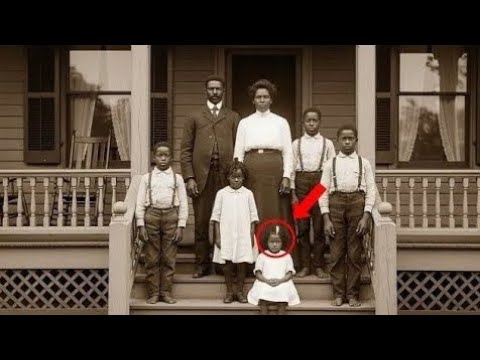
The discovery sent shockwaves through historical circles. Experts identified the family as the Carters, who lived in a small Massachusetts town. The room behind the window, according to property records, had been sealed since 1901. No one should have been there. Yet the woman’s features were unmistakable: eyes, nose, mouth, and a small pendant around her neck. Researchers compared the image with a photograph of Alice Mercer, a young maid who had worked for the Carters and allegedly died after a fall in 1899. The resemblance was chilling.
Clara, the nine-year-old in the photo, looked terrified, her eyes fixed not on the camera but on that window. A letter from Margaret, written three days before the photo, revealed: “Clara says she heard footsteps again. She insists someone is walking upstairs. Thomas says the room is locked.” Another line added: “I checked the lock myself. It was sealed. There should have been no one inside. Yet it seemed someone was there.”
Investigators dug deeper. They found Clara’s childhood diary, most pages missing, but one entry dated October 14, 1904, read: “I saw Alice again.” Three days later, the family photo was taken. The camera was positioned directly toward that window—not by accident, but by design. The photographer’s notebook confirmed: “Mrs. Carter insisted the window remain visible.” A second photo, taken minutes later, showed the figure gone, but Clara now staring at her mother, her face pale with dread.
What had Clara seen? And why did the family preserve a image that seemed to haunt them? The answers lay buried in a hidden passage behind the sealed room, in a maid’s secret, and in a warning that had waited a century to be ignored.
The discovery of the hidden passage rewrote the entire case. Architectural plans revealed a narrow corridor behind the sealed storage room, connecting to a disused service stairwell. The stairwell had been closed off in 1901, but closure did not mean destruction. A photograph of the home’s interior, unearthed in a local archive, showed the stairwell and a small door at its base—painted over, but with enough space behind it for someone to hide. The implication was horrifying: someone had been secretly living inside the Carter house.
Researchers returned to the wooden box and found a receipt dated October 12, 1904—five days before the photograph. Thomas Carter had made a substantial payment to an unnamed recipient. The amount was unusually large. “Why would Thomas pay someone just days before the portrait?” one historian asked. “Unless that payment was meant to make someone disappear.”
Then came the most disturbing find yet. In the photographer’s original notebook, beneath the entry for the Carter family, a line had been crossed out but not erased. It read: “The girl refused to face the camera. She kept looking at the window. Mrs. Carter told her to be still.” The next line, in darker ink, added: “There is someone up there. A person, not a thing.” Parker had been told about the figure—and he took the picture anyway.
The second photograph, taken minutes later, became the key. The figure had vanished from the window, but Clara’s expression had changed from fear to sheer terror. She was no longer looking at the window. She was looking at her mother. Between the two exposures, a small curtain in the upper window had moved. Someone had been standing behind it—and then they were gone. “Who left that room?” the researchers asked. “And where did they go?”
The answer came from an unexpected source: a family story passed down through generations of a local carpenter. His grandfather had been hired in 1905 to renovate the Carter house. While removing an old wooden panel, he found personal belongings hidden behind the wall—a woman’s coat, and inside its pocket, a small silver pendant. The same pendant seen around Alice Mercer’s neck in the window.
For the first time, the mystery had a physical link. But one question remained unanswered. If Alice had died in 1899, who was standing in that window in 1904? The researchers turned to Alice’s sister, Mary Mercer, who had spent years trying to uncover what happened. Her last surviving letter, dated 1905 and addressed to a lawyer, contained a single explosive line: “I know what they told you about Alice. It was not true. Alice was alive after they said she died.”
If authentic, the letter changed everything. A second death record was found—a woman who died in 1906, aged twenty-six, a few miles from the Carter property. No family listed. No known address. But the physical description mentioned a small scar above the left eyebrow. Mary had described that same scar years earlier. The timeline was chilling: Alice supposedly died in 1899, a woman matching her description appeared in 1906, and in 1904, a woman who looked like Alice stood in the Carter window.
Experts re-examined the original image using infrared imaging. Beneath the surface, a second layer of writing emerged, invisible to the naked eye. The words were faint but reconstructable: “She knows what happened.” At first, researchers assumed it referred to Clara. But it could have meant Alice—or Margaret. There was no way to know.
Then came the most chilling detail of all. In the reflection of the upper window glass, the photographer had unintentionally captured a second face—not behind the woman, but behind the camera itself. A man stood several feet behind Parker, outside the frame. Only his reflection was visible. His clothing matched Thomas Carter’s. But Thomas was supposed to be standing beside his wife, and he was. Which meant there were two men who looked nearly identical.
The explanation, when it came, was almost disappointingly mundane. The reflection was caused by a glass plate positioned near the photographer. It was not another man. It was a visual duplication. One person reflected twice. The mystery seemed to collapse again—until researchers noticed what the reflected man was holding. A folder. And on that folder, a symbol that appeared in Thomas Carter’s business documents. The symbol traced back to a private financial firm later investigated for fraud. The connection suggested Thomas may have been involved in transactions that Alice had discovered. Perhaps that was the secret. Perhaps Alice had threatened to expose him. Perhaps she disappeared because of it.
But the photograph—the moment, the family, the house, the window, the child who seemed to know more than the adults wanted her to—refused to be explained away. The final piece of evidence came from Clara herself. Years later, she wrote a letter to her own daughter. In it, she mentioned the old photograph. “You may find our picture outside the house someday. If you do, do not believe the story written beneath it.” Then she added: “Look at the window.” That was all. No explanation. No name. No confession. Just: look at the window.
Today, the image remains unresolved. Experts agree that some shapes could be reflections, flaws, or limitations of early photography. The identity of the woman in the upper window cannot be proven. Nor can it be proven that she was Alice Mercer. But several facts remain. Alice worked for the Carter family. She died—or was presumed to have died—under questionable circumstances. The upper room was sealed tight. Clara wrote of seeing someone there. Margaret insisted the window remain visible in the family portrait. And someone wrote on the back: “Do not enlarge this photograph.”
Perhaps the warning was never about a ghost. Perhaps it was about evidence—something the family believed would be discovered if anyone looked closely enough. After more than a century, someone finally did. What appeared to be an ordinary family portrait became something else entirely: a record of fear, a record of secrets, and perhaps even a silent accusation. Five people stood outside the house that morning in 1904. But when the camera clicked, someone else seemed to be watching from above. And perhaps the most unsettling part is not that someone was there—but that one of the children seemed to know exactly who they were.
Clara looked toward the window. She did not smile. She did not move. She simply stared, as if she had been warned never to speak of it. And for over a hundred years, she never did.
The final breakthrough came not from the photograph, but from the house itself. In 2027, a preservation team began restoring the old Carter mansion. Behind the sealed upper room, they found the hidden corridor intact—and at its end, a small leather journal wedged beneath a loose floorboard. The handwriting matched Alice Mercer’s. The first page read: “I am not dead. Thomas locked me away because I knew about the fraud. He told my family I fell. He told everyone I died. But I lived in the walls for five years.”
Alice had been hidden in the house, fed by someone—likely Margaret, who feared her husband but could not abandon the girl. When Clara began hearing footsteps, Margaret realized the secret could not hold. The photograph was her desperate act: a silent record, a plea for someone to look closely. “She insisted the window remain visible,” Parker had written. Margaret wanted the world to see what she could not say aloud.
But the most haunting entry came last. Dated October 17, 1904, the day of the portrait, Alice wrote: “Clara saw me today. She held up the key I gave her. I pressed my hand to the glass. I wanted her to know I was still here. Then Thomas came. He took her inside. He did not know I was watching.” The key in Clara’s hand was not a curiosity—it was a promise. The child had been keeping Alice’s secret, carrying the key to the room where her friend was hidden.
What happened after that remains unclear. Alice’s second death record in 1906 suggests she eventually escaped, or was moved. The coat behind the wall, the pendant, the hidden corridor—all fragments of a woman erased by a powerful man’s fear. Clara never spoke of it publicly, but her letter to her daughter held one final clue: “Look at the window.” Not at the ghost. At the woman who was never a ghost at all.
Today, the photograph hangs in a small historical society, still unresolved, still unsettling. Experts debate reflections and film defects. But the diary proves one thing: Alice Mercer was alive in that house, and a nine-year-old girl knew it. Five people posed for a portrait in 1904. A sixth watched from above—not a spirit, but a prisoner. And one child stared back, holding a key, sworn to silence.
Was Margaret’s insistence on the window an act of courage, or the quietest confession a mother could make? What would you have done, knowing the truth was hiding in plain sight?
Report this article
Select a reason for reporting:






