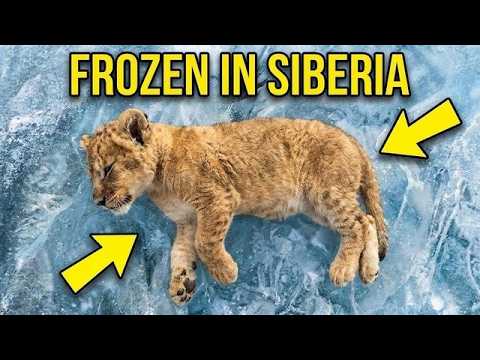
The brush moves slowly. It has to. One wrong angle and 50,000 years of preservation disappears in seconds. In the Siberian permafrost, northeast of the Kolyma River, a team is uncovering something that should not exist: a cave lion cub, frozen mid-existence, its fur still intact, its limbs arranged as if it simply lay down. This is not a fossil. It is tissue—soft, preserved, impossibly ancient.
When researchers extract a sample from behind the ear and send it to the sequencer, something happens that defies everything we thought we knew about ancient DNA. The DNA reads. Not fragments too broken to interpret. Not noise. Actual readable sequence from an animal that died 50,000 years ago. But the DNA told a story nobody had predicted—a story that would challenge the very limits of science.
For decades, the scientific consensus on ancient DNA had a practical ceiling. Genetic material degrades. It breaks apart through chemical reactions—hydrolysis attacking the sugar-phosphate backbone, oxidation corrupting the base pairs. Most researchers agreed that beyond 30 to 40,000 years, the chances of recovering anything meaningful dropped close to zero, even in the best preservation conditions. Permafrost could slow the process, but it could not stop it forever.
That assumption wasn’t careless. It was built from real experience. Every attempt to recover readable DNA from specimens in this age range had produced the same frustrating results: fragments too small, too corrupted, contaminated by microbes and handling and the environment itself. The ancient DNA revolution that reshaped human prehistory in the 2000s was extraordinary, but its main focus was human remains. Megafauna were secondary. The fieldwork was expensive. The samples were inconsistent. And when attempts at older specimens failed, the reasonable conclusion was that the ceiling was real.
So for everything researchers knew about Ice Age cave lions—their range, their behavior, their relationship to modern lions and extinct relatives—they relied on bones, on morphology, on the shape of a skull or the length of a limb. Fossils told you where an animal had been. They told you approximately when it died. What they could not tell you was which population it belonged to, how that population related to others, whether it was isolated or connected, thriving or quietly disappearing. Those questions lived inside the genome, and the genome, everyone assumed, was gone.
The assumption had held for decades. Then, one sample broke it.
Here’s what changed. The specimens themselves weren’t new. Cave lion cubs had been recovered from Siberian permafrost before, and the discovery of preserved soft tissue had made headlines. What was new was what happened when researchers returned to those specimens with tools that simply hadn’t existed before. Modern short-read sequencing can work with fragments as small as 35 base pairs. That’s almost nothing. Earlier methods needed longer, more intact stretches of genetic code to produce reliable results. But computational reconstruction tools can now take thousands of tiny overlapping fragments and assemble them back into something legible, like reassembling a shredded document when you have 10,000 copies of the same page, each shredded differently.
The contamination problem was harder. Ancient DNA doesn’t just compete with degradation. It competes with contamination from researchers, from the surrounding soil, from microbes that colonized the tissue after death. And modern human or animal DNA is everywhere. The solution was damage pattern recognition. Ancient DNA carries a specific chemical signature at the ends of its fragments, a kind of molecular aging mark left by thousands of years of slow decay. Modern contamination doesn’t carry that mark. Filter for it, and the ancient signal starts to separate from the noise.
The sample that worked came from tissue that had been shielded—interior soft tissue protected from direct exposure, where the permafrost had functioned as something close to a molecular deep freeze. And when the sequencing came back clean, when the damage patterns confirmed this was genuinely ancient material and not contamination, researchers compared the results against every known reference point they had.
Here’s where the story stopped making sense. The genome didn’t match what it was supposed to match. Cave lions are known from the fossil record across a wide swath of Eurasia and into North America. Researchers expected the Siberian specimen to cluster with what was understood as the dominant Eurasian cave lion lineage. It didn’t. The genetic signal pointed somewhere else, toward a population that either diverged far earlier than the morphology suggested, or had persisted in a refugium that the fossil record hadn’t captured. A lineage that, by existing extinction models, should not have been present in that region at that time.
This animal, according to its bones, belonged to a well-mapped story. According to its genome, it belonged to a chapter nobody had written yet.
The result held up. Different labs processed portions of the same sample independently. The damage patterns were consistent. Contamination was ruled out through multiple filters. And when compared against the emerging database of Ice Age megafauna genomes—still sparse, still being built—the anomaly didn’t disappear. It deepened.
What this rules out first is simple but significant. Morphology, the shape of bones, had been the primary tool for understanding population relationships in extinct megafauna. The assumption was that animals that looked similar were closely related. That geographic proximity predicted genetic proximity. This genome says that assumption was wrong. A cave lion in northeastern Siberia could carry ancestry from a lineage considered separate or extinct, and you would never know from the skeleton. The bones fit the map. The DNA did not.
The second implication is harder to sit with. If this population survived longer than the timeline suggested, or ranged into regions where it wasn’t thought to exist, then the picture of what early humans were encountering changes. Modern humans were in Siberia by 40 to 45,000 years ago. They were hunting. They were spreading. And they may have been sharing that landscape with a cave lion lineage that science had already declared gone. A ghost population, invisible to the fossil record, alive in the ice.
And that’s when researchers realized this wasn’t one anomaly. It was the beginning of a pattern.
Other specimens are being reexamined. The cave lion cubs recovered from Yakutia. Woolly rhinoceros remains from the same permafrost belt. Ancient horse specimens from the Yukon, a region that preserved Ice Age animals in conditions comparable to Siberia. In each case, the question being asked now is the same one this genome forced. Does the morphology match the lineage? Does the range map match the genome? And in several cases, the early answers are suggesting the same thing.
Ice Age megafauna weren’t distributed in the clean, mappable populations the fossil record implied. They were fragmented, isolated, diverging quietly in refugia that left almost no physical trace. The fossil record captured anatomy. The genome is capturing something the fossils never could: the invisible structure of populations that lived and separated and died in silence.
Here’s where honesty requires some care. One specimen is not a population study. The conclusions drawn from a single genome, however well preserved, need to be replicated across multiple individuals before they become a settled picture. Permafrost preservation is uneven. Siberia and the Yukon are heavily sampled partly because of geography and research access, and that may be shaping the results in ways that aren’t yet visible. The field is moving fast. Some interpretations are still being debated.
What is established is that this genome is real, ancient, and anomalous. What is strongly suggested is that Ice Age megafauna population structure was more complex than the fossil record implied. What remains open is exactly how complex, and what the full pattern looks like when more specimens are sequenced.
But the questions the genome raised didn’t stay confined to population maps. They reached into something more intimate: how these animals lived, how they moved, what they endured. And here, the DNA offered something bones never could—a glimpse of biological stress written into the code itself.
When researchers examined the cub’s genome for signs of inbreeding, the results were striking. Heterozygosity was low. Not catastrophically low, but lower than expected for a population presumed to be large and widespread across the Eurasian steppe. The kind of low that accumulates when a lineage has been small for a long time. When breeding pairs are limited. When a population has been pushed into a corner and stayed there for generations.
This wasn’t just an animal from an unexpected lineage. It was an animal from a lineage that had been struggling long before it died.
The cub itself was young, perhaps weeks old. Too young to have hunted, too young to have wandered far from its den. Its death may have been ordinary—a collapse, a predator, a mother who didn’t return. But its genome carried the signature of something larger: a population contracting, splitting, holding on in isolated pockets while the world around it shifted.
And that raised a question the fossil record had never been able to answer. Were these isolated populations already doomed when early humans arrived? Or did the arrival of a new predator—efficient, social, armed with fire and coordinated hunting—accelerate a decline that was already underway?
The distinction matters more than it might seem. If cave lion populations were already fragmented and genetically depleted, then the human impact may have been the final push against a door already swinging shut. If they were robust and connected, then human hunting and habitat disruption may have been the primary cause of their disappearance. The genome can’t answer that question alone. But it can tell us which populations were vulnerable, which were isolated, and which were still exchanging genes across vast distances.
That’s the next phase of the work. Researchers are now comparing the Siberian cub’s genome against specimens from Europe, from Alaska, from the caves of France and the steppes of Ukraine. The goal is to build a map not of bones, but of breeding networks. Of corridors and barriers. Of populations that met and mixed, and populations that never did.
Early results suggest something unexpected. The cave lions of northeastern Siberia were not a single, uniform population. They were a mosaic. Some individuals carried ancestry linked to European lineages. Others showed connections to populations that had been thought extinct for tens of thousands of years before this cub was born. The region wasn’t a simple frontier. It was a crossroads, a refugium, a place where lineages that should have been gone were still breathing.
And that changes how we think about extinction itself. Not as a single event, a clean line between alive and gone. But as a long, uneven process. A fading. A retreat into smaller and smaller places, until one day there are no places left.
The cub in the preservation facility doesn’t know any of this. It lies in its drawer, fur intact, eyes closed, a small animal from a world we are only beginning to see. But its genome is speaking. And what it’s saying is that the Ice Age was more complicated, more crowded, and more fragile than the bones ever let on.
The next step is replication. More cubs, more specimens, more genomes pulled from the ice. Each one a data point, a correction, a quiet revision of a story we thought was settled. The permafrost is yielding its secrets slowly, one frozen animal at a time.
And somewhere beneath the Siberian soil, another cub waits. Another genome holds its breath. Another chapter sits unread, patient as stone, waiting for the tools—and the questions—that will finally let it speak.
What will the next frozen discovery rewrite? Share your thoughts below.
Report this article
Select a reason for reporting:






